

This post is part of a series examining where 2024 candidates running for public offices in the Southeast stand on key energy and climate issues. Note: The Southern Alliance for Clean Energy does not support or oppose candidates or political parties. Links to reports, candidate websites, and outside sources are provided as citizen education tools.

In this blog post, we examine the policies and positions of Don Davis, Democratic Party candidate running for reelection to represent North Carolina Congressional District 1 in the U.S. House of Representatives. Also in this series, we profile Republican candidate Laurie Buckhout. Election Day is November 5, 2024.
Born and raised in Snow Hill, North Carolina, Davis served eight years in the US Air Force. He also worked as an assistant professor of Aerospace Studies at East Carolina University instructing national security affairs and leadership courses, and later became mayor of Snow Hill at age 29. Beginning in 2008, he served six terms as a North Carolina State Senator.
In 2022, Davis was elected to the U.S. Congress representing his home community, eastern North Carolina. He lives in Greene County, NC, with his wife and three sons.
Renewable Energy and Energy Efficiency
Don Davis has helped secure two federal grants for Carolina Poultry Power, a company that converts poultry litter waste into energy.
Climate Change
Don Davis has voted in favor of expanding research into carbon sequestration, and against repealing the Greenhouse Gas Reduction Fund and Methane Emissions Reduction Program provisions from the Inflation Reduction Act.
Davis has also voted to criticize the idea of a carbon tax.
Electric Transportation
As a Congressman, Don Davis has acted against the growth of electric vehicles. He voted to limit the authority of the Environmental Protection Agency (EPA) to regulate emissions from motor vehicles. He also voted to denounce a federal rule facilitating the growth of electric vehicle charging infrastructure.
Energy Equity and Energy Burden
Don Davis’ campaign website includes a promise to fight for a better environment in his district, stating that “Air and water pollution and the impacts of the climate crisis often disproportionately impact our poorest families, working-class communities, and communities of color, who are more likely to live in areas where air and water pollution exceed national standards.”
High-Risk Energy: Coal, Nuclear, Oil, Gas
Don Davis has taken actions that both support and constrain high-risk energy sources.
As a Congressman, he voted to preserve federal regulations on the exporting of Liquid Natural Gas. He also voted against a sweeping bill that would have supported fossil fuel industries while getting rid of fossil fuel regulations and clean energy programs.
He voted in favor of the Restoring American Energy Dominance Act, which repeals constraints on oil and gas extraction on federal lands. He also voted in favor of requirements to accelerate the deployment of advanced nuclear reactors.
Voter Information
Election Day is November 5. Here are important dates and deadlines to consider, from the North Carolina State Board of Elections:
- Sept. 6, 2024: County boards of elections begin mailing absentee ballots to eligible voters who submitted an absentee ballot request form.
- Oct. 11, 2024: Voter registration deadline (5 p.m.).*
- Oct. 17, 2024: In-person early voting begins; same-day registration available.
- Oct. 29, 2024: Absentee ballot request deadline (5 p.m.).*
- Nov. 2, 2024: In-person early voting ends (3 p.m.).
- Nov. 5, 2024: General Election Day.
- Nov. 5, 2024: Absentee ballot return deadline (7:30 p.m.).*
*Voter registration and absentee voting deadlines are different for military and overseas citizen voters.
Find additional important election information here.
#CandidatesOnEnergy2024
The post Candidate Don Davis on Climate & Energy appeared first on SACE | Southern Alliance for Clean Energy.

 The United States seems set on propelling itself backwards.
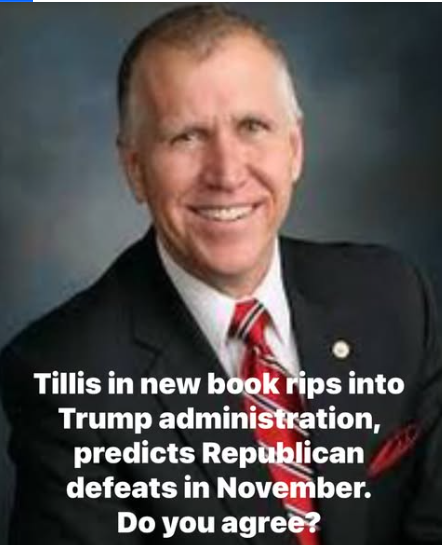 Maybe, as they say, “Hell has a special place reserved in it” for people like Thom Tillis, Republican Senator from North Carolina, who enabled Trump to rape and destroy the United States.
That was until it became clear to Tillis that he could jump ship, write a scathing book about the president, get all over mainstream news promoting it, and go on to enjoy another chapter of political success.
That we Americans are so stupid that we accept this blatant hypocrisy and criminality is sad proof that we’re not the people we were 20 years ago. Maybe what many people are saying are correct: we deserved what we got.
Here’s a short video from Elle Cordova that reminds us that science is something of a rarity in human history.
The great tyrants of history have done their best to cause the people they ruled to reject science, simply to ensure the masses are ignorant, terrified, superstitious, and thus easily controlled.
The current political administration is particularly engrossed in the rejection of science. I wonder why.



-
Climate Change1 year ago
Guest post: Why China is still building new coal – and when it might stop
-

 Greenhouse Gases2 years ago
嘉宾来稿:满足中国增长的用电需求 光伏加储能“比新建煤电更实惠”
-
Greenhouse Gases1 year ago
Guest post: Why China is still building new coal – and when it might stop
-

 Climate Change2 years ago
嘉宾来稿:满足中国增长的用电需求 光伏加储能“比新建煤电更实惠”
-

 Renewable Energy12 months ago
Sending Progressive Philanthropist George Soros to Prison?
-
Climate Change2 years ago
Bill Discounting Climate Change in Florida’s Energy Policy Awaits DeSantis’ Approval
-
Greenhouse Gases1 year ago
嘉宾来稿:探究火山喷发如何影响气候预测
-

 Climate Change2 years ago
Analysis: China’s CO2 falls 1% in Q2 2024 in first quarterly drop since Covid-19