

UK governments have fallen so far short of their tree-planting targets since 2020 that they have failed to plant an area of forest nearly equivalent to the size of Birmingham, Carbon Brief analysis shows.
During the 2019 election campaign, the Conservatives committed to a UK-wide goal of creating 30,000 hectares of new woodland a year by 2025.
This pledge became part of the government’s net-zero strategy, which relies on “significant” tree-planting to make up for emissions from polluting sectors, such as aviation and farming.
Authorities in England, Scotland, Wales and Northern Ireland have all set out their own tree-planting ambitions, including annual goals between 2020 and 2025.
Every nation in the UK has repeatedly failed to meet these goals. This means that, despite the latest figures showing an increase in woodland creation over the past year, thousands of hectares of trees have gone unplanted across the UK since the original target was set.
By 2050, the unplanted trees would have removed some 8.5m tonnes of carbon dioxide (MtCO2) from the atmosphere, Carbon Brief analysis shows – roughly 2% of the UK’s annual emissions in 2023. This will need to be made up for with stronger efforts elsewhere, if the UK’s net-zero by 2050 target is to be met.
‘Abandoned’ target
Centuries of deforestation have left the UK one of the least forested nations in Europe.
Tree-planting can help the country meet its climate targets by removing CO2, as well as improving biodiversity and providing protection from flooding.
In this context, tree-planting enjoyed cross-party support in the run up to the 2019 general election, with parties vying to release the most ambitious targets.
Ultimately, the Conservatives emerged victorious from the election and pledged to raise tree-planting levels from around 13,000 hectares per year in 2018-19 to 30,000 hectares by the end of parliament, which was pegged for 2024-25. (Annual tree-planting figures are reported for the period between 1 April in one year and 31 March in the following year.)
This goal was roughly in line with guidance from government advisers the Climate Change Committee (CCC). The committee concluded that achieving 30,000 hectares a year by 2025 and then gradually raising it to 50,000 hectares a year by 2035, could increase forest cover from 13% to 18% by 2050, while removing more than 10MtCO2 from the atmosphere each year by 2050.
However, tree-planting is a devolved matter in the UK. England and the governments of Scotland, Wales and Northern Ireland each had to develop their own policies to drive afforestation following the 2019 election.
It soon became clear that the 2025 UK-wide target was slipping out of reach. Each year, data released by government body Forest Research showed nationwide tree-planting rates flatlining, rather than rising to meet the 30,000 hectares target.
The most recent dataset, released on 20 June – two weeks before another general election – shows that only 20,660 hectares of new woodlands were planted in 2023-24.
While this is a significant jump from the previous three years, it is still far short of the 30,000 hectares target for 2025, as the chart below shows.

As early as 2021, a report by the Institute for Government thinktank declared that the government’s overall tree-planting target had been “abandoned”.
A highly critical report released by MPs on the Environmental Audit Committee in 2023 concluded that it was “extremely unlikely” the goal would be met. It stated:
“We are extremely concerned by the consistently poor progress made in increasing tree-planting rates across all four of the nations in the UK.”
None of the major parties have included significant tree-planting targets in their manifestos for the upcoming election. Labour includes a vague pledge to plant “millions of trees” and “create new woodlands”, while the Conservatives say they will deliver existing commitments.
Birmingham-sized forest
The Conservatives’ ultimate goal of 30,000 hectares is only part of the story. Each nation has its own interim targets for scaling up tree-planting and each annual target missed means areas of forest that have not been planted.
The gaps between the nations’ combined annual targets and the actual area of trees planted across the UK can be seen in the chart below.
According to Carbon Brief calculations, these missed targets amount to 22,129 hectares of forest that has not been planted between 2020-21 and 2023-24. This is an area nearly the size of Birmingham, the nation’s second most populous city.

Scotland, which is home to around half the UK’s forests and most of its timber industry, set out its tree-planting goals in a 2020 update to its 2018-2032 climate change plan. This included a target of planting 12,000 hectares of woodland in 2020/21, rising gradually to 18,000 hectares in 2024-25.
England also set out a “planned trajectory” for tree-planting under its Nature for Climate Fund tree programme, which is also meant to contribute to the government’s legally binding goal of reaching 16.5% tree cover in England by 2050.
This trajectory covered government schemes pushing up English tree-planting from 673 hectares in 2020-21 to 7,500 hectares in 2024/25. (The 2020-21 target appears to be a significant underestimate, considering that in 2019-20 the rate was 2,340 hectares.)
In Wales and Northern Ireland, the devolved governments both committed to planting rates roughly in line with CCC recommendations.
For Wales, that meant “at least” 2,000 hectares a year from 2020, with a non-specific pledge that this would increase “over time”, as set out in its Woodlands for Wales strategy.
Northern Ireland set out plans to plant 9,000 hectares of new forest between 2020 and 2030, under the Forests for Future scheme. Annual goals up to 2023-24 are set out in the country’s forest service business plans, and a spokesperson from the Northern Ireland Executive says future plans will appear in an upcoming climate action plan.
(Together, the devolved administration targets add up to just 27,500 hectares in 2024-25. However, the flexibility in future targets for Wales and Northern Ireland could make up the remaining 2,500 hectares.)
The charts below show how afforestation in UK nations has compared to their targets since 2020-21.

Tree-planting rates have increased in England – boosted by schemes such as the Woodland Creation Offer, which pays farmers and landowners to plant forests on their land. Nevertheless, the government did not achieve its targets for the country.
In Scotland, tree-planting rates had been falling until last year – a trend that was attributed to cuts in its woodland creation budget, as well as labour and skills shortages. Scotland’s repeated failure to hit its afforestation targets was cited by the CCC in March as one of the reasons the Scottish National Party-led government’s climate plan was “no longer credible”.
A failure to allocate enough funds to tree-planting, expand the nation’s tree nurseries and drive demand for domestic timber have all been highlighted as barriers to the UK’s afforestation programme by MPs on the Environment, Food and Rural Affairs Committee.
A spokesperson for the Scottish government tells Carbon Brief that Scotland has “consistently created the lion’s share of UK new planting and this year is no exception”. They say that changes to the country’s forestry grant scheme and a sped-up applications process helped them to reach the highest level of planting in 34 years in 2023-24.
A Welsh government spokesperson tells Carbon Brief that while they see last year’s tree-planting as “a significant achievement, we recognise we need to continue building on this success”.
The UK Department for Environment, Food and Rural Affairs (Defra) declined to comment on the figures.
Stuart Goodall, the chief executive at the Confederation of Forest Industries (Confor), tells Carbon Brief the trade association is “extremely disappointed” that all four nations failed to meet what he calls “achievable planting targets”. He adds:
“Tree-planting is heavily regulated and grant-aided…It is vital that adequate public funds are made available and that the process of approving applications to plant is improved, especially for larger woodland creation projects.”
The UK government’s carbon budget delivery plan, published in 2023 to flesh out the strategy for achieving its upcoming climate targets, includes some pessimistic estimates for tree-planting. It sees UK-wide afforestation falling between 2021 and 2025 and continuing to remain relatively low out to 2035.
Despite these estimates, Carbon Brief understands that, on paper at least, 30,000 hectares per year by 2025 has remained the official target within government.
Extra carbon
A nationwide shortfall in tree-planting has implications for the UK’s climate targets. The government’s net-zero strategy relies on “significant afforestation” to “balance” the UK’s so-called “residual emissions” in 2050.
These are emissions for which affordable or scalable low-carbon alternatives are not expected to be available by mid-century, meaning CO2 has to be removed from the atmosphere in order to achieve “net-zero”. Examples include some of the emissions from aviation, livestock farming and the waste sector.
Trees absorb more CO2 as they grow larger. This means that while the short-term emissions saving from newly planted trees is small, it increases as the years pass.
In the CCC’s “balanced pathway” to net-zero, it estimates that afforestation over the next few decades would be removing more than 10m tonnes of CO2 (MtCO2) per year by 2050.
However, the CO2 savings from the trees planted over the past four years alone are not expected to be large.
If the devolved governments had met their tree-planting targets in full up to 2023-24, 32MtCO2 would have been removed cumulatively by 2050, according to Carbon Brief analysis. Trees planted in line with these goals would remove around 1.2MtCO2 per year by 2050.
Due to the tree-planting shortfall, some 8.5MtCO2 of removals have been lost over this period – equivalent to around 2% of the UK’s economy-wide emissions in 2023. These trees would have removed 0.23MtCO2 per year by 2050.

The shortfall in tree-planting could leave the UK more reliant on CO2 removal technologies, which are still in the early stages of deployment. (The net-zero strategy already assumes that 75-81MtCO2 will need to be removed using these technologies in 2050.)
Alternatively, the UK could make up for the shortfall by making deeper emissions cuts elsewhere – for example, by reducing demand for flights or meat-based diets.
Lydia Collas, a senior policy analyst at Green Alliance, tells Carbon Brief that a new land-use framework in England would help to link up landowners and farmers prime tree-planting areas with money and resources:
“The UK must start to take its commitments to restore nature seriously, including targets to create woodlands. To avoid missing our 2030 target to cut emissions under the Paris Agreement, we need to get back on track.”


The post Analysis: UK misses tree-planting targets by forest the ‘size of Birmingham’ appeared first on Carbon Brief.
Analysis: UK misses tree-planting targets by forest the ‘size of Birmingham’

Drought and heatwaves occurring together – known as “compound” events – have “surged” across the world since the early 2000s, a new study shows.
Compound drought and heat events (CDHEs) can have devastating effects, creating the ideal conditions for intense wildfires, such as Australia’s “Black Summer” of 2019-20 where bushfires burned 24m hectares and killed 33 people.
The research, published in Science Advances, finds that the increase in CDHEs is predominantly being driven by events that start with a heatwave.
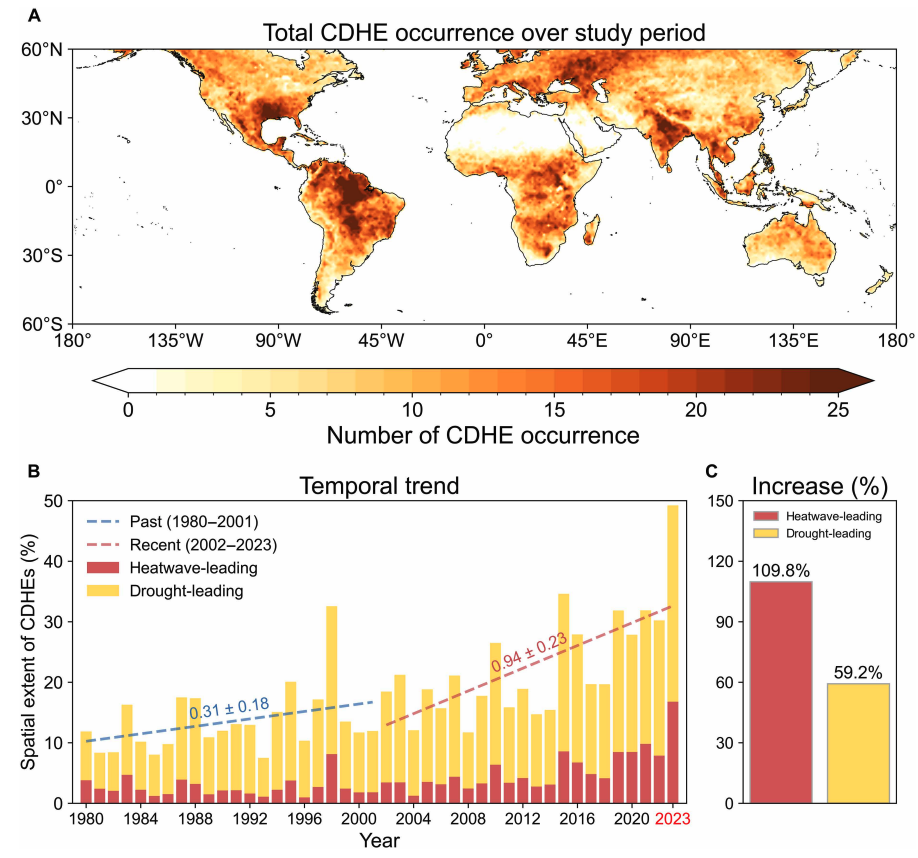
The global area affected by such “heatwave-led” compound events has more than doubled between 1980-2001 and 2002-23, the study says.
The rapid increase in these events over the last 23 years cannot be explained solely by global warming, the authors note.
Since the late 1990s, feedbacks between the land and the atmosphere have become stronger, making heatwaves more likely to trigger drought conditions, they explain.
One of the study authors tells Carbon Brief that societies must pay greater attention to compound events, which can “cause severe impacts on ecosystems, agriculture and society”.
Compound events
CDHEs are extreme weather events where drought and heatwave conditions occur simultaneously – or shortly after each other – in the same region.
These events are often triggered by large-scale weather patterns, such as “blocking” highs, which can produce “prolonged” hot and dry conditions, according to the study.
Prof Sang-Wook Yeh is one of the study authors and a professor at the Ewha Womans University in South Korea. He tells Carbon Brief:
“When heatwaves and droughts occur together, the two hazards reinforce each other through land-atmosphere interactions. This amplifies surface heating and soil moisture deficits, making compound events more intense and damaging than single hazards.”
CDHEs can begin with either a heatwave or a drought.
The sequence of these extremes is important, the study says, as they have different drivers and impacts.
For example, in a CDHE where the heatwave was the precursor, increased direct sunshine causes more moisture loss from soils and plants, leading to a drought.
Conversely, in an event where the drought was the precursor, the lack of soil moisture means that less of the sun’s energy goes into evaporation and more goes into warming the Earth’s surface. This produces favourable conditions for heatwaves.
The study shows that the majority of CDHEs globally start out as a drought.
In recent years, there has been increasing focus on these events due to the devastating impact they have on agriculture, ecosystems and public health.
In Russia in the summer of 2010, a compound drought-heatwave event – and the associated wildfires – caused the death of nearly 55,000 people, the study notes.

The record-breaking Pacific north-west “heat dome” in 2021 triggered extreme drought conditions that caused “significant declines” in wheat yields, as well as in barley, canola and fruit production in British Columbia and Alberta, Canada, says the study.
Increasing events
To assess how CDHEs are changing, the researchers use daily reanalysis data to identify droughts and heatwaves events. (Reanalysis data combines past observations with climate models to create a historical climate record.) Then, using an algorithm, they analyse how these events overlap in both time and space.
The study covers the period from 1980 to 2023 and the world’s land surface, excluding polar regions where CDHEs are rare.
The research finds that the area of land affected by CDHEs has “increased substantially” since the early 2000s.
Heatwave-led events have been the main contributor to this increase, the study says, with their spatial extent rising 110% between 1980-2001 and 2002-23, compared to a 59% increase for drought-led events.
The map below shows the global distribution of CDHEs over 1980-2023. The charts show the percentage of the land surface affected by a heatwave-led CDHE (red) or a drought-led CDHE (yellow) in a given year (left) and relative increase in each CDHE type (right).
The study finds that CDHEs have occurred most frequently in northern South America, the southern US, eastern Europe, central Africa and south Asia.
Threshold passed
The authors explain that the increase in heatwave-led CDHEs is related to rising global temperatures, but that this does not tell the whole story.
In the earlier 22-year period of 1980-2001, the study finds that the spatial extent of heatwave-led CDHEs rises by 1.6% per 1C of global temperature rise. For the more-recent period of 2022-23, this increases “nearly eightfold” to 13.1%.
The change suggests that the rapid increase in the heatwave-led CDHEs occurred after the global average temperature “surpasse[d] a certain temperature threshold”, the paper says.
This threshold is an absolute global average temperature of 14.3C, the authors estimate (based on an 11-year average), which the world passed around the year 2000.
Investigating the recent surge in heatwave-leading CDHEs further, the researchers find a “regime shift” in land-atmosphere dynamics “toward a persistently intensified state after the late 1990s”.
In other words, the way that drier soils drive higher surface temperatures, and vice versa, is becoming stronger, resulting in more heatwave-led compound events.
Daily data
The research has some advantages over other previous studies, Yeh says. For instance, the new work uses daily estimations of CDHEs, compared to monthly data used in past research. This is “important for capturing the detailed occurrence” of these events, says Yeh.
He adds that another advantage of their study is that it distinguishes the sequence of droughts and heatwaves, which allows them to “better understand the differences” in the characteristics of CDHEs.
Dr Meryem Tanarhte is a climate scientist at the University Hassan II in Morocco, and Dr Ruth Cerezo Mota is a climatologist and a researcher at the National Autonomous University of Mexico. Both scientists, who were not involved in the study, agree that the daily estimations give a clearer picture of how CDHEs are changing.
Cerezo-Mota adds that another major contribution of the study is its global focus. She tells Carbon Brief that in some regions, such as Mexico and Africa, there is a lack of studies on CDHEs:
“Not because the events do not occur, but perhaps because [these regions] do not have all the data or the expertise to do so.”
However, she notes that the reanalysis data used by the study does have limitations with how it represents rainfall in some parts of the world.
Compound impacts
The study notes that if CDHEs continue to intensify – particularly events where heatwaves are the precursors – they could drive declining crop productivity, increased wildfire frequency and severe public health crises.
These impacts could be “much more rapid and severe as global warming continues”, Yeh tells Carbon Brief.
Tanarhte notes that these events can be forecasted up to 10 days ahead in many regions. Furthermore, she says, the strongest impacts can be prevented “through preparedness and adaptation”, including through “water management for agriculture, heatwave mitigation measures and wildfire mitigation”.
The study recommends reassessing current risk management strategies for these compound events. It also suggests incorporating the sequences of drought and heatwaves into compound event analysis frameworks “to enhance climate risk management”.
Cerezo-Mota says that it is clear that the world needs to be prepared for the increased occurrence of these events. She tells Carbon Brief:
“These [risk assessments and strategies] need to be carried out at the local level to understand the complexities of each region.”




The post Heatwaves driving recent ‘surge’ in compound drought and heat extremes appeared first on Carbon Brief.
Heatwaves driving recent ‘surge’ in compound drought and heat extremes
Greenhouse Gases
DeBriefed 6 March 2026: Iran energy crisis | China climate plan | Bristol’s ‘pioneering’ wind turbine
Welcome to Carbon Brief’s DeBriefed.
An essential guide to the week’s key developments relating to climate change.
This week
Energy crisis
ENERGY SPIKE: US-Israeli attacks on Iran and subsequent counterattacks across the Middle East have sent energy prices “soaring”, according to Reuters. The newswire reported that the region “accounts for just under a third of global oil production and almost a fifth of gas”. The Guardian noted that shipping traffic through the strait of Hormuz, which normally ferries 20% of the world’s oil, “all but ground to a halt”. The Financial Times reported that attacks by Iran on Middle East energy facilities – notably in Qatar – triggered the “biggest rise in gas prices since Russia’s full-scale invasion of Ukraine”.
‘RISK’ AND ‘BENEFITS’: Bloomberg reported on increases in diesel prices in E