

From Berlin and Paris, to Brussels and Bucharest, European farmers have driven their tractors to the streets in protest over recent weeks.
According to reports, these agricultural protesters from across the European Union have a series of concerns, including competition from cheaper imports, rising costs of energy and fertiliser, and environmental rules.
Farmers’ groups in countries including Belgium, France, Germany, Greece, Lithuania, Poland and Romania have all been protesting over the past couple of months.
The UK’s Sunday Telegraph has tried to frame the protests as a “net-zero revolt” with several other media outlets saying the farmers have been rallying against climate or “green” rules.
Carbon Brief has analysed the key demands from farmer groups in seven countries to determine how they are related to greenhouse gas emissions, climate change, biodiversity or conservation.
The findings show that many of the issues farmers are raising are directly and indirectly related to these issues. But some are not related at all. Several are based on policy measures that have not yet taken effect, such as the EU’s nature restoration law and a South American trade agreement.
Why farmers are protesting
The issues EU farmers are raising centre around “falling sale prices, rising costs, heavy regulation, powerful and domineering retailers, debt, climate change and cheap foreign imports”, the Guardian reported.
Carbon Brief has gathered a range of specific concerns based on media reports and farmer union statements across seven EU countries.
Each one is classified around whether the concern is related to climate change and/or greenhouse gas emissions (green), biodiversity and/or conservation (yellow), or not related to either set of issues (red).
Note, this table is not exhaustive.
These issues relate to climate change and biodiversity in different ways.
In some countries, protesters are calling for more action on climate adaptation, particularly in Greece where farmers are asking for measures to prevent farmland being damaged by flooding and other extreme weather.
In other cases, farmers are calling for fuel subsidies to continue and for fertiliser and pesticide restrictions to be reconsidered.
The EU’s “farm to fork” strategy – the bloc’s broad sustainable food initiative – focuses on cutting both pesticides and fertilisers in the years ahead to optimise their use and reduce harm (read Carbon Brief’s Q&A on fertilisers and climate change).
Last November, politicians voted against the EU’s proposed pesticide regulation which aimed to halve the use and risk of chemical pesticides by the end of this decade. This “buried the bill for good”, the Associated Press noted. Any new proposal “would need to start from scratch” after the European parliament elections in June.
The EU said these rules would have “translate[d] our commitment to halt biodiversity loss in Europe into action”, highlighting the health risks and water quality issues associated with pesticide use.
European legislators are working to finalise a number of other climate and biodiversity rules this year ahead of the June elections.
How the protests have developed
In December, the German government announced plans to reduce subsidies and spending in an effort to fill a €17bn gap in the country’s 2024 budget.
The measures included cutting some agricultural subsidies and tax breaks, leading to an outburst of farmer protests (as covered in Carbon Brief’s Cropped newsletter).
In the weeks since then, other farmer groups across the EU have been taking to the streets with their own concerns.
Germany
The German government eased its budget cut plans in January by “giving up a proposal to scrap a car tax exemption for farming vehicles” and phasing-out agricultural diesel subsidies instead of outright removing them, the Associated Press reported.
German farmers continued to protest, calling for the subsidies to remain fully in place. The Financial Times said the subsidy issues were the “immediate trigger” for the protests, but German farmer Frank Schmidt told the outlet that he and others were already “at the end of our tether”.

The protests “tapped into wider discontent with Germany’s government”, the Associated Press said, with farmers raising similar concerns around requirements and cheap imported food.
Around 30,000 protestors and thousands of tractors brought Berlin’s city centre “to a standstill” in mid-January as the demonstrations continued, the Guardian said.
France
The protests in France also began partly over plans to reduce agricultural fuel subsidies, which the government rolled back at the end of January (but not before farmers in Dijon sprayed manure on a local government building).
Protests escalated last week as hundreds of tractors blocked off major roads into the country’s capital in what was called the “siege of Paris” by many media outlets, including BBC News.
President Emmanuel Macron was “scrambling to end an escalating political and social crisis”, the Times said. (Read last week’s edition of Carbon Brief’s Cropped newsletter for more details on the French protests.)

On 1 February, the country’s main farmer unions called for an end to the protests after “securing promises of government assistance” on issues around finance and regulations, according to Al Jazeera.
These included a government decision to suspend efforts to halve the use of pesticides by the end of this decade, the Daily Telegraph reported, which environmentalists described as a “major step backwards”. The newspaper said:
“Studies indicate the population of farmland birds has fallen by 30% in France over the past 30 years, with pesticides blamed as the primary cause for their demise.”
Belgium
Belgian farmers blocked roads in and out of Brussels last week, the Brussels Times reported, before the city was taken over by a wider protest on 1 February. Hundreds of “angry farmers” gathered outside the European parliament building, starting fires and throwing eggs in protest against “taxes, rising costs and cheap imports”, Sky News said.

EU farmers “won their first concession from Brussels” last week, the Guardian reported, after the commission proposed to delay rules for farmers to “set aside land to encourage biodiversity and soil health”.
This will offer “additional flexibility to farmers at a time when they are dealing with multiple challenges”, commission president Ursula von der Leyen said in a statement.
Farmers in Belgium and France are also concerned about competition from trade deals between the EU and other countries.
This includes the EU-Mercosur trade deal, which intends to boost trade between the EU and Argentina, Brazil, Paraguay and Uruguay. Many EU farmers believe that it will lead to unfair competition.
Most negotiations were finalised for the deal in 2019, but the final talks were paused “due to the positions of [former] Brazilian President Jair Bolsonaro on deforestation”, Euractiv reported. (An edition of Carbon Brief’s Cropped newsletter covered this in more detail last year.)
Since Luiz Inácio Lula da Silva took over office last year, the deal has gotten closer to completion despite continued opposition from countries including France and Ireland.
Talks are ongoing and the EU “continues to fulfil its objective of achieving an agreement that respects our sustainability goals and respects our sensitivities, particularly in agriculture”, a European commission spokesperson told Reuters last week.

Greece
At the ongoing protests in Greece, farmers raised concerns about accessing more reimbursement for lost crops due to “natural disasters and disease”, eKathimerini reported. Greece was badly impacted by wildfires last summer.
The government has said it will help farmers with energy costs and promised a “one-year extension of a tax rebate for agricultural diesel”, Reuters reported.
Romania
Romanian farmers and truck drivers cited a number of different concerns, many of which related to climate change or biodiversity in different ways.
A major issue for Romanian farmers and other eastern European countries is controlling Ukrainian grain imports. Farmers in countries surrounding Ukraine have been arguing for months that they “can’t compete” with the price of these imports.
Some in Romania also took issue with “disruptions caused by Ukrainian grain imports”, Politico said, noting that “Russia's blockade of Ukraine's Black Sea ports has made Romania a key transit hub for Ukrainian grain.”
In response to the protests, the Romanian government announced extra farmer funding and fuel subsidies on 26 January, according to Radio Romania International.

Last week, the European Commission proposed extending its free trade deal with Ukraine until June 2025, but with a new measure to prevent too many Ukrainian agricultural products being sold in EU states, Euronews reported.
Other EU countries
Farmer protests remain ongoing in Lithuania and Poland over similar concerns, many of which are outlined in the above interactive table.
In Ireland, protests began on 1 February in “solidarity” with other farmers, RTÉ reported. The president of the Irish Farmers Association, Francie Gorman, said there is “mounting frustration about the impact of EU policy”.
Elsewhere, France24 reported that more than 300 vehicles gathered in protest near Milan, Italy last week. Meanwhile, a small group of farmers protested in Portugal on 1 February, Reuters reported.
Farmers in Spain are preparing to take to the streets later this month. Similar plans are underway in Slovakia, where separate protests are ongoing against plans to close the country’s special prosecutor’s office.
Far right taking note
This year will see major elections across the globe.
EU citizens will elect new members of the European parliament in June and recent polling has suggested that there could be a “sharp turn to the right” in the results, Deutsche Welle reported.
As these protests continue, Politico said that right-wing parties in several European countries – such as France, Italy, the Netherlands and Germany – are “piggybacking on farmers’ noisy outrage”.

Dr Gilles Ivaldi, a politics researcher at Sciences Po who has examined the far right in Europe, says that right-wing groups may use the farmer protests to “boost their electoral support”. He tells Carbon Brief:
“What we see, particularly in France, is that the far right is seeking to capitalise on public discontent with the impact of the green transition, not only among farmers but also in social groups affected most by the economic cost of environmental policies.”
He says that in France’s case, the far right is “clearly trying to instrumentalise” the farmer protests to “mobilise against the government and the EU”. Sky News reported that the protests “are being seized upon by various groups”, including Marine Le Pen’s right-wing Rassemblement National party.
But Ivaldi notes that the far right’s EU election focus will mostly remain on topics such as immigration, the economy, the future of the EU and the bloc’s Green Deal. The “main factors” behind a potential right-wing surge will not come from agriculture alone. He adds:
“Far-right parties are currently capitalising on the economic crisis and rise in prices, on the immigration issue, particularly growing concerns about the massive influx of refugees in Germany and, more broadly, the many anxieties caused by the war in Ukraine and geopolitical instability.”


The post Analysis: How do the EU farmer protests relate to climate change? appeared first on Carbon Brief.
Analysis: How do the EU farmer protests relate to climate change?

When the Turkish COP31 presidency presented its priorities to international business leaders for the first time in New York in September, among those invited to give the private sector’s first response was Ali Koç, scion of one of Türkiye’s wealthiest families.
On stage, the vice chair of the board of Koç Holding said the family company, which weeks earlier had been announced as one of the top sponsors for the UN climate summit, can be seen as “quite exemplary” for its climate record.
What Koç did not mention was that the group’s biggest money-making arm – Türkiye’s largest oil refiner Tüpraş – plans to keep running its refineries “at maximum potential”. Nor did he say that, in 2025, both parent company and subsidiary cut their 2030 climate targets to a level they had already nearly achieved, as Climate Home News’ analysis of company records reveals.
The decision to hand Koç Holding a prominent role at COP31 – the company is also the summit’s “Global Business Partner” – has reignited a long-running controversy over the platforming of fossil fuel interests at the annual UN climate conference.
It has also thrown into question how COP sponsors are chosen and screened. The hosting agreement between the Turkish government and the UN climate secretariat (UNFCCC) says that a partner company’s “climate integrity” should be taken into account.
COP31 electrification pledge leaves out clean power commitment
But how that test is applied is unclear and the process for picking sponsors remains largely opaque. The Turkish COP31 presidency has not published its selection criteria, nor the financial terms of any of its partnership agreements, including Koç’s. The UNFCCC declined to clarify how it advises on such deals.
Campaigners have long argued that accepting sponsorship from polluting companies is wrong because it gives them a global stage, visibility and access to policymakers at talks that are meant to move the world away from fossil fuels, and tarnishes the reputation of the COPs.
Koç’s energy division, which is dominated by oil refiner Tüpraş, accounted for three-quarters of the parent firm’s income in the first half of 2026.
“How was Koç Holding ever chosen as a COP31 sponsor? Any corporation that makes most of its money from oil refining should not qualify as sustainable,” said Pascoe Sabido, a campaigner at Corporate Europe Observatory, which exposes company lobbying. “This is hugely embarrassing for the UNFCCC and its climate integrity check, which doesn’t appear to be worth the paper it’s written on.”
Koç Holding “is not just standing still but walking backwards”, he told Climate Home News.
Koç Holding and Tüpraş did not reply to multiple requests for comment. The UNFCCC secretariat and the Turkish COP31 presidency declined to respond to questions from Climate Home News on the sponsorship agreement.
Oil refining windfall
Türkiye’s biggest industrial group, Koç Holding has stakes in several key sectors of the economy, spanning vehicle manufacturing in a joint venture with Ford to electronics, home appliances and banking.
But the conglomerate’s crown jewel is oil refiner Tüpraş, which Koç controls. Last year its four refineries turned crude oil into 26.8 million tonnes of petrol, diesel, jet fuel and other products, enough to fill about 36 Olympic swimming pools every day.
The company plans to raise its production to 29 million tonnes in 2026 – already a bumper year so far with soaring profits, thanks to sky-rocketing refining margins driven by a crunch in global oil processing capacity caused by the Middle East crisis.
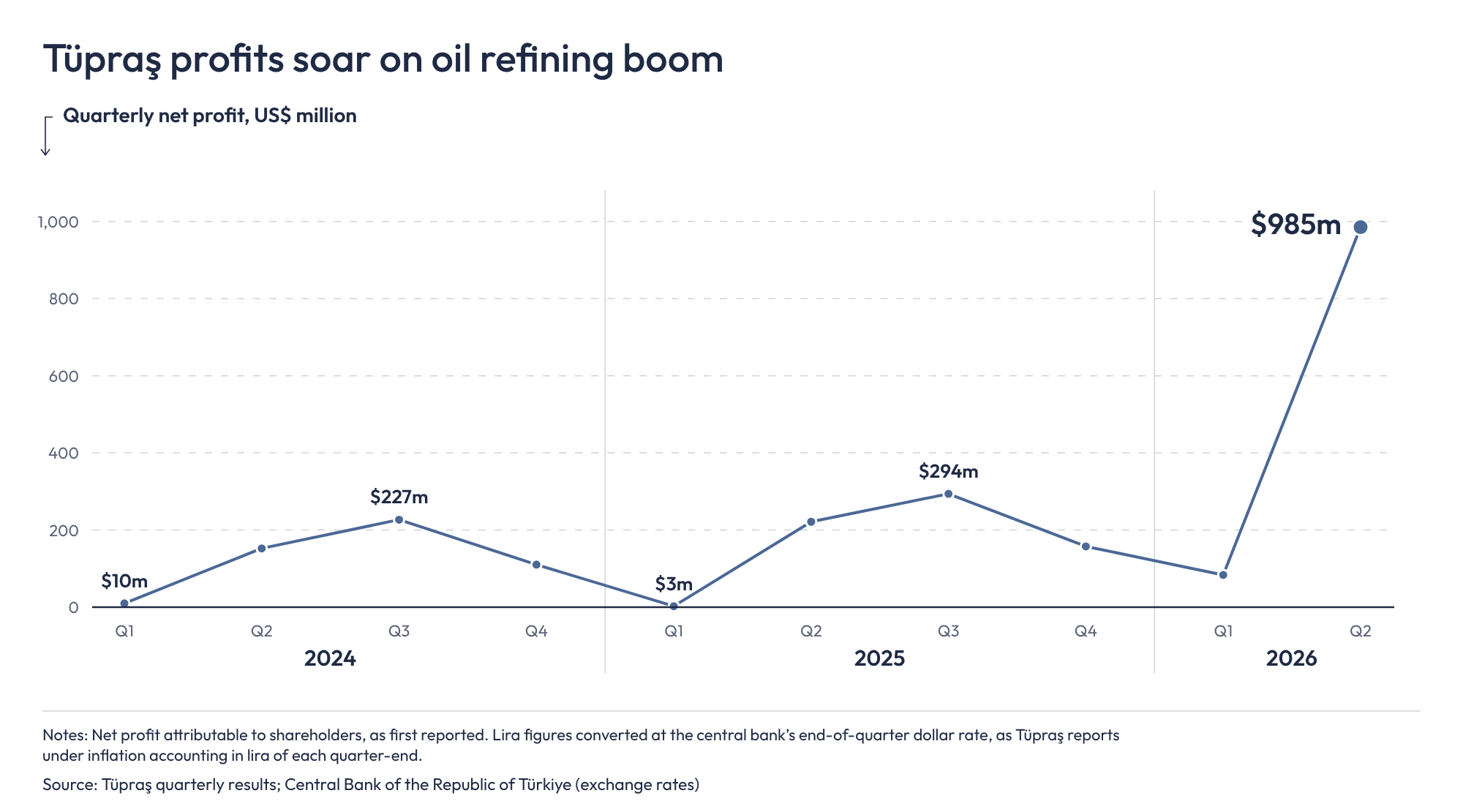
The oil business boom sits awkwardly with the climate and energy transition plans Koç and Tüpraş unveiled in 2021, when both pledged to become carbon neutral by 2050. Then, Tüpraş set out its aim to become “a leading carbon-neutral energy company”.
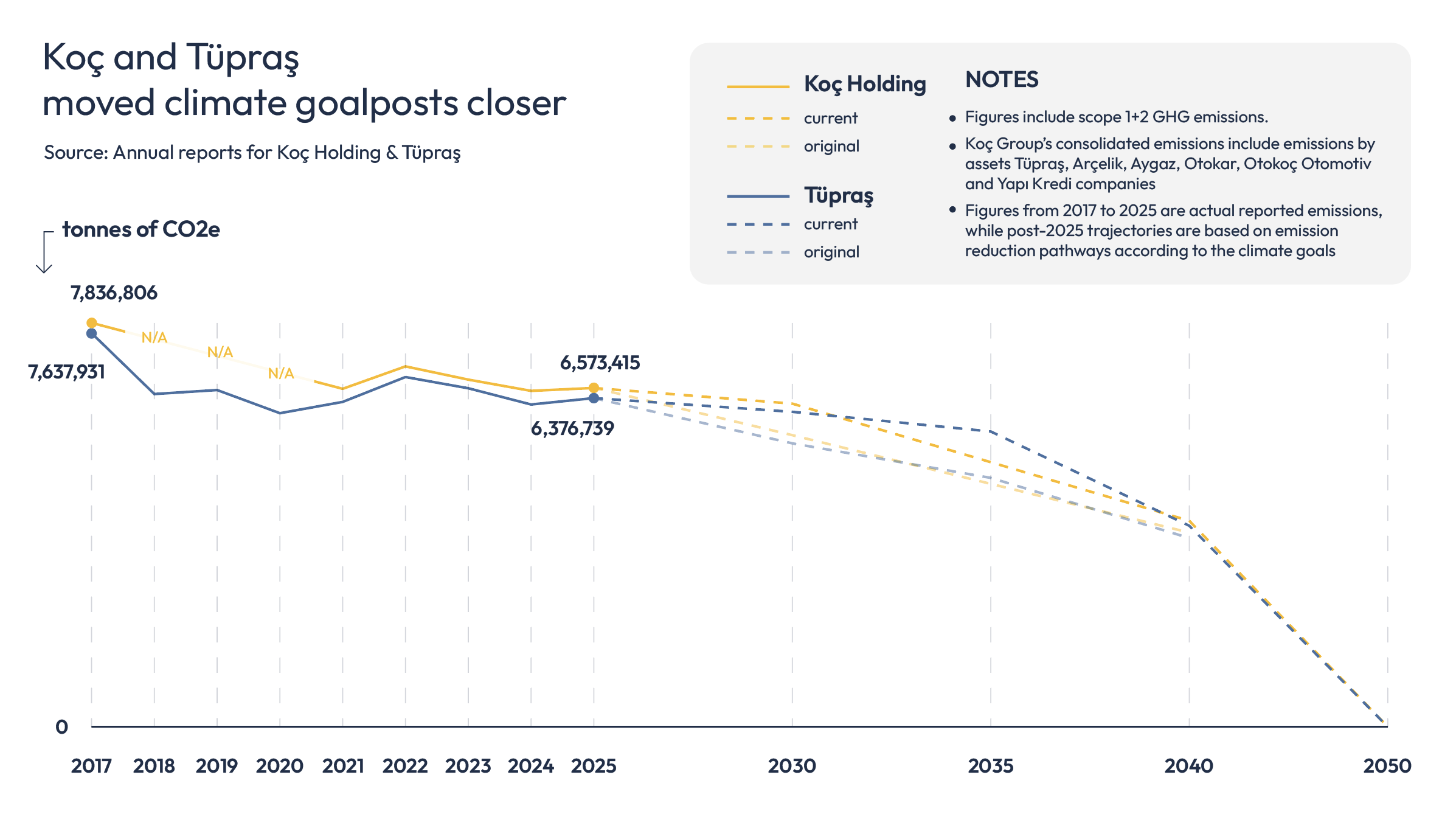
Despite these promises, in 2025, both companies lowered their targets for cutting emissions from their own operations by 2030, from 27% to 20% below 2017 levels. Tüpraş also cut its 2035 goal from 35% to 25%. The company still technically retains its long-term target of carbon neutrality by 2050, but the new plan will require much more drastic cuts after 2035.
Lowering the climate bar
Tüpraş blamed its weakening of climate ambition on “changing market dynamics, economic conditions and technological developments”. In a presentation announcing the revision to investors, the refiner said the energy outlook had changed since 2021.
The reasons it listed included elevated geopolitical tensions, increased investment in oil and gas extraction, which it said showed refined fuels remain vital for energy security – and even the depletion of the carbon budget to keep global warming to 1.5C.
Its parent company Koç pointed the finger at the slow pace of green hydrogen development, which the group said now had a “low feasibility” of transforming the energy sector after it had previously pinned much of its transition plan on the sustainable fuel.
The Turkish company’s new 2030 targets are certainly within reach. Tüpraş had already cut its operational emissions by 17% from 2017 levels by 2025, with nearly all of that progress achieved before the transition plan was unveiled, while Koç had reduced them by 16%.
The softer targets also exclude the bulk of the group’s climate impact. Most of its emissions come not from its own refineries and factories but from the products it sells: petrol, diesel and jet fuel burned in the engines of cars or planes.
These so-called Scope 3 emissions make up about 97% of Koç’s carbon footprint. They rose by around a sixth between 2019 and 2024, and neither Koç nor Tüpraş has set a target to cut them.
Efe Baysal, Türkiye team lead at campaign group 350.org, said there is a “clear contradiction” between talking about climate action while weakening emission targets and seeing emissions from the use of petroleum products keep rising.
“If the company is serious about the transition, it needs a clear plan to wind down fossil fuel operations, rather than relying on efficiency measures and technologies that let business as usual continue,” she told Climate Home News.
‘Sustainable refining’ push
Tüpraş’s updated transition plan rules out expanding its oil refineries, but commits to “maintaining the existing capacity” and running it “at maximum potential”. Oil refining is expected to remain its main source of earnings for years to come. Koç listed “growing oil demand and diesel deficit” in Türkiye as a competitive advantage for its energy business in a pitch to investors last month.
The biggest component of the Tüpraş transition plan is what the company calls “sustainable refining”. It plans to invest $3.9 billion between 2025 and 2035 in programmes to modernise its refineries, improve their energy efficiency and bring down the direct emissions they generate. The company is also shifting some of its pr