Connect with us

Published

on

AEMC

Alaska Energy Metals Corporation (AEMC) has unveiled exciting findings from its 2024 inaugural exploration drilling program at the Canwell claim block which is a part of the Nikolai Project in Alaska. The Canwell area hosts three key prospects—Emerick, Odie, and Upper Canwell—located about 30 kilometers northeast of AEMC’s nickel-rich Eureka deposit.

AEMC’s Eureka Deposit: A Foundation for Growth

Exploring deeper, AEMC’s flagship Eureka deposit is a massive polymetallic resource with over 3.9 billion pounds of nickel in the Indicated category and 4.2 billion pounds in the Inferred category. This deposit also includes critical materials such as cobalt, chromium, platinum, and palladium. It also holds copper, iron, and gold which positions AEMC as a significant player in the strategic metals sector.

The advantage doesn’t end here, having such a rich resource potential aligns with U.S. government priorities for securing domestic supplies of strategic metals.

Nikolai Project – Property Location Map

eureka deposit AEMC nickel

Breaking Ground at Canwell: Promising Results for Nickel and Critical Metals

According to the company’s press release they used one surface diamond drill rig to drill three holes across the Emerick, Odie, and Upper Canwell prospects, covering a total of 1,047.9 meters. Each hole targeted geological, geophysical, and geochemical anomalies, providing valuable data for understanding the region’s mineralized ultramafic systems.

Alaska Energy Metals Chief Geologist Gabe Graf commented,

 “After 20 years of limited exploration on the Canwell property, the information collected from these drill holes will aid our understanding of the mineralized ultramafic systems within the Wrangellia Terrane of interior Alaska. In fact, the blebby sulfides intersected at the Upper Canwell prospect is the first subsurface indication for higher-grade sulfides on the property. Furthermore, the potential for coarser-grained nickel sulfides and additional disseminated sulfide zones on the Nikolai Project is encouraging, and we are excited to continue advancing the geologic understanding of the property. We look forward to getting back into these areas in the next exploration season.”
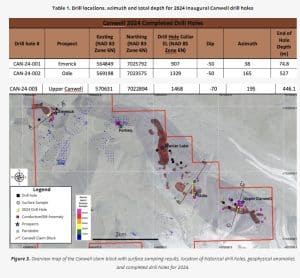
AEMC Canwell property nickel

Source: AEMC

Key Findings from the Drill Sites

1. Emerick Prospect (CAN-24-001)

Drill hole CAN-24-001 started with 16 meters of overburden, followed by serpentinized peridotite containing 0.2–0.5% sulfide minerals. The drilling reached a depth of 72.5 meters before encountering challenging rock conditions. These included intense fracturing, clay alteration, and serpentinization, which made sulfide estimation difficult.

Non-mineralized mafic dikes were also present within the peridotite. Drilling became harder due to poor rock quality, and the hole was abandoned at 74.8 meters due to a large fault. Unfortunately, it did not reach the targeted magnetic anomaly or the base of the ultramafic intrusion.

Rather than retrying, the team decided to postpone further drilling on this target until 2025. The key findings were:

  • 56.5 meters @ 0.40% nickel equivalent (NiEq) (0.26% Ni, 0.62% Cr, 7.00% Fe, 0.012% Co, 0.01% Cu, 0.019 ppm Pd, 0.032 ppm Pt & 0.007 ppm Au)

 EMERICK PROSPECT SUMMARY nickel AEMC

Source: AEMC

2. Odie Prospect (CAN-24-002)

Drill hole CAN-24-002 started with 12.2 meters of overburden, followed by serpentinized dunite containing 0.2–6.0% nickel sulfide and Ni-Fe alloy. This mineralized zone extended to a depth of 245.5 meters. Within the dunite, several non-mineralized gabbroic dikes were found.

At 245.5 meters, the drill hit an unmineralized diorite intrusion, which continued down to 527.0 meters. The targeted DIGHEM magnetic anomaly is believed to mark the contact between the mineralized dunite and the diorite intrusion. This area also showed increased pyrrhotite content, offering valuable clues for further exploration. The team discovered:

  • 193.6 meters @ 0.42% NiEq (0.26% Ni, 0.69% Cr, 8.58% Fe, 0.01% Cu, 0.014% Co, 0.035 ppm Pd, 0.041 ppm Pt and 0.007 ppm Au)
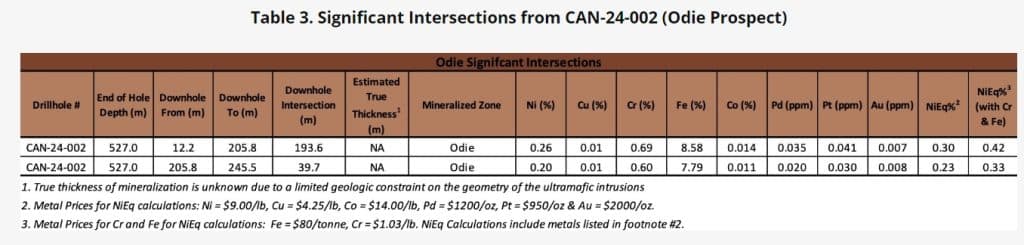
AEMC NICKEL Odie Prospect

Source: AEMC

3. Upper Canwell Prospect (CAN-24-003)

Drill hole CAN-24-003 began with 16.8 meters of overburden, followed by serpentinized and faulted dunitic rocks. These rocks showed 0.5–5.0% nickel sulfide and Ni-Fe alloy mineralization. Several cross-cutting gabbroic dikes with minimal sulfide mineralization were also encountered.

Due to challenging terrain, the drill site was relocated north of the original plan. This adjustment allowed the team to test multiple geophysical targets and resulted in drilling down the dip of the intrusion.

The targeted DIGHEM magnetic anomaly showed higher sulfide content and better nickel grades, confirming its exploration potential. The key findings were:

  • 429.3 meters @ 0.39% NiEq (0.24% Ni, 0.64% Cr, 8.12% Fe, 0.01% Cu, 0.013% Co, 0.031 ppm Pd, 0.035 ppm Pt and 0.007 ppm Au), including 1.4 meters @ 0.93 NiEq (0.65% Ni, 0.66% Cr, 8.90% Fe, 0.06% Cu, 0.021% Co, 0.275 ppm Pd, 0.246 ppm Pt and 0.012 ppm Au)
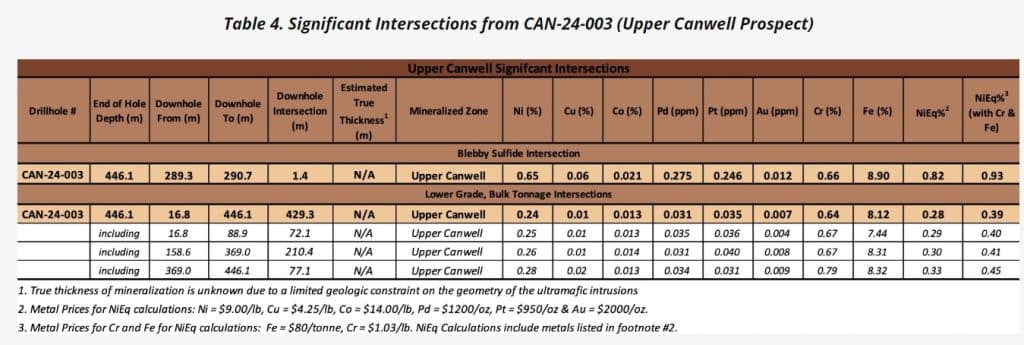
Upper Canwell Prospect AEMC NICKEL

Source: AEMC

Ensuring High Standards for Exploration

AEMC upholds stringent Quality Assurance – Quality Control for its Nikolai Project to ensure the best practices for logging, sampling, and analysis of samples.

As revealed by the company,

“For every 10 core samples, geochemical blanks, coarse reject or pulp duplicates, or Ni-Cu-PGE-Au certified reference material standards (CRMs) were inserted into the sample stream.”

Furthermore, drill cores were flown daily to the McLaren River Lodge in Alaska, where they were meticulously logged, labeled, and cut. Half of each core was archived, while the other half was sent to SGS Laboratories in Burnaby, B.C., for detailed analysis using advanced geochemical methods.

This indicates that the company integrates environmental, social, and governance (ESG) principles into its operations. At the same time focusing on sustainable practices and carbon reduction. With offices in Anchorage and Vancouver, AEMC aims to supply critical materials essential for national security and clean energy.

What’s Next for AEMC?

Significantly, the recent results at Canwell strengthen the vision for district-wide exploration across the Nikolai Project. By confirming nickel mineralization and identifying promising areas for future drilling, AEMC has highlighted the potential for major discoveries in Alaska’s interior.

They plan to revisit the site in the 2025 season, targeting expanded sulfide zones and higher-grade nickel deposits. In addition to the Nikolai Project, AEMC is advancing the Angliers-Belleterre Project in Quebec, which holds potential for high-grade nickel-copper sulfides and white hydrogen.


Disclosure: Owners, members, directors, and employees of carboncredits.com have/may have stock or option positions in any of the companies mentioned: AEMC.

Carboncredits.com receives compensation for this publication and has a business relationship with any company whose stock(s) is/are mentioned in this article.

Additional disclosure: This communication serves the sole purpose of adding value to the research process and is for information only. Please do your own due diligence. Every investment in securities mentioned in publications of carboncredits.com involves risks that could lead to a total loss of the invested capital.

Please read our Full RISKS and DISCLOSURE here.

The post Alaska Energy Metals Corporation Unlocks Vast Nickel and Critical Mineral Potential at Canwell Property, Nikolai Project, Alaska appeared first on Carbon Credits.

Continue Reading

Carbon Footprint

Climate-Linked Supply Chain Risk Is Already in Your P&L

Published

on

The earnings calls that quietly reframed climate from sustainability question to operating risk.

Three earnings calls in the last 18 months tell the story without any help from a press release.

Hershey, May 2024: cocoa price exposure compresses margin, and the company attributes part of the cost shock to West African weather. Olam, July 2024: coffee climate exposure quantified in the annual report. JBS, January 2025: supply chain climate disclosures expanded materially in response to investor pressure and regulatory expectation. None of these companies issued the announcement as climate news. They issued it as financial news. The climate-linked supply chain risk did not arrive with a sustainability framing; it arrived as a P&L line.

You are probably reading this article because you suspect the same thing is happening to your business. This piece walks through what is showing up on which earnings calls, how procurement and finance leaders are quantifying the exposure, and what serious corporates are doing about it before the regulator asks.

Where climate risk has already appeared in earnings

The pattern is consistent across resource-intensive sectors. A weather event compresses supply, the price spikes, the cost flows through the income statement, and the analyst on the call asks whether the event is anomalous or structural. Increasingly, the honest answer is the second one.

Cocoa is the cleanest example. The 2023 to 2024 West African harvest fell sharply on the back of erratic rainfall and disease. Cocoa futures more than tripled. Companies with concentrated West African sourcing absorbed the cost; companies with diversified sourcing absorbed less. The exposure was not climate as ESG topic. It was climate as cost of goods.

Coffee follows the same pattern. Brazilian and Vietnamese harvests have moved on weather more sharply across the last several seasons. Roasters with long-tenor supplier relationships and origin diversification have managed the volatility; roasters with spot-market exposure have not. Wheat, sugar, palm oil, beef: the same dynamic in different commodities, a pattern the IPCC AR6 Working Group II report projects will intensify across agricultural systems through mid-century.

What this means: climate risk is no longer a footnote in the 10-K. It is a line item the CFO has to explain on the call.

The three commodity exposures that hit margin first

For most companies with material Scope 3 exposure, three exposures dominate the near-term P&L risk.

  • Concentrated single-origin sourcing in a climate-vulnerable region. If your tier-one supply for any material commodity sits in one geography, you have a concentration risk that climate amplifies. Diversification across origins is the obvious hedge, but it takes years to build and requires relationships you cannot acquire by tender.
  • Supplier financial fragility under climate stress. Smallholder farmers, who supply a large share of the global cocoa, coffee, and palm oil market, do not carry the balance sheets to absorb yield shocks. When yields collapse, they exit. When they exit, your supply base shrinks, and the surviving suppliers raise prices. The risk is structural, not cyclical.
  • Logistics and storage exposure to extreme weather. Hurricane disruptions to Gulf shipping, drought-driven Panama Canal restrictions, flooding in European inland waterways: each of these has moved input costs in the last three years, a pattern documented in Munich Re’s natural catastrophe data. The exposure shows up as a one-quarter event in the financial press but accumulates over time on the cost line.

TCFD and ISSB disclosure changes

The disclosure architecture has now caught up with the risk. The Task Force on Climate-related Financial Disclosures, whose recommendations are now embedded in the ISSB’s IFRS S2 climate standard, requires companies to disclose climate-related risks across physical and transition categories, with quantification where possible.

For physical risk specifically (the climate-linked supply chain risk you are reading about), the disclosure must address both acute exposures (extreme weather events) and chronic exposures (gradual changes in temperature, precipitation, and growing seasons). The disclosure must address the time horizon over which the risk is material, the parts of the value chain exposed, and the financial impact under different scenarios.

The CSRD imposes similar requirements under European law, with double materiality (both financial and impact materiality) embedded in the assessment. The practical effect: your auditors and your investor relations team now need a defensible answer to the climate-linked supply chain risk question, and the answer needs to be quantified.

What procurement and finance can do now

Three actions matter near-term.

Map your exposure. Most companies do not have a clear view of which tier-one and tier-two suppliers sit in which climate-vulnerable geographies. Without the map, you cannot quantify the risk, and without the quantification, you cannot disclose it credibly. The map is the foundation, and World Resources Institute climate risk research provides useful public tooling to start.

Diversify and deepen, in that order. Diversification across origins reduces concentration risk, but the deeper move is to invest in the resilience of the suppliers you already have. Regenerative practices, agroforestry, soil health interventions: these reduce yield volatility under climate stress and protect your input cost trajectory.

Embed the climate spend inside procurement, not outside it. Treating climate risk as a sustainability cost line subordinates it to the ESG budget. Treating it as a procurement and resilience investment puts it in the budget that matters, which is the cost-of-goods budget that the CFO defends quarterly.

Nature-based supply chain investments are the asset class designed for exactly this purpose. They sit inside the value chain, they reduce climate-linked supply risk, they generate verifiable Scope 3 reductions, and they produce the documentation an auditor and a regulator can both test.

If you are quantifying climate-linked supply chain risk in advance of the next earnings cycle or the next disclosure period, the carbon and sustainability experts at Carbon Credit Capital can help you map your exposure and structure a Dual-Value Model response that addresses reduction, resilience, and disclosure-readiness in a single program. Schedule a consultation.

Continue Reading

Carbon Footprint

Where should an SME start with a carbon action plan?

Published

on

More and more small and medium-sized businesses are hearing the same question from their larger customers: What is your carbon footprint? That question now travels down entire supply chains, and it arrives next to tender requirements, certification criteria, and rising customer expectations.

Continue Reading

Carbon Footprint

Insetting vs Offsetting: Which Actually Counts Toward Your Scope 3 Targets

Published

on

The accounting differences that decide whether your nature investment shows up in inventory, in BVCM, or nowhere at all.

The question reaches a procurement team about three weeks before the next sustainability committee meeting. Someone has read about insetting. Someone else has just signed off on an offset purchase. The CSO wants to know if the two are interchangeable. The answer is no, and the GHG Protocol Land Sector and Removals Standard is the reason why.

This article walks through what each term means at audit-grade specificity, what the standards actually say about how each gets counted, and how to decide which tool fits which target. The insetting vs offsetting question is one of the most-searched in corporate climate strategy, and one of the most poorly answered. By the end of this piece, you should be able to brief a committee on the difference without notes.

The two definitions, in plain English

Offsetting means buying carbon credits generated outside your value chain and retiring them against your residual emissions. The reduction happens somewhere else, financed by you, and the credit is the receipt.

Insetting means investing in emission reductions or removals inside your own value chain, typically with suppliers, where the reduction is directly linked to the products and services you buy. The reduction happens inside the boundary of your Scope 3 inventory, and the accounting treatment is fundamentally different.

The shorthand from the University of Oxford’s Nature-based Insetting Initiative is useful: insetting is what you do with the supply chain you have; offsetting is what you do with the supply chain you do not have.

What the GHG Protocol Land Sector Standard actually says

The GHG Protocol Land Sector and Removals Standard, finalised in 2024 after a multi-year pilot, sets the rules for how land-based emission reductions and removals enter corporate inventories. The Standard distinguishes between inventory accounting (Scope 1, 2, and 3) and project or intervention accounting (a separate methodology for crediting).

For insetting, the practical implication is that supplier-level interventions, when properly measured and attributed, can reduce your Scope 3 category 1 (purchased goods and services) emissions in your inventory. The reduction is not a credit retired against the inventory; it is a lower inventory number, period.

For offsetting, the credit is retired separately. It can be reported as a contribution toward a net-zero claim under the SBTi Beyond Value Chain Mitigation framework or as part of a VCMI Carbon Integrity claim, but it does not lower the inventory number.

A practical consequence: if your Science Based Target requires a 50% absolute reduction in Scope 3 emissions by 2030, insetting moves you toward the target. Offsetting does not. This single point of difference reshapes the procurement decision.

When insetting counts toward Scope 3 (and when it does not)

Insetting counts toward Scope 3 only when several conditions are met:

  • The intervention must occur with an entity in your value chain.
  • The emissions reduction or removal must be measured against a defensible baseline.
  • The reduction must be attributed to your share of that supplier’s output, not double-counted with other buyers.
  • It must follow the inventory accounting rules in the GHG Protocol Land Sector Standard, not the project accounting rules used to generate credits.

The most common failure mode is double counting. If your supplier sells the same reduction as a credit on the voluntary market and also reports it to you as a Scope 3 reduction, the math breaks. The Standard requires you to address this risk, typically by purchasing and retiring the supplier-issued credit as part of your inventory or by contractual provisions that prevent the supplier from selling the reduction twice.

When insetting does not count toward Scope 3: when the intervention sits with a supplier you do not buy from, when the baseline is not defensible, when the attribution is unclear, or when the documentation does not survive audit. Those cases default to Beyond Value Chain Mitigation, which is still useful but operates on a different ledger.

The procurement and supplier engagement question

Insetting is harder than offsetting. That is the unfashionable truth most buyers eventually confront. Offsetting is a transaction; insetting is a relationship.

To run an insetting program, you need supplier mapping precise enough to know which farms or facilities sit at which Scope 3 boundary. You need an engagement model that gets suppliers to participate, which usually requires multi-year commitments and shared economics. You need an MRV architecture that measures the right things and produces audit-ready documentation. And you need a contractual structure that prevents double counting and protects both sides.

The trade-off you receive in return is significant. Reductions count against your inventory rather than your residual. Supplier relationships deepen, which protects sourcing continuity. Yield and quality improvements often follow regenerative interventions, which reduces your input cost over time. And the regulatory file, under CSRD, CSDDD, EUDR, and the SBTi FLAG Guidance, is materially stronger.

Choosing the right tool for the right target

A practical decision rule. If your target is a science-based Scope 3 reduction and you operate in a FLAG sector or source FLAG commodities, insetting is the structurally correct tool. If your target is a net-zero claim that includes neutralising hard-to-abate residual emissions outside your value chain, BVCM via high-integrity offsets is the structurally correct tool. Most companies with material Scope 3 exposure need both, in different proportions, sequenced over time.

The sequencing matters. Insetting takes longer to stand up but produces a permanent reduction in the inventory. Offsetting can be transacted faster but does not change the inventory and now sits under tighter claim restrictions. Treat them as complementary tools with different jobs, not as substitutes. The Accountability Framework Initiative and the IUCN Global Standard for Nature-based Solutions both provide useful guardrails for the insetting side, with biodiversity, human rights, and benefit-sharing requirements that go beyond carbon math.

If you are mapping a Scope 3 reduction roadmap and need to scope which interventions count toward your inventory versus which sit in Beyond Value Chain Mitigation, the carbon and sustainability experts at Carbon Credit Capital can help you structure a nature-based supply chain investment program that fits your FLAG exposure, your target architecture, and your audit horizon. Schedule a consultation.

Continue Reading

Trending

Copyright © 2022 BreakingClimateChange.com

