

Two weeks before Brazil hosts the COP30 summit in the Amazon city of Belém, its state-run oil firm Petrobras has been granted a licence to explore for oil in an offshore block in the mouth of the Amazon River, a move criticised by campaigners as undermining the country’s climate leadership.
After five years of discussions, Brazil’s government approved an environmental permit for Petrobras to drill an exploratory oil well in block FZA-M-59 in the Foz do Amazonas Basin, in Amapá state.
The offshore site is 540 kilometres from the mouth of the Amazon River, near the border with Guyana. As Climate Home News previously reported, almost 20% – 5.3 billion barrels of oil equivalent – of global oil reserves identified between 2022 and 2024 are located in the Amazon, primarily along South America’s northern coast between Guyana and Suriname.
-
At pre-COP in Brazil, climate finance roadmap to $1.3 trillion remains hazy
Ahead of COP30, Azerbaijan and Brazil provide scant details about a keenly awaited report on how to scale up finance for developing countries -
Global South campaigners question inclusivity of COP30 as some stay home
Civil society groups hoped to send large numbers to the UN climate talks in Brazil, but developing-country activists say it’s too expensive and they have received limited badges -
COP30 president hints Brazil may be open to a cover decision in Belém
André Corrêa do Lago tells Climate Home News the COP30 talks could conclude with an additional text on key outcomes if countries want it – something Brazil has so far resisted


The licence for block FZA-M-59 was earlier denied in 2023, when experts at environmental agency Ibama concluded that Petrobras had failed to present a solid impact mitigation and emergency response plan. But after the company made adjustments, it said on Monday it had been given permission to proceed.
The company said the drilling is expected to start right away and last around five months, adding that no oil will be produced for now.
Observatório do Clima, a coalition of Brazilian climate groups, said it is planning to challenge the decision in court and “denounce the illegalities and technical failures in the licensing process” in a bid to render the licence null and void.
Suely Araújo, the network’s coordinator of public policies, described the issuance of the license as “a double sabotage”.
“On the one hand, the Brazilian government acts against humanity by stimulating further fossil expansion, contradicting science and betting on more global warming. On the other hand, it hinders COP30 itself, whose most important delivery needs to be the implementation of the determination to phase out fossil fuels,” she said.
Ilan Zugman, Latin America and Caribbean Director at climate campaign 350.org, said that “authorising new oil licenses in the Amazon is not just a historic mistake – it’s doubling down on a model that has already failed”, adding that it produces profits for a few but can bring violence for locals.
“Brazil must take real climate leadership and break the cycle of extraction that has led us to the current climate crisis,” he said.
Brazilian energy ministry defends decision
Announcing the decision to grant the licence, Brazil’s Minister of Mines and Energy Alexandre Silveira said the oil in the Equatorial Margin region “represents the future of our energy sovereignty”.
He said Brazil had made “a firm and technical defence” to ensure that exploitation “is done with full environmental responsibility, within the highest international standards, and with concrete benefits for Brazilians and Brazilians”.
The Amazon rainforest emerges as the new global oil frontier
The ministry said in a press release that the FZA-M-59 block “has the potential to open a new exploratory frontier”, with the activity expected to generate more than 300,000 direct and indirect jobs, strengthen the local economy and boost royalty revenues.
Silveira also argued that Brazil’s oil “is one of the most sustainable in the world, with one of the smallest carbon footprints per barrel produced”, ahead of countries such as Canada, the UK and Russia.
ICJ warns on state support for fossil fuels
Campaigners said that the decision goes against recent rulings by the Inter-American Court of Human Rights and the International Court of Justice (ICJ), which reinforce countries’ commitments to protect the climate.
In a landmark advisory opinion issue in July, the ICJ mentioned granting fossil fuel exploration licenses as one example of state policies that could constitute “an internationally wrongful act”.
The International Energy Agency, meanwhile, has said that no new fossil fuel projects are needed if global emissions are to fall to net zero by 2050 in line with limiting warming to 1.5C, as governments said they would aim to do under the Paris Agreement.
Carlos Nobre, co-chair of the Amazon Scientific Panel, warned that ignoring such advice could see global warming hit 2C, threatening to push the Amazon rainforest across an irreversible tipping point.
“Beyond eliminating all deforestation, degradation and fires in the Amazon, it is urgent to reduce all fossil fuel emissions. There is no justification for any new oil exploration. On the contrary, rapidly phasing out existing fossil fuel operations is essential,” he said.

Luiz Inácio Lula da Silva, Brazil’s president, backs oil exploration in the country – already the world’s eighth-largest producer – arguing that the profits could be used to finance the transition to clean energy. “I dream of a day when we no longer need fossil fuels, but that day is still far away. Humanity will depend on them for a long time,” he said in a speech back in February in Pará, the state that will host COP30.
After the licence was approved, Clara Junger, campaign coordinator for Brazil at the Fossil Fuel Non-Proliferation Treaty Initiative, refuted Lula’s perspective. “This decision undermines commitments to the energy transition and puts communities, ecosystems, and the planet at risk. Contrary to official claims, oil revenues contribute almost nothing to the transition – only 0.06%,” she said in a statement.
Banks pour billions into Amazon oil and gas
Back in 2023, at COP28 in Dubai, countries agreed to “transition away from fossil fuels in energy systems”. Earlier this year, Brazil’s Environment Minister Marina Silva suggested COP30 could result in a roadmap to guide a “planned and just transition” to end fossil fuels, although there has been little advance since.
Livia Duarte, a congresswoman from Pará State, said a global agreement to phase out fossil fuels is needed, especially in the Amazon. “Corporate profit should never take precedence over life on the planet. Granting a license in Block FZA-M-59, in the Amazon River estuary basin, is a dangerous choice for Brazil,” she added.
On Tuesday, new data published in the Banks vs. the Amazon scorecard, showed that Brazilian and international banks have extended an additional $2 billion in direct financing for Amazon oil and gas projects – including to Petrobras – since the beginning of 2024.
In a statement, green group Stand.earth said that by financing these projects, “banks are fuelling both the climate crisis and the destruction of the Amazon, instead of backing the just energy transition urgently needed”. It called on them to implement Amazon oil and gas financing exclusion policies to protect Indigenous communities and “help avert Amazon’s imminent tipping point”.
The post Ahead of COP30, Brazil grants Petrobras a licence to drill for oil in Amazon region appeared first on Climate Home News.
Ahead of COP30, Brazil grants Petrobras a licence to drill for oil in Amazon region

Three countries have been named by the Paris Agreement’s compliance committee for failing to submit a nationally determined contribution (NDC) and repeatedly snubbing offers of help with their climate plans.
After months of internal debate over whether to identify serial non-responders, the Paris Agreement’s Implementation and Compliance Committee (PAICC) named the three countries which have failed to engage with it over their NDCs on Friday.
It named Democratic Republic of Congo, Senegal and North Korea in a footnote of its annual report, adding that it decided to name them “with a view to facilitating engagement”, adding that representatives of the three nations had been invited to its meeting in early 2027 “with the purpose of identifying any challenges and constraints”.
“The Committee noted the importance of Parties engaging with the Committee in a timely manner, while noting that some delays may be due to the national capabilities and circumstances of the Parties”, the report said.
-
Under US pressure, World Bank says it will back gas “where appropriate”
The US wants the World Bank to expand its gas support while climate campaigners are pushing for it to end – its head spoke this week of limited backing for the fossil fuel -
IPCC scientists vow to press on with climate reports despite political deadlock
After governments again failed to agree a timeline, nearly 120 IPCC authors pledged to complete their assessment on time and with full scientific rigour -
Paris Agreement committee snubbed over missing NDC climate plans
Many governments have still not submitted a nationally determined contribution to the UN, breaching a key requirement of the Paris Agreement

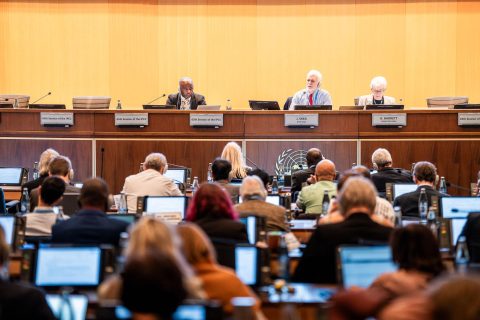

In July, PAICC said 12 countries had ignored its repeated attempts to discuss why they had not published an NDC as required every five years under the 2015 Paris accord.
Members of the committee had been divided over whether to name them, but at a September meeting decided to do so in their annual report to the annual climate COP summit.
By the time the report was published on Friday, only Congo, Senegal and North Korea “had not communicated an NDC or submitted a [Biennial Transparency Report] and had not yet responded to any of the Committee’s notifications, despite several reminders issued by the Committee in this regard”.
Rainforest and renewable energy ambitions
The silence from Congo and Senegal is notable because the former is home to much of the Congo Basin rainforest while the latter has sought billions of dollars in climate finance to support its renewable energy ambitions.
After Brazil, Congo has more rainforest than any country in the world. This forest, and the country’s peatlands, absorb huge amounts of greenhouse gas but are fast being lost to expanding farmland, charcoal production, logging and mining.
Senegal signed a Just Energy Transition Partnership with Canada and wealthy European nations in 2023, to help it meet its renewable energy targets under the-then government of Macky Sall. It was chair of the Least Developed Countries group between January 2022 and December 2023.

Tejas Rao, who is researching the PAICC as part of a doctoral thesis at Cambridge University, said the governments of the three countries should engage with the committee.
“Engagement costs these governments very little and the committee has shown it will listen,” he said.
“Silence leaves the committee with no basis to help, and it leaves the [governments] exposed to the narrative that they are simply disengaged,” he told Climate Home News.
Paris Agreement requirement
The 2015 Paris Agreement requires all parties to publish an NDC every five years outlining their emissions reduction targets, with each plan meant to be more ambitious than the country’s last NDC.
The latest set – the third round of plans, with new targets for 2035 – was due in February 2025. While most countries missed this deadline, all but around 30 – mostly small emitters but including Egypt, Vietnam and Argentina – have now submitted them.
Over the year, the PAICC – which is made up of government climate officials from developed and developing countries – has been communicating with governments that have not submitted NDCs and trying to overcome barriers to them doing so.
Some nations have cited exceptional circumstances as the reason for not submitting an NDC, a process that requires a significant amount of work in tracking emissions and consulting on how to curb them across the economy. For example, a letter from a Sudanese official to the PAICC, seen by Climate Home News, said that the country’s civil war had led to the suspension of its NDC preparation.
-
IPCC scientists vow to press on with climate reports despite political deadlock
After governments again failed to agree a timeline, nearly 120 IPCC authors pledged to complete their assessment on time and with full scientific rigour -
Under US pressure, World Bank says it will back gas “where appropriate”
The US wants the World Bank to expand its gas support while climate campaigners are pushing for it to end – its head spoke this week of limited backing for the fossil fuel -
Who shapes climate science? The equity question facing the IPCC
Early completion of the next global climate science assessment reports risks excluding research from the Global South, which is key to ensuring the findings are fair
The US and Iran are not signed up to the Paris Agreement and so do not have active NDCs, nor does Taiwan, which is not a UN member state.
Rao said that because the PAICC is “facilitative and non-punitive”, naming the countries “is meant to open a door, not close one – the invited consultation is the point”.
“In recent months, governments that explained their constraints, whether capacity, finance or domestic process, have been met with follow-up and support rather than sanction, and the number of silent governments has fallen sharply,” Rao said.
The post Paris Agreement committee names three countries snubbing it over NDCs appeared first on Climate Home News.
Paris Agreement committee names three countries snubbing it over NDCs