African leaders at a regional energy summit in Tanzania this week called for more investment in aging grid infrastructure in their countries to tackle widespread power outages that hamper major economies including Nigeria and South Africa, and to expand modern energy access to half of the 600 million people who lack it on the continent.
The conference was organised by Mission 300, an initiative launched in April 2024 by the African Development Bank and the World Bank to provide 300 million energy-poor Africans with electricity by 2030. This will be done mainly by connecting them to national grids or local minigrids powered by renewables such as solar.
The development banks have committed to collectively deliver $40 billion under the initiative – a target that was raised this week to more than $50 billion by contributions from other financial institutions, including the Asian Infrastructure Investment Bank (AIIB) with around $1.5 billion and the Islamic Development Bank Group with $2.65 billion.
To meet the Mission 300 goals, a first batch of 12 countries – Chad, Côte d’Ivoire, Democratic Republic of Congo, Liberia, Madagascar, Malawi, Mauritania, Niger, Nigeria, Senegal, Tanzania and Zambia – presented national energy compacts with detailed targets to scale up electricity access through renewable energy, as well as strategies to boost regional integration and attract private sector investment.
Presenting their plans, African leaders spoke of how outdated infrastructure has limited energy expansion on the continent and held back development in areas like healthcare, education, job creation and digital inclusion.
President Hakainde Hichilema of Zambia said African countries “need energy to develop our economies faster,” adding that “energy is life – as is water”- and energy is essential to extract water for human consumption, agriculture and industry, and keep people healthy.
He pointed to the need for a diversified energy mix coming from different sources including solar, hydro and geothermal, and emphasised that the power they generate must also be transmitted. “We need to take it where it’s needed,” he said.
Other countries echoed a similar concern in their energy compacts. Nigeria’s plan, for instance, stated that “the ability of the transmission system to evacuate available generation capacity is inadequate due to aging and poorly maintained infrastructure”. It called for “targeted concessionary lending to qualifying distribution companies (DISCOs) to strengthen distribution infrastructure”.
Tanzania also mentioned in its compact that the country’s electricity connections are faced with the challenge of “poor reliability and quality of service, caused by a deteriorating network with overloaded transformers [and] distribution feeders”. It called for improvements in the quality of the electricity service that “require investments in grid stabilization, network rehabilitation, reinforcement, and upgrades”.
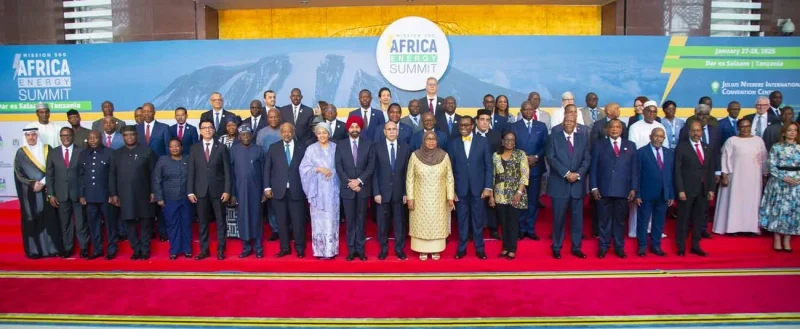
African leaders at the Mission 300 energy summit (Photo: AfDB)
Makhtar Diop, managing director of the International Finance Corporation (IFC), noted that “a lot of the power outages in Africa are not linked often to production – they are often linked to distribution because the [electricity] network is not robust enough” and called for investments in distribution.
The companies managing distribution require capital injections because most are “under-capitalised and not in a good finance situation and therefore not able to invest in operational maintenance”, he added.
Meanwhile, the progress of some countries like Uganda shows that grid improvement and extension to improve distribution is achievable. With World Bank support, the country extended its grid and installed solar energy in health centres and water supply schemes, directly benefiting almost 8.8 million people in rural areas between 2016 and 2023. It has now embarked on another such project, involving the private sector.
Off-grid ‘cheaper and faster’
Off-grid electrification is also seen as key to the Mission 300 objective – and the energy compacts presented in Dar es Salaam reflected how, in the face of delays to grid extensions, distributed renewable energy (DRE) offers a faster means to electrify under-served communities.
Half of the Mission 300 goal is due to be achieved by off-grid connections. World Bank President Ajay Banga said geo-spatial mapping was being used within countries to decide which areas can be connected to the grid and which require DRE, including solar and battery storage systems that are “cheaper and faster” to install.
Coal-reliant South African provinces falling behind on just transition
Woochong Um, CEO of the Global Energy Alliance for People and Plant (GEAPP), said this group of government agencies, development banks and philanthropic foundations, is looking to support “hard-to-reach activities, like the productive use of the electrons by the farmers and people on the ground”. GEAPP is planning to pilot promising models that can be scaled up by banks if they produce successful results, he told Climate Home.
Sarah Malm, executive director of GOGLA, a global association for the off-grid solar industry, said off-grid systems “will complement weak grid environments” as the “least-cost and the fastest way to get basic energy access to households”, especially in rural communities.
“It provides light to study. It provides safety. It provides the ability for a kiosk to stay open at night. It provides really huge quality of life improvements – and then also, when light is intermittent and the grid doesn’t work, it is a source of back-up,” she said.
From 2020 to 2022, off-grid solar accounted for 55% of new connections in sub-Saharan Africa, according to the World Bank, and is projected to provide electricity access to nearly 400 million people by 2030.
Malm believes that off-grid solar is the best way to achieve the global goal of providing everybody with modern, sustainable power by 2030, because extending power grids is a long-term investment and progresses more slowly.
Private-sector investment
African leaders and energy backers at the summit highlighted the role of private-sector investment in fulfilling the goals of Mission 300.
“To actually achieve what we want to do, it requires more than public-sector money, it requires a lot of private sector,” said Akinwumi Adesina, president of the African Development Bank Group. He added that the private sector will play a role in delivering mini-grids and providing electricity to under-served areas.
Indonesia’s next priority should be finding alternatives to replace coal
The cost of capital, however, is one of the major challenges facing businesses in Africa. Mission 300’s partners will “play a big role to reduce the risk using partial risk and credit guarantees” and provide long-term, low-interest capital, as well as develop bankable projects to attract private investors, Adesina said.
Um told Climate Home that GEAPP will work with multilateral development banks to help governments set up regulatory frameworks that can reassure the private sector their investments in African countries are safe.
Diop of IFC said the private sector is not yet as involved as it should be in financing clean energy development in Africa and this has constrained the uptake of renewable energy. He called for a “change in the paradigm” to catalyse heavy investment in renewables.
(Reporting by Vivian Chime; editing by Megan Rowling)
The post African leaders seek investments in ailing grid infrastructure to achieve energy goals appeared first on Climate Home News.
African leaders seek investments in ailing grid infrastructure to achieve energy goals
Climate Change
The risk of another “super typhoon” is growing – that’s why we’re suing Shell
Trixy Elle, a fishmonger from Batasan Island, lost her home and her business when Typhoon Odette tore through the Philippines in 2021. She is among a group of survivors who filed a lawsuit this week in a UK court seeking damages from Shell over the oil giant’s role in climate change.
In today’s world, it sometimes feels like we’re all slightly more connected: that smartphones and social media have helped us to understand what people on the other side of the world are going through.
But after living through the horrors of Super Typhoon Odette, which tore through my home in the Philippines in December 2021, killing or injuring more than 1,800 people, I know this isn’t true. Unless you’ve lived through it yourself, you’ll never know the feeling of having to swim away from your own collapsing home, or the sound of 175 mph (281 km/h) winds devastating your entire community. No amount of photo or video footage can ever bridge that gap.
Fossil fuel companies in the Global North, which bear huge responsibility for the climate crisis, are largely protected from the impacts of their polluting activities. But those of us living on small islands, at the sharp edge of climate change, don’t have that luxury.
My family lost everything. We lost our business and had to sell our precious belongings just to rebuild our house. We now live in non-stop fear. Even moments meant for joy are now tinged with anxiety and stress. After all, Odette – also named Rai – tore through our islands right before Christmas. We didn’t, and still don’t, know when the next disaster will hit, only that thanks to the fossil fuel industry, the threat is always growing.
Profit before people
We’ve done nothing to cause the climate crisis, but because fossil fuel companies have chosen profit over people, our lives have been destroyed. Scientists have said the likelihood of a disaster like Odette in the Philippines has roughly doubled due to global warming.
None of this is fair. That’s why we’ve chosen to turn our fear into action and take the fossil fuel giant Shell to court.
Since at least 1965, Shell has known that fossil fuels are the primary cause of climate change. The corporation was warned that if it failed to curb its emissions, the world could suffer major economic consequences by 2038. But still, it chose not to change course. Shell is one of the world’s largest emitters, accounting for 2.04% of historical global emissions. Contrast that to the Philippines, which has the highest risk of climate hazards but has contributed just 0.2%.
We’re not naive about the scale of the challenge. Shell is a huge company with endless resources. But we’re living in an age of scientific discovery. Attribution science can now directly link individual extreme weather events to climate change, and emissions to specific fossil fuel companies.
The law is also changing. We’re seeing courts recognise the role and responsibilities of major emitters in the harm climate change causes our planet. In May, a German court ruled that major emitters can be held liable for climate damages abroad.
Peruvian farmer loses climate case against RWE – but paves way for future action
In July, the International Court of Justice advised that governments have a binding duty to protect people and the planet from the climate crisis, and so the potential liabilities for fossil fuel companies are substantial. Some estimates say the climate damages attributable to the 25 largest oil and gas companies could be more than $20 trillion.
Polluters must pay
By filing this case, we are seeking financial compensation for losses and damages. We’re still living with the consequences of Odette, even today.
The “polluter pays” principle is clear: those most responsible for environmental harms, including fossil fuel giants like Shell, should cover the costs of managing them. That’s the basis of our claim. We are also asking for concrete steps to be taken, from replanting mangroves to rebuilding sea walls, in line with our right to a balanced and healthy environment, something set out in the Filipino constitution.
Just as importantly, we are asking for justice. We want to send a powerful message to companies like Shell. For too long they have been able to burn fossil fuels while chasing endless profit, despite knowing how dangerous it is. But in 2025 the science and the law are both on our side. Sooner or later they will have to clean up their act.
===========================================================
Shell says claim is “baseless”
When asked to comment on the pending case by Climate Home News in October, Shell acknowledged that more global action was needed on climate change but rejected the suggestion that the company had unique knowledge about the problem.
A company spokesperson has responded to media reports about this week’s court filing saying: “This is a baseless claim, and it will not help tackle climate change or reduce emissions.”
The post The risk of another “super typhoon” is growing – that’s why we’re suing Shell appeared first on Climate Home News.
The risk of another “super typhoon” is growing – that’s why we’re suing Shell
Climate Change
Funding for protected areas fell in 2024, threatening global nature target
A global goal to protect 30% of the planet’s land and sea ecosystems by 2030 is at risk of falling off track due to a decline in international finance, a new report has found, which leaves developing countries with a $3 billion funding gap.
The target known as “30×30” was adopted at UN biodiversity talks in 2022, and aims to protect nature and cut emissions by increasing protected areas across the world. Experts estimate this can contribute to slash at least 10 gigatonnes of carbon emissions annually.
To achieve this target and as part of the landmark Kunming-Montreal biodiversity pact, developed countries agreed to mobilise $20 billion directly to developing countries by 2025. About a fifth of this funding is estimated to reach protected areas, which means that developing countries should receive $4 billion by 2025 for this purpose. By 2030, this figure should reach $6bn.
But a new report by Indufor – a forest intelligence group supported by nature NGOs – found that developed countries only delivered $1 billion in 2024 for protected areas, falling $3 billion short of the 2025 target.
Last year also marked the first year-on-year decline in funding for protected areas after a post-pandemic growth, the report shows.
$3bn funding gap
The report shows there has been an increase in support for protected areas in developing countries, which has grown by more than 150 percent in the last decade. After the pandemic, philanthropic funding drove most of the growth, rising by more than 70 percent during this period.
These funds are meant to pay for establishing new protected areas, providing capacity to park rangers, and supporting Indigenous groups and local communities, among other initiatives.
However, the current rate of increase is too slow to reach the $6 billion by 2030 target, the report says. To achieve this, international funding must grow by about 33 percent each year between now and 2030, since at the current pace developing countries would only receive $2bn by 2030.
The drop in 30×30 funding in 2024 could be driven by a reporting lag by philanthropies, the report says, as some grants are coming to an end after the growth in post-pandemic contributions and could be renewed. However, the reports also warns that cuts to US foreign aid could further reduce the available finance in 2025.
Small islands underfunded
So far, Africa has received the most finance with about half of the overall funding reaching the continent in 2024, while small island developing states remained severely underfunded by international flows.
Safiya Sawney, Grenada’s Climate Ambassador, said at the report launch on the sidelines of the UN Environment Assembly in Nairobi that the funding coming to the Caribbean is not enough. She added that “we’ve heard from the report that there has been scaled up philanthropic financing, I can tell you that it’s not reaching my region, it’s not reaching my country”.
Jiwoh Abdulai, Sierra Leone’s minister of environment and climate change, also told the event that developed countries should step up finance, warning that the cost of inaction will be higher. “The best time to put out a fire is when it is in your neighbour’s house before it gets to yours,” he added.
Earlier modelling by Campaign for Nature in 2020 suggested that expanding and managing the world’s protected areas would require an average investment of at least $140 billion per year globally by 2030, funded through a mix of domestic and international sources. Already, the $6bn target falls significantly short of this figure.
Abdulai said that besides the funding gap, there is also an accessibility problem. Countries ask for funds and it comes five years later, making “the money not even close to enough to solve the problem” as the funding needs tend to grow after the initial request.
He said developed countries need to fulfil their pledges because “if the funding is not coming then we are not addressing the problem and if we are not addressing the problems today in the frontline countries, tomorrow the frontline will move from our countries to yours”, he added.
US retreat sounds alarm
The report also shows that the funding for protected areas has come mostly from a few sources. Since 2022, just Germany, the World Bank, the Global Environment Facility (GEF), the European Union, and the United States, provided more than half of all international finance for the 30×30 goal.
“There is a real risk or a significant vulnerability if even one major donor were to pull back,” said Michael Owen, one of the authors of the report. He warned that this leaves global biodiversity protection vulnerable to political transitions, at a time of rising geopolitical tensions, which could trigger sudden changes in funding or even retrenchment.
The report notes that “the shuttering of USAID leaves a significant gap to be filled, as it has been the sixth largest international 30×30 funder making up nearly 5% of total flows”.
With just five years left to meet the 30×30 target, Brian O’Donnell, director of Campaign for Nature, said there is “a clear need to ramp up marine conservation finance”, especially to small island states. He added that meeting the 30×30 target “is essential to prevent extinctions, achieve climate goals, and ensure the services that nature provides endure, including storm protection and clean air and water.”
Anders Haug Larsen, advocacy director at Rainforest Foundation Norway, said the world is currently far off track, both in mobilizing resources and protecting nature.
“We now have a short window of opportunity, where governments, donors, and actors on the ground, including Indigenous Peoples and local communities, need to work together to enhance finance and actions for rights-based nature protection,” Larsen added.
The post Funding for protected areas fell in 2024, threatening global nature target appeared first on Climate Home News.
Funding for protected areas fell in 2024, threatening global nature target
Climate Change
As the Paris Agreement turns 10, what has it achieved?
The world’s efforts to avert catastrophic climate change are still far off track a decade after the Paris Agreement’s adoption, but the landmark pact has spurred big strides on cutting planet-heating emissions and reducing the expected rise in global warming.
UN Secretary-General António Guterres conceded for the first time this year that the global average temperature will increase by more than the 1.5C limit above pre-industrial levels agreed in the Paris deal, though he described it as a “temporary overshoot” that could be reversed before the end of this century.
The legally binding accord set an overarching goal to hold “the increase in the global average temperature to well below 2C above pre-industrial levels” while pursuing efforts to limit it to 1.5C.
But even if the most symbolic 1.5C target is missed, the projected global temperature increase by the end of the century has fallen in the decade since the Paris deal was struck on December 12, 2015 – and climate experts say the agreement is still the compass of global climate action.
To mark the agreement’s 10-year anniversary, we take a look at what it has achieved, and what remains to be done:
What has the Paris Agreement achieved on emissions?
When the Paris deal was adopted, no countries had pledged to cut their emissions to net zero. Now, about 70% of global greenhouse gas emissions are covered by net-zero pledges.
“Countries have moved from a patchwork of targets to economy-wide, absolute emission-reduction goals, and projected 21st-century emissions under both current policies and targets have fallen markedly since 2015,” said an analysis by Climate Analytics, adding that climate policies meant global emissions could peak before 2030.
Assuming current policies on tackling emissions are maintained, the world’s projected temperature increase by the end of the century has fallen to 2.8C from 3C-3.7C when the deal was struck, according to the UN Environment Programme’s latest Emissions Gap Report, showing the impact of climate action.
If countries’ national climate targets, known as nationally determined contributions (NDCs), are fully implemented, projected warming would come down to between 2.3C and 2.5C, the report said.
Paris Agreement helping to avert dozens of hot days each year, scientists say
Still, climate action since 2015 has not been sufficient to prevent overshooting of the 1.5C limit. And even if that happens temporarily and temperatures are brought back down again, it could still have disastrous consequences for ecosystems, economies and vulnerable communities.
“This is not a failure of the Agreement’s design; it is a failure of collective ambition to match its aims,” the Climate Analytics analysis said.
The State of Climate Action 2025 report from the World Resources Institute (WRI) also found there is still a long way to go.
“Across every single sector, climate action has failed to materialise at the pace and scale required to achieve the Paris Agreement’s temperature goal,” the WRI report said.

What are the biggest hurdles for the key Paris goals?
None of the 45 indicators assessed in the WRI report were found to be on track to reach their 1.5C-aligned targets by the end of this decade, with some of the worst-performing metrics including halting permanent forest loss, phasing out coal-generated power and scaling up climate finance.
At the same time, public finance for fossil fuels continues to grow – even two years after the world agreed to transition away from coal, oil and gas in energy systems – rising by an average of $75 billion per year since 2014, the WRI report said.
Elsewhere, climate experts say progress has started to slow down, warning that this could push the Paris Agreement’s goals on limiting temperature rise further out of reach.
“Progress made in decarbonising steel has largely stagnated; and the share of trips taken by passenger cars – many of which still rely on the internal combustion engine – continues to rise,” the WRI report said.
The Climate Action Monitor 2025, issued by the Organisation for Economic Co-operation and Development, shows that the number and stringency of policies increased by only 1% in 2024.
Climate Analytics CEO Bill Hare said that while improved national policies meant a global peak in emissions before 2030 was now in sight, a dwindling sense of urgency among decision-makers must be tackled.
“Action has slowed in the last four years, even as climate impacts have grown, and we are still a long way from 1.5C. But the science shows that it is still possible to bring temperatures back well below 1.5C by 2100 after a brief period of overshoot,” Hare said.
COP30 this November highlighted the political challenges in weaning the world off fossil fuels.
While there was growing momentum for an agreement to start work on a roadmap to transition away from fossil fuels during the summit, the proposal did not make it into the final Belém deal due to opposition from nations that are heavily reliant on fossil fuel production.
The Trump administration, which is withdrawing the US from the Paris Agreement for a second time, did not send a formal delegation to the talks in Brazil, and Washington is expected to use its year in charge of the G20 to promote fossil fuels.
Ten years on, what is actually working?
However, the obstacles to meeting the world’s climate goals do not mean no progress has been made towards them.
“Paris is working: it bent the curve,” said Hare from Climate Analytics. “Now our future depends on the political will to move forward fast enough to finish the job,” he added.
Framework climate laws have more than tripled since 2015 and national climate policy tools are up seven-fold, a recent study by the Energy & Climate Intelligence Unit (ECIU) found.
When it comes to the clean energy rollout, “the Paris Agreement has had a transformative global impact”, the ECIU report said.
Renewables now provide an additional 20% or more of electricity in 20 countries, according to a new study by Zero Carbon Analytics. Global clean energy capacity has increased 2.4 times since the pact was agreed, reaching 4,448 gigawatts (GW) in 2024.
Solar and wind have grown more than 1,500% faster than forecast by the International Energy Agency (IEA) in 2015, and renewables have just overtaken coal as the largest source of electricity generation.
“We are already investing twice as much into renewables than fossil fuels. Now renewables meet 80% of global electricity demand growth [and] solar has been deployed 15 times faster than predicted 10 years ago,” said Christiana Figueres, one of the architects of the Paris Agreement and a founding partner of the Global Optimism civic organisation.
The adoption of electric vehicles (EVs) is already 40% above the IEA’s 2015 projections and on track to be 66% higher by 2030.
Yet despite the faster-than-expected growth in EV adoption, the WRI analysis said the sector was still off track for achieving the Paris Agreement’s 1.5C warming limit.
“The advances we’re seeing in the real economy are telling us we are walking in the right direction, even if too slowly,” added Figueres.
What’s next for the Paris Agreement?
On top of US President Donald Trump’s abandonment of climate action, heightened geopolitical tensions, trade rivalries and aid cuts could hamper the new cycle of national climate plans (NDCs), said Paula Castro from the Center for Energy and the Environment at Zurich University of Applied Sciences.
The NDCs are a key Paris Agreement mechanism and must be strengthened in a five-year cycle. The latest round of plans were due by September 2025, but around two-thirds of countries missed the UN deadline. Several dozen NDCs have filtered in since then, including the European Union’s plan.
Global emissions are expected to fall by about 10% by 2035 based on a preliminary assessment of the new NDCs announced by countries that produce nearly 60% of the world’s greenhouse gases, the United Nations Framework Convention on Climate Change has said.
The Intergovernmental Panel on Climate Change has said that countries should cut their emissions much more rapidly, with a 60% drop from 2019 required by 2035 to limit warming to 1.5C.
Angola lowers climate ambition in blow to “spirit” of Paris Agreement
Trump’s decision to pull the world’s biggest economy out of the Paris Agreement drew international criticism, but climate experts do not expect it to halt progress elsewhere.
“While it’s clear the speed and scale has to increase, the institutional buy-in of the Paris Agreement continues and moves forward despite two pull-outs by the US,” said Jennifer Morgan, former German state secretary and special envoy for international climate action.
She said the rising cost of climate-linked disasters should give fresh impetus to the goals of the 2015 accord.
“We know just in Europe extreme weather events cost 43 billion euros per year … Not acting on climate has a huge cost to the economy, and that’s beginning to resonate with leaders,” she said.
The Paris Agreement paved the way for the establishment of a global fund to help deal with the growing “loss and damage” from worsening extreme weather and rising seas in developing countries.
It recognised the issue – and the need to address it – for the first time in an international treaty, while stipulating in line with rich nations’ demands that this should not open the door for liability or compensation for the effects of the climate crisis.
Nonetheless, a loss and damage fund was subsequently launched in 2023 with contributions from donor governments and is due to start allocating money next year for projects in vulnerable countries.
This article was updated on December 11 to add the latest projections and the outcome of COP30.
The post As the Paris Agreement turns 10, what has it achieved? appeared first on Climate Home News.
-
Climate Change4 months ago
Guest post: Why China is still building new coal – and when it might stop
-
Greenhouse Gases4 months ago
Guest post: Why China is still building new coal – and when it might stop
-
Climate Change2 years ago
Spanish-language misinformation on renewable energy spreads online, report shows
-
Greenhouse Gases2 years ago嘉宾来稿:满足中国增长的用电需求 光伏加储能“比新建煤电更实惠”
-
Climate Change Videos2 years ago
The toxic gas flares fuelling Nigeria’s climate change – BBC News
-
Climate Change2 years ago嘉宾来稿:满足中国增长的用电需求 光伏加储能“比新建煤电更实惠”
-
Carbon Footprint2 years agoUS SEC’s Climate Disclosure Rules Spur Renewed Interest in Carbon Credits
-

Climate Change2 years ago
Why airlines are perfect targets for anti-greenwashing legal action
