Climate change has a habit of exploiting weaknesses. Existing problems are made worse and new ones are created in its wake.
How the climate crisis unequally impacts women is well-documented – but no less shocking. According to the UN, women and girls make up 80% of the people displaced due to climate change. This often forces them into extreme poverty and a heightened threat of violence.
Researchers attribute this disparity to a range of factors. Women are typically among the majority of the world’s poor, with fewer decision-making powers and a greater reliance on their country’s natural resources for survival. The crisis brings deeply entrenched inequalities to the surface and makes them hard to ignore.
This year’s International Women’s Day takes up the issue with the theme of “For All Women and Girls: Rights. Equality. Empowerment”.
Many women in Peru, for example, are experiencing these inequalities firsthand as climate change forces them to adapt.
But they aren’t alone in the effort. Profonanpe, the Peruvian environmental fund, was established in 1992, and is at the forefront of conserving the country’s globally significant biodiversity.
As part of this work, the fund empowers women to take a central role in their future, by moving into new roles in their communities, and contributing vital local knowledge to adaptation responses.
Business leaders
Profonanpe is spearheading two climate projects, financed by the Adaptation Fund, and women’s rights are a main priority throughout. One of these initiatives, located in the Andes, is about to get underway, while another on the coast has recently reached completion.
Both present different challenges. In the mountains, women often participate in the same activities as men. The new project will increase adaptive capacity and reduce the vulnerability of forests, grasslands and wetlands using an inclusive approach that combines ecosystem monitoring and resilience-building.
A tale of two women: What climate vulnerability actually looks like
Along the coast it is uncommon to find women who work on fishing boats, but they play a crucial role in processing and marketing the day’s catch. Acknowledging this fact and finding alternative lines of work was a key consideration.
Peru’s significant fishing industry accounts for an estimated 10% of all fish captured around the world, but as fish stocks plummet, local communities need to diversify fast. Profonanpe’s approach was to help women create their own community associations, and run their own businesses.
New industries popped up using fish waste as a biofertiliser, aquaponic plants were created to cultivate fish stocks, and eco-tourism was promoted in marine protected areas.
José Zavala, a general coordinator on the project, explained: “The work of women within the productive chain of artisanal fishing was invisible for a long time. That is why it was decided, in a participatory way, to include activities exclusively for them and that would adapt to their way of life.”
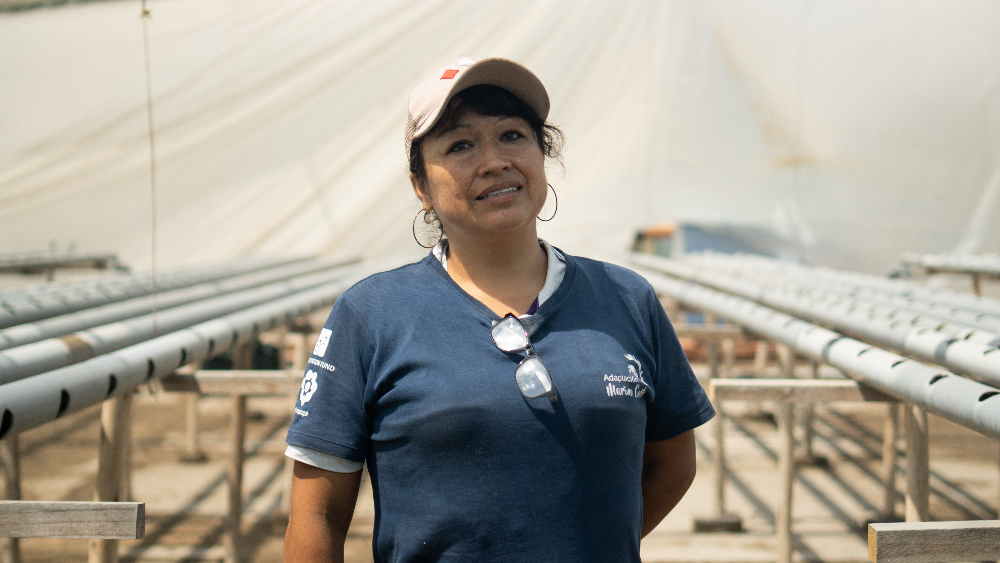
Gloria Tarazona, president of the Women’s Association of Aquaponics in Huacho, said many women in Peru – particularly mothers of young children – can’t work because they have to take care of their family. The project changes this dynamic by allowing them to join part-time with manageable schedules. “We are generating food and jobs for many people,” Tarazona said.
“The food is natural and organic, and little by little with climate change and pollution these products are becoming more necessary. The positive change that I’ve seen in all the women of the project is that they like what they have learned. I always tell them they have to continue forward because this is a project of the future,” Tarazona added.

Inspiring change
Claudia Godfrey, Profonanpe’s director of innovation and strategic management, told Climate Home how women’s stories from the project are a strong motivator.
“Daughters have seen the change in their mothers, and felt inspired. They realise that their mothers can be leaders and entrepreneurs,” she said.
“Seeing younger generations inspired by their mothers reminds us how important it is to include women in climate adaptation.”
Strong gender policies, including setting high targets for female leadership on projects, have helped embed women’s rights in other organisations. These policies ensure fewer women are overlooked for leadership positions.
The Adaptation Fund’s own social and gender policies are aimed at empowering women and marginalised groups. They do this by providing equitable access to resources and livelihoods, and inclusive decision-making.
Sustainable fishing offers lifeline to communities hit by climate crisis
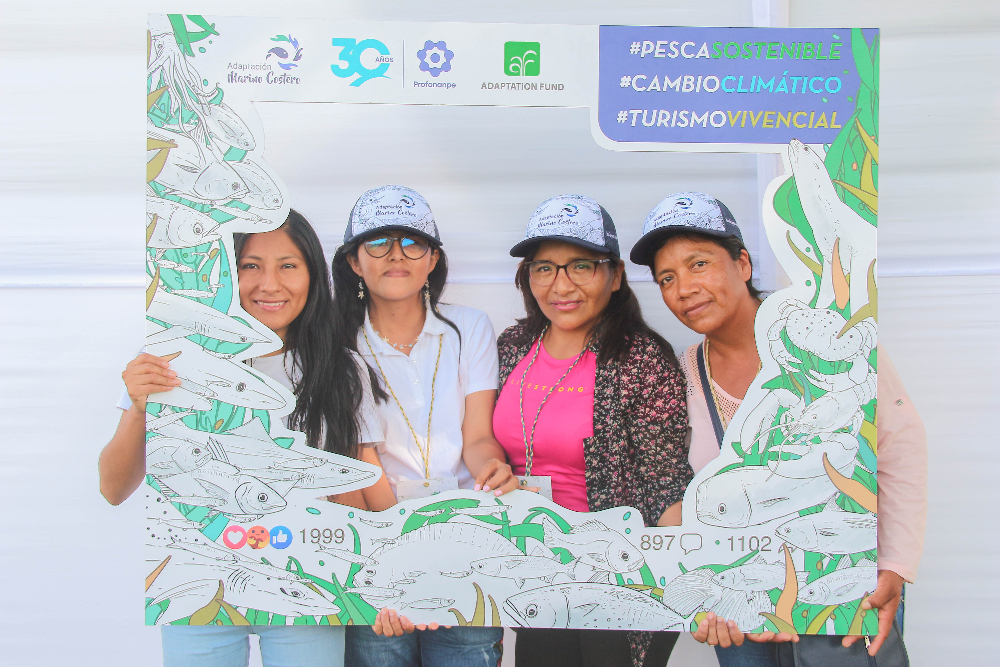
“It’s moving to see how women have grown in confidence and recognition within their communities. Many of them have told us that they now have a voice in decision-making and how their lives have changed. Not just economically, but socially,” Godfrey added.
She added that climate change is increasing awareness of women’s roles and pushing them to have a stronger voice on the issue. The crisis has been a catalyst for changing how women within the environmental sector are viewed.
“In Peru, there has been great progress in recognising women’s role in environmental management. But there is still a lot to do,” Godfrey said.

Tracking progress
Mikko Ollikainen, head of the Adaptation Fund (AF), said the fund’s gender policies and monitoring approaches are continually being enhanced.
“For me, this resonates deeply with the fund’s ongoing efforts to promote gender equality and empower women and girls.”
“Women are a vulnerable group at risk of being overlooked in the design and implementation of adaptation projects. We need to actively ensure that women’s specific adaptation needs are duly considered. This in turn improves adaptation work on the ground,” he added.
“Lessons learned about considering the needs of women and girls will help us address the needs of other vulnerable groups.”
“We are continuously tracking progress on our gender work. We will continue to increase gender responsiveness so no one is left behind.”
Sponsored by the Adaptation Fund. See our supporters page for what this means.
Adam Wentworth is a freelance writer based in Brighton, UK.
The post Advancing women’s rights and empowerment in climate adaptation appeared first on Climate Home News.
Advancing women’s rights and empowerment in climate adaptation
Climate Change
A New Tool Could Help Track Deep-Sea Mining Activity
Countries are still debating whether to mine the seafloor for minerals, but exploratory efforts have already begun.
As demand for critical minerals surges around the world, countries are debating whether to mine the untapped deep-sea reserves of cobalt, copper and manganese, miles below the surface. But a growing body of research shows that these activities could have profound consequences for ocean ecosystems, and the industries and communities that rely on them.
Climate Change
IEA: Slow transition away from fossil fuels would cost over a million energy sector jobs
A slower shift to clean energy could leave the world with 1.3 million fewer energy sector jobs by 2035 compared with a scenario in which governments fully implement their green policies, the International Energy Agency (IEA) has found.
In its annual World Energy Employment report, the Paris-based watchdog said on Friday that the Current Policies Scenario (CPS), which it reintroduced under pressure from the Trump administration, has “more muted” employment growth than the Stated Policies Scenario.
The CPS sees oil and gas demand continuing to rise until at least 2050 – a scenario that the IEA described as “cautious” and “anchored in enacted laws and measures” and was widely criticised by clean energy experts.
A fast energy transition would spur investment in construction, creating more jobs across the sector. New roles for electricians, building insulators, solar panel and energy-efficient lightbulb installers, and transition mineral miners would more than offset job losses in coal mines, power plants and oil and gas fields, the report found.
Anabella Rosemberg, Just Transition lead at Climate Action Network International, lamented that the clean energy sector is “being undermined at a time when employment creation is of utmost priority”.
“Climate ambition and decent job creation must go hand in hand – but as the recent conversations at COP30 showed, there is a need for both the right targets and just transition strategies to make it happen,” she added.
A more ambitious Net Zero Emissions scenario, aligned with the Paris Agreement goal of limiting global warming to 1.5C, would see roughly ten million more energy jobs created than under the CPS, report author Daniel Wetzel told Climate Home News at a press conference.
Bottleneck warnings
The IEA warned that governments must act to train workers for these roles or risk facing shortages of electricians, welders, and grid specialists – a gap that could slow the energy transition and drive up wages and energy costs.
IEA head Fatih Birol highlighted a particular shortage of qualified workers in the nuclear industry, warning that the problem could worsen as the sector’s workforce continues to age. “I hear nuclear is making a comeback, but the interest in the nuclear sector for the jobs is rather weak,” he said.
Laura Cozzi, IEA’s Director of Sustainability, Technology and Outlooks, warned of a shortage of skilled workers in electricity grids. “That is one of the key ingredients why we are not seeing grids ramp up as [they] should,” she said. Over 60 governments pledged at COP29 to improve and expand their grids to enable clean electricity to flow to where it is needed.
Bert De Wel, Global Coordinator for Climate Policy at the International Trade Union Confederation, celebrated that the energy transition is creating jobs but added that they should be good jobs with decent pay, conditions and union rights. Decent work would attract skilled workers, he added.
The report found that wages in the oil and gas industry have generally risen faster over the past year than in the solar – and especially the wind – sectors. It noted that the oil and gas industry has a “historical tendency to offer highly competitive wages to attract and retain top talent”.
At the COP30 climate summit, governments agreed to set up the Belém Action Mechanism to try and make the energy transition fairer to groups such as workers in the energy industry. It will give trade unions a formal role in shaping just transition policies, for what the ITUC says is the first time.
ITUC General Secretary Luc Triangle called it a “decisive win for the union movement and working people across the world, in all sectors but especially those in transition industries.”
The post IEA: Slow transition away from fossil fuels would cost over a million energy sector jobs appeared first on Climate Home News.
IEA: Slow transition away from fossil fuels would cost over a million energy sector jobs
Climate Change
DeBriefed 5 December: Deadly Asia floods; Adaptation finance target examined; Global south IPCC scientists speak out
Welcome to Carbon Brief’s DeBriefed.
An essential guide to the week’s key developments relating to climate change.
This week
Deadly floods in Asia
MOUNTING DEVASTATION: The Associated Press reported that the death toll from catastrophic floods in south-east Asia had reached 1,500, with Indonesia, Sri Lanka and Thailand most affected and hundreds still missing. The newswire said “thousands” more face “severe” food and clean-water shortages. Heavy rains and thunderstorms are expected this weekend, it added, with “saturated soil and swollen rivers leaving communities on edge”. Earlier in the week, Bloomberg said the floods had caused “at least $20bn in losses”.
CLIMATE CHANGE LINKS: A number of outlets have investigated the links between the floods and human-caused climate change. Agence France-Presse explained that climate change was “producing more intense rain events because a warmer atmosphere holds more moisture and warmer oceans can turbocharge storms”. Meanwhile, environmental groups told the Associated Press the situation had been exacerbated by “decades of deforestation”, which had “stripped away natural defenses that once absorbed rainfall and stabilised soil”.
‘NEW NORMAL’: The Associated Press quoted Malaysian researcher Dr Jemilah Mahmood saying: “South-east Asia should brace for a likely continuation and potential worsening of extreme weather in 2026 and for many years.” Al Jazeera reported that the International Federation of Red Cross and Red Crescent Societies had called for “stronger legal and policy frameworks to protect people in disasters”. The organisation’s Asia-Pacific director said the floods were a “stark reminder that climate-driven disasters are becoming the new normal”, the outlet said.
Around the world
- REVOKED: The UK and Netherlands withdrew $2.2bn of financial backing from a controversial liquified natural gas (LNG) project in Mozambique, Reuters reported. The Guardian noted that TotalEnergies’ “giant” project stood accused of “fuelling the climate crisis and deadly terror attacks”.
- REVERSED: US president Donald Trump announced plans to “significantly weaken” Biden-era fuel efficiency requirements for cars, the New York Times said.
- RESTRICTED: EU leaders agreed to ban the import of Russian gas from autumn 2027, the Financial Times reported. Meanwhile, Reuters said it is “likely” the European Commission will delay announcing a plan on auto sector climate targets next week, following pressure to “weaken” a 2035 cut-off for combustion engines.
- RETRACTED: An influential Nature study that looked at the economic consequences of climate change has been withdrawn after “criticism from peers”, according to Bloomberg. [The research came second in Carbon Brief’s ranking of the climate papers most covered by the media in 2024.]
- REBUKED: The federal government of Canada faced a backlash over an oil pipeline deal struck last week with the province of Alberta. CBC News noted that First Nations chiefs voted “unanimously” to demand the withdrawal of the deal and Canada’s National Observer quoted author Naomi Klein as saying that the prime minister was “completely trashing Canada’s climate commitments”.
- RESCHEDULED: The Indonesian government has cancelled plans to close a coal plant seven years early, Bloomberg reported. Meanwhile, Bloomberg separately reported that India is mulling an “unprecedented increase” in coal-power capacity that could see plants built “until at least 2047”.
$518 billion a year
The projected coastal flood damages for the Asia-Pacific region by 2100 if current policies continue, according to a Scientific Reports study covered this week by Carbon Brief.
Latest climate research
- More than 100 “climate-sensitive rivers” worldwide are experiencing “large and severe changes in streamflow volume and timing” | Environmental Research Letters
- Africa’s forests have switched from a carbon sink into a source | Scientific Reports
- Increasing urbanisation can “substantially intensify warming”, contributing up to 0.44C of additional temperature rise per year through 2060 | Communications Earth & Environment
(For more, see Carbon Brief’s in-depth daily summaries of the top climate news stories on Monday, Tuesday, Wednesday, Thursday and Friday.)
Captured
A new target for developed nations to triple adaptation finance by 2035, agreed at the COP30 climate summit, would not cover more than a third of developing countries’ estimated needs, Carbon Brief analysis showed. The chart above compares a straight line to meeting the adaptation finance target (blue), alongside an estimate of countries’ adaptation needs (grey), which was calculated using figures from the latest UN Environmental Programme adaptation gap report, based on countries’ UN climate plans (called “nationally determined contributions” or NDCs) and national adaptation plans (NAPs).
Spotlight
Inclusivity at the IPCC
This week, Carbon Brief speaks to an IPCC lead author researching ways to improve the experience of global south scientists taking part in producing the UN climate body’s assessments.
Hundreds of climate scientists from around the world met in Paris this week to start work on the Intergovernmental Panel on Climate Change’s (IPCC’s) newest set of climate reports.
The IPCC is the UN body responsible for producing the world’s most authoritative climate science reports. Hundreds of scientists from across the globe contribute to each “assessment cycle”, which sees researchers aim to condense all published climate science over several years into three “working group” reports.
The reports inform the decisions of governments – including at UN climate talks – as well as the public understanding of climate change.
The experts gathering in Paris are the most diverse group ever convened by the IPCC.
Earlier this year, Carbon Brief analysis found that – for the first time in an IPCC cycle – citizens of the global south make up 50% of authors of the three working group reports. The IPCC has celebrated this milestone, with IPCC chair Prof Jim Skea touting the seventh assessment report’s (AR7’s) “increased diversity” in August.
But some IPCC scientists have cautioned that the growing involvement of global south scientists does not translate into an inclusive process.
“What happens behind closed doors in these meeting rooms doesn’t necessarily mirror what the diversity numbers say,” Dr Shobha Maharaj, a Trinidadian climate scientist who is a coordinating lead author for working group two (WG2) of AR7, told Carbon Brief.
Global south perspective
Motivated by conversations with colleagues and her own “uncomfortable” experience working on the small-islands chapter of the sixth assessment cycle (AR6) WG2 report, Maharaj – an adjunct professor at the University of Fiji – reached out to dozens of fellow contributors to understand their experience.
The exercise, she said, revealed a “dominance of thinking and opinions from global north scientists, whereas the global south scientists – the scientists who were people of colour – were generally suppressed”.
The perspectives of scientists who took part in the survey and future recommendations for the IPCC are set out in a peer-reviewed essay – co-authored by 20 researchers – slated for publication in the journal PLOS Climate. (Maharaj also presented the findings to the IPCC in September.)
The draft version of the essay notes that global south scientists working on WG2 in AR6 said they confronted a number of diversity, equity and inclusion (DEI) issues, including “skewed” author selection, “unequal” power dynamics and a “lack of respect and trust”. The researchers also pointed to logistical constraints faced by global south authors, such as visa issues and limited access to journals.
The anonymous quotations from more than 30 scientists included in the essay, Maharaj said, are “clear data points” that she believes can advance a discussion about how to make academia more inclusive.
“The literature is full of the problems that people of colour or global south authors have in academia, but what you don’t find very often is quotations – especially from climate scientists,” she said. “We tend to be quite a conservative bunch.”
Road to ‘improvement’
Among the recommendations set out in the essay are for DEI training, the appointment of a “diversity and inclusion ombudsman” and for updated codes of conduct.
Marharaj said that these “tactical measures” need to occur alongside “transformative approaches” that help “address value systems, dismantle power structures [and] change the rules of participation”.
With drafting of the AR7 reports now underway, Maharaj said she is “hopeful” the new cycle can be an improvement on the last, pointing to a number of “welcome” steps from the IPCC.
This includes holding the first-ever expert meeting on DEI this autumn, new mechanisms where authors can flag concerns and the recruitment of a “science and capacity officer” to support WG2 authors.
The hope, Maharaj explained, is to enhance – not undermine – climate science.
“The idea here was to move forward and to improve the IPCC, rather than attack it,” she said. “Because we all love the science – and we really value what the IPCC brings to the world.”
Watch, read, listen
BROKEN PROMISES: Climate Home News spoke to communities in Nigeria let down by the government’s failure to clean up oil spills by foreign companies.
‘WHEN A ROAD GOES WRONG’: Inside Climate News looked at how a new road from Brazil’s western Amazon to Peru has become a “conduit for rampant deforestation and illegal gold mining”.
SHADOWY COURTS: In the Guardian, George Monbiot lamented the rise of investor-state dispute settlements, which he described as “undemocratic offshore tribunals” that are already having a “chilling effect” on countries’ climate ambitions.
Coming up
- 1-12 December: UN Environment Assembly 7, Nairobi, Kenya
- 7 December: Hong Kong legislative elections
- 11 December: Falkland Islands legislative assembly elections
Pick of the jobs
- Greenpeace International, engagement manager – climate and energy | Salary: Unknown. Location: Various
- The Energy, newsletter editor | Salary: Unknown. Location: Australia (remote)
- University of Groningen, PhD position in motivating people to contribute to societal transitions | Salary: €3,059-€3,881 per month. Location: Groningen, the Netherlands
DeBriefed is edited by Daisy Dunne. Please send any tips or feedback to debriefed@carbonbrief.org.
This is an online version of Carbon Brief’s weekly DeBriefed email newsletter. Subscribe for free here.
The post DeBriefed 5 December: Deadly Asia floods; Adaptation finance target examined; Global south IPCC scientists speak out appeared first on Carbon Brief.
-
Climate Change4 months ago
Guest post: Why China is still building new coal – and when it might stop
-
Greenhouse Gases4 months ago
Guest post: Why China is still building new coal – and when it might stop
-
Climate Change2 years ago
Spanish-language misinformation on renewable energy spreads online, report shows
-
Greenhouse Gases2 years ago嘉宾来稿:满足中国增长的用电需求 光伏加储能“比新建煤电更实惠”
-
Climate Change Videos2 years ago
The toxic gas flares fuelling Nigeria’s climate change – BBC News
-

Climate Change2 years ago嘉宾来稿:满足中国增长的用电需求 光伏加储能“比新建煤电更实惠”
-
Carbon Footprint2 years agoUS SEC’s Climate Disclosure Rules Spur Renewed Interest in Carbon Credits
-
Climate Change2 years ago
Why airlines are perfect targets for anti-greenwashing legal action


