

ACORE Commends Biden Administration Actions to Accelerate Transmission Development
WASHINGTON, D.C. – Following is a statement from the American Council on Renewable Energy (ACORE)’s Vice President of Regulatory Affairs, Elise Caplan, on the actions announced by the Biden administration today to improve federal transmission permitting processes and accelerate the development of transmission in the United States:
“We are very pleased to see the Department of Energy (DOE) and the White House addressing America’s critical need for transmission expansion. Numerous studies, including DOE’s National Transmission Needs study, have shown that having more transmission, especially interregional lines, would enhance grid reliability, reduce electricity costs, and dramatically lower carbon emissions. Yet, today, the construction of transmission lines often takes a staggering length of time that is nowhere near the speed at which transmission must be built to meet our nation’s goals.
“DOE’s creation of the Coordinated Interagency Transmission Authorizations and Permits (CITAP) Program will add much-needed efficiencies to the permitting of high-voltage lines undergoing National Environmental Policy Act environmental studies while also ensuring early and meaningful community engagement. The expansion of Categorical Exclusions for transmission upgrades, coupled with the White House’s announcement of a goal to upgrade 100,000 miles of transmission lines over the next five years, will obtain greater capabilities from the existing grid. Finally, the advancement of the Southwest Intertie Project through the innovative Transmission Facilitation Program is an important investment in expanding America’s transmission capacity.
“While there is still more to be done, these DOE actions represent helpful progress toward a more streamlined system and expanded electric grid.”
##
About ACORE:
For over 20 years, the American Council on Renewable Energy (ACORE) has been the nation’s leading voice on the issues most essential to renewable energy expansion. ACORE unites finance, policy, and technology to accelerate the transition to a renewable energy economy. For more information, please visit www.acore.org.
Media Contact:
Alex Hobson
Sr. Vice President, Communications
American Council on Renewable Energy
hobson@acore.org | 202.830.3592 (o) | 202.594.0706 (c)
The post ACORE Commends Biden Administration Actions to Accelerate Transmission Development appeared first on ACORE.
https://acore.org/news/acore-commends-biden-administration-actions-to-accelerate-transmission-development/

 Most Americans see our nation falling apart. Massive corruption, asinine economic policies, silly, illegal wars, horrific financial conditions for the common citizen, and a criminally insane president.
Now, should those who kill firefighters (is this a thing?) receive a life prison sentence or the death penalty? Now that’s something worth taking about.
As the Country Descends into the Abyss, Trump Offers Pabulum to Hateful Morons
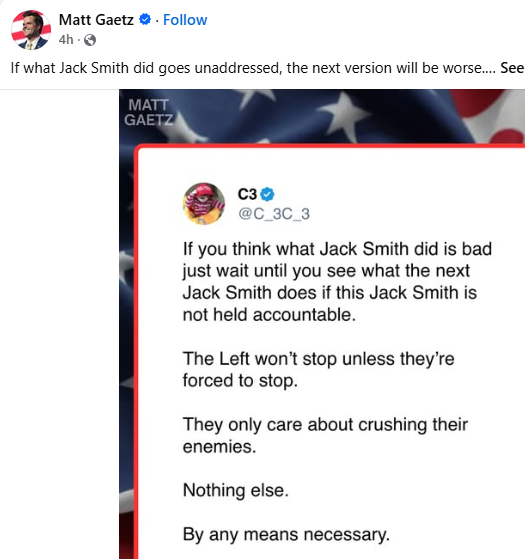 If I were sex criminal Matt Gaetz, this is exactly what I’d be flooding out on social media. But will it work?
What do clear-thinking Americans find more likely? a) Jack Smith hates Republicans and America too, or b) Jack Smith has spent his entire adult life honestly prosecuting the most high-level criminals domestically and abroad?
Weather Guard Lightning Tech

How CICNDT Qualifies Inspectors for Complex Blade Scans
Jeremy Heinks, founder and CEO of CICNDT, joins to discuss the inspector shortage, Level III oversight, blade samples, drone thermal limits, and IEC updates.
The Uptime Wind Energy Podcast is brought to you by Weather Guard Lightning Tech, creators of the StrikeTape Ultra LPS retrofit. Subscribe to Uptime’s Substack newsletter. And check out Rosemary’s “Engineering with Rosie” Youtube channel. Have a question we can answer on the show? Email us!



-
Climate Change1 year ago
Guest post: Why China is still building new coal – and when it might stop
-

 Greenhouse Gases2 years ago
嘉宾来稿:满足中国增长的用电需求 光伏加储能“比新建煤电更实惠”
-
Greenhouse Gases1 year ago
Guest post: Why China is still building new coal – and when it might stop
-

 Climate Change2 years ago
嘉宾来稿:满足中国增长的用电需求 光伏加储能“比新建煤电更实惠”
-

 Renewable Energy12 months ago
Sending Progressive Philanthropist George Soros to Prison?
-
Climate Change2 years ago
Bill Discounting Climate Change in Florida’s Energy Policy Awaits DeSantis’ Approval
-
Greenhouse Gases1 year ago
嘉宾来稿:探究火山喷发如何影响气候预测
-

 Climate Change2 years ago
Analysis: China’s CO2 falls 1% in Q2 2024 in first quarterly drop since Covid-19