Connect with us

Published

on

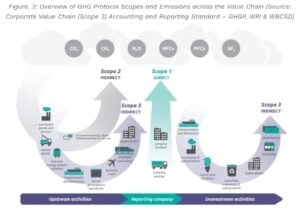
Not only do we provide you with your supplier’s carbon emissions data, we are now in the beta stage of providing specific climate action items that can mitigate your supplier’s carbon emissions. Each recommendation sheet expresses your supplier’s carbon emissions for each of the categories we have access to as well as tailored actions to reduce emissions. For a detailed understanding of these categories, including scope 1, scope 2, and scope 3 emissions, refer to our post attached here:

Let’s focus on each of these scopes and the actions that your supplier can take to reduce their emissions. 


Scope 1:

  • Because this scope encompasses direct emissions, companies often have more control over transitioning these sectors to becoming more carbon efficient and less reliant on fossil fuels
  • These are often only a small aspect of a company’s carbon footprint but are relatively easily to mitigate 

  • A big aspect of mitigating scope 1 emissions is investing in newer, cleaner technologies like replacing heating and cooling systems and transitioning to electric vehicles


Scope 2:

  • Scope 2 emissions stem from the consumption of purchased energy by a company, so to mitigate these emissions companies simply purchase energy that produces minimal carbon emissions 

  • Power Purchase Agreements (PPAs) and Renewable Energy Certificates (RECs) are popular means to minimize scope 2 emissions 

    • PPAs: contracts between a company and a renewable energy provider in which a company agrees to purchase a specified amount of renewable energy over a set period, this provides a stable, often cost-effective, and long-term source of renewable energy to the company

    • RECs: certificates bought by a company to support a renewable energy project even if their energy is not necessarily from that source, similar to an offset

Scope 3:

  • Scope 3 often accounts for the vast majority of a company’s carbon footprint because these encompass all emissions from the value chain 

  • Because these emissions span so many different aspects of a company, most actions taken to mitigate these emissions are focused on promoting sustainability and climate-conscious choices within the company

    • Business travel and employee commute are aspects of scope 3 emissions, so choosing climate conscious options for travel (like electric vehicles) or minimizing travel (supporting remote work) lessens these emissions

    • Purchase, transportation, distribution, and disposal of goods and services accounts for a large aspect of scope 3 emissions and these can be minimized through incorporating sustainability and efficiency into all aspects of the supply chain 


Your suppliers should be disclosing their carbon emissions data and participating in initiatives that affirm their commitment to mitigating their carbon footprint as well as taking active steps towards lessening their emissions impact. 


Minimizing carbon emissions should be a priority in all of your supplier’s decisions. Now, you can demand it.

Continue Reading

Carbon Footprint

The U.S. EV Supply Chain Race: Where Surge Battery Metals Fits in the National Critical Minerals Strategy

Published

on

NILI - Electric Vehicles USA - Surge Battery Metals

Disseminated on behalf of Surge Battery Metals Inc.

lithium Price Analysis Today

Lithium prices trended upward today, primarily driven by supply-side tightening measures. The market continues to react to Zimbabwe’s recent suspension of concentrate exports and the revocation of 27 mining permits in China’s Jiangxi province, which have restricted raw material availability. Additionally, short-term demand is being bolstered by battery manufacturers rushing to restock inventories ahead of impending export rebate reductions in April, effectively offsetting bearish sentiment from slower EV sales data.


Electric vehicles (EVs) are central to the global shift away from fossil fuels. EV sales continue to rise each year. Analysts estimate that global lithium demand may grow to over 2.8 million tonnes of lithium carbonate equivalent (LCE) by 2030 as EVs and grid storage expand.

Battery energy storage systems (BESS) are another major source of demand. Shipments of stationary storage batteries are forecast to grow around 50% in 2025, driven by renewable energy and grid needs.

Growth in both EVs and energy storage is pushing demand for lithium and other battery minerals higher. Many forecasts suggest lithium demand could more than triple by 2030 versus today’s levels.

Lithium demand vs supply
Source: Surge Battery Metals

These trends are visible in price movements. Lithium prices have risen sharply in recent years. They might hit high levels if demand keeps exceeding supply growth.

Despite some volatility in the market, long-term demand remains robust because EVs and BESS use large amounts of lithium per unit. Cell chemistries like lithium-iron-phosphate (LFP) are expanding, further increasing lithium use across applications.

Tight Supply, Rising Risk: The Global Lithium Bottleneck

Global lithium supply is strained by rapid growth in demand. Supply forecasts have shifted from a modest surplus in 2024 to potential deficits as early as the mid-2020s.

BESS is a key factor. It could account for 30–36% of total lithium demand by 2030, according to major banking forecasts.

lithium demand by use 2030

At the same time, much of the world’s lithium refining and battery production capacity remains concentrated outside the U.S., especially in China. This concentration raises supply chain risks for North American manufacturers and automakers.

Domestic supply development has not kept pace with demand. Historically, the U.S. produced only a small fraction of the total lithium supply, even though it sits on large known lithium resources.

These factors have pushed companies and governments to speed up new projects and improve local production skills.

Federal Strategy: Building a Domestic Supply Chain

The U.S. government has passed several policies to strengthen the EV supply chain and domestic critical minerals base. Key federal actions include incentives, regulations, and strategic planning. These efforts involve several agencies, like the Department of Energy (DOE) and the Department of Defense (DoD).

Programs like the Inflation Reduction Act (IRA) provide tax incentives for EV manufacturing and battery production. These incentives emphasize sourcing from the U.S. and allied countries to reduce reliance on foreign supply chains. The DOE also funds energy storage research, materials processing, and efforts to scale domestic industrial capacity.

The FY26 National Defense Authorization Act (NDAA) includes provisions that support critical materials production and supply chain resilience in the defense sector. It broadens the Defense Industrial Base Fund’s authority. Now, it includes support for domestic production and modernization projects, including batteries and related infrastructure. 

The law sets rules on buying certain key minerals and advanced batteries from non-allied foreign sources. Over a phased timeline, DoD must avoid sourcing these materials from “foreign entities of concern,” such as those linked to China and other designated countries. They must expedite the qualification of compliant domestic and allied suppliers.

The NDAA also requires the Department of Defense to assess weaknesses in key material supply chains. It promotes programs for stockpiling, recycling, and reuse to reduce reliance on imports. These federal actions support U.S. projects that provide lithium, nickel, and other battery materials. They boost confidence for investors and the industry in the domestic supply chain.

Inside the Battery Metals Economy

Lithium’s role in the EV supply chain is clear: it is a core input for lithium-ion batteries. Long-term demand forecasts for lithium reflect this central position. Some market forecasts project global lithium demand to rise to 3–4 million tonnes LCE by 2030, depending on EV market growth assumptions.

Price forecasts vary but generally reflect tightening supply. Some analysts estimate lithium prices could continue to rise if supply fails to match demand growth. Lithium carbonate spot prices recently jumped to $24,086, a 191%+ increase from July 2025. 

lithium price

Nickel and cobalt remain important for certain battery chemistries, even as some EV makers move toward low-cobalt or cobalt-free chemistries. All these metals are part of the broader battery metals ecosystem that underpins the EV supply chain.

Beyond EVs, electric grid storage, industrial batteries, and portable electronics all contribute to long-term demand. Even conservative estimates show sustained growth in battery-grade materials over the coming decade.

Nevada’s Lithium Anchor: NILI and Its Role in the U.S. Supply Chain

Surge Battery Metals (TSX-V: NILI; OTCQX: NILIF; FRA: DJ5) stands out as a lithium exploration and development company focused on the Nevada North Lithium Project (NNLP).

NNLP hosts one of the highest-grade lithium clay resources in the United States. Its inferred resource of approximately 11.2 million tonnes of LCE at an average grade above 3,000 ppm positions it well above many domestic peers.

Surge lithium clay comparison

This high quality makes the resource attractive for future development. A Preliminary Economic Assessment (PEA) indicates strong economics. It shows a net present value of about US$9.2 billion and an internal rate of return of over 22%. This reflects the project’s strong potential.

The project’s operating cost metrics are also competitive, with estimated costs significantly lower than those of many North American rivals.

Surge-NNLP-Preliminary-Economic-Assessment-PEA

NNLP’s shallow geology and proximity to infrastructure help keep capital and processing costs down. The project sits near power lines, highways, and existing mining hubs in Nevada.

Recent drilling programs continue to show promising results. In 2025, the focus was on infill drilling and core sampling. These efforts aim to upgrade resources and prepare for prefeasibility work. Results show thick lithium clay layers, which boost confidence in the project’s size and consistency.

More recently, Surge reported additional strong drill results from Nevada North. The company announced a 31-meter intercept grading 4,196 ppm lithium from surface in a 640-meter step-out hole to the southeast. This step-out extends mineralization about 640 meters beyond the current resource footprint, confirming the strong continuity of high-grade lithium. 

The intercept grade is well above the project’s current average resource grade of about 3,000 ppm lithium. Near-surface mineralization also reduces stripping requirements and supports efficient future development. These results strengthen the project’s scale and reinforce its role as a growing domestic lithium source.

Surge Battery Metals North Nevada drilling results
Source: Surge Battery Metals

Surge has also secured strategic partnerships. A joint venture with Evolution Mining will speed up exploration and development. This partnership will increase land holdings by over 21,000 acres of promising land.

The company has been recognized for performance in the market, including being named a Top 50 performer on the TSX Venture Exchange in 2024.

Surge Battery Metals plans to improve metallurgical testing for lithium chemicals with over 99% purity. This will help supply battery makers and energy storage companies with high-quality products.

Its management team brings both industry and policy experience, including executives with track records in lithium development and the energy sectors.

Live Nickel Spot Price

Unit: USD/kg

Loading Chart…

The New Energy Reality: Demand, Security, and Strategic Supply

Surge Battery Metals’ project aligns well with broader U.S. efforts to strengthen domestic supply chains for critical battery metals. With rising demand for lithium, NNLP provides a high-quality, near-surface resource. This could greatly benefit the EV and energy storage battery markets.

Domestic projects, such as NNLP, reduce reliance on imports. They can also gain from federal incentives that promote U.S.-based production and processing. This strategic fit makes the project more relevant to policymakers, investors, and supply chain planners.

For policymakers, projects such as NNLP help diversify sources of critical minerals and build resilience against global market disruptions. For investors, strong project economics and top-quality resources offer a way to create value as market demand increases.

The U.S. EV supply chain race centers on securing reliable sources of battery metals. Lithium remains at the heart of this transition, driven by both EV and energy storage demand. Strong long-term demand forecasts and tighter supply show the need for new domestic sources.

The federal strategy backs this shift with policy incentives, funding, and programs. These focus on resilient, locally sourced materials. This environment favors projects that are high quality, well-positioned, and strategically relevant.

Surge Battery Metals and its Nevada North Lithium Project represent one such opportunity within the U.S. critical minerals strategy. NILI has solid resources, low costs, and important partnerships. This enables the company to strengthen the U.S. supply chain for lithium and other battery metals. This alignment shows how market forces and policy priorities shape the future of EVs, energy storage, and clean energy infrastructure.

DISCLAIMER 

New Era Publishing Inc. and/or CarbonCredits.com (“We” or “Us”) are not securities dealers or brokers, investment advisers, or financial advisers, and you should not rely on the information herein as investment advice. Surge Battery Metals Inc. (“Company”) made a one-time payment of $75,000 to provide marketing services for a term of three months. None of the owners, members, directors, or employees of New Era Publishing Inc. and/or CarbonCredits.com currently hold, or have any beneficial ownership in, any shares, stocks, or options of the companies mentioned.

This article is informational only and is solely for use by prospective investors in determining whether to seek additional information. It does not constitute an offer to sell or a solicitation of an offer to buy any securities. Examples that we provide of share price increases pertaining to a particular issuer from one referenced date to another represent arbitrarily chosen time periods and are no indication whatsoever of future stock prices for that issuer and are of no predictive value.

Our stock profiles are intended to highlight certain companies for your further investigation; they are not stock recommendations or an offer or sale of the referenced securities. The securities issued by the companies we profile should be considered high-risk; if you do invest despite these warnings, you may lose your entire investment. Please do your own research before investing, including reviewing the companies’ SEDAR+ and SEC filings, press releases, and risk disclosures.

It is our policy that the information contained in this profile was provided by the company, extracted from SEDAR+ and SEC filings, company websites, and other publicly available sources. We believe the sources and information are accurate and reliable, but we cannot guarantee them.


CAUTIONARY STATEMENT AND FORWARD-LOOKING INFORMATION

Certain statements contained in this news release may constitute “forward-looking information” within the meaning of applicable securities laws. Forward-looking information generally can be identified by words such as “anticipate,” “expect,” “estimate,” “forecast,” “plan,” and similar expressions suggesting future outcomes or events. Forward-looking information is based on current expectations of management; however, it is subject to known and unknown risks, uncertainties, and other factors that may cause actual results to differ materially from those anticipated.

These factors include, without limitation, statements relating to the Company’s exploration and development plans, the potential of its mineral projects, financing activities, regulatory approvals, market conditions, and future objectives. Forward-looking information involves numerous risks and uncertainties and actual results might differ materially from results suggested in any forward-looking information. These risks and uncertainties include, among other things, market volatility, the state of financial markets for the Company’s securities, fluctuations in commodity prices, operational challenges, and changes in business plans.

Forward-looking information is based on several key expectations and assumptions, including, without limitation, that the Company will continue with its stated business objectives and will be able to raise additional capital as required. Although management of the Company has attempted to identify important factors that could cause actual results to differ materially, there may be other factors that cause results not to be as anticipated, estimated, or intended.

There can be no assurance that such forward-looking information will prove to be accurate, as actual results and future events could differ materially. Accordingly, readers should not place undue reliance on forward-looking information. Additional information about risks and uncertainties is contained in the Company’s management’s discussion and analysis and annual information form for the year ended December 31, 2025, copies of which are available on SEDAR+ at www.sedarplus.ca.

The forward-looking information contained herein is expressly qualified in its entirety by this cautionary statement. Forward-looking information reflects management’s current beliefs and is based on information currently available to the Company. The forward-looking information is made as of the date of this news release, and the Company assumes no obligation to update or revise such information to reflect new events or circumstances except as may be required by applicable law.

Carboncredits.com receives compensation for this publication and has a business relationship with any company whose stock(s) is/are mentioned in this article.

Additional disclosure: This communication serves the sole purpose of adding value to the research process and is for information only. Please do your own due diligence. Every investment in securities mentioned in publications of carboncredits.com involves risks that could lead to a total loss of the invested capital.

Please read our Full RISKS and DISCLOSURE here.

Carboncredits.com receives compensation for this publication and has a business relationship with any company whose stock(s) is/are mentioned in this article.

Additional disclosure: This communication serves the sole purpose of adding value to the research process and is for information only. Please do your own due diligence. Every investment in securities mentioned in publications of carboncredits.com involves risks that could lead to a total loss of the invested capital.

Please read our Full RISKS and DISCLOSURE here.

The post The U.S. EV Supply Chain Race: Where Surge Battery Metals Fits in the National Critical Minerals Strategy appeared first on Carbon Credits.

Continue Reading

Carbon Footprint

Renewables Plus Storage Surge as Battery Costs Drop Record Low, BNEF Reports

Published

on

Battery energy storage has entered a new era. Costs have fallen to historic lows, and deployments are accelerating across major markets. According to BloombergNEF’s (BNEF) Levelized Cost of Electricity 2026 report, the economics of grid storage shifted dramatically in 2025 — even as other clean energy technologies became more expensive.

  • The global benchmark cost for a four-hour battery storage project dropped 27% year-on-year to $78 per megawatt-hour (MWh) in 2025.

That marks the lowest level since BNEF began tracking the data in 2009. As a result, batteries are now reshaping how power systems balance renewable energy and meet rising electricity demand.

At the same time, solar and wind projects faced cost pressures. Supply chain constraints, weaker resource quality in some regions, and policy reforms in mainland China pushed up benchmark costs. However, despite these short-term headwinds, BNEF expects long-term clean energy costs to continue declining through 2035.

BATTERY COST
Source: BNEF

Battery Storage Breaks Records While Solar and Wind Stall

In 2025, battery storage clearly stood out. The $78/MWh benchmark for a four-hour system reflected a steep and rapid decline. Lower battery pack prices, stronger competition among manufacturers, and better system design all helped drive the drop.

By contrast, solar and wind moved in the opposite direction. The global benchmark cost for a fixed-axis solar farm rose 6%, reaching $39/MWh. Onshore wind increased to $40/MWh. Offshore wind climbed sharply to $100/MWh due to tight supply chains and financing challenges.

Thermal power also became more expensive. The levelized cost of electricity (LCOE) for new combined cycle gas turbine (CCGT) plants jumped 16% to $102/MWh — the highest level recorded. Equipment price increases and strong demand for gas turbines, partly fueled by data center expansion, kept costs elevated. Coal plants also faced higher capital expenses.

Yet even with solar and wind costs rising in 2025, BNEF projects that innovation and scale will push prices down again over the next decade. By 2035, the firm expects:

  • Solar LCOE to fall 30%
  • Battery storage to decline 25%
  • Onshore wind to drop 23%
  • Offshore wind to decrease 20%

These projections suggest the current cost increases are temporary rather than structural.

China’s Cost Advantage 

Wind energy told a more mixed story.

Mainland China retained a cost advantage. However, projects built in lower wind-speed regions pushed up the global benchmark. Onshore wind projects outside mainland China saw a 4% cost decline, but the global average rose 2% due to Chinese market dynamics.

Offshore wind faced deeper challenges. Supply chain bottlenecks increased turbine and installation costs across major markets. In the United Kingdom, recently financed offshore wind projects now cost 69% more than they did five years ago. BNEF expects offshore wind costs to remain elevated until at least 2030.

Still, in the United States, wind power regained its position as the cheapest source of new electricity generation in 2025. Rising gas turbine costs pushed wind ahead of gas for the first time since 2023.

EV Overcapacity Slashes Battery Prices

One major factor behind the storage cost collapse is manufacturing overcapacity in the electric vehicle (EV) sector.

China’s lithium-ion battery production capacity surpassed 2 terawatt-hours in 2024. That was about 60% higher than total battery demand. As a result, manufacturers competed aggressively on price, which benefited grid-scale storage buyers.

Battery pack prices for EVs fell 8% in 2025 to a record low of $108 per kilowatt-hour, according to BNEF’s December survey. Lower pack prices directly reduced the cost of large storage projects. Meanwhile, system-level improvements — including better integration and optimized engineering — improved performance and reduced overall project expenses.

According to Amar Vasdev, senior energy economics associate at BNEF and lead author of the report, manufacturing overcapacity and better system designs are transforming the economics of large energy storage projects. In six markets, the LCOE of a four-hour battery system has already dropped below $100/MWh.

That threshold is critical. At those levels, battery storage becomes highly competitive with fossil fuel peaking plants.

Lower Battery Costs Drive Renewables Plus Storage Boom Worldwide

Lower battery costs are accelerating hybrid renewable development. In 2025 alone, developers added 87 gigawatts of co-located solar and storage projects worldwide. These combined systems delivered electricity at an average cost of $57/MWh.

This model solves one of solar’s biggest challenges — intermittency. Batteries allow solar farms to store excess daytime generation and dispatch it later when demand peaks. As storage becomes cheaper, solar-plus-storage projects become more financially attractive and reliable.

BNEF expects annual global energy storage additions to reach 220 GW by 2035, growing at a compound annual rate of nearly 15%. If that projection holds, batteries will become central to grid balancing worldwide.

renewable global
Source: IEA

The U.S. Storage Boom Accelerates

The United States is emerging as a key growth engine for battery deployment.

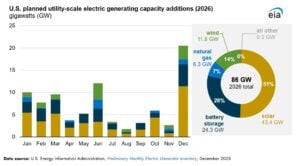
According to the February 2026 Electric Power Monthly report from the U.S. Energy Information Administration (EIA), 86 GW of new utility-scale capacity is expected to come online in 2026. Of that total, 26.3 GW will come from battery storage.

That represents the largest single-year capacity expansion in more than two decades. Solar and battery storage together account for nearly 79% of planned additions.

Texas has become a hotspot for battery development. As of July 2025, the state had 12.2 GW of storage capacity operating. Developers rushed projects online ahead of summer peak demand, including nearly 1 GWh brought online by esVolta across three projects.

California continues to lead nationally, with more than 12 GW of operational storage capacity. Projects such as the Rexford solar-plus-storage facility in Tulare County strengthened the state’s position as a grid storage pioneer.

US energy boom

Meanwhile, New England expanded its footprint with large-scale additions to the ISO New England grid. These projects demonstrate that battery storage is no longer confined to a few early-adopter markets.

Australia’s Breakout Year

Australia also delivered a major milestone in 2025. The country commissioned 4.9 GWh of utility-scale battery storage during the year — more than the combined total installed between 2017 and 2024.

In the fourth quarter alone, over 1,000 MW of new capacity came online. Large projects, including the 500 MW Liddell battery system in New South Wales, highlighted the rapid pace of expansion.

Australia’s experience shows how quickly storage can scale once policy support, market design, and financing align.

Data Centers Drive the “Race for Electrons”

A powerful new demand driver is reshaping electricity markets: data centers.

The rapid expansion of AI and cloud computing has triggered strong demand for reliable power. Gas turbine orders surged as operators sought firm capacity. This demand doubled U.S. turbine capital costs in just two years.

However, higher gas costs are improving the competitiveness of renewables and storage. In regions like California and parts of Texas, co-located solar and four-hour battery systems can already meet a significant share of data center demand at lower cost than new gas plants.

Grid interconnection queues and gas turbine supply constraints are also slowing fossil fuel projects. In contrast, solar and storage systems can often deploy more quickly.

data center AI

As Vasdev explained, the world is in a “race for electrons” to meet rising demand from electrification and data centers. In many markets, renewables are not only cheaper for new builds — they are now undercutting the operating costs of existing fossil fuel plants.

Solar beats new coal and gas across most Asia-Pacific markets. Wind is the lowest-cost new generation source in the U.S. and Canada. Solar consistently outcompetes fossil fuels in Southern Europe, while wind dominates in Northern Europe.

From Niche Technology to Grid Backbone

Battery storage has moved beyond its early-stage niche. It is now central to power system planning.

As storage costs fall, batteries strengthen renewable energy revenues, stabilize grids, and reduce reliance on fossil-fuel peaking plants. Instead of building new gas capacity for short-duration peaks, operators can increasingly rely on storage-led balancing.

BNEF’s annual LCOE report analyzed more than 800 recently financed projects across over 50 markets and 28 technologies. Its expanded coverage of the Middle East and Africa highlights how storage economics are improving globally, not just in mature markets.

The broader message is clear. While 2025 delivered mixed signals for clean power costs, battery storage emerged as the clear winner. Manufacturing overcapacity, technological learning, and intense competition have driven prices to record lows.

Looking ahead, continued cost declines could accelerate the global shift toward renewable-dominated grids supported by flexible storage. In that transition, batteries are no longer optional. They are becoming the backbone of a reliable, low-carbon electricity system.

The post Renewables Plus Storage Surge as Battery Costs Drop Record Low, BNEF Reports appeared first on Carbon Credits.

Continue Reading

Carbon Footprint

Mercedes-AMG PETRONAS Expands Carbon Removal Portfolio to Accelerate Net Zero Push

Published

on

The Mercedes-AMG PETRONAS F1 Team has stepped up its climate action strategy with a major expansion of its global carbon dioxide removal (CDR) portfolio. The team has added seven new projects across multiple carbon removal pathways, making it one of the most diverse portfolios in global sport.

This move is a long-term, multi-year investment designed to support high-integrity, science-backed climate solutions. While emissions reduction remains the top priority, the team recognizes that some emissions cannot be eliminated. That is where durable carbon removals come in.

The expansion marks another milestone in Mercedes’ broader Net Zero journey — one built on practical solutions, data transparency, and industry collaboration.

A Clear Net Zero Roadmap

Mercedes tracks its carbon footprint in two ways. First, it measures Race Team Control emissions (RTCe). These include Scope 1, Scope 2, and selected Scope 3 emissions that the team can influence directly. Second, it reports its total emissions across Scopes 1, 2, and 3.

Unlike many companies that only focus on direct emissions, Mercedes extends its control boundary to include upstream transport, waste, fuel-related activities, business travel, employee commuting, and energy use. This broader approach aligns with Formula 1’s 2030 Net Zero commitment.

The team has set two major targets:

  • Achieve Race Team Control Net Zero by 2030
  • Reach Full Net Zero across all scopes by 2040

For its 2030 goal, Mercedes plans to cut 75% of RTC emissions compared to its 2022 baseline. The remaining 25% will be addressed through high-quality carbon removals, following the Oxford Offsetting Principles.

Progress so far is significant. By 2024, the team had already reduced its Race Team Control emissions by 35% compared to 2022.

scope emissions mercedes
Source: Mercedes

Where the Emissions Cuts Came From

The 35% reduction came from targeted operational changes. During the European race season, 98% of logistics used HVO100 biofuel. This low-carbon fuel helped slash transport emissions. Meanwhile, 68% of aviation emissions were addressed through Sustainable Aviation Fuel certificates (SAFc).

At its Brackley factory in the UK, Mercedes reduced gas consumption and improved energy efficiency. The team also continued electrifying its company vehicle fleet.

However, not everything went smoothly. In 2024, an F-gas leak at the factory temporarily increased Scope 1 emissions. F-gases have high global warming potential, so even small leaks can have an outsized impact. While the team has already transitioned to lower-impact refrigerants where possible, some cooling systems still rely on high-impact gases. Mercedes has tightened monitoring systems and plans to shift to better alternatives as soon as viable options become available.

Despite this setback, the overall emissions trend remains downward. The team now aims to fully eliminate Scope 1 and 2 emissions by 2026, with any small residual amounts neutralized through removals.

mercedes race car emissions
Source: Mercedes

Building a Long-Term Carbon Removal Strategy

Even with aggressive cuts, some emissions remain hard to eliminate — especially across global supply chains. Purchased goods and services represent a large share of Scope 3 emissions. These are complex and often outside direct control.

That is why Mercedes is investing in durable, verifiable, and scalable carbon removals.

MERCEDEs CARBO REMOVALS
Source: Mercedes

In total, the team is investing in roughly 18,900 tonnes of CO2 equivalent across nature-based, hybrid, and engineered removal projects. These investments support the 2030 Race Team Control Net Zero goal.

Importantly, the strategy follows the Oxford Offsetting Principles. This means prioritizing permanent removals and gradually shifting from short-term nature-based offsets toward long-term engineered solutions.

A Diverse Portfolio Across Technologies

To reduce risk and build resilience, Mercedes has spread its investments across several technologies and geographies. The portfolio now spans:

  • Direct Air Capture
  • Biochar, Biomass Storage
  • Bioenergy with Carbon Capture and Storage (BECCS)
  • Ocean Alkalinity Enhancement
  • Enhanced Rock Weathering

Frontier: One key partner is Frontier, supporting durable removal technologies. Through this agreement, Mercedes backs solutions such as direct air capture and enhanced weathering. These technologies aim to store carbon for more than 1,000 years and eventually reduce costs below $100 per tonne. The team expects to begin receiving credits from Frontier-backed projects as early as 2027.

Blaston Farm: In the UK, Mercedes works with Blaston Farm near Silverstone to support regenerative agriculture. This project removes carbon while restoring soil health and boosting biodiversity. The team signed a three-year agreement and used 2,000 tonnes of removals from the project against its 2024 footprint. Advanced soil monitoring combines direct sampling with AI-driven image analysis, improving both accuracy and scalability.

Chestnut Carbon: In the US, Mercedes partnered with Chestnut Carbon to restore degraded agricultural land in the southeastern region. The first project will convert 200 hectares into biodiverse forests by planting more than 260,000 native trees. Since 2022, Chestnut Carbon has planted over 17 million trees across 30,000 acres. The collaboration is expected to deliver 1,000 to 1,500 tonnes of carbon removals annually starting in 2027.

The broader portfolio also includes projects in Brazil, Canada, Denmark, and India. This geographic spread reflects the team’s goal to create impact in regions connected to the Formula One race calendar.

All projects are curated and verified by CUR8, a carbon removal marketplace that assesses durability, transparency, and methodology. This adds an extra layer of credibility to the portfolio.

Collaboration Beyond the Track

Mercedes understands it cannot solve climate challenges alone. The team actively collaborates within and beyond motorsport.

It participates in the F1 ESG Working Group, sharing best practices across the grid. Internally, its Sustainability Working Group connects team partners to exchange ideas and tackle shared challenges.

Notably, Mercedes was the first motorsport team to sign The Climate Pledge, committing to Net Zero across total emissions by 2040.

Team partners such as Signify, UBS, and Nasdaq support high-integrity climate solutions as well. Meanwhile, companies like Meta and Microsoft have played a major role in scaling the carbon removals industry, helping create demand for early-stage technologies.

Speaking at Economist Impact’s Sustainability Week, Head of Sustainability Alice Ashpitel emphasized that emissions reduction remains the priority. However, she stressed that high-quality removals are essential for dealing with residual emissions. By investing early across different technologies and regions, the team aims to help scale durable climate solutions while delivering benefits to communities and ecosystems.

Engineering Change On and Off the Track

Formula One has committed to Net Zero by 2030. As one of the sport’s most prominent teams, Mercedes is positioning itself at the forefront of that transition.

The team’s approach combines aggressive emission reductions, early investment in permanent carbon removal technologies, and strong governance. Instead of relying on short-term offsets, it is helping build a long-term carbon removal market capable of delivering climate impact at scale.

This strategy reflects the same engineering mindset that drives success on the track: test, refine, optimize, and scale.

By cutting emissions where it has control and investing in durable removals where it does not, Mercedes is shaping a credible path toward Net Zero. The goal is not just to meet targets but to help raise standards across motorsport and beyond.

In a sport defined by speed and precision, Mercedes is proving that climate leadership also requires bold action and long-term thinking.

The post Mercedes-AMG PETRONAS Expands Carbon Removal Portfolio to Accelerate Net Zero Push appeared first on Carbon Credits.

Continue Reading

Trending

Copyright © 2022 BreakingClimateChange.com