Connect with us

Published

on

WA is falling behind on pollution limits

Western Australia often likes to go its own way. Sadly, when it comes to carbon pollution WA has been stubbornly bucking the national trend – but not in a good way. While the rest of the country has been reducing emissions, WA’s have been rising, largely thanks to the gas industry.

It’s true that some things are a bit different in the West and the decarbonisation pathway for WA will have its own twists and turns. When it comes to electricity, WA will soon be the first state to fully exit from coal-fired power generation, but its reliance on another fossil fuel – gas, means it has had a remarkably slow build out of renewable energy.

Which means the transition is lagging behind.

WA currently uses as much gas as the rest of the Australian states combined. But most of it is not for households. It’s for electricity generation, industry, mining, and the biggest user of all is the gas export industry.
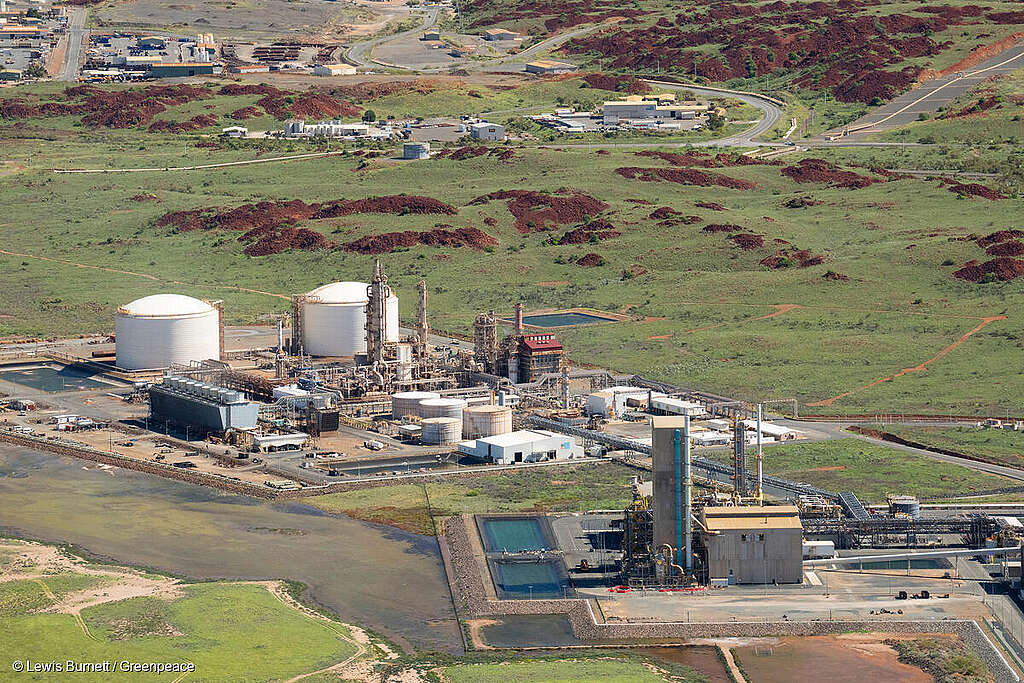
Aerial view of the Yara Pilbara operated liquid ammonia plant on the Burrup Peninsula. © Lewis Burnett / Greenpeace

Our report shows that WA can power its industry with clean energy – not gas.

We are all too familiar with the tired arguments of the gas industry who want to keep WA hooked on gas, who claim that even more is needed to keep WA running. Because of lobbying from Big Gas, WA has often argued that the state deserves special leeway in its emission reduction efforts due to its gas-reliant heavy industry.

Big Gas uses the same arguments to justify drilling for new gas – even where that will involve massive new emissions, and in the case of Woodside’s Browse project, drilling 50 gas wells around Scott Reef. They claim WA needs these new environmentally destructive projects to maintain our prosperity.

Well, now the evidence is in. We have run the numbers and modelled an achievable pathway that clearly shows that no new gas is needed in WA to keep our economy growing through the energy transition.

Our new report Power Shift: WA’s Electrified Future written in collaboration with Springmount Advisory, clearly demonstrates that rapid emissions reduction is not only possible in WA but is in the economic interests of the West Australian public. 

The report breaks down the path Western Australia needs to take across its economy to drive down emissions in line with limiting warming to 1.5 degrees, and to become a renewable energy and green export powerhouse. It does so with a detailed breakdown of key timelines and dates for the phase out of fossil fuels that has not been seen before.
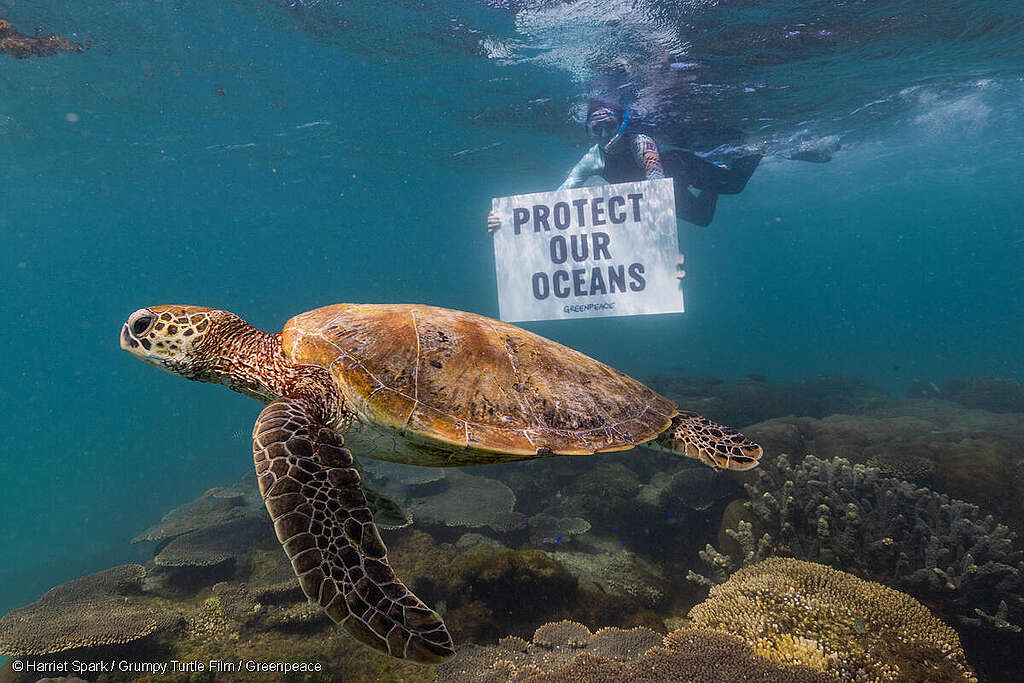
Banner reading “Protect Our Oceans” is displayed near a turtle during Greenpeace Rainbow Warrior’s documentation trip off Exmouth, Western Australia. © Harriet Spark / Grumpy Turtle

It is time for WA to choose its future

But key decisions will need to be made – to be clear, this is no small task.

WA currently lacks the sufficient supporting policies to encourage industry to decarbonise, attract investment and support workers through the transition. Australia needs WA to be leading the charge to a renewable energy future if we are to meet our national emissions reduction commitments and if we are to maintain our country’s economic status through exportable green commodities.

Some big mining operations are already making the move to renewables due to their cost effectiveness, but for many years Governments of all stripes have subsidised and incentivised fossil fuel use, meaning many industries are stuck with the status quo. Governments now have a role in creating a new set of policies which reward reducing pollution.

This report comprehensively breaks down the transition pathway WA can take to make that future possible. It covers energy, industry, transport and agriculture, highlighting the challenges and opportunities across each, and providing policy level solutions to achieve these ambitions.
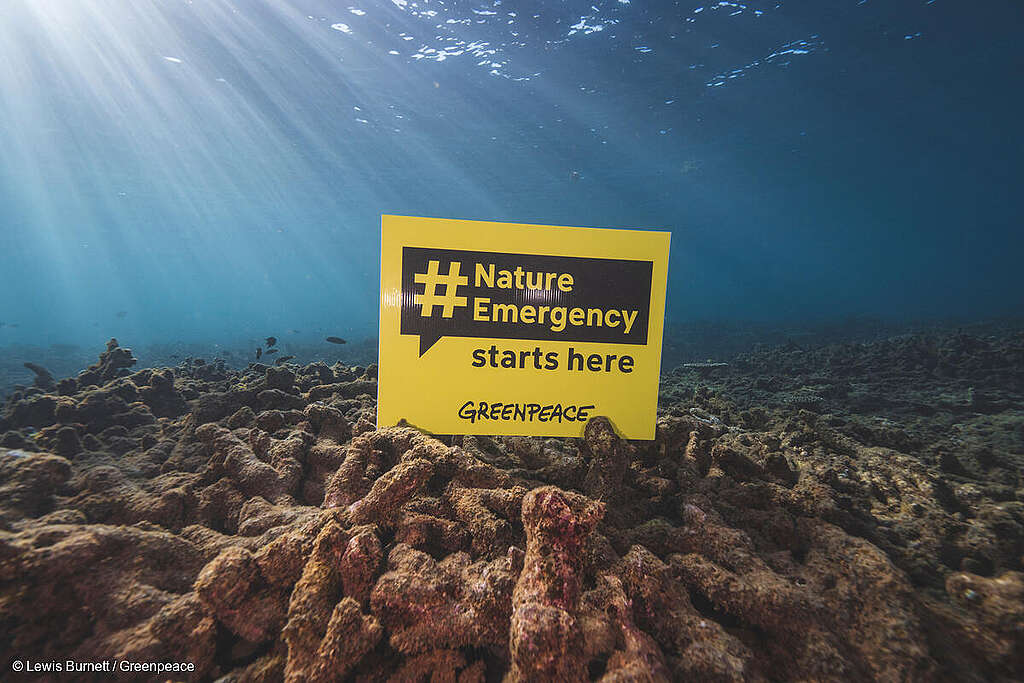
A Greenpeace sign placed on a dead coral reef in Ningaloo Marine Park. © Lewis Burnett / Greenpeace

Key Findings

Critically, this modelling demonstrates that WA does not need any new gas to keep the lights on and grow the economy.

The modelling in this report demonstrates that:

  1. There is a fast and achievable path for WA to move to clean energy, protecting our climate and nature, while keeping the lights on and growing the economy
  2. WA can be the heart of a strong Australian renewable energy economy 
  3. WA doesn’t need more gas (including Woodside’s Browse gas field which lies directly under the pristine Scott Reef).

Send a message to WA’s Leaders

Please read the report, share it with your friends, your MP and sign our petition calling on Premier Roger Cook to put WA on a clean, fair and renewable path.

A Pathway for WA on Emissions Reductions is Possible!

Continue Reading

Climate Change

On the Farm, the Hidden Climate Cost of America’s Broken Health Care System

Published

on

American farmers are drowning in health insurance costs, while their German counterparts never worry about medical bills. The difference may help determine which country’s small farms are better prepared for a changing climate.

Samantha Kemnah looked out the foggy window of her home in New Berlin, New York, at the 150-acre dairy farm she and her husband, Chris, bought last year. This winter, an unprecedented cold front brought snowstorms and ice to the region.

On the Farm, the Hidden Climate Cost of the Broken U.S. Health Care System

Continue Reading

Climate Change

A Little-Used Maneuver Could Mean More Drilling and Mining in Southern Utah’s Redrock Country

Published

on

Two Utah Congress members have introduced a resolution that could end protections for Grand Staircase-Escalante National Monument. Conservation groups worry similar maneuvers on other federal lands will follow.

Lawmakers from Utah have commandeered an obscure law to unravel protections for the Grand Staircase-Escalante National Monument, potentially delivering on a Trump administration goal of undoing protections for public conservation lands across the country.

A Little-Used Maneuver Could Mean More Drilling and Mining in Southern Utah’s Redrock Country

Continue Reading

Climate Change

Heatwaves driving recent ‘surge’ in compound drought and heat extremes

Published

on

Drought and heatwaves occurring together – known as “compound” events – have “surged” across the world since the early 2000s, a new study shows. 

Compound drought and heat events (CDHEs) can have devastating effects, creating the ideal conditions for intense wildfires, such as Australia’s “Black Summer” of 2019-20 where bushfires burned 24m hectares and killed 33 people.

The research, published in Science Advances, finds that the increase in CDHEs is predominantly being driven by events that start with a heatwave.

The global area affected by such “heatwave-led” compound events has more than doubled between 1980-2001 and 2002-23, the study says.

The rapid increase in these events over the last 23 years cannot be explained solely by global warming, the authors note.

Since the late 1990s, feedbacks between the land and the atmosphere have become stronger, making heatwaves more likely to trigger drought conditions, they explain.

One of the study authors tells Carbon Brief that societies must pay greater attention to compound events, which can “cause severe impacts on ecosystems, agriculture and society”.

Compound events

CDHEs are extreme weather events where drought and heatwave conditions occur simultaneously – or shortly after each other – in the same region.

These events are often triggered by large-scale weather patterns, such as “blocking” highs, which can produce “prolonged” hot and dry conditions, according to the study.

Prof Sang-Wook Yeh is one of the study authors and a professor at the Ewha Womans University in South Korea. He tells Carbon Brief:

“When heatwaves and droughts occur together, the two hazards reinforce each other through land-atmosphere interactions. This amplifies surface heating and soil moisture deficits, making compound events more intense and damaging than single hazards.”

CDHEs can begin with either a heatwave or a drought.

The sequence of these extremes is important, the study says, as they have different drivers and impacts.

For example, in a CDHE where the heatwave was the precursor, increased direct sunshine causes more moisture loss from soils and plants, leading to a drought.

Conversely, in an event where the drought was the precursor, the lack of soil moisture means that less of the sun’s energy goes into evaporation and more goes into warming the Earth’s surface. This produces favourable conditions for heatwaves.

The study shows that the majority of CDHEs globally start out as a drought.

In recent years, there has been increasing focus on these events due to the devastating impact they have on agriculture, ecosystems and public health.

In Russia in the summer of 2010, a compound drought-heatwave event – and the associated wildfires – caused the death of nearly 55,000 people, the study notes.

Saint Basil's Cathedral, on Red Square, in Moscow, was affected by smog during the fires in Russia in the summer of 2010.
Saint Basil’s Cathedral, on Red Square, in Moscow, was affected by smog during the fires in Russia in the summer of 2010. Credit: ZUMA Press, Inc. / Alamy Stock Photo

The record-breaking Pacific north-west “heat dome” in 2021 triggered extreme drought conditions that caused “significant declines” in wheat yields, as well as in barley, canola and fruit production in British Columbia and Alberta, Canada, says the study.

Increasing events

To assess how CDHEs are changing, the researchers use daily reanalysis data to identify droughts and heatwaves events. (Reanalysis data combines past observations with climate models to create a historical climate record.) Then, using an algorithm, they analyse how these events overlap in both time and space.

The study covers the period from 1980 to 2023 and the world’s land surface, excluding polar regions where CDHEs are rare.

The research finds that the area of land affected by CDHEs has “increased substantially” since the early 2000s.

Heatwave-led events have been the main contributor to this increase, the study says, with their spatial extent rising 110% between 1980-2001 and 2002-23, compared to a 59% increase for drought-led events.

The map below shows the global distribution of CDHEs over 1980-2023. The charts show the percentage of the land surface affected by a heatwave-led CDHE (red) or a drought-led CDHE (yellow) in a given year (left) and relative increase in each CDHE type (right).

The study finds that CDHEs have occurred most frequently in northern South America, the southern US, eastern Europe, central Africa and south Asia.

Charts showing spatial and temporal occurrences over study period
Spatial and temporal occurrence of compound drought and heatwave events over the study period from 1980 to 2023. The map (top) shows CDHEs around the world, with darker colours indicating higher frequency of occurrence. The chart in the bottom left shows how much land surface was affected by a compound event in a given year, where red accounts for heatwave-led events, and yellow, drought-led events. The chart in the bottom right shows the relative increase of each CDHE type in 2002-23 compared with 1980-2001. Source: Kim et al. (2026)

Threshold passed

The authors explain that the increase in heatwave-led CDHEs is related to rising global temperatures, but that this does not tell the whole story.

In the earlier 22-year period of 1980-2001, the study finds that the spatial extent of heatwave-led CDHEs rises by 1.6% per 1C of global temperature rise. For the more-recent period of 2022-23, this increases “nearly eightfold” to 13.1%.

The change suggests that the rapid increase in the heatwave-led CDHEs occurred after the global average temperature “surpasse[d] a certain temperature threshold”, the paper says.

This threshold is an absolute global average temperature of 14.3C, the authors estimate (based on an 11-year average), which the world passed around the year 2000.

Investigating the recent surge in heatwave-leading CDHEs further, the researchers find a “regime shift” in land-atmosphere dynamics “toward a persistently intensified state after the late 1990s”.

In other words, the way that drier soils drive higher surface temperatures, and vice versa, is becoming stronger, resulting in more heatwave-led compound events.

Daily data

The research has some advantages over other previous studies, Yeh says. For instance, the new work uses daily estimations of CDHEs, compared to monthly data used in past research. This is “important for capturing the detailed occurrence” of these events, says Yeh.

He adds that another advantage of their study is that it distinguishes the sequence of droughts and heatwaves, which allows them to “better understand the differences” in the characteristics of CDHEs.

Dr Meryem Tanarhte is a climate scientist at the University Hassan II in Morocco, and Dr Ruth Cerezo Mota is a climatologist and a researcher at the National Autonomous University of Mexico. Both scientists, who were not involved in the study, agree that the daily estimations give a clearer picture of how CDHEs are changing.

Cerezo-Mota adds that another major contribution of the study is its global focus. She tells Carbon Brief that in some regions, such as Mexico and Africa, there is a lack of studies on CDHEs:

“Not because the events do not occur, but perhaps because [these regions] do not have all the data or the expertise to do so.”

However, she notes that the reanalysis data used by the study does have limitations with how it represents rainfall in some parts of the world.

Compound impacts

The study notes that if CDHEs continue to intensify – particularly events where heatwaves are the precursors – they could drive declining crop productivity, increased wildfire frequency and severe public health crises.

These impacts could be “much more rapid and severe as global warming continues”, Yeh tells Carbon Brief.

Tanarhte notes that these events can be forecasted up to 10 days ahead in many regions. Furthermore, she says, the strongest impacts can be prevented “through preparedness and adaptation”, including through “water management for agriculture, heatwave mitigation measures and wildfire mitigation”.

The study recommends reassessing current risk management strategies for these compound events. It also suggests incorporating the sequences of drought and heatwaves into compound event analysis frameworks “to enhance climate risk management”.

Cerezo-Mota says that it is clear that the world needs to be prepared for the increased occurrence of these events. She tells Carbon Brief:

“These [risk assessments and strategies] need to be carried out at the local level to understand the complexities of each region.”

The post Heatwaves driving recent ‘surge’ in compound drought and heat extremes appeared first on Carbon Brief.

Heatwaves driving recent ‘surge’ in compound drought and heat extremes

Continue Reading

Trending

Copyright © 2022 BreakingClimateChange.com

