

The attacks on climate science by the Trump administration means the US is now “part of the problem” on global warming and “not part of the solution”, says Prof Ben Santer.
Santer – a leading climate scientist and early pioneer in establishing the human “fingerprint” on warming – has played a central role in major climate change reports during his career spanning four decades.
In a wide-ranging interview with Carbon Brief, Santer says the Trump administration is “engaged in a systematic attempt to dismantle climate science”.
The “insane” cuts to major scientific institutions, satellite monitoring and climate research funding amounts to “institutionalised efforts to destroy the US capability to monitor, measure and understand changes in Earth’s climate”, he says.
He adds that “we all lose if we embrace ignorance with open arms and claim that the real world is what the president believes it to be, not what we actually measure and monitor”.
It is “heartbreaking” that “many of the best and the brightest [scientists] will leave the country”, says Santer, and go to work in Europe, China, Japan or Australia.
Now semi-retired, Santer himself is relocating to the UK in order to continue his research in the Climatic Research Unit at the University of East Anglia as it has become “difficult” to do so in the US.
He has been granted a five-year visa under the UK’s “Global Talent” programme.
He says he worries about the US influence on European politics as there “have been some efforts to export our willful ignorance” over to the UK.
The interview was conducted shortly before the Trump administration announced that it was withdrawing from more than 60 international bodies and treaties, including the UN Framework Convention on Climate Change (UNFCCC) and Intergovernmental Panel on Climate Change (IPCC).
- On why he is relocating to the UK: “The notion of not being able to do [my] work anymore in the US is unacceptable to me.”
- On his experiences during Trump’s first term: “In the end, the Trump administration did cut the funding for my research and my group’s research in climate change detection and attribution.”
- On managing to continue his work: “I was able to continue my research by cutting down the amount of time that I was actually paid by the Department of Energy.”
- On the reported cuts to US climate science: “It’s unthinkable to actually kill those kinds of critically important measurements, but yet, that’s where we are. It’s heartbreaking.”
- On whether other countries can step into the void: “If the US no longer is willing to lead, is no longer willing to invest in basic monitoring of weather and climate, other countries have to try and fill the gap.”
- On the risks of an “eddy of ignorance” in the US: “We’re part of the problem now in the US, not part of the solution to the problem of climate change.”
- On the Department of Energy climate review: “What did surprise me was just how brazen and blatantly wrong bits of it were.”
- On attacks on climate science: “What’s different today is that it’s an entire administration. This is institutionalised, willful ignorance on the part of the administration.”
- On engaging with science communication: “If you don’t, if you remain silent, then really bad stuff happens.”
- On advice to other scientists: “Only when you push back quickly and forcefully in a united way do you have some hope of avoiding the worst outcomes.”
- On lessons for Europe from US politics: “It’s one I worry about a lot, because there have been some efforts to export our willful ignorance.”
- On the next move for the Trump administration: “I think there will be continued efforts to go after modelling capability, which is – again – heartbreaking.”
- On the EPA’s “endangerment finding”: “I think the EPA Administrator Lee Zeldin has, right from the beginning, intended to rescind the endangerment finding.”
- On his reflections on Climategate: “When you go after the integrity of individuals and the[ir] decency and honesty – in the public arena – in such a vicious and nasty way, it has consequences.”
- On public trust in scientists: “When there’s this drum beat of incendiary language – “con job”, “hoax”, “conspiracy” – again and again and again, it erodes public trust in science and scientists.”
- On media coverage of climate change: “I do think that there’s more effort to hold the [Trump] administration accountable…for making incorrect claims.”
- On geopolitics affecting the IPCC: “I do worry about this fractured landscape, with powerful forces out there seeking to undermine the work of the IPCC.”
Carbon Brief: Ben, thank you very much for joining us. So, after a long career in the US, you’re now relocating to the UK, where you studied for your degrees. What has prompted your return?
BS: It’s really difficult for me to continue doing work in attribution science in the US in 2026. I’m a scientist – working on identification of human fingerprints on climate is in my life blood. It’s part of who I am. It’s part of what I’ve done for the last 40 years. The notion of not being able to do that work anymore in the US is unacceptable to me, so that’s one of the reasons why I’m moving to the UK to continue to do work in trying to disentangle human and natural effects on climate. I’m also coming to the UK because my partner lives here and I want to be with her.
CB: In Trump’s first term [as US president], you were at the Lawrence Livermore National Laboratory. I wonder, what impacts did you experience of the Trump administration when you were there?
BS: A number of impacts and those impacts started right at the beginning of the first Trump administration. So Trump’s nominee for the Environmental Protection Agency, Scott Pruitt, when he was nominated, had to go through Senate confirmation hearings. During those confirmation hearings, he was asked about the reality and seriousness of climate change. He responded that there had been no significant global warming since 1998. 1998 was a big natural El Nino, natural warming event. And Mr Pruitt was cherrypicking. He was saying [in effect], “when I look at satellite temperature records, the temperature of the lower atmosphere – the troposphere – and only go back to 1998 and then march forward in time, I believe there’s been no significant warming”. That was wrong, demonstrably so.
My colleagues and I at Lawrence Livermore National Lab were asked to investigate Mr Pruitt’s claim. We did. We published a paper in 2017 in the Journal of Climate [it was actually in Scientific Reports], showing that that claim was wrong. Even if one did the cherrypicking and forgot about the pre-1998 portion of the satellite temperature record. The LA Times [it was actually the Washington Post] reported on our Journal of Climate paper and I think it’s fair to say that the Trump administration did not like that we had factchecked Mr Pruitt. And did not like that we had shown that his on-the-record statement to the US Senate was wrong.
That incident led to a complaint by the Trump Department of Energy – the funder, primary funder, of Lawrence Livermore National Lab – to the director of Lawrence Livermore National Lab. The director asked for a meeting with me and, during that meeting, told me that the Trump administration was in a position to cut my funding for detection and attribution research at Livermore – and, indeed, to cut funding for Lawrence Livermore National Lab. In the end, the Trump administration did cut the funding for my research and my group’s research in climate change detection and attribution. In my opinion, that was a direct result of doing science [by] factchecking Mr Pruitt. The administration didn’t like that and they didn’t like the result of the factchecking.
CB: So, how were you able to continue your research at the time?
BS: I was able to continue my research by cutting down the amount of time that I was actually paid by the Department of Energy. So, essentially, I reduced my time at Livermore in order to allow my younger colleagues to continue to do this critically important work. At the time of these cuts, I had been in my position at Livermore for nearly three decades. I was at the tail end of my career. They were not – my younger colleagues were not – and I wanted them to continue to have sufficient funding to do this work.
CB: Fast forward to the Trump second term and there have been reported cuts to climate science and related programmes at the EPA [US Environmental Protection Agency], NCAR [National Center for Atmospheric Research], NOAA [National Oceanic and Atmospheric Administration] and NASA. I wonder which of these concerns you the most?
BS: They are all of deep concern to me. I would say the administration – the second Trump Administration – has engaged in a systematic attempt to dismantle climate science and not only climate science in the US, but I know the climate science piece of things reasonably well. They’ve gone after monitoring. They’ve gone after computer modelling. They’ve gone after people who do the kind of attribution science work that I do; people who look at extreme events and human contribution to the changes in the properties of extreme events – droughts, flooding, all of that – they’ve fired thousands of employees.
And when you break the evidentiary chain, when you no longer monitor, say, changes in Arctic sea ice extent or carbon emissions or atmospheric temperature, you make it difficult for people like me to get at the causes of climate change. That’s a deep, deep concern that we may no longer be able to continuously monitor stuff that we urgently need to monitor, not only for climate, but also for basic weather prediction. For example, if you stop monitoring atmospheric moisture, then you degrade the quality of weather forecasts that give you early warning of severe storms, of atmospheric rivers – it’s unthinkable to actually kill those kinds of critically important measurements, but yet, that’s where we are. It’s heartbreaking.
I have hundreds of colleagues at the National Centre for Atmospheric Research, at the Geophysical Fluid Dynamics Lab at the [NASA] Goddard Institute for Space Studies – women and men who have devoted their entire scientific careers to trying to model the climate system, understand the climatic shape of things to come. Many of them, particularly probationary employees, are gone. And you can’t flip a switch under a more enlightened administration, which we hope we get in three years from now, and bring all of that back. Science doesn’t work that way. Many of the best and the brightest will leave the country and will go to Europe or go to China or go to Japan or Australia. They will leave the US. They will see no future for themselves there. Or they won’t even come to the country to study, to do degrees – and that loss of talented, dedicated researchers is heartbreaking. That’s the only word for it.
CB: You mentioned a lot of programmes that have been cut – for example, monitoring. Do you think other countries can step into the void? And, if so, who and how?
BS: I hope so. I hope the Europeans and the Chinese and the Australians and the Japanese are making serious contingency plans – and recognising that this is a real thing. The Trump administration is going to turn off satellites. They’ve announced their intent to severely cut NASA and go after things like the Orbiting Carbon Observatory and other remote sensing systems that make measurements that they don’t like. So hopefully other space agencies recognise the danger to this evidentiary chain.
But, again, that’s not like flipping a switch that you can suddenly launch a satellite – developing sensors, deploying sensors in space – all of that is the stuff of years, not the stuff of a couple of months. But I hope that these kinds of discussions are going on at the highest level in countries that recognise the value of information – again, not only for climate, but for basic weather forecasting. If the US no longer is willing to lead, is no longer willing to invest in basic monitoring of weather and climate, other countries have to try and fill the gap.
CB: Shortly before Trump won his second term, you wrote that his election risks trapping the US and the planet in an “eddy of ignorance”. I wonder what your reflections are now that Trump is in power?
BS: We are in that “eddy of ignorance” in the US. Clearly, this administration seeks to redefine reality itself; seeks in its public-facing websites – say NASA, EPA – to generate a picture of a world where climate isn’t changing, or if it is, the changes are purely natural – they’re due to the sun, volcanoes, orbital perturbations; humans have no agency, have no discernible influence on climate. So, they’re creating an alternative universe in which human caused fossil fuel burning has no impact on climate. And what do you even call that? “Eddy of ignorance” is too weak a term to describe that willful misrepresentation of the world we actually live in – of the climate we actually live in – how it’s changed, how it’s likely to change it. It’s – again – heartbreaking when you think of the destruction of information on websites, the destruction of libraries – like, as has recently been reported, the Goddard Space Flight Centre library of volumes about atmospheric science, ocean science – the thought of that stuff going away, of not being there anymore. I don’t know what to do with that, I guess.
The only thing I can do with it – and have tried to do with that kind of willful ignorance – is shine a light on it and say “this is wrong”. No matter what differences in political positions we have, we all lose if we embrace ignorance with open arms and claim that the real world is what the president believes it to be, not what we actually measure and monitor. That’s where we are in the US – president Trump is defining reality and we risk – as many have written – going back to the Soviet Lysenkoism, where any science that conflicts with the prevailing political views of the leader is dismissed and denied. And that has serious negative consequences – of course, not only for the US, but for the entire world. We’re part of the problem now in the US, not part of the solution to the problem of climate change.
CB: You mentioned the Department of Energy (DoE) earlier and its involvement in the Lawrence Livermore Lab. And I wonder what your reaction was to their “critical review” on climate change that they published last year?
BS: So they published this review in July of 2025. It involved five noted climate change sceptics. I had dealt with all of them over the course of my time at Livermore. It was not a surprise that the administration was going to try and come up with some counter narrative to IPCC and national climate assessments. But what did surprise me was just how brazen and blatantly wrong bits of it were.
So, I’ll give you an example. Chapter 5.5 of this Department of Energy climate working group review dealt with temperature changes in the stratosphere. And it touched on work that my colleagues and I had had done and published most recently in 2023 in a paper in Proceedings of the National Academy of Sciences. And the DoE report cited our 2023 paper and said that we had not found a human fingerprint on climate. We had. We had found the most convincing evidence yet of a human fingerprint on the structure of atmospheric temperature. This predicted fingerprint of warming of the lower atmosphere and cooling of the upper atmosphere – predicted by Suki Manabe back in 1967 – we had found it in satellite measurements of atmospheric temperature change. And we had found that this signal was particularly clear where Manabi had predicted back in ‘67 – that it would be clear right in the upper stratosphere. The Department of Energy, in saying “you didn’t find a fingerprint”, was essentially doing the equivalent of something like this: The walls here in this room were white. They’re essentially telling you, “no, they’re not white, they’re black”. What do you do with something like that? When someone mischaracterises your own work and the work of your colleagues – sober, mature science that you’ve spent decades doing – and fundamentally turns it on his head in an official government report for a specific political purpose.
You know, the report was released on the same day as EPA administrator Lee Zeldin announced his intent to repeal the 2009 endangerment finding – the finding that emissions of greenhouse gases, through their effect on temperature and through temperature effects on air pollution, materially harm human health. So, this report fed into that political goal of wanting to repeal the endangerment finding. And our science is being misrepresented to support that political goal. That was pretty shocking to me – that it would be so blatant. There was no pretence, really, of trying to get the science right. And the example that I just mentioned – with our vertical fingerprint work with atmospheric temperature – is only one example of many dozens that the Dessler report takedown – and Carbon Brief’s own takedown of the many errors in the DoE report – showed. This was a pattern of behaviour. My job is about pattern analysis and there was a pattern in the DoE report of trying to misrepresent well-understood science.
CB: Your career has spanned periods where climate science has been attacked quite fiercely – back to the time of Kyoto in the 90s or Climategate at the end of the 2000s. What parallels or differences do you see today?
BS: So, back in the mid-90s, the attacks focused on the IPCC second assessment report. That report came out in early 1996 and its headline finding was the infamous 12-word statement: “The balance of evidence suggests a discernible human influence on global climate.” And that was significant because it was the first time that the international scientific community said formally: “We see a signal of human activity.” Other individual scientists had made such claims in the past – notably, Jim Hansen in 1988 in a paper in Journal of Geophysical Research. But this was the international community, the IPCC, saying: “Hey, humans are no longer innocent bystanders in the climate system. We formally identified a climate change signal due to our actions. It’s not the sun, it’s not volcanoes, it’s not natural internal variability, it’s on us.”
And as the play Kyoto, which you just mentioned, clearly notes, that was threatening – that discernible human influence finding – to very powerful, moneyed interests. To, for example, the Global Climate Coalition – a consortium of energy interests – they recognised that this was bad for business, that this finding might have downstream implications for their business models, for their ability to continue burning fossil fuels without considering the negative externalities of their actions. So the Global Climate Coalition and other fossil-fuel funded organisations – Western Fuels [Association], the Petroleum Association [the American Petroleum Institute] – went after the IPCC and went after me. No personal animus, but I was the lead author of the chapter in which this finding was situated. And individual folks in Congress, too, like Dana Rohrabacher, a Republican congressman, wanted to make names for themselves and felt that they could do so by casting doubt on the integrity of the IPCC process – the scientific integrity of people like me. So there was some attempt back then to politicise the science too. It wasn’t just fossil-fuel interests that went after the IPCC. It was also folks like Rohrabacher who wanted to make a name for themselves.
What’s different today is that it’s an entire administration. This is institutionalised, willful ignorance on the part of the administration – institutionalised efforts to destroy the US capability to monitor, measure and understand changes in Earth’s climate. That’s qualitatively different from anything I encountered in the mid-90s at the time of the IPCC second assessment report.
CB: If you were in the earlier stages of your career now, as you were then, do you think you would be just as involved in communication and public engagement on climate change?
BS: Absolutely. The lesson I learned 30 years ago – back at the time of the discernible human influence finding in 1996 – was, sometimes, you don’t have the luxury of sitting on the fence and just waiting to see how things develop. Back then, I was a representative of an entire scientific community. My job had been to – with my peers – assess the then-available science and come up with our best representation of what the science, back then – 30 years told us – and we did and we were right. The cautious, even wimpy, “balance of evidence suggests a discernible human influence on global climate” [statement] was justified by the then-available science. And, in the next 30 years, the science progressed – better models, longer data records, better fingerprint techniques for disentangling human and natural effects on climate, more scientists involved in this kind of work all over the world – leading to the word “unequivocal”.
It is now unequivocal, as the IPCC judged in its 2021 sixth assessment report [on climate science], that there are human fingerprints all over Earth’s climate system – atmosphere, oceans, land surface. Back then, in 1995-96, we were primarily looking at surface thermometer records, surface temperature records. Now, folks have interrogated literally dozens of variables – Arctic sea ice extent, atmospheric moisture, specific humidity, sea level pressure, ocean heat content, clouds, circulation patterns, extreme event properties – you name it, they’ve looked at it. They’ve kicked the tires. They’ve used pattern recognition methods to assess whether purely natural influences can explain the changes in each of those independently measured variables – natural causes can’t.
And that’s the frustration, I would say – this disconnect between this much more mature understanding of causes now in 2021 and this willful ignorance that we see in the Trump administration. Where the president of your own country refers to all of the work that you’ve done and your colleagues have done as a “con job”. So not only wrong, but criminal – as if there’s intent, on your part and your colleagues’ part, to mislead the global public about the reality and seriousness of climate change. The only response, in my opinion, is you have to, as a scientist, push back against that. If you don’t, if you remain silent, then really bad stuff happens. And I think that’s true for our democracy as well. If good people remain silent when there are serious challenges facing science and democracy, we all lose.
CB: What would be your advice to climate scientists in the US today, particularly those leading the organisations under attack?
BS: “Hang together or hang separately,” as Benjamin Franklin, I believe, famously said. You have to provide some kind of united front to these systematic efforts to dismantle US science. If you don’t, if you leave that to individuals or let the administration attack individual universities, you’re not going to prevail in preventing really serious harms. And I would say it’s taken the scientific community a long time to recognise that. In the US, certain institutions that should have led right from the beginning and said, “no, this is wrong”. Going after the CDC [Centers for Disease Control and Prevention] and going after vaccine schedules harms public health. People will die. Those kinds of messages needed to be made public very early, very forcefully – and they weren’t.
Same with climate science – starting to fire probationary employees, starting to go after climate modelling and to argue that modellers were scaring America’s children by making projections of the climatic shape of things to come. All of that demanded a firm, clear response, which was late in coming. And unfortunately, again, many of the harms that happened in those first few months – the firings, the withholding of grant money that will affect research at universities, climate research, medical research labs, the continuity of whole departments – those harms can’t be easily reversed. I think, for me, the personal lesson learned from the first administration is only when you push back quickly and forcefully in a united way do you have some hope of avoiding the worst outcomes.
CB: We’ve seen how quickly US federal climate science policy has changed under a new government. I wonder what lessons can European governments and institutions and scientists take from that on protecting climate science, regardless of political change?
BS: That’s a great question and it’s one I worry about a lot, because there have been some efforts to export our willful ignorance, say, to this country [the UK]. Steve Koonin, one of the five authors of the DoE climate working group report, has tried to persuade British colleagues that the science – the climate science done, say, at the Hadley Centre and other research centres and universities isn’t credible, that they shouldn’t make policy based on IPCC or internal climate assessments. And I think we’ll see more of that. I think the Royal Society needs to be very clear that it has to push back against those efforts to try and export our willful ignorance to this country and to Europe.
[The following part of Santer’s answer is missing from the video recording because of a technical issue.]
Those efforts are only just starting to ramp up in the US. We hear that the same five folks who worked on the DoE report are going to be in charge of the next [US] national climate assessment. And I would not be surprised to see folks like Koonin and others make more appearances over here and it’s in the [Trump] administration’s interests to undermine climate science internationally. Why? Because then they can say, well, “buy our oil – there are no consequences, no climate consequences. And the people who have told you that there are climate consequences are not real, credible scientists – believe our five hand-picked experts who wrote this DoE report and are now rewriting national climate assessments.”
I think you need here, in the UK, to observe what happened and the institutional failures to push back against this kind of willful ignorance and to learn from those failures. It really is critically important to support science and leading institutions can’t be silent. They can’t say, oh, we don’t want to offend president Trump, or we don’t want to offend Elon Musk, who is one of our members in the Royal Society. No, you will suffer serious, long-lasting reputational harm if you don’t defend science. That’s my lesson learned.
CB: Where do you see things going next in the US? What’s the next move for the Trump administration on climate change?
BS: Well, what I’ve mentioned already is that the five individuals who wrote the DoE’s climate working group report in July 2025 have apparently been tasked with leading the next national climate assessment, which is a congressionally mandated report to Congress. And it’s likely that that will be the same stuff we saw in the DoE report in July 2025 – a counter narrative, if you will, to mature scientific understanding encoded in 30+ years of IPCC reports. So, on the science side of things, it’s about presenting that counter narrative. It’s also, I think, about continuing to dismantle websites and continuing to present the public on EPA and NASA and NOAA websites with a very, very different understanding of the causes of climate change.
It’s – if Congress doesn’t do anything to stop it – going to involve continued cuts to NASA. The Trump administration has made it very clear that they don’t care about observing changes in Earth’s climate from space and they’re going to go after missions that they don’t like that provide basics – atmospheric temperature and atmospheric moisture and, again, pollutants, CO2 emissions, methane emissions, all of those kind of things I would say are imperilled, which is insane. That’s the only word for it. Removing our ability to measure and monitor how the world around us is changing, makes no sense whatsoever. But, yet, that’s where we are, because the data is inconvenient and doesn’t comport with the narrative of the president, that nothing is happening, nothing is changing, or if it is, it’s all natural.
I think there will be continued efforts to go after modelling capability, which is – again – heartbreaking. Some of the institutions I mentioned – like the National Centre for Atmospheric Research, Geophysical Fluid Dynamics Lab in Princeton, Goddard Institute for Space Studies [GISS] – they’re already under attack. Their funding is under attack. Their leases, in the case of GISS, have been rescinded or cancelled. There are efforts to break up these groups of very, very talented women and men and scatter them to the wind. I think that’s going to continue. And what will be important will be to see whether Congress pushes back against these things or is fearful of incurring Trump’s wrath and allows this sort of stuff to continue internationally.
I think the US is not going to engage with IPCC or UN Framework Convention [on Climate Change] or COPs. [The Trump administration has now withdrawn the US from the IPCC and UNFCCC.] They don’t care. All they care about is exporting US and now Venezuelan oil, presumably. And they don’t care about advancing climate science or any kind of science, really, which is an unbelievable thing to say, coming from a country where science has, since the end of the second world war, been an integral part of the country, of its development, of its economy, of its of its future. Now we’re turning away from science in the US. It’s like we’re handing the baton of leadership to you and saying, “here, we’re done leading in climate science, medical science – you lead now, rest of the world, we’re going to go back and try and make the horse and buggy great again”.
CB: What do you see happening to the [EPA’s] “endangerment finding”?
BS: I think the EPA Administrator Lee Zeldin has, right from the beginning, intended to rescind the endangerment finding – following Trump’s lead and following the guidance of Project 2025 [A blueprint to reshape the US federal government under a Republican president, published in 2023 by the Heritage Foundation and other right-wing organisations.] There are powerful interests in the US that, right from the beginning, have argued, “the endangerment finding is bad for business, so get rid of it. This should be an important thrust of the second Trump administration.” And it has been, right from the beginning of the administration. And part of the job has been to come up with this scientific counter narrative – in the DoE report and, I believe, now in the planned next national climate assessment – to argue that, “the science isn’t credible. We don’t need an endangerment finding because human actions aren’t endangering the climate. It’s all natural, folks. Nothing to see here.” That’s going to continue.
But, as I mentioned, that faces challenges, that counter narrative now, because it was so badly done. The DoE report was so sloppy, so riddled with mistakes – some of which were really transparent, not shades of grey differences between experts, but really badly wrong stuff. That’s the DoE report. The factchecking on that report has been done. It’s out there, [it] got widespread publicity – thank you Carbon Brief; thank you, Andy Dessler. The fast track study of the US National Academy of Sciences – done partly in response to the DoE report – has affirmed and confirmed the science is credible. Humans are influencing global climate through burning fossil fuels, through particulate pollution, and we need to do something about it. This is a serious danger to human health.
So, Mr Zeldin’s challenge is a difficult one. I would say he’s got powerful scientific – well, decades of mature science – that he’s going against, that he’s tilting against. And that’s going to be a tough sell. But, that said, it’ll wind up before the US supreme court and the supreme court has a conservative majority. How they adjudicate, given that they already decided back in 2009 [it was actually 2007] that climate change constitutes a danger to human health, will they reverse their decision? There’s a lot of uncertainty. But one thing that is very certain is that Trump wants the endangerment finding rescinded and everything flows from that.
CB: I want to look back now a little bit more. We’re now 15+ years on since Climategate [when thousands of emails between climate scientists were stolen from a university server and selectively released online in an attempt to undermine COP15 in Copenhagen in 2009]. And I wondered how you feel about that whole experience now?
BS: Pretty bad about the whole experience. I did my PhD at the Climatic Research Unit at UEA [the University of East Anglia]. I got my PhD in 1987 and I then went to Hamburg to do a postdoc at the Max Planck Institute [for Meteorology]. Then, after Max Planck, I went to Livermore in 1992 and I continued to work together with people at the Climatic Research Unit. They weren’t only colleagues. They were friends. We published a boatload of papers together. Watching what happened, what unfolded in 2009 and thereafter was terrible. The human cost hasn’t really been revealed – to good people who spent their lives trying to compile surface temperature data sets.
The case of Phil Jones, in the case of Keith Briffa – to do dendrochronology and advance understanding of century timescale changes in climate from looking at tree rings – all of that good work was dragged through the mud by these forces of unreason, by folks who had no real understanding of the science of the integrity of the work. It was sickening and disgusting to witness bad things happen to such good people. I spent a fair bit of time back then in 2009 and 2010 providing input to various investigations, speaking publicly about the individuals involved, and I remain deeply concerned at that human cost. This isn’t a game. When you go after the integrity of individuals and the[ir] decency and honesty – in the public arena – in such a vicious and nasty way, it has consequences.
Some of those consequences aren’t visible to people on the outside, who don’t know folks like Phil Jones and folks like Keith Briffa and others deeply involved in Climategate – folks like Michael Mann. But those consequences, those personal consequences, are very real and I’m concerned that that’s where we’re going again. The way forward, say, for the Trump administration is to challenge the integrity and decency and honesty and motives of climate scientists – as is occurring with use of incendiary language like “con job”. That’s where we’re going again.
CB: How do you think that public trust in climate science – and scientists – compares now to back then?
BS: Well, language matters. Words matter. That’s been a lesson of mine – a lesson I learned back in 1995 with those 12 words with the “discernible human influence” finding. So when there’s this drum beat of incendiary language – “con job”, “hoax”, “conspiracy” – again and again and again, it erodes public trust in science and scientists: “Well, the President surely wouldn’t be saying these things if there weren’t something behind them.” These folks have huge megaphones that they can exploit on a daily basis.
They are in control of the levers of power now – websites at NASA, NOAA, EPA. The president can address the UN General Assembly and use this kind of “con job” language, “you’re all fools if you believe scientists”. I have to believe that that has impact – cumulative impact. If you keep on doing it again and again and again, you can erode public confidence in science. And that’s why part of my job, as I see it, is to be a public figure – to speak and to write about evidence: “How do we know? How have we reached this time in history when we know that we’re not innocent bystanders in the climate system. What’s the nature of the evidence? Who gained it? How did they gain it? Do scientists look at alternate hypotheses? Could it all be the sun, volcanoes, orbital perturbations, intrinsic variability?” We have to do a better job explaining how we know and why it matters to what’s at stake here.
This [year] is likely – 2025 – to be the second- or third-warmest year ever. [This has now been confirmed.] And, over my lifetime, I’ve seen the signal of human-caused warming emerge from the noise of natural variability. We know it’s real. We know that if we do nothing to reduce emissions of greenhouse gases, that signal is going to manifest more clearly every year. So it’s critically, just critically, important to speak science to power and continue to push back against this narrative of “con job” and “hoax” and “conspiracy”. But it’s an uphill struggle. Again, given that I can have an interview with you, I can write stuff in Scientific American, but the president can reach tens of millions of people every day.
CB: Just thinking about the media, how do you think the media’s coverage of climate science has changed over time?
BS: I think it’s gotten better. Certainly back in the 90s, it was much more this binary, “he says, she says” type things: “Here’s Expert A, here’s Expert B, giving you some completely different view of a scientific question.” I would say that the reporting is now much more focused on trying to understand the science and rather than having duelling experts out there. Even in the US, we don’t get [prominent climate-sceptic scientists] Dick Lindzen or John Christy now, as we used to on every story about warming and changes in sea ice. You don’t get the counter narrative out there. And that’s good and that’s really positive.
Much of the reporting is now more in depth about what’s going on with the Thwaites great glacier, or what’s going on with sea level and what are the drivers of sea level rise? And all of that is good and positive. And I do think that there’s more effort to hold the administration accountable – the Trump administration accountable – for making incorrect claims. We were unwilling to use the word “lie” at the beginning of the first Trump administration. People are more willing now to say, “this is untrue, there’s no scientific basis for this statement or that statement”, and that’s good, too.
What I think is necessary, as I said before, is for more voices to enter the fray – for the leadership of powerful professional organisations to say, “this claim by the administration that climate science is a ‘con job’ is wrong. It’s not. And here are three decades of reports that we published that show that it’s a thing and we need to worry about it.” It can’t be just individual voices there of a few climate scientists speaking about the reality and seriousness of climate change.
CB: So, you have, obviously, been heavily involved in all IPCC reports throughout the years. We’re now at the early stages of the seventh assessment and countries are still yet to agree on a timeline for publication of the assessment reports. And I wonder what you thought that says about the state of climate politics today?
BS: Well, I’ve been involved in every IPCC assessment since the first one in 1990. I think they’re unique. They’re an invaluable way of providing the collective understanding of an entire community and showing how that understanding has evolved over time. I hope the IPCC continues. I think there’s a continuing need for an authoritative international organisation to say: “This is our best understanding of the science and this is our best understanding of likely outcomes if we do nothing to address the problem, or we follow this emission scenario, or this overshoot scenario.” We need that and it’s clearly good to be able to put error bars on these projections, to have the entire global scientific community involved – and be able to say: “This is what we know with confidence, this is what we don’t know with confidence. Here are our levels of confidence.”
All of that is extraordinary when you think about it, how a community has come together to make these authoritative assessments of the state of our understanding. Which is why it’s been so threatening, I think, to the Trump administration and why they pulled out of IPCC [in 2025] and why they don’t like it.
[The following part of Santer’s answer is missing from the video recording because of a technical issue.]
Because it doesn’t support the president’s narrative that this is a “con job” and that history is valuable to see how, over time, things have firmed up, how the “balance of evidence” finding was transformed into “unequivocal” human fingerprints on climate. Capturing that arc of history, that arc of scientific understanding.
But the IPCC has challenges. The US is backing out now. There are some efforts on the part of the philanthropic community to allow individual US scientists to participate. I hope that that continues. I hope that the US, in some way or other, continues to make scientific contributions to the IPCC. But I do worry about this fractured landscape, with powerful forces out there seeking to undermine the work of the IPCC. We’re going to see the rise of those forces – not only in the US, but elsewhere – to silence or diminish the effectiveness of voices like IPCC. So we need to be prepared for that and we need to have very clear communications about the richness of the evidence.
I think the scientific community and the IPCC maybe haven’t been that good in terms of explaining just how compelling the evidence is for human effects on climate – just how multivariate it is: atmosphere, ocean, land, temperature, moisture, circulation, ice. It’s everywhere. It’s in our backyards. It’s not just evidence of human effects on climate in the far flung Arctic or a few Pacific islands, we need to communicate that better.
CB: Thank you so much for your time.

The post Prof Ben Santer: Trump administration is ‘embracing ignorance’ on climate science appeared first on Carbon Brief.
Prof Ben Santer: Trump administration is ‘embracing ignorance’ on climate science

Anuradha Barua, Aakriti Wanchoo and Swapan Mehra are from Iora Ecological Solutions, a New Delhi-based company focused on nature-based solutions, climate action, conservation and environmental policy.
When Rojo Neog’s village in northeast India was hit by a power cut in July, he headed out to buy candles. Three days later, his body was recovered – swept away by surging floodwaters. His niece said the water had risen from knee- to neck-level in about half an hour.
The devastating floods highlight how climate risk across India is becoming harder to confine to a season or a disaster bulletin. Just weeks before the disaster in Assam, authorities in Mumbai rationed water as reservoir storage fell to just over 10%.
India does not lack warnings about climate risk. The more difficult task is making sure money, institutions and communities are ready to act before those warnings become disasters. Adaptation should not be just an obligation once a crisis has arrived, but an investment made while there is still something to protect.
-
Bonn climate talks end in “gridlock” on adaptation and emissions-cutting
Splits between developed and developing countries over finance and science held back progress on key areas of climate action, leaving disappointment and much work for COP31

As governments head towards COP31 in Antalya this November, India should push not only for more adaptation finance, but for finance that arrives earlier and can be traced to outcomes on the ground.
That is the gap India needs to close if we wish to become truly resilient in the face of the changing climate. Money must move with risk, institutions must know what to do before an emergency is declared, and long-term spending must reduce vulnerability before it becomes loss.
India’s adaptation disconnect
This year the disconnect has become painfully clear in Assam, where more than 100 people have died due to the flooding, with nearly 140,000 people across seven districts affected. More than 450 villages remain inundated, while some 49,000 people are taking shelter in relief camps after losing everything.
No financing mechanism can stop a river from rising. But timely measures can change what happens before it does. If forecasts and river levels triggered financing before the water arrived, authorities could position boats and stock shelters, and evacuate people where needed, while families could move cattle, seed, medicines and documents before roads disappeared.
For Indian women workers, a just transition means surviving climate impacts with dignity
India already has much of the information needed to address climate change. High-risk states and districts should agree in advance which local thresholds trigger action, who is responsible and how funds will be released, so officials do not have to negotiate responsibility and budgets from scratch once risk becomes an emergency.
Linking community know-how to financing
Our work in Majuli, a river island district in Assam, shows why this matters.
Across 64 villages, communities helped identify flood and erosion risks, assess their capacity to respond, and to develop resilience measures with indicative budgets and possible funding sources.
Communities often know what would help; the harder task is connecting that knowledge to institutions and finance that can act on it.
Extreme heat costing India’s poorest workers 2% of GDP, survey finds
Public health offers an example of how systems can adapt as risks change. In New Delhi, vector-control workers who once prepared for a defined “dengue season” now remain on alert throughout the year, using surveillance and hotspot mapping to identify risks earlier.
The next step is to make these systems more predictive by integrating climate forecasts into public health planning.
India needs sustained investment in drainage, health systems, wetlands, water security and climate-resilient agriculture. Some will remain public responsibilities; others, including water reuse, efficient irrigation, resilient cold chains and risk-proofed infrastructure, can generate savings or revenue and attract private capital if projects are prepared well.
The economic case for adaptation is not always about generating new revenue. Often, it is about avoiding future costs. Flood shelters, public-health preparedness, early-warning systems and support for the poorest households will still need public or grant finance. The point is to match the finance to the risk rather than treat adaptation as a single financing problem.

Rising disaster bill shows cost of inaction
India is already spending heavily on adaptation, with related expenditure reaching 5.6% of GDP in 2021-22. Yet tracked adaptation finance was only about $15 billion annually, almost entirely from domestic public sources, against estimated needs of about $100 billion a year through 2030.
Internationally, the shortfall is wider: developing countries may need $310 billion-$365 billion annually by 2035, compared with just $26 billion in international public adaptation finance in 2023.
For governments repeatedly paying for flood, droughts and heat relief, the cost of inaction can quickly exceed the cost of building resilience, though not all the costs of inaction appear neatly on a balance sheet.
In floodplain landscapes such as Assam’s Kaziranga National Park, animals move towards higher ground every monsoon as the floodplain fills, crossing roads and leaving the park in search of safety. During the 2024 floods, 215 animals died, including 13 one-horned rhinos.
Development plans in such sensitive landscapes must leave room for water, wildlife and communities to move safely. A wetland may not generate monetary revenue, but the floodwater it stores has real value. The cost of losing that capacity may only become visible when the next flood arrives.
Comment: Climate adaptation in Africa needs investment, not imported solutions
Success should not be measured only by how quickly relief follows a disaster. It should also be measured by what never had to be replaced: people and animals moved before the water rose, seeds kept dry, medicines waiting at the shelter, a wetland that still had room to hold water, and a family that could leave while the road was still open.
Adaptation becomes an investment when it preserves those choices before they disappear.
The post India needs climate adaptation cash to be an investment, not a quick fix appeared first on Climate Home News.
India needs climate adaptation cash to be an investment, not a quick fix
The African continent’s hopes for a legally binding agreement to combat drought have been dashed again, as UN land restoration talks in Mongolia passed the issue onto the next set of talks in Egypt in two years’ time.
For over a decade, Africa has pushed for a UN protocol on drought risk management that would acknowledge drought as an issue requiring a regional and global – not just a national – response, potentially paving the way for more finance to help ensure water is available when drought hits.
A formal protocol would enable countries to transition from reacting to drought once it hits to “a proactive enabling mechanism to address drought and its effects such as migration”, said a Tunisian negotiator on behalf of the African Group of countries last week. Once land is regularly too dry and infertile to grow crops or graze animals, people often leave to seek a living elsewhere.
But this effort to adopt a protocol, led by Africa, has been resisted at successive land restoration COPs under the UN Convention to Combat Desertification (UNCCD), mainly by developed countries, which argue that a legally weaker alternative – a framework – would be faster and cheaper to set up.
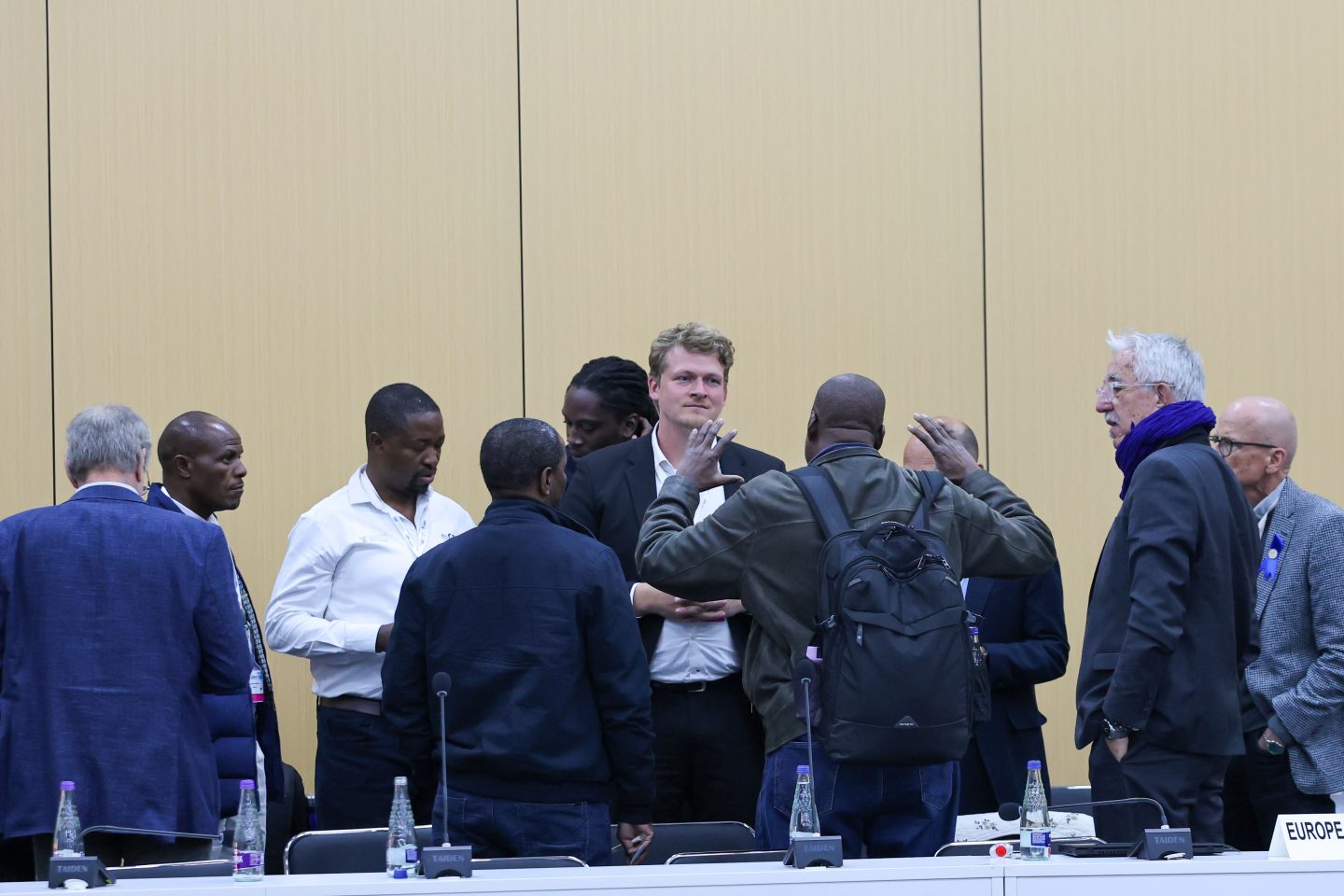
Governments at the previous COP in Saudi Arabia in 2024 failed to reach agreement despite talks running past midnight, while this year’s saw African officials coordinate a walkout from negotiating rooms on Wednesday morning, according to two sources at the talks.
Drought deal delayed until 2028
The IISD’s Earth Negotiations Bulletin, a non-governmental organisation which unlike the media is allowed to watch and report on closed-door talks, said a call to suspend negotiations on Wednesday showed negotiations had reached “boiling point” and “made some jaws drop”.
Negotiations resumed after a lunchtime meeting with the Mongolian COP presidency although governments were only eventually able to agree that they could not find consensus in Ulaanbaatar and should resume talks on an instrument to deal with drought in 2028.
Christine Colvin, WWF’s head of freshwater policy, told Climate Home News that, with droughts hitting from Honduras to the English region of Hampshire, something concrete – whether a protocol or a framework – is needed urgently “rather than the can being kicked down the road for another two years as will now happen with the protocol procrastination”.
But, in a closing press conference on Friday, the Mongolian minister presiding over talks celebrated that governments had reached consensus on several “contentious” issues and that agenda items blocked at this year’s COP17 would be put on the agenda for COP18 in Egypt.
US blocks agenda items
Other agenda items that divided countries were on measuring land degradation’s effects on women, enhancing the involvement of civil society and women in land COPs, and the UNCCD working more closely and effectively with the UN’s climate and nature conventions.
On the COP’s opening day two weeks ago, the US representative said the Trump government objects to these agenda items “on their premise and no amount of negotiation will allow us to join consensus on these items. As such we request that they be struck from the agenda at which time we will then be able to approve it, saving us valuable negotiating time.”
A US State Department spokesperson later told Climate Home News that the US wants the UN “to get back to basics by refocusing on its core mandate, eliminating overlap, and reducing competition for scarce resources”.
The spokesperson added, “that means prioritising the concrete work member states created [the UN] to do – rather than diverting limited time, attention, and resources toward social and political agendas, including gender-related initiatives.”
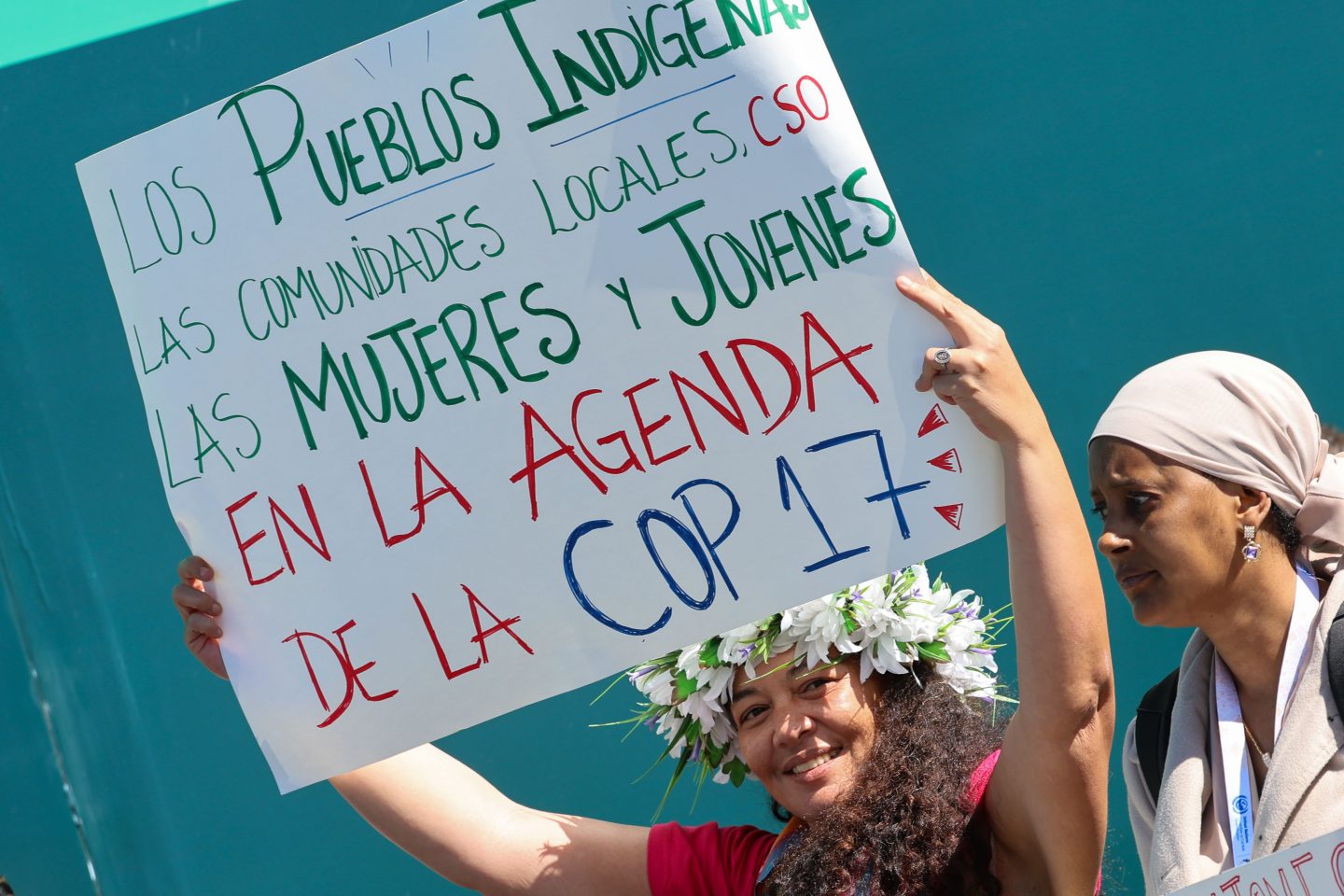
On COP’s first day, the European Union and Brazil pushed back against the blocking of these agenda items, with a Brazilian negotiator saying his country attaches “great importance” to them. But the Mongolian presidency directed governments to adopt the rest of the agenda without the controversial items, which were discussed privately with countries throughout the two weeks.
An EU statement, read out later by Irish minister Timmy Dooley, accused “some parties” (meaning national governments) of having adopted a “less constructive approach” and preventing “discussions on important matters from even commencing”.
The agenda items the US refused to engage with were never discussed and were only placed onto the agenda for the next COP on the last day. Those talks will take place in Egypt in two years’ time, with Donald Trump due then to be in his last year as US president.
No restoration without women
The blocking of the gender agenda item has stymied attempts, agreed on by governments at the last COP, to develop gender-specific indicators for the UNCCD’s next overall framework and to facilitate more women delegates at COPs. Women made up only about a quarter of delegates to COP15 in 2022, UNCCD analysis with the latest data shows
Criticising the move to keep gender off the agenda, the EU said in a statement that it welcomes “the attention being given at COP17 to women pastoralists and herders, recognising their contribution to sustainable land management and resilient rural livelihoods”.
The head of the UNCCD, former Egyptian environment minister Yasmine Fouad, said on Friday that “regardless that the agenda item was blocked”, she was proud that she and COP17 President Batmunkh Battsetseg had led the COP as women and attended the gender caucus (a meeting of groups supporting women at the talks).

“Without the women,” she told the closing press conference on Friday, “we will not be able to restore land, restore hope, restore life or restore even our children and grandchildren. And we will keep on pushing that agenda.”
The civil society agenda item aimed to allow NGOs to attend land COP negotiations, as they do at climate COPs, and included terms of reference for an Indigenous Peoples Caucus.
A representative of Indigenous Peoples told the COP’s closing plenary meeting that the group had “deep disappointment that the agenda of this COP has removed the dedicated space for indigenous peoples”. “We cannot restore the land while removing the voices of those who care for it,” she said.
On Tuesday, the UNCCD’s deputy head Andrea Meza was asked about Indigenous Peoples’ participation. She said that the blocking of “one agenda item” is “generating uncertainty in the progress” towards creating caucuses for Indigenous Peoples and for Local Communities within the talks.
Because of the “complex geopolitical situation” making it hard to obtain consensus, coalitions of the willing have become more important, she added.
Mining out, money in
Outside the formal negotiations, the summit was marked by a focus on the strongly Mongolian issues of the role played by pastoralists and rangelands like grasslands, as well as mining, in both degrading and restoring land.
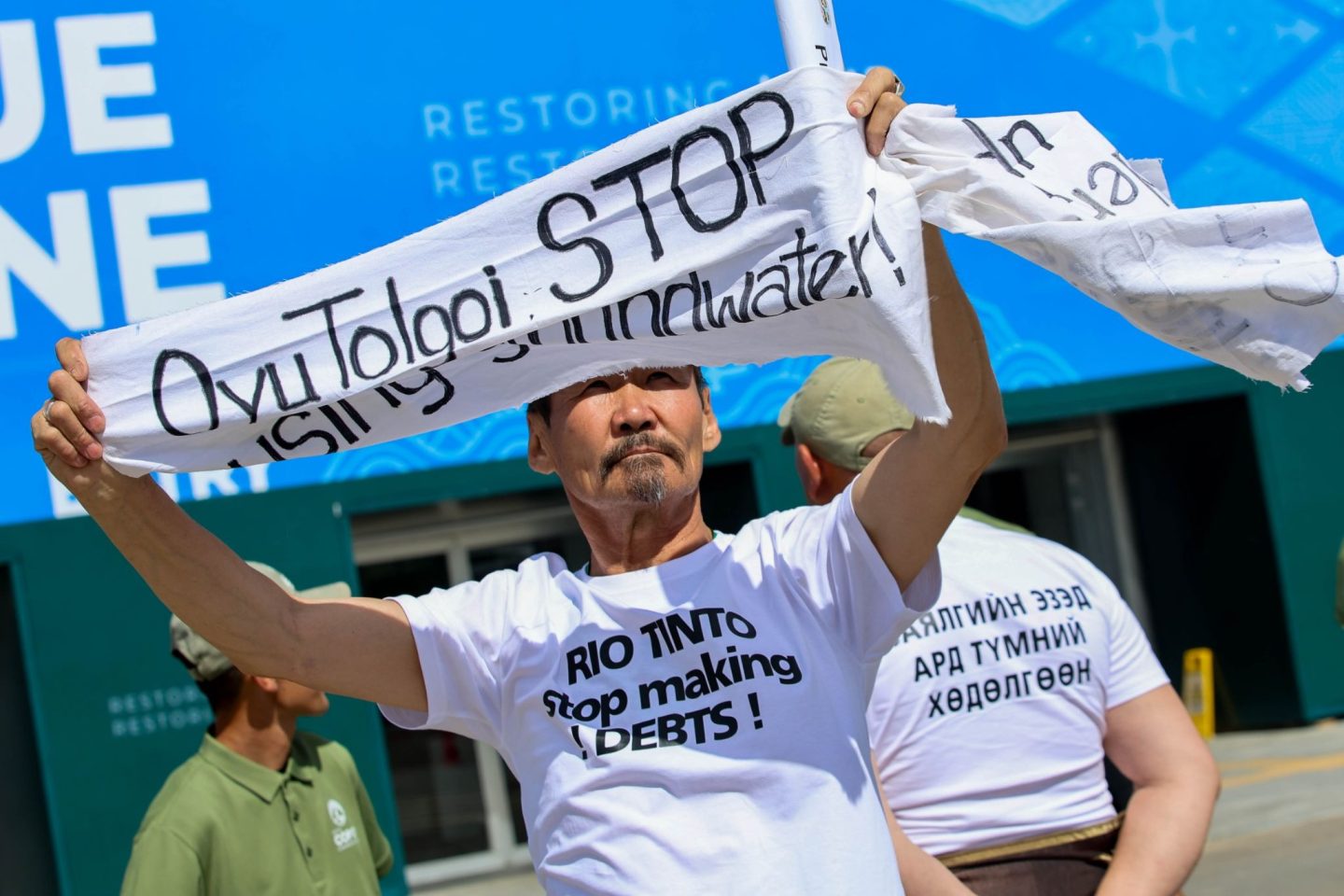
Part of the conference was sponsored by Australian mining company Rio Tinto and its local partner Oyu Tolgoi. Their presence was protested by campaigners wearing T-shirts calling on the companies to “stop wasting drinking water” and to “get out of Mongolia”.
The UNCDD and others praised the success of the summit in raising more finance for land restoration. The COP saw institutions like the Asian Development Bank and Global Environment Facility pledge money to combat land degradation, with the UNCCD estimating that $645 million of new commitments were made.
An estimated $355 billion a year is needed through 2030 to meet global land restoration commitments, compared with around $77 billion currently invested. Private finance accounts for only around 6% of global investment, according to the UNCCD.
UNCCD chief scientist Baron Orr told a press conference that many of the announcements were public-private partnerships that use government money to “even the playing field” for companies that want to protect land, in a bid to ensure they are not disadvantaged compared with those that do not.
Such partnerships are a “huge opportunity”, he said, especially as “we’re not in a moment of public finance – public finance is tight in every country.”
The post Despite African walkout, fractious land COP ends without drought deal appeared first on Climate Home News.
Despite African walkout, fractious land COP ends without drought deal
Burdened by rising fuel import costs and an “ocean crisis” of record-breaking heat, Pacific island nations are seeking to build support for a new regional fund ahead of COP31, intended to channel investment into renewable energy, community resilience and ocean protection, experts said.
Leaders from the 18-member Pacific Islands Forum (PIF), including Australia and New Zealand, are expected to issue a call for global pledges to the Pacific Resilience Facility (PRF) at a high-level meeting this coming week in Palau, seeking to build a new model for financing climate action.
The new regional fund was formally launched in May this year and is meant to “serve communities at a community level”, swiftly channelling investments for their projects on the ground, according to Fiji’s assistant minister for foreign affairs, Lenora Qereqeretabua.
“We are expecting pledges for the PRF, and these funds will go to communities that apply,” she told journalists at an online briefing. “We have organised it in such a way that it makes our application processes much, much easier than applying for global funding.”
Qereqeretabua added that she expects that PRF funds will be “utilised by communities to protect themselves from climate change and the effects of climate change.”
The Pacific Islands Forum meeting is expected to shape the region’s priorities ahead of this year’s pre-COP, hosted by Fiji and Tuvalu, and COP31, which will be co-led by Australia and Türkiye.
At COP31, a dedicated session on the climate finance needs of small island states will seek to drive pledges into the PRF. The fund has so far received about $172 million in capital – with about $67 million coming from Australia – and aims to close the year with $500 million.
-
Battle over cleaning up shipping set to resume at London talks
The US and Saudi Arabia want to scrap shipping’s Net-Zero Framework and have swung behind a far less ambitious alternative -
As marine heat breaks records, countries seek ocean roadmap at COP31
Africa and the EU are leading a push for COP31 to deliver a roadmap that lays out measures to protect fast-warming oceans -
Indonesia’s nickel production cuts are not enough to create a sustainable industry
The government is restricting nickel production to push up prices but producing more sustainable nickel for a premium requires addressing the industry’s coal issue


Ocean heat and fossil fuel shocks
Leaders from the Pacific will meet in Palau from Sunday amid an “ocean crisis” of record-breaking ocean heat caused by this year’s “super El Niño”, according to Kevin Chand, Pacific ocean policy director at National Geographic’s Pristine Seas conservation project.
Leaders at the PIF are expected to put forward commitments towards new marine protected areas, which will be key for shielding ecosystems from future climate extremes, Chand said. The forum is expected to issue a statement on the need for ocean action at COP31, and announce commitments towards reaching the global goal of protecting 30% of the planet’s land and sea ecosystems by 2030.
Rising ocean heat could lead to food insecurity and lost government earnings in the region, as key fish stocks like tuna start migrating away from their coastline in search of colder waters, said Coral Pasisi, director of climate change and sustainability at the Pacific Community (SPC).
Climate shocks are deepening existing economic pressures, as Pacific nations have spent up to a quarter of their GDP on fossil fuel imports due to the war in Iran, according to a recent report by the University of New South Wales (UNSW) in Australia.
Wesley Morgan, one of the study’s authors, told journalists that partner nations “ought to be putting their money where their mouth is”, and should support the energy transition in the Pacific by covering the upfront costs of switching from polluting diesel to solar power, batteries and electricity grid upgrades.
China keeps Indonesia’s battery dream afloat but future less certain
Given the increase in climate-related shocks and sea-level rise, the PIF should also mention the need to phase out fossil fuel extraction and consumption, said Sindra Sharma, international policy lead at the Pacific Islands Climate Action Network (PICAN).
Last year’s COP30 failed to deliver a global roadmap on transitioning away from fossil fuels, which led to a group of countries – including several Pacific island nations – pursuing their own fossil fuel phase-out summit in Santa Marta, Colombia. Next year’s conference will be hosted by Tuvalu and co-chaired by Ireland, which should also receive backing from the PIF, Sharma said.
Both the chairs of the Santa Marta coalition and the Australian COP31 co-presidency have vowed to continue a push for this topic to be discussed at COP31.

New fund to test allies
As local communities in the Pacific struggle to access global climate funds, the PRF’s planned model for quick, direct disbursements has “very solid and good” intentions, Sharma said, but it will need political and financial backing from donor countries.
“The proof is going to be when the fund actually starts operating and delivering to communities,” she added. “If there is too much bureaucracy in being able to access the funds, for example. These things will have to be scrutinised.”
The facility aims to deliver funds in two categories: one for climate adaptation and “disaster resilience”, and another for social and community resilience that includes areas like community capacity-building, education, data analytics and financial management, among others. It will launch its first call for proposals at the PIF.
Morgan added that Australia will need to “leverage global interests” so that funding is directed to the Pacific Resilience Facility “or else the Pacific won’t be able to trust Australia as a partner”. The country ratified the PRF treaty in May, triggering its entry into force.
“The perception [of Australia] in the region is genuinely divided, and it’s worth being honest about it,” Sharma said, adding that the pre-COP31 in Fiji, which is usually limited to a technical space for negotiations, will determine how meaningful Australia’s advocacy for the Pacific can be.
This time, Pacific nations want to use the pre-COP in early October as an opportunity to demonstrate the challenges their largely low-lying islands face and to advocate for their political priorities, including a renewed global effort to limit global warming to 1.5C by cutting emissions faster and deeper. World leaders are due to visit Tuvalu to experience the frontline of rising sea levels, although Australia and Fiji have yet to confirm who will attend.
“In Bonn, Australia was largely missing on the negotiated outcomes that we so urgently need to see. It’s not enough to get Pacific priorities on the agenda. Agenda placement is not delivery,” Sharma added.
The post Pacific islands seek backing for new regional fund ahead of COP31 appeared first on Climate Home News.
Pacific islands seek backing for new regional fund ahead of COP31



-
Climate Change1 year ago
Guest post: Why China is still building new coal – and when it might stop
-
Greenhouse Gases1 year ago
Guest post: Why China is still building new coal – and when it might stop
-

 Greenhouse Gases2 years ago
嘉宾来稿:满足中国增长的用电需求 光伏加储能“比新建煤电更实惠”
-

 Climate Change2 years ago
嘉宾来稿:满足中国增长的用电需求 光伏加储能“比新建煤电更实惠”
-
Climate Change2 years ago
Bill Discounting Climate Change in Florida’s Energy Policy Awaits DeSantis’ Approval
-

 Renewable Energy10 months ago
Sending Progressive Philanthropist George Soros to Prison?
-
Greenhouse Gases1 year ago
嘉宾来稿:探究火山喷发如何影响气候预测
-

 Carbon Footprint2 years ago
US SEC’s Climate Disclosure Rules Spur Renewed Interest in Carbon Credits