

Resource-rich African nations risk missing out on the investment needed to extract and refine their mineral wealth into high-value products for the clean energy transition because they lack accurate information on what they have, experts are warning.
African countries have attracted huge interest as the world scrambles to access the minerals and metals needed for the energy transition and digital and military technologies, with investors from the US, China, the United Arab Emirates and Europe jostling to secure access to the continent’s resources.
But any knowledge of Africa’s mineral wealth is, at best, an estimate based on century-old-mapping and haphazard geological data, policy experts and investors told Climate Home News.
The United Nations says Africa is home to 30% of the world’s mineral reserves, including cobalt, copper, lithium and manganese, which are needed to manufacture batteries and other clean energy technologies.
But experts like Bright Simons, who tracks natural resource spending in Africa for the Ghana-based IMANI Centre for Policy and Education, said the 30% number is not backed by any “empirical, evidence-based assessment” of the continent’s mineral wealth. While some analysts like Simons think the figure could be an overestimate, others argue it is likely an underestimate of the continent’s mineral reserves.
-
AI and satellite data help researchers map world’s transition minerals rush
Filling “mind-boggling” gaps in mining data will make it easier to track the environmental impact of surging global appetite for critical minerals, experts say -
Push for global minerals deal meets opposition, more talks agreed
Colombia’s proposal for the UNEA to set up an expert group to identify options for governing mineral supply chains was rejected by a broad group of states -
South Africa’s platinum mine dumps get a second look as clean energy lifts demand
Mining firms say extracting minerals from tailings is a sustainable way to boost global supplies, but local communities want to see benefits this time around


Up-to-date and accurate data is critical for governments to negotiate better deals with prospecting mining companies and to help drive investment in mineral extraction and processing facilities that can add value to the continent’s resources.
But the lack of good mapping has negatively impacted the continent’s efforts to capture the economic benefits of booming mineral demand and to create jobs by extracting and processing raw materials into higher-value products before export, experts said.
Colonial maps
Under-exploration and scant information about Africa’s resources have made it challenging for states to attract investment and develop their resources, said Pritish Behuria, a political economist at the Global Development Institute at the UK’s University of Manchester.
“In many cases, former colonial powers retain more current knowledge of the kinds of mineral deposits that exist in African countries – and often, this has proven difficult to access for African governments,” he told Climate Home News.
Thabit Jacob, a researcher of extractive and energy resources at Roskilde University in Denmark, said many African countries “still rely on colonial maps”.
“There’s a growing realisation that Africa must know its true value in mineral richness and investment in geological mapping is crucial,” he added.
Mapping inequality
However, mapping investment is falling short. Africa’s share of global exploration investment has fallen in the last two decades, data shows.
In 2024 alone, both Canada and Australia received significantly more investment in geological mapping than the whole of Africa, even though the continent’s landmass is three times the size of the two countries combined, according to the Center for Strategic and International Studies.
Even in South Africa, a major mining destination, only 12% of the country has been mapped at a detailed level “which compares poorly with other popular mining destinations such as Canada and Australia where there is near complete coverage at similar scales”, explained Tania Marshall, of the Geological Society of South Africa.
Nigeria’s push to cash in on lithium rush gets off to a rocky start
To address the dearth in data, multinational institutions like the World Bank have provided African countries with finance for mapping, but have simultaneously encouraged them to liberalise and privatise their mining industries.
As a result, international investors prioritising project development have come to dominate the continent’s mining sector, crowding out state-sponsored initiatives with stronger incentives to invest in data-gathering, researchers have found.

Digging blind
Orina Chang, an investor leading geological mapping across Somaliland, which has reserves of copper and zinc ore, said she was surprised to find out that even countries attracting huge interest from institutional miners, such as the Democratic Republic of the Congo (DRC), do not have systematic up-to-date mapping.
Instead, mining firms rely on artisanal mining and surface signs, like exposed ores on the ground – and crossing their fingers, she told Climate Home News.
The mapping deficit means there is little certainty on the size and quality of mineral deposits and provides few incentives for miners to invest in processing plants, Chang explained.
“Without mapping, everyone is blindly digging and you just get people who are not interested in really investing in your country,” she said. “With mapping, you’re able to attract much better players and build plants, create jobs, drive economic growth, help the GDP.”
The rise of AI-driven exploration tools
Today, AI-driven mapping tools have created new opportunities to obtain high-precision information with less on-the-ground investment. Geophysical data and satellite imagery are fed into a model that creates a geological map which can help point to high-potential deposits.
Last year, California-based KoBold Metals, which is backed by US billionaires Jeff Bezos and Bill Gates, discovered a massive copper deposit in Zambia using AI-driven exploration. In July, the firm signed an agreement with the DRC to lead critical mineral exploration there.
But the technology is expensive and not widely available to governments.
Instead, in its 2024 Green Minerals Strategy, the African Union called for some of the revenues from mineral rents to be reinvested into mapping using low-cost techniques such as satellite imagery and drones, which are less precise.
-
Victims of Zambian copper mine disaster demand multibillion dollar payout
Dozens of families are threatening to sue China’s Sino-Metals over a devastating spill of toxic mining waste that caused one of the nation’s worst environmental disasters -
Nigeria’s push to cash in on lithium rush gets off to a rocky start
The West African nation wants to supply refined lithium to the EV battery industry to diversify its economy away from oil – but early processing efforts are facing challenges -
EU weakening of corporate sustainability rules ‘jeopardises’ climate action, critics say
A major revision to the EU’s law on corporate due diligence removes a requirement for large companies to publish plans to align their business model with global climate goals


The case for co-operation
For Gerald Arhin, a research fellow at University College London, greater regional collaboration and pooling resources could also help reduce the costs of mapping for individual governments. Last year, for example, South Africa signed an agreement with South Sudan to co-operate on mineral exploration.
“The sharing of data, industrial intelligence and technical expertise across borders could be transformative for African countries, as well as for developing countries in other regions,” Clovis Freire, who heads the Extractive Commodities Section at UN Trade and Development (Unctad), told Climate Home News.
Mapping, however, is only one element of a complicated equation when it comes to developing minerals for the energy transition, said Eszter Szedlacsek, who researches climate justice in the context of the green transition at the Vrije Universiteit Amsterdam.
“In the race for Africa’s critical minerals, deals hinge only partly on where resources are found, and more on geopolitics, investment conditions and longstanding trade ties,” she said.
The post Outdated geological data limits Africa’s push to benefit from its mineral wealth appeared first on Climate Home News.
Outdated geological data limits Africa’s push to benefit from its mineral wealth

Climate Change
Albanese’s NY Climate Week address acknowledges scale of the climate challenge, but fossil fuels notably absent
SYDNEY, Tuesday 22 September 2026 — In response to Prime Minister Albanese’s keynote address at New York Climate Week, Dr Simon Bradshaw, COP31 Lead and climate expert at Greenpeace Australia Pacific, said:
“It is encouraging to see Prime Minister Anthony Albanese acknowledging the immediate and profound climate threat to communities in the Pacific, Australia and worldwide, and the need to work together, with bravery and compassion. Now we must match those words with real action to phase out fossil fuels.
“Earlier this month in Palau, Prime Minister Anthony Albanese committed Australia to helping accelerate the transition away from fossil fuels and defend the crucial goal of limiting warming to 1.5°C — a survival line for Pacific island countries and all those paying the cost of our fossil fuel addiction through worsening floods, fires, drought and sea level rise.
“However, Australia continues to undermine its aspirations for global climate leadership by expanding fossil fuel production. The Albanese Government has approved an astonishing 37 new, extended or expanded coal and gas projects since first elected. Every one of which compounds the threats to our shared security and wellbeing. Remarkably, in his major climate speech in New York overnight, the Prime Minister failed to even mention fossil fuels.
“As our Minister for Climate Change Chris Bowen has said, we are in a global fossil fuel crisis. Getting off fossil fuels through transitioning to renewable energy is the quickest pathway to greater security, stability and affordability for all. But right now Australia is throwing more fuel on the fire.
“We are now near certain to overshoot 1.5°C of warming. For the Pacific and Australia alike, this will be measured in more communities torn from their land and homes, and the loss of more people and places we love. There is a path back below 1.5°C of warming, and every fraction of a degree matters, but it will demand all minds and all hearts working together.
Australia fought hard for the privilege to chair the next round of global climate negotiations. The world is crying out for a clear vision and leadership from Australia as we head towards COP31 in Antalya.
“Australia must lead by example at home through an immediate end to new fossil fuel approvals, including rejecting Woodside’s mammoth Browse project. And must ensure that COP31 boosts our shared security by accelerating the transition away from fossil fuels. Get this right, and Australia will emerge as a responsible middle power and force for good in troubled times.”
-ENDS-
Media contact
Kate O’Callaghan on 0406 231 892 or kate.ocallaghan@greenpeace.org
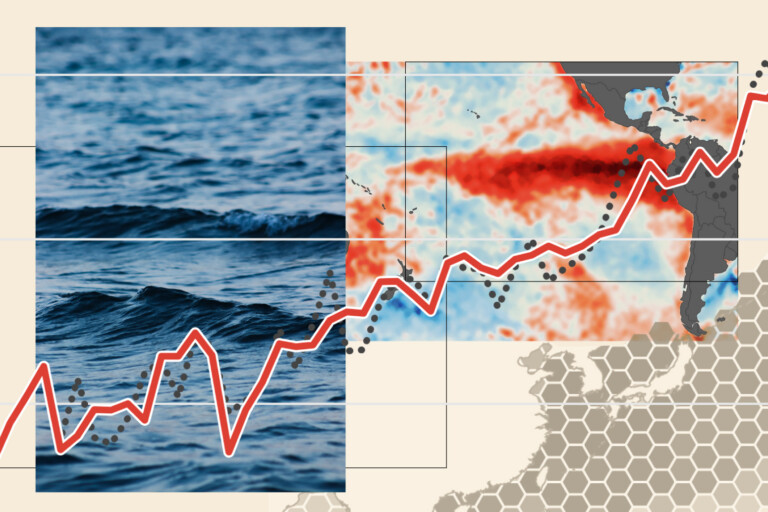
This year’s so-called “super El Niño” is entering into record-breaking territory.
Sea surface temperatures in the tropical Pacific now equal the previous daily record set in 2015 and will likely keep rising in the days ahead.
El Niño is a naturally occurring climate phenomenon in the Pacific that reshapes weather patterns around the world and temporarily boosts global temperatures.
The current El Niño event – which has been underway since June and is expected to last until next year – has been developing faster than any previous event on record.
The strength of an event is tracked using the “Niño 3.4 anomaly”, which measures how much warmer sea surface temperatures in a section of the central Pacific are than average.
As of 19 September, the daily anomaly in the Niño 3.4 region stands at 3.07C, putting it in a statistical tie with the previous record of 3.08C.
Some scientists, using a different baseline for calculating the anomaly, have already called the new record.
Either way, this is remarkable, in part because of how early in the calendar year it is occurring. El Niño typically peaks in the winter months, most commonly in November or December.
Every strong El Niño on record has continued to strengthen after mid-September – and there is every reason to think that this one will as well.
(For more on El Niño, see Carbon Brief’s recent interactive explainer.)
Record territory
El Niño events are typically classed as “weak” when the Niño 3.4 anomaly reaches 0.5C, “moderate” above 1C, “strong” above 1.5C and “very strong” above 2.0C.
For this year’s event, the Niño 3.4 anomaly has now reached 3.07C, which puts it in a statistical tie with the record set on 18 November 2015, set during a “very strong” El Nino event.
The chart below shows how the strength of the current El Niño (red line) is dramatically outpacing both 2015-16 (blue) and another “very strong” event in 1997-98 (light blue).
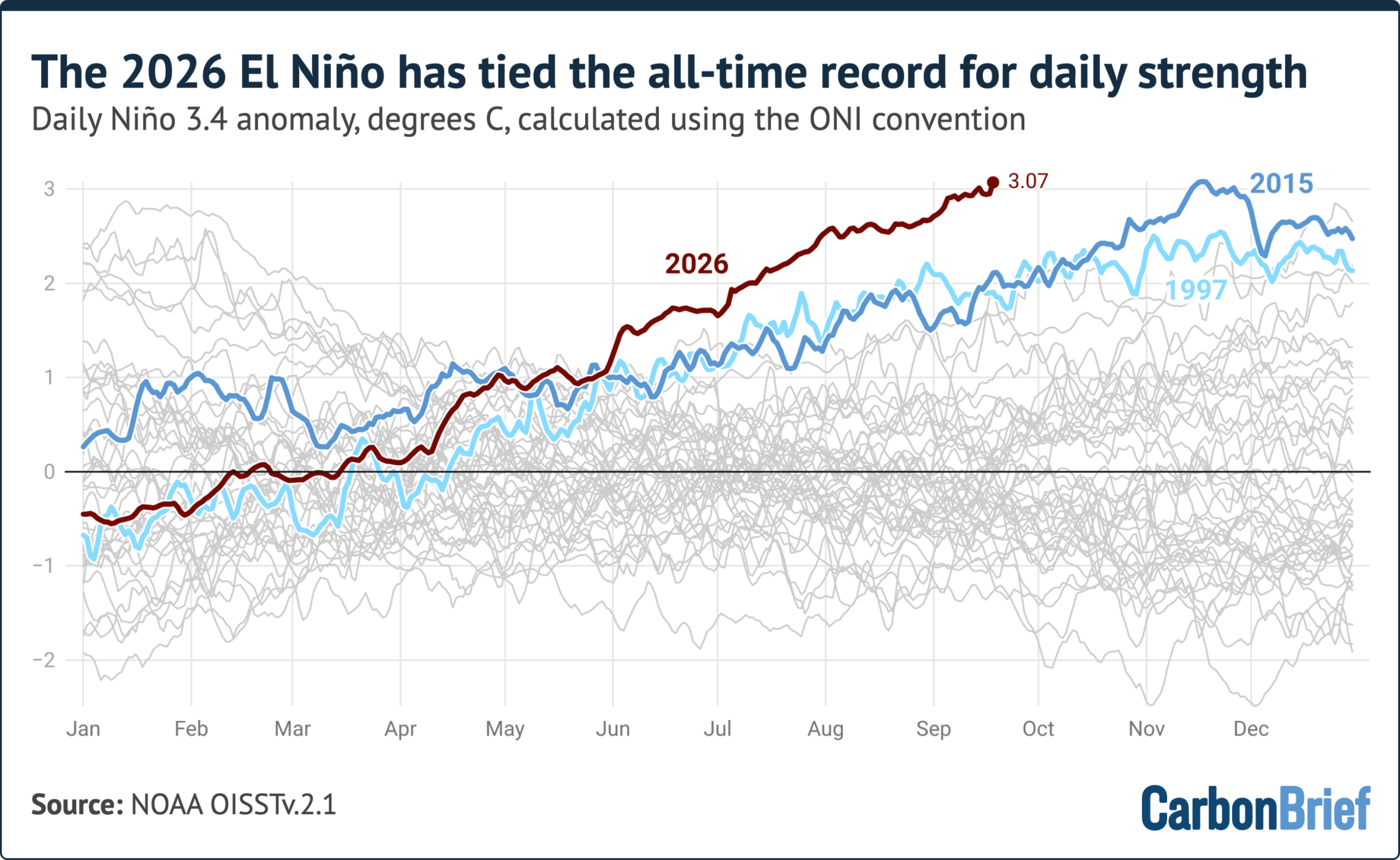
To analyse the developing El Niño, Carbon Brief followed the convention of the US National Oceanic and Atmospheric Administration’s (NOAA) Oceanic Niño index (ONI).
ONI is calculated by subtracting the latest 30-year average temperature in the Nino 3.4 region from daily sea surface temperatures. This approach allows for the most recent years to be compared against the most recent 30-year period. It removes much of the influence of longer-term, human-driven warming from the index.
(While meteorological organisations typically track changes to ONI on a three-month rolling average basis, Carbon Brief’s analysis looked at how the metric is changing on a daily basis.)
If ONI is calculated using a baseline of 1991-2020 then the current El Niño has already set a new record.
Since the start of June, El Niño’s strength has been greater than any other year. In early September in both 1997 and 2015, anomalies were around 1.9C – more than one degree below where they are this year.
An alternative index
There is another commonly used metric – the relative Oceanic Niño index (RONI) – used to study El Niño.
Introduced by NOAA in 2024, the RONI index adjusts for tropical ocean warming linked to human-caused climate change. To do this, it takes sea surface averages in the Nino 3.4 region and subtracts out temperature anomalies observed across the tropical oceans (between the latitudes of 20 degrees north and south).
This approach may better remove the influence of climate change in this specific region, but can also diminish the apparent strength of strong El Niño events, such as the current one, which extend well outside the Niño 3.4 region.
The chart below shows daily RONI values, which are record setting for this time of year, but remain below an all-time daily record set during the 1982-83 El Niño event.
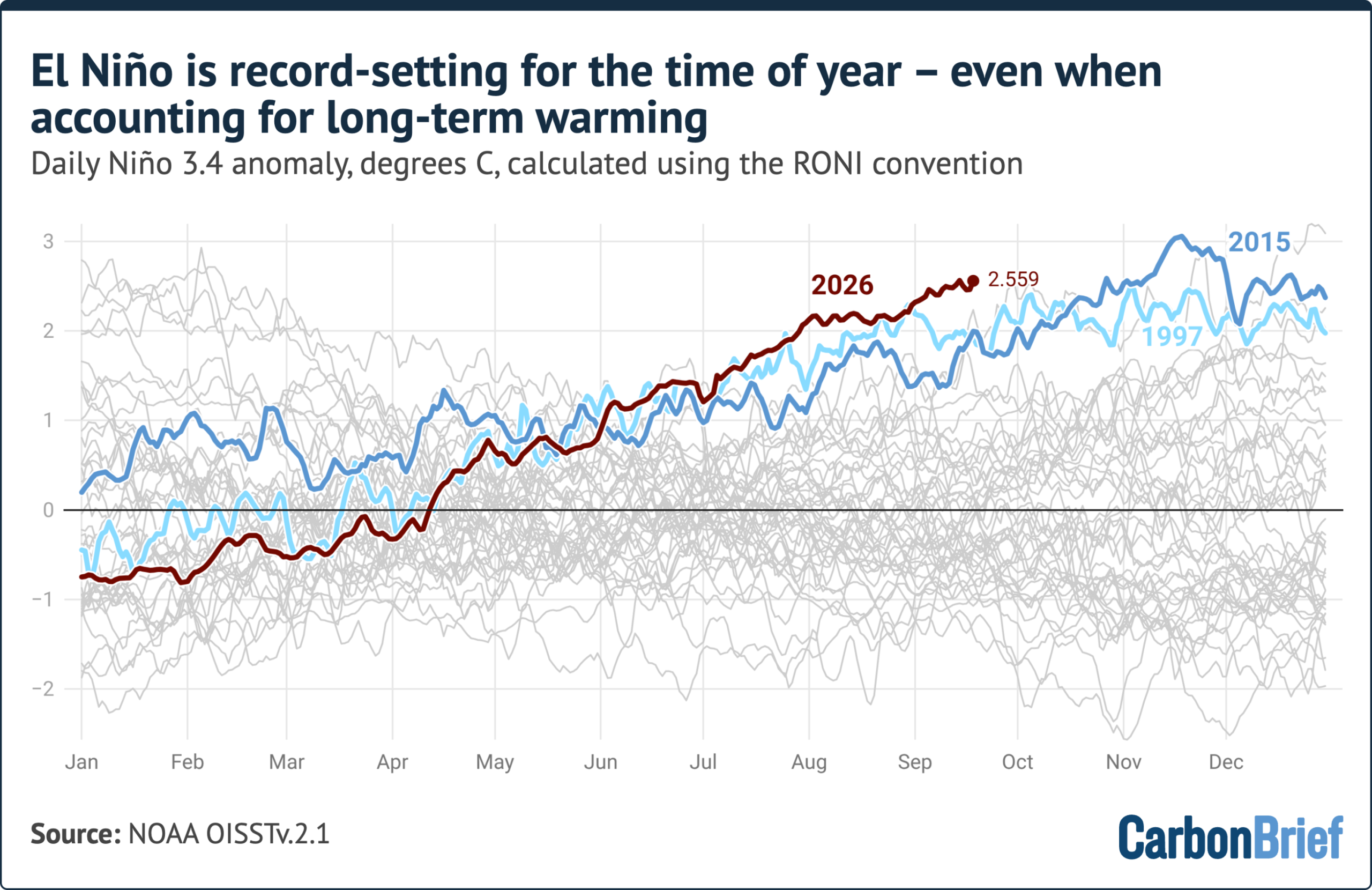
RONI stood at around 2.5C in mid-September, some 0.7C below the 1982 record.
However, that record was set in late December, at the peak of the event.
The 1982-83, 1997-98 and 2015-16 events added between 0.5C and 1.9C to their RONI values between mid-September and their peaks.
On track to smash monthly and seasonal records
Because daily El Niño values are noisy, scientists typically turn to monthly or seasonal averages to compare El Niño events.
The latest full calendar month for which data is available – August 2026 – had a Niño 3.4 anomaly of around 2.45C. This is higher than the peak of every prior El Niño event on record except 2015-16 – where the anomaly reached 2.75C – and 1877-78, when the anomaly sat at around 2.7C, based on a reconstruction of sea surface temperatures using sparse ship data.
The figure below shows the monthly evolution of the five strongest El Niño events on record alongside 2026, as well the current forecast from 14 seasonal forecast models.
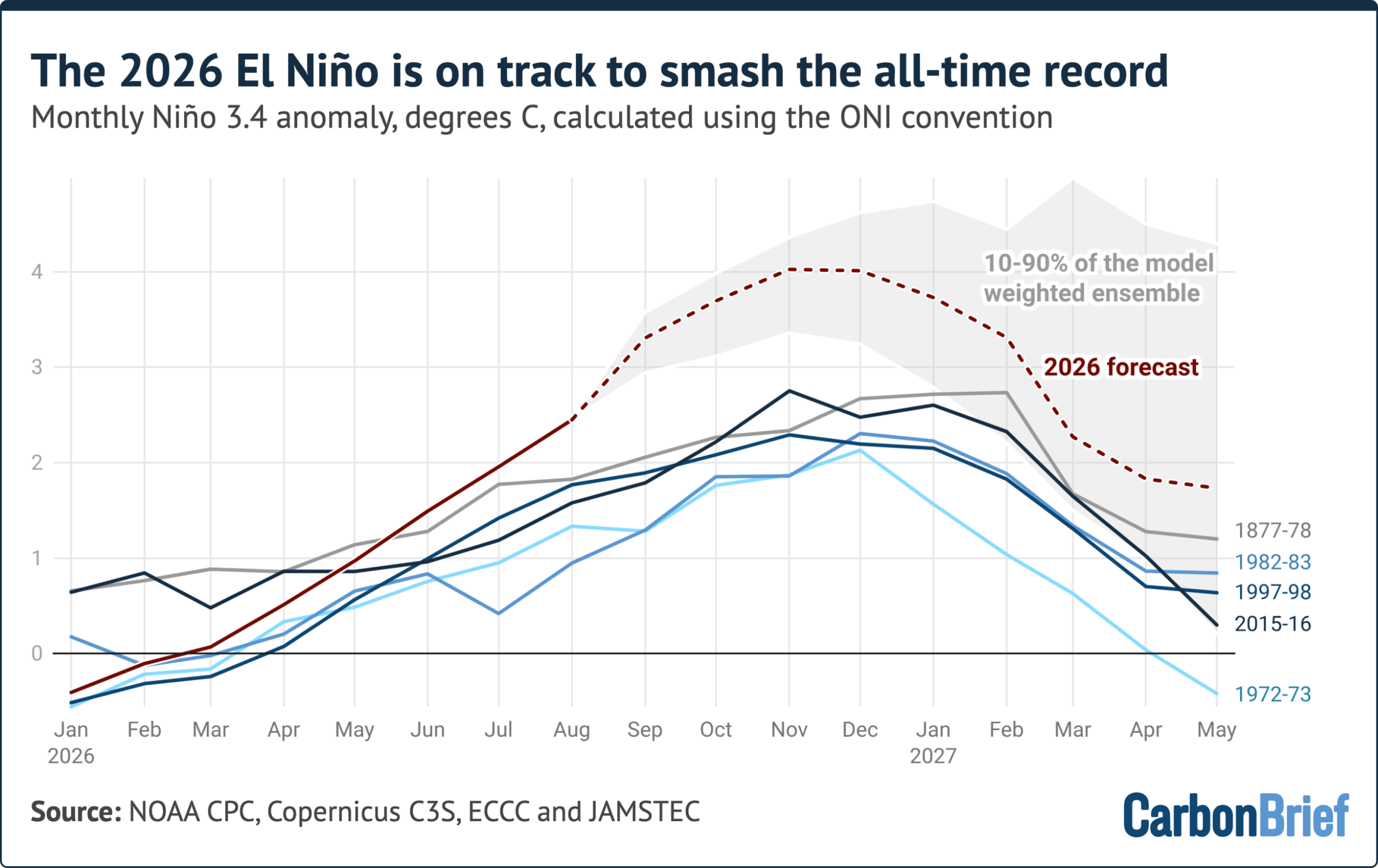
Taken together, the models project a peak monthly anomaly later this year of around 4.1C, with 80% of the 674 individual model runs falling between 3.4C and 4.6C.
Every single model run peaks above the 2015-16 record. The projected margin over that record, some 1.3C, is larger than the entire gap between the strongest and fifth-strongest El Niño of the past 150 years.
Some caution here is warranted, however. No seasonal forecast system has ever been verified against an event of this size, because none has ever occurred. The models also predicted temperatures slightly warmer than observed this summer, with real-world observations for August coming in around 0.3C below forecasts.
However, all strong El Niño events on record have continued to strengthen well into the winter – and the models are in near-unanimous agreement that this one will, too. If the forecast holds, the current event will peak between November and January at a level far beyond any event previously observed in the instrumental record.
El Nino’s effect on global temperatures typically lags rising ocean temperatures in the Pacific by several months, so most of the impact will be felt in 2027 rather than 2026.
Carbon Brief’s most recent “state of the climate” quarterly analysis found 2026 on track to be the warmest or second-warmest year on record. The next update in early October will examine what a record El Niño means for 2027.


The post Analysis: ‘Super El Niño’ reaches ‘remarkable’ all-time record appeared first on Carbon Brief.
Analysis: ‘Super El Niño’ reaches ‘remarkable’ all-time record
Artificial intelligence (AI) is set for a bigger role at this year’s UN climate summit, as Türkiye’s COP31 presidency seeks backing for a new pledge on the technology’s energy use.
In a statement on Monday, the COP31 hosts said they will launch the Antalya Pledge on AI, which they billed as a “political” commitment on how AI is “designed, procured, powered, deployed, measured and managed” in support of climate action.
“We must openly discuss AI’s growing energy consumption and it is time for governments to start setting the terms,” COP31 president Murat Kurum said in an emailed statement. “We expect companies to be transparent about their energy use and to power their operations with clean energy”.
No further details about the pledge have been made available so far, including whether it will include a clean energy commitment or whether governments and companies will be invited to sign on. The COP31 presidency said it would share a draft before the summit opens in Antalya in early November.
UN climate chief Simon Stiell went further in a New York speech on Monday, warning that AI leaders are “on thin ice when it comes to license to operate, and sinking deep underwater when it comes to public support”.
“Energy-guzzling artificial intelligence is driving up planet-heating pollution from coal, oil and gas, while ratcheting up energy costs for households and businesses,” he said, adding that data centre projects are being put on hold due to public opposition from New York to Texas.
Growing energy use and emissions
Concerns about the environmental impacts of AI infrastructure and its impact on rising electricity prices have led to a growing backlash in some communities, especially in the US.
Big Tech’s breakneck race to develop new AI models and build out the energy-hungry infrastructure supporting them has stoked fears over the technology’s growing climate impact.
Greenhouse gas emissions generated by data centres through their electricity use are set to more than double between 2024 and 2030, according to the International Energy Agency (IEA).
Data centres, which underpin various technologies including AI, are expected to consume more power than all but five countries by the end of the decade.
-
UN asks AI companies to reveal full environmental impacts
UN chief António Guterres says big AI firms should disclose the emissions, water and energy use of their data centres amid community opposition -
Explainer: Will AI data centres make or break the energy transition?
As grids struggle to meet soaring electricity demand for AI data-crunching, big tech is under pressure to cover the costs of boosting power supplies – which may be dirty or clean


The AI race is also driving a surge in new fossil gas investment in the United States, where Big Tech giants including Microsoft, OpenAI and Meta have struck up major deals with fossil fuel operators to power their infrastructure.
In China, the other major global AI force, coal provides around 70% of the electricity powering the country’s data centers, according to an IEA report published last year.
More space for AI at COPs?
Despite AI’s rapidly growing relevance for the world’s ability to limit global warming, high-level discussions on the climate impact of the technology have been largely absent at UN climate summits.
While the pledge is still being developed and scarce details have been made public so far, the Antalya initiative, alongside sharper rhetoric from Stiell, suggests that might be changing.
Climate Home News understands that the UN climate change body is encouraging AI companies to be present at COPs as the climate summits set the global direction for energy policy and tech firms now have a major stake in it.
Earlier this year, UN Secretary-General António Guterres launched an initiative aimed at holding AI companies accountable for their environmental impacts and repeated a call for all big AI companies to commit to powering every data centre with renewable energy by 2030.
Align AI with science
Stiell said that tech titans need to start showing why the benefits of AI outweigh its “skyrocketing costs”, by setting credible climate targets, coming clean about their energy use and powering data centres with renewable energy.
AI proponents claim that, despite its growing energy use, the technology’s widespread application would bring net benefits in the fight against climate change by driving massive energy efficiency gains and optimising renewable energy integration. The IEA estimates that existing AI applications could cut emissions by more than data centres add.
Fossil fuel expansion threatens COP31 hosts’ credibility, experts warn
But critics argue that it is wrong to compare theoretical gains with real-world emission growth and any gains are outweighed by the widespread adoption of AI tools by fossil fuel companies to extract planet-heating oil and gas faster and more cheaply.
Stiell said the tech industry needs to “respect science and start aligning with global climate efforts – urgently”.
Alongside the AI pledge, the COP31 presidency has also announced it will launch an ‘AI for Clean Technologies’ Initiative, which will develop a portfolio of AI-enabled clean-technology pilots in priority sectors, including smart energy and green industry.
This programme aims to demonstrate the responsible use of AI in practice, the COP31 presidency promised.
The post COP31 presidency announces AI pledge as UN climate chief says Big Tech ‘on thin ice’ appeared first on Climate Home News.
COP31 presidency announces AI pledge as UN climate chief says Big Tech ‘on thin ice’



-

 Greenhouse Gases2 years ago
嘉宾来稿:满足中国增长的用电需求 光伏加储能“比新建煤电更实惠”
-
Climate Change1 year ago
Guest post: Why China is still building new coal – and when it might stop
-
Greenhouse Gases1 year ago
Guest post: Why China is still building new coal – and when it might stop
-

 Climate Change2 years ago
嘉宾来稿:满足中国增长的用电需求 光伏加储能“比新建煤电更实惠”
-

 Renewable Energy11 months ago
Sending Progressive Philanthropist George Soros to Prison?
-
Climate Change2 years ago
Bill Discounting Climate Change in Florida’s Energy Policy Awaits DeSantis’ Approval
-
Greenhouse Gases1 year ago
嘉宾来稿:探究火山喷发如何影响气候预测
-

 Carbon Footprint2 years ago
US SEC’s Climate Disclosure Rules Spur Renewed Interest in Carbon Credits