

Only around a third of the latest country climate pledges submitted to the UN express support for the “transition away from fossil fuels”, according to Carbon Brief analysis.
Several countries even have used their 2035 climate plans to commit to increasing the production or use of fossil fuels, predominately gas, the analysis finds.
The first global stocktake of progress to tackle climate change, agreed at the COP28 climate summit in Dubai in 2023, calls on all countries to contribute to “transitioning away from fossil fuels”.
Countries were meant to explain how they are implementing the outcomes of the global stocktake, including their contribution to transitioning away from fossil fuels, in their latest climate plans.
However, just 23 of the 63 plans submitted to the UN so far express support for “transitioning away from fossil fuels”, or the “phase out” or “phase down” of their use.
In addition, six countries, including Russia, Nigeria and Morocco, use their climate plans to commit to boosting gas production.
Some two-thirds of countries have not yet announced or submitted their pledges, missing not only the UN deadline of 10 February, but also an extension to September.
How to address the lack of sufficient action from countries with their latest plans is billed to be one of the major issues up for debate at the COP30 climate summit in Brazil next month.
Taking stock
In 2015, countries forged the Paris Agreement, the landmark deal to keep temperature rise “well-below” 2C, with “aspirations” to limit global warming to 1.5C of warming by the end of this century.
At the time, countries’ initial pledges were not enough to put the world on track to meet the temperature targets, so they built a “ratchet mechanism” into the Paris Agreement, requiring them to keep increasing their ambition in the following years.
As part of this, countries agreed to submit new, more ambitious plans every five years detailing what they are doing to take action on climate change and adapt to its impacts. These are called “nationally determined contributions” (NDCs).
The Paris Agreement also stated that, following on from these plans, “global stocktakes” should be conducted to assess collective progress in meeting the temperature goal.
The first global stocktake concluded at the COP28 climate summit in Dubai in 2023, with countries agreeing to a new document setting out how they will respond to a lack of sufficient action to meet the Paris goals.
The two-week talks saw fierce debate about how fossil fuels – the main driver of human-caused climate change – should be referred to in this text.
In the end, the stocktake “calls on” all countries to “contribute to” a list of global goals, including “transitioning away from fossil fuels…accelerating action in this critical decade” towards net-zero by 2050.
It was the first time that countries formally acknowledged the need to transition away from fossil fuels in almost 30 years of international climate negotiations.
However, many countries were disappointed that the text did not contain a firmer commitment to phase out all fossil fuels, or even just those with “unabated” emissions.
After Dubai, countries were expected to come up with new NDCs for 2035 that explained how they responded to the priorities set out in the stocktake.
The deadline for submitting the “3.0” NDCs was 10 February 2025, which 95% of countries missed.
On 24 September, the UN convened a climate summit in New York at the sidelines of the UN general assembly in the hope of encouraging more countries to come forward with new NDCs.
China stole the show at the event, announcing a pledge – although not yet formally submitted to the UN – to cut greenhouse gas emissions to 7-10% below peak levels by 2035. Several other countries announced new plans, including Russia, Turkey and Bangladesh.
Following the summit, around one-third of countries have announced or submitted their 2035 NDCs.
Fossil-fuel focus
For the analysis, Carbon Brief reviewed each of the NDCs submitted to the UN to determine whether they express support for “transitioning away” from fossil fuels or for phasing them out or “down”.
Countries were considered to have expressed support if they explicitly mentioned the terms “transition” or “phase out/down” in relation to “fossil fuels” when speaking about their own actions to address climate change.
Some countries spoke in general terms about “reducing” or “replacing” fossil fuels, but did not explicitly reference the need to transition away from or phase them down or out. Others spoke about transitioning to a clean or renewable-based economy, but did not explicitly mention fossil fuels.
For the purposes of this analysis, all of these countries were considered to have not expressed support for the need to transition away from fossil fuels.
In addition, some countries mentioned in their NDCs that the global stocktake calls for a transition away from fossil fuels, but did not say that transitioning away from fossil fuels would be part of their own actions to address climate change.
These countries were also considered to have not expressed support for the need to transition away from fossil fuels.
Overall, the results show that only one-third of countries express support for the need to transition away from fossil fuels in their NDCs.
Countries used varying language when speaking about the need to transition away from fossil fuels.
Some directly acknowledged that transitioning away from fossil fuels was a key conclusion of the global stocktake and committed to doing this within their own borders.
This includes the UK, Brazil, Canada, Australia, Singapore, Lebanon and Niue. For example, the UK’s NDC states:
“At home and in line with the outcomes of the GST [global stocktake], the UK is committed to transitioning away from fossil fuels to achieve net-zero by 2050.”
Other countries chose to commit to “phasing out” fossil fuels instead of “transitioning away”.
This includes Iceland and Vanuatu. Similarly, Colombia’s NDC says:
“NDC 3.0 reaffirms that the phasing out of fossil fuels is not only a climate imperative, but also an opportunity to strengthen energy sovereignty [and] democratise the benefits of the transition.”
(Colombia and Vanuatu were two of the countries that were disappointed not to see a commitment to phase out fossil fuels included within the global stocktake text.)
Barbados, an island nation known for its strong commitment to climate action, committed in its NDC to “achieve a fossil fuel-free economy” by 2040. In addition, Chile pledged to contribute to the “elimination of fossil fuels”.
In the analysis, these pledges were considered to be support for transitioning away from fossil fuels, despite not using the terms “transition” or “phase out”.
The table below shows the language used by each of the 21 countries that expressed support for transitioning away from fossil fuels, according to the analysis.
| Country | Expression of support for ‘transitioning away from fossil fuels’ in NDC |
|---|---|
| United Kingdom | “At home and in line with the outcomes of the GST, the UK is committed to transitioning away from fossil fuels to achieve net-zero by 2050.” |
| Brazil | “Brazil will respond to the call to contribute to global efforts under paragraph 28 of decision 1/CMA.5, through the policies and national efforts below, including those under the National Climate Plan. In addition, Brazil would welcome the launching of international work for the definition of schedules for transitioning away from fossil fuels in energy systems, in a just, orderly and equitable manner, with developed countries taking the lead, on the basis of the best available science, reflecting equity and the principle of common but differentiated responsibilities and respective capabilities in the light of different national circumstances and in the context of sustainable development and efforts to eradicate poverty, as per paragraph 6 of decision 1/ CMA.5.” |
| Canada | “Canada also remains committed to implementing the mitigation outcomes of the Global Stocktake (GST), agreed at COP28…This includes…transitioning away from fossil fuels in energy systems.” |
| Lebanon | “Guided by the UAE Consensus reached at COP28, which calls on all Parties to transition away from fossil fuels and strengthen support for adaptation, this NDC reflects Lebanon’s commitment to scaling ambition while addressing national vulnerabilities.” |
| Iceland | “Iceland’s NDC takes note of the outcome of the global stocktake, according to Decision 1/CMA.5. Specifically, Iceland’s NDC seeks to represent the need for deep, rapid and sustained reductions in greenhouse gas emissions in line with 1.5°C pathways by contributing to the phase-out of fossil fuels across sectors and the strategic, fair and ambitious implementation of carbon capture, utilisation and storage, according to para. 28.” |
| Barbados | “In 2020, the Government of Barbados set the aspirational goal to achieve a fossil fuel-free economy and to reduce GHG emissions across all sectors to as close to zero as possible by 2030. In light of the significant challenges faced by the country, the aspirational goal is currently expected to be reached around 2040.” |
| Chile | “In 2023, within the framework of the 28th Conference of the Parties to the UNFCCC (COP) in Dubai, the report on the First Global Stocktake, designed within the framework of the Paris Agreement to assess the global response to the climate crisis, was presented…Among its main conclusions, the agreement to move towards the elimination of fossil fuels in energy systems…stands out. All these conclusions are addressed in this NDC, demonstrating Chile’s commitment to climate ambition.” |
| Vanuatu | “Moving beyond our current net-zero status, this NDC recommits Vanuatu to rapidly phasing out fossil fuels, deeply decarbonising and transitioning completely to a circular economy.” |
| Pakistan | “Natural gas and furnace oil are set to decline, with net reductions of 2,147 MW and 430 MW respectively, as per IGCEP 2025-2035, signaling a gradual phase down of fossil fuels in Pakistan’s capacity mix.” |
| Colombia | “NDC 3.0 reaffirms that the phasing out of fossil fuels is not only a climate imperative, but also an opportunity to strengthen energy sovereignty, democratize the benefits of the transition, and consolidate Colombia as a Power of Life.” |
| Niue | Niue understands the need to transition from fossil fuel-based electricity generation to renewable energy to reduce the GHG emissions footprint and ensure energy security.” |
| Singapore | “Singapore is contributing to the first global stocktake’s call to triple global renewable energy capacity and double the global average annual rate of energy efficiency improvements by 2030. We are also supporting efforts to transition away from fossil fuels in energy systems and phase out inefficient fossil fuel subsidies.” |
| Australia | “The global stocktake recognised the global direction of travel in its consensus call to transition away from fossil fuels in energy systems and to phase-down unabated coal-fired power. In Australia, our transition is underway.” |
| United Arab Emirates | “The GST Outcome at COP28, together with the broader UAE Consensus and the work under the Troika, has provided a strong impetus for the UAE NDC 3.0. The outcome of the first GST notably emphasizes the need to transition away from fossil fuels in energy systems in a just, orderly and equitable manner, urging parties to adopt ambitious, economy-wide emission reduction targets.” |
| Japan | “The items listed in decision 1/CMA.5 have been incorporated to the greatest extent possible into the Plan for Global Warming Countermeasures, which is a comprehensive implementation plan for achieving Japan’s NDC.” |
| Bolivia | “The persistent dependence on fossil fuels, both for electricity generation and transportation, not only contributes to national greenhouse gas emissions, but also exposes the country to volatility in international oil and gas prices, highlighting the urgency of a fair, sovereign, and resilient energy transition toward renewable sources.” |
| Nicaragua | “The transition to an energy matrix less dependent on fossil fuels is a fundamental priority of the government.” |
| Marshall Islands | “This NDC also demonstrates our drive, our achievements, and the challenges we face. In particular, we detail our domestic actions to contribute to the collective commitments made following the global stocktake, including the tripling of renewable energy, doubling of energy efficiency and removal of fossil fuel subsidies, all in pursuit of accelerating the transition away from fossil fuels this decade.” |
| Cambodia | “This transition will be implemented in two key phases: 70% renewable energy by 2030, followed by a further increase to 72% by 2035, ensuring a gradual yet decisive shift away from fossil fuel dependency in the power sector.” |
| Bangladesh | “Transitioning away from fossil fuels in energy systems, in a just, orderly and equitable manner [is] central to Bangladesh’s contribution to the global response to climate change. The NDC 3.0 commitments are designed not only to reduce Greenhouse Gas (GHG) emissions but also to accelerate the just energy transition, promote zero- and low-emission technologies, and enhance climate resilience.” |
| Tuvalu | “We are steadfast in our transition to 100% renewable energy.” |
| Sri Lanka | “With abundant solar, wind, and hydropower resources, Sri Lanka has a clear opportunity and expressed ambitious commitments to move towards total electricity generation based on renewable sources, to transition away from fossil fuels toward cleaner, decentralised energy systems.” |
| Nepal | Nepal’s NDC is “informed” by Decision 1/CMA.5 Outcome of the first GST, “such as 1.5C decarbonisation pathway…just transition away from fossil fuels in energy systems.” |
Source: Carbon Brief analysis of UN NDC registry
Separately, the thinktank E3G has examined how countries speak about their policies for reducing fossil fuels in their NDCs.
It found that more than two-thirds of countries include “explicit references to displacing fossil fuels in their electricity mix”.
However, E3G also noted that “specific language on winding down the production of coal, oil, and fossil gas is lacking in almost all NDCs”.
‘Transitional fuel’
Carbon Brief also examined each of the submitted NDCs to see how countries speak about new fossil-fuel production and use within their borders.
Six of the 64 nations – around 10% – used their NDCs to pledge to increase fossil-fuel production or use, predominately gas, claiming this could contribute to their efforts to lower emissions.
In its NDC, the world’s fourth biggest emitter, Russia, says it “emphasises the importance of implementing a just transition to low-emission development models using all available solutions”, including “gas as a transition fuel and technologies for reducing emissions in coal-fired power generation”.
During negotiations on the stocktake text in 2023, Russia had pushed successfully to include a controversial paragraph that says “transitional fuels can play a role in facilitating the energy transition while ensuring energy security”, Climate Home News reported.
The publication noted that, after this text was agreed, Antigua and Barbuda negotiator Diann Black-Layne called it a “dangerous loophole”, adding that gas is also a fossil fuel that “we need to transition away from”.
Several African nations, including Nigeria, Morocco, Mauritius and Zimbabwe, also pledged to boost the production or use of gas as part of their “climate” actions.
Nigeria, Africa’s second biggest emitter, says that the country “relies heavily on the oil and gas industry” and that the sector will be “called upon to further grow while adopting sustainability measures”. It continues:
“Natural gas use will be boosted, serving as a key transition fuel in Nigeria’s move towards increased adoption of renewable energy for meeting its net-zero emissions target.”
The world’s energy watchdog, the International Energy Agency, recently reemphasised that there would be no need for any new fossil-fuel production, if the world cuts emissions in line with limiting global warming to 1.5C.
It comes after the world’s top court this year concluded that new fossil-fuel production, consumption, the granting of exploration licences or the provision of subsidies “may constitute an internationally wrongful act”, leaving the states involved vulnerable to legal action.
COP30 calls
After nearly all nations missed the deadline for submitting NDCs in February, UN climate chief Simon Stiell asked laggard countries to do so by the end of September.
This will allow their plans to be included in a new report synthesising the level of progress contained within the latest NDCs, which is due to be published on 24 October. (Less than a third of nations met Stiell’s request.)
The report will come just before COP30, which will take place from 10-21 November in the rainforest Brazilian city of Belém.
Whether and how to respond to the insufficient progress contained within these NDCs, including whether to call for increased ambition in line with the outcomes of the first global stocktake, are among the key issues up for debate at the summit.
The Brazilian presidency is pushing for a formal COP decision on any “disappoint[ment]” over NDCs falling short, collectively, of what is needed to avoid dangerous global warming.
However, other countries would need to agree to this proposal at the summit.
The post Revealed: Only a third of national climate pledges support ‘transition away from fossil fuels’ appeared first on Carbon Brief.
Revealed: Only a third of national climate pledges support ‘transition away from fossil fuels’

© Harriet Spark / Grumpy Turtle Film / Greenpeace
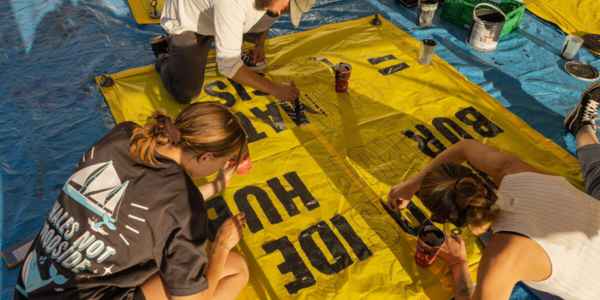
The banner drop is a distinctive part of the Greenpeace repertoire.
The moment of the unfolding is intrinsically dramatic. It is the reveal; when the moral and scientific truth of a situation is unveiled to the world. The wrong is being labelled—not through a written submission, or a social media post, or a statement in a meeting—but in words emblazoned in real physical space, chosen and occupied with precision, for all to see. There is jeopardy and transgression. And there are consequences—for the activists and for Greenpeace, as well as for the target of the communication. One of the reasons the banner remains such an effective tool in our toolbox is because of its undeniable clarity in cutting through, driving change and accountability in a way that few other tactics can. It is naming the wrong: in giant, clear letters.
We’ve hung these massive messages at environmental crime scenes, corporate headquarters, and iconic landmarks; on government buildings, ships and planes—in locations all around the world, for years.
My own memories unfurl even as I write this, but because the campaign to stop Woodside at Scott Reef is so pressing, what immediately springs to mind are two of our banners in that campaign: one on a crane outside their Perth HQ, and another on some of their corroding industrial junk at sea. What about you? Is there a particular banner that you picture when you think of Greenpeace?
The banners can attract global attention, but they have quiet beginnings. Each one is made by hand, often by volunteers. It is the invisible labour behind each spectacular public moment. One of the key pieces of equipment in our workshop at Rainbow Warrior House is the sewing machine. Sometimes our workshop is full of people and noise; at others it is quiet, the only sound being the gentle, purposeful, whir and buzz of a banner being sewn. It is usually our warehouse manager, Kieran Holmes, on the tools, head over the machine, carefully pouring over the raw canvas or tarp as the banner takes shape. Kieran’s one of those people who seems to be able to turn his hand to almost anything, but you wouldn’t know it because he’s old-school modest. In addition to being incredibly skilled, Kieran’s an all-round beaut human to have in the heart of our headquarters; never too busy to take the time to show a newcomer, or curious visitor, around his domain.
Once the banner is sewn up, the lettering needs to be outlined. This is done on a magnetic wall—a fit-for-purpose feature at Rainbow Warrior House, where the banner is held up with magnets, and the edges of the letters neatly traced from a projection.
Next comes the painting. It usually starts late in the afternoon, sometimes going into evenings and weekends, with volunteers, staff, mates crowded around, brushes in hand. It is a calming meditative feeling of shared purpose, giving each letter its visual heft, the colour building power and presence with each stroke.
Then you stand back, stretch, and look at the message, now ready.
S A V E S C O T T R E E F
Throughout history, every great push for social change has required some form of invisible labour; preparation in the form of quiet things seldom seen, but vital. It is the enabling work of love instantiated in action. And of course, so much of the time it has been women who have done this labour, so that the men could get the chance to make the speeches and stand on the podiums. The inaugural Greenpeace voyage to stop nuclear testing in 1971 had a male-only crew, but wouldn’t have happened without the ideas and work of women behind the scenes.
It is what we do together, after all, that changes the world. Sometimes that work happens on a stage, a ship on the wild seas, or up the side of a building. But mostly, it is the hidden diligence of those who care and contribute to all the enabling work that makes a change once thought impossible, inevitable. It is Kieran at his sewing machine. It was Dorothy Stowe doing the administrative work of the ‘Don’t Make A Wave Committee’ that became Greenpeace.
When we think of social change, it is the sturm and drang that we remember. The drop of the banner, the chant of the crowd, the raising of the new flag. But look behind the curtain, and there’ll be a crew of people who are taking responsibility for the administration, the sewing and the painting, making the food, checking the bus timetables, getting stuff done. And behind them are even more handsinvisibly donating time and trust; the financial, material and expert resources that make it all possible. There’s love, camaraderie and know-how at every stage.
We are social and cooperative creatures by nature. And we human beings have been stitching for millenia, sewing the possibilities of our common future. Political and corporate bullies and algorithmically manipulative platforms would have us forget this, and abandon who we are. But we should be in no doubt that the brighter prospects for ourselves and life on earth continue to be stitched and painted; collaboratively and with love, by the diligent hands of millions of people who care, each day, in every community and city across the world.
With Love,
David
Q & A
I always get great questions when interviewing prospective new team members. One that came up again recently was: “Is Greenpeace actually one organisation?”
Around the world, people know Greenpeace by our one global name, united by a shared mission: securing an Earth capable of nurturing life in all its magnificent diversity, with a particular focus on climate and biodiversity. Behind the scenes, though, we’re organised as a network of 25 legally autonomous national and regional offices, including Greenpeace Australia Pacific, working alongside Greenpeace International.
That structure gives us the best of both worlds: we work together leveraging the power of a global network on the issues that matter most, while each office remains legally independent and deeply connected to the communities, cultures and political realities where we’re embedded. Local knowledge informs global action, and global collaboration strengthens and supports local campaigns.
It’s a model that has enabled Greenpeace to take on some of the world’s biggest challenges for over five decades–while withstanding challenges and attacks from governments and corporations. Global enough to tackle global problems, local enough to understand our communities and the natural places we love.
If you’re curious to learn more, you can read about the Greenpeace Global Network structure here.
Steven Stone is acting director of the United Nations Environment Programme’s Office of Science
In 1934, American economist Simon Kuznets presented a paper to Congress advocating for a new way of measuring economic performance.
The United States was reeling from the Great Depression, and Kuznets – a future Novel prize winner – wanted to gauge just how badly the country’s economy had been dented.
His metric, which would come to be known as gross domestic product (GDP), was a breakthrough. But as pioneering as it was, Kuznets saw its limitations.
“The welfare of a nation can scarcely be inferred from a measure of national income,” he wrote in the 1934 paper.
Some nine decades on, we have largely forgotten that message. GDP has become a barometer of economic progress, a kind of one-number-that-rules-them-all upon which national policies turn and governments rise and fall.
With the climate crisis deepening by the day – as evidenced by the heatwaves and wildfires now searing Europe – our attachment to GDP is looking like a problem.
In a single-minded pursuit of GDP growth, humanity is inadvertently feeding several environmental crises that, over the long run, threaten to make most of us poorer, sicker and more miserable. Climate change alone could slice 20 per cent off global GDP by 2100 – a staggering number.
Clear-cutting boosts GDP not wealth
We need to broaden our vision and definition of economic success before it’s too late.
I grew up in the 1970s and 80s surrounded by the mixed hardwood forests of the northeastern United States. For me, the trees were a refuge, a place to run, discover and savor the history and mystery of the land and its people.
Those experiences with my friends were more important than the amount of money in my pocket. And they led to a realization early on in my career as an economist: that wealth is about more than just income.
This is one of GDP’s most significant oversights.
With every forest we clear cut and every ounce of fossil fuel we burn, GDP rises. But through those actions, we are whittling away at the natural world, which supplies us with food, water, medicine, clean air and countless other essentials.
-
China’s coal power rebounds as record clean energy goes to waste
Long-term contracts guarantee coal plants buyers regardless of demand, crowding out renewables, report finds -
Southeast Asia’s fragile grids threaten billions in clean energy investment
Renewables developers need reliable electricity infrastructure and stable policies to help the region meet climate goals and surging demand for power
By focusing only on GDP, we’re ignoring what’s happening to the natural assets on which our prosperity ultimately depends. It’s like we’re driving a car and only looking at the speedometer, not the energy remaining in the battery.
That is the difference between measuring income versus measuring wealth.
The answer to this dilemma lies in looking beyond GDP. We must start considering a broader range of indicators when making policy decisions.
From an environmental perspective, that means measuring and valuing natural assets like forests, water, soil, biodiversity and clean air. By assigning a value to nature, decision-makers can better understand the economic consequences of, say, strip-mining a mountain top or letting plastic waste overwhelm a river.
There is still some debate over how exactly to do this kind of natural capital accounting. But that’s not a reason to dismiss it, as many have done. It took years of refinement to end up with the GDP formula we have today.
Costa Rica’s example
The idea of looking beyond GDP isn’t only a theoretical debate. Countries and communities around the world have started to make economic decisions based on their natural assets. A prime example is Costa Rica, a biodiversity hotspot where a years-long effort to conserve land and seascapes has led to a boom in tourism. That in part helped elevate the country into the club of high-income nations.
This kind of environmentally focused economic decision making can pay huge dividends. By stabilizing the climate, ending pollution and halting the loss of the natural world, humanity could save millions of lives a year and create US$20 trillion in economic benefits annually by 2070, found the Global Environment Outlook 7, a 2025 report from the United Nations Environment Programme (UNEP). The report was funded by the European Union among others.
I began my career as an economist before moving to UNEP, which focuses on solving the world’s thorniest environmental problems. During that time, I’ve come to appreciate that “wealth” means more than simply “income.” True prosperity means being able to provide for ourselves now and into the future. Anything short of that is an empty kind of affluence – and ultimately doomed to be short-lived.
As deadly heat blankets our cities, species slip into extinction and the planet struggles with rising toxicity and pollution, I am convinced that we can do better at measuring what matters. And that means updating and expanding how we measure economic progress.
The post As fires burn and temperatures soar, it’s time to imagine a world beyond GDP appeared first on Climate Home News.
As fires burn and temperatures soar, it’s time to imagine a world beyond GDP
Amira Odeh Quiñones is a hydrologist and Caribbean organiser for the 350.org climate campaign group
El Niño, likely to be one of the strongest in modern history, has arrived on Caribbean shores.
Drought is slowly creeping up on our islands. But unlike the fiery wildfires ravaging parts of Europe, there’s no smoke signalling the damage being done, no sirens to warn of the danger. Only announcements from public health officials to stay indoors and remain hydrated — as if outdoor workers and farming communities have the luxury to heed such advice.
During El Niño, strong atmospheric winds alter rain patterns and trap heat across the Caribbean. But while we have experienced El Niño many times before, it has become very visible in recent years how climate change is making this natural phenomenon worse.
Across the Greater Antilles, temperatures are soaring past 38°C (100°F), with real-feel indexes reaching a gruelling 43°C in parts of Puerto Rico where I live. Cuba has it worse. Widespread power outages mean that methods for cooling down are unavailable for most of the day, leaving millions of vulnerable people at risk of heat stroke when temperatures hit 38°C.
Santa Marta coalition tested as co-chair Colombia turns back to fossil fuels
During the last strong drought a decade ago, I had water only two days a week in my home. Today, there are many families whose taps are about to run completely dry. Water authorities have already begun strict rationing in some municipalities, with more on the list scheduled for rationing if conditions don’t change.
Water rationing is far more than an inconvenience; it is an immediate health risk. This means thousands of people need to constantly haul heavy buckets up flights of stairs just so they could bathe, cook, stay hydrated – the basics of survival.
Heat causes health problems
Puerto Rico is home to roughly 300,000 elderly residents. Many live alone, isolated and without support. They risk severe physical injury when carrying heavy water containers, and are wont to suffer from silent heat exhaustion in unventilated rooms.
Furthermore, when water shortages force residents to store water in open household containers, it inadvertently creates breeding grounds for Aedes aegypti mosquitoes. Paired with scorching temperatures that tend to shorten the mosquito breeding cycle, the region is facing explosive outbreaks of dengue fever that endanger our most vulnerable: children and the elderly.
The economic fallout is equally devastating. Dry fields mean millions of dollars in lost crops, forcing small agricultural businesses to collapse, needing urgent government relief to survive. Extreme fuel shortages have already paralyzed Cuba’s agricultural sector, cutting food output by 60% – the El Niño dry spell threatens to decimate it.
At sea, warmer ocean waters fuel massive influxes of sargassum seaweed. Rotting sargassum chokes our beaches, destroying the local tourism industry that so many working families rely on. Tangled seaweed also damages nets and boat engines, slashing fish catches and driving up equipment costs for local fishers.
In the south of Puerto Rico, the coastal town of La Parguera is currently witnessing a historic amount of sargassum on its shores. This has halted most of the boating activity in the area, which is the seaside town’s main tourist draw and economic driver.
All over the Caribbean, from town halls to local group gatherings, the story I hear is always the same: constant headaches, lost work hours, failing health, and a sense that quality of life is silently being stolen. The compounding effects of heatwaves, drought, and marine destruction are exhausting our people, our islands.
Climate change to blame
Climate change makes each El Niño year hotter and more damaging. Higher baseline global temperatures increase the energy and moisture available for extreme weather. Latest projections show that El Niño may push the monthly global average temperature past 2°C of warming for the first time in early 2027. In the Caribbean islands, that will not just be breaking records – it’ll be breaking lives.
Recently, I had the opportunity to share a panel with climate scientists behind what is known as the field of “attribution science” – or the science that compares today’s climate conditions to what the Earth’s climate would be like without human activity, particularly burning fossil fuels. They’re unequivocal: it’s no longer a question of whether extreme weather is caused by climate change, it’s just a question of how much.
-
Southeast Asia’s fragile grids threaten billions in clean energy investment
Renewables developers need reliable electricity infrastructure and stable policies to help the region meet climate goals and surging demand for power -
Quarter of countries still missing UN climate plans 18 months after deadline
Egypt, Vietnam, Argentina and the Philippines are among the 45 nations which have breached the Paris Agreement by not submitting their climate plan to the UN -
China’s coal power rebounds as record clean energy goes to waste
Long-term contracts guarantee coal plants buyers regardless of demand, crowding out renewables, report finds

Attribution science recently got a boost from the U.S.’ top scientific advisory body. The National Academies of Sciences, Engineering and Medicine recognized that researchers’ methods have advanced considerably in recent years, resulting in better assessments on how much extreme weather can be attributed to human-caused climate change. It noted that attribution findings could be relevant in some types of legal cases, including those seeking damages from oil companies for climate impacts.
This crisis, which is already taking a heavy toll on our communities’ survival, needs real, urgent, and structural action that goes beyond aid. With similar droughts now gripping parts of Asia and Africa, we’re falling into the familiar narrative of treating the looming humanitarian crisis as if no one was to blame, as if it is being caused solely by a natural phenomenon we can’t control.
It’s not. The world was already on fire before its regular visitor, El Niño, came. While we need humanitarian action, we need climate action too, in order to permanently put out the flames.
The post When taps run dry in the Caribbean, it’s not enough to blame El Niño appeared first on Climate Home News.
When taps run dry in the Caribbean, it’s not enough to blame El Niño



-
Climate Change12 months ago
Guest post: Why China is still building new coal – and when it might stop
-
Greenhouse Gases12 months ago
Guest post: Why China is still building new coal – and when it might stop
-

 Greenhouse Gases2 years ago
嘉宾来稿:满足中国增长的用电需求 光伏加储能“比新建煤电更实惠”
-

 Climate Change2 years ago
嘉宾来稿:满足中国增长的用电需求 光伏加储能“比新建煤电更实惠”
-
Climate Change2 years ago
Bill Discounting Climate Change in Florida’s Energy Policy Awaits DeSantis’ Approval
-

 Renewable Energy10 months ago
Sending Progressive Philanthropist George Soros to Prison?
-
Greenhouse Gases1 year ago
嘉宾来稿:探究火山喷发如何影响气候预测
-

 Carbon Footprint2 years ago
US SEC’s Climate Disclosure Rules Spur Renewed Interest in Carbon Credits