


The semiconductor industry powers artificial intelligence, cloud computing, and modern data centers. Yet, it is also one of the most energy-hungry and resource-heavy industries. When Nvidia announced a $5 billion investment in Intel, with plans to co-develop chips that combine Nvidia’s AI technology with Intel’s CPU architecture, many see this as a big business move.
Adding to the spotlight, Nvidia also signed a $100 billion deal with OpenAI to supply advanced AI hardware for the next generation of AI models. However, these moves raise an important question: can such deals help reduce carbon emissions and improve sustainable computing?
The High Cost of Silicon: Why ESG Matters
Environmental, social, and governance (ESG) issues now play a major role in how technology companies are judged. Making chips requires huge amounts of water, energy, and chemicals.
Once built, the chips power data centers and AI systems that consume even more electricity. This makes sustainability a challenge for both chip production and chip use.
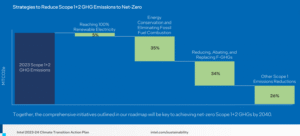
Both Intel and Nvidia have set ambitious climate goals. Intel has pledged to reach net-zero greenhouse gas emissions for Scope 1 and Scope 2 operations by 2040. The company further aims for net-zero upstream Scope 3 emissions by 2050. It also targets net-positive water use and zero waste to landfills by 2030.
Nvidia, which outsources chip production, promises to lower emissions in its products. It also wants suppliers to set science-based climate goals.
By the end of fiscal 2025, Nvidia used 100% renewable electricity in all its offices and data centers. This move cut its Scope 2 emissions to zero. In fiscal 2024, the company emitted 3,692,423 metric tons of CO₂ equivalent. This total includes emissions from Scopes 1, 2, and 3, showing its environmental impact.

Nvidia surpassed its supplier engagement goal. It worked with partners covering over 80% of Scope 3 Category 1 emissions, up from the initial target of 67%.
By joining forces with Intel, Nvidia gains access not only to its production capacity but also to its sustainability practices. Intel aims for cleaner supply chains and greener manufacturing. This effort could lower the impact of new joint chips.
- RELATED: Intel Stock Surges 9.8% on $2B SoftBank Deal: Can Its Net-Zero Push Power the Future of Chips?
Nvidia is “fabless” and usually relies on partners like Taiwan Semiconductor Manufacturing Company (TSMC). This partnership gives Nvidia more control over how chips are made, packaged, and delivered.
The recent OpenAI deal further emphasizes Nvidia’s role in high-powered AI while keeping sustainability in mind. The company will provide energy-efficient chips for OpenAI’s large AI tasks. This shows the importance of balancing AI development and reducing carbon emissions.
Power-Hungry AI: Cutting Emissions per Computation
The environmental impact of chips is not limited to their production. In fact, much of the emissions tied to semiconductors come from how they are used in practice. Large-scale AI training, for example, requires massive computing power and electricity.
As demand for AI continues to surge, the energy needs of data centers are climbing quickly. The International Energy Agency predicts that global data center electricity demand may double by 2030. This raises concerns about the carbon footprint of AI-driven growth.

Here, the Nvidia-Intel partnership could play a vital role. Intel has set a target to improve the energy efficiency of its processors by 10 times by 2030. Nvidia is also focusing on efficiency. They aim to cut emissions for each computation. This includes lowering carbon dioxide equivalent per petaflop of processing power.
The OpenAI deal adds another layer. Nvidia will supply AI chips to power massive models while aiming to maintain energy efficiency. This ensures that even as AI workloads grow dramatically, emissions per computation can stay lower than older technologies.
“Compute infrastructure will be the basis for the economy of the future,” said Sam Altman, cofounder and CEO of OpenAI. “We will utilise what we’re building with Nvidia to both create new AI breakthroughs and empower people and businesses with them at scale.”
- RELEVANT: NVIDIA Stock (NVDA) Surges: Driving AI Mobility and Cloud Growth with OpenAI and Oracle Partnerships
Nvidia and OpenAI: The $100 Billion AI Hardware Deal
Under its $100 billion deal with OpenAI, Nvidia will provide AI hardware for the next generation of large AI models. This agreement names Nvidia as the main supplier of specialized GPUs and AI chips for OpenAI’s large computing tasks.
The deal includes support for AI training infrastructure. It also covers software optimization and ongoing maintenance of data center operations.
Nvidia’s fine print states it will provide advanced GPUs over the years. This way, OpenAI can grow its AI systems smoothly and without delays. OpenAI will also commit to using Nvidia’s energy-efficient chips and adopt best practices to limit energy use per computation. Both companies will closely track power use and emissions. They will link efficiency gains to contract milestones.
The companies will work together to build advanced AI supercomputing systems, starting with the Nvidia Vera Rubin platform in the second half of 2026. They plan to roll out 10 gigawatts of computing power, creating one of the largest AI infrastructures ever.
This partnership emphasizes two points:
-
AI demand is growing at an unprecedented speed, and
-
There is increasing pressure to meet that demand while minimizing carbon emissions.
Nvidia is using high-performance, energy-efficient hardware to support OpenAI’s bold AI projects. This helps keep energy use and emissions low. The deal further boosts Nvidia’s role in driving sustainable AI growth. It aligns with its ESG and supply-chain efforts.
Following this announcement, Nvidia’s stock experienced a significant uptick. Shares surged over 4%, making it a top performer on major indices including the Dow, Nasdaq, and S&P 500. This surge reflects investor optimism about Nvidia’s strengthened position in the AI infrastructure market.

The Fine Print: Supply Chains and Scope 3 Hurdles
Even with progress, the semiconductor industry faces significant challenges in reducing its environmental footprint. Making advanced chips requires temperatures over 1,000°C. It also requires special chemicals and rare materials such as gallium, cobalt, and indium.
Modern fabs use a lot of energy. For example, one Intel fab can use up to 150 million kWh of electricity each year. This results in about 50,000 metric tons of CO₂ emissions annually.
Globally, semiconductor manufacturing produces over 400 million metric tons of CO₂ each year. This is about 1% of all global emissions. With demand for AI chips and cloud services growing, efficiency gains risk being offset.
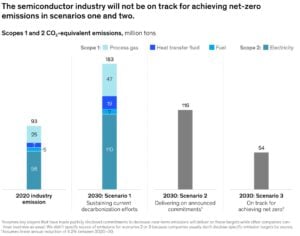
McKinsey & Company’s analysis suggests that the industry must reduce Scope 1 and 2 emissions by at least 4.2% annually from 2020 levels to align with a 1.5°C trajectory by 2030. However, even with full implementation of current decarbonization measures, emissions could reach 89 million tons of CO₂e by 2030, falling short of the 54 million tons needed for net-zero by 2050.
Supply chains are an even bigger hurdle. Scope 3 emissions cover raw material extraction, supplier manufacturing, packaging, and logistics. They can account for 70–80% of a chipmaker’s total carbon footprint.
Nvidia has already engaged suppliers covering over 80% of Scope 3 Category 1 emissions, exceeding its initial 67% target. Yet, emissions from mining, wafer fabrication by foundries, transportation, and overseas assembly are still significant. For example, shipping a single ton of semiconductor wafers internationally can add up to 20 metric tons of CO₂.
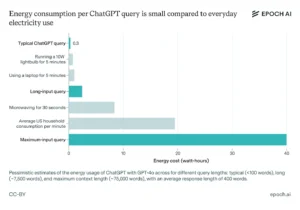
Energy sourcing is also critical. Chips remain high-emission if produced or operated in regions reliant on fossil fuels. Training a large AI model, such as OpenAI’s GPT-4 or the future GPT-5, can use up to 1,000 MWh of electricity. This process may emit hundreds of metric tons of CO₂, depending on the energy source. It does not even include the energy for using the AI model.
A coal-powered data center with an efficient chip generates 17 kg of CO₂ per teraflop. In contrast, renewable-powered setups only produce 4–5 kg per teraflop. The Nvidia–OpenAI deal focuses on providing GPUs and AI hardware.
This new tech aims to boost energy efficiency. It could cut emissions per computation by 30–50% compared to older hardware. This shows that while chip-level efficiency is essential, a full lifecycle approach is necessary.
Emissions reduction relies on several factors. It depends on processor design, energy sources for manufacturing, supplier practices, and how data centers operate. Without cleaner grids and good supply chain management, much of the carbon-saving potential from new chips and AI workloads may be wasted.
Beyond Business: A Climate Play in Disguise
These partnerships show that top chipmakers now see sustainability as part of growth. Investors, customers, and regulators are increasingly focused on the carbon footprint of technology. Linking climate goals to high-profile deals shows that Nvidia and Intel view emissions reduction as a strategic priority.
The Nvidia-Intel partnership and Nvidia’s OpenAI deal could shape the chip industry’s climate impact. Intel’s clean manufacturing record and Nvidia’s efficient AI hardware can help reduce emissions in production and use.
Still, the results will depend on whether efficiency matches demand and if energy sources move to renewables. For now, these collaborations highlight how innovation and sustainability can go hand in hand.
The post NVIDIA’s Mega Deals with OpenAI and Intel Fuel Stock Performance and Sustainable Tech in 2025 appeared first on Carbon Credits.

For most businesses, the emissions that matter most sit outside their own walls. Scope 3 emissions, everything generated across your value chain, from the suppliers who make your inputs to the customers who use your products, typically make up the majority of a company’s total carbon footprint. Under the Corporate Sustainability Reporting Directive (CSRD), those value-chain emissions now have to be measured and disclosed with a rigour that spend-based estimates alone struggle to satisfy. This guide sets out how to improve Scope 3 data accuracy for CSRD: the calculation methods open to you, how to move from estimates to verified supplier data, and how to govern that data so it holds up to audit.

A carbon credit is a commitment that extends well into the future. The tonne of CO₂ compensated for today from a nature-based carbon project must remain out of the atmosphere for good, which means the forest behind the credit has to remain standing long after the transaction is complete. For any buyer, this raises a defining question: What ensures that the forest endures?

What replaced the cheap REDD credit on the boardroom slide deck, and why procurement is leading the rewrite.
Three years ago, a corporate slide showing a portfolio of cheap REDD+ credits could carry a board meeting. The number was big, the price was low, and the press release wrote itself. Today, that same slide gets sent back with questions. The questions are uncomfortable, the answers are unclear, and your general counsel is suddenly in the room.
Conventional carbon offsets are not dead. The voluntary carbon market retired 202 million tonnes in 2025, and the Morgan Stanley Institute for Sustainable Investing survey published in January 2026 confirmed that interest from corporate buyers remains substantial. What changed is the credibility threshold. The integrity floor has risen, the disclosure scrutiny has tightened, and the buyer profile has shifted. This article tracks what changed, what sophisticated buyers now ask before signing, and what serious corporates are putting on the board slide instead.
What boards used to buy, and why it stopped working
The 2020 to 2022 model was simple: buy a large tranche of avoidance credits at low single-digit prices, retire them against the company footprint, announce the carbon-neutral claim, and move on. Most of those credits came from REDD+ projects, renewable energy installations in countries where the renewable energy was already economic, or methane projects with thin documentation.
Several things broke that model. Academic research published in 2023, including a widely cited Science paper, found that the majority of REDD+ credits issued under the most common methodologies did not represent additional reductions when tested against rigorous counterfactuals. The Voluntary Carbon Markets Integrity Initiative published its Claims Code of Practice, which sets requirements for what companies can credibly claim from credit use. The European Union finalised its Green Claims Directive, restricting how companies can describe products as climate-neutral. France’s Décret 2022-539 already restricts carbon neutrality advertising. California’s AB 1305 imposes disclosure requirements on any company making net-zero or carbon-neutral claims while doing business in the state.
The collective effect: the cheap credit no longer buys the announcement, and the announcement now carries litigation risk.
The integrity reset: ICVCM, VCMI, and what changed
The Integrity Council for the Voluntary Carbon Market published the Core Carbon Principles in 2023 and began assessing methodologies against them in 2024. The first methodologies received the CCP label later that year. The point of the label is to give corporate buyers a defensible quality screen they can cite in disclosure.
The Voluntary Carbon Markets Integrity Initiative complements this on the demand side. Its Claims Code of Practice defines what a buyer can say (Silver, Gold, or Platinum claims, with associated requirements) based on the quality of credits used and the underlying decarbonisation strategy. Together, CCP and VCMI build a quality stack: CCP on the supply, VCMI on the claim, with the science-based target sitting underneath both.
The reset is not a ban on offsets. It is a ratchet. Credits that meet the new bar continue to clear; credits that do not, do not. The Morgan Stanley survey found that 61% of current buyers like the CCP label concept but that supply of labelled credits remains limited. That supply constraint is now visible in pricing.
What sophisticated buyers ask before they sign
The questions on the procurement scorecard have changed. A 2022 buyer might have asked about price, vintage, and project type. A 2026 buyer asks five different questions before any of those.
- What does the counterfactual look like, and who validated it.
- What is the permanence regime, and what is the buffer pool exposure.
- What is the leakage risk, and how is it mitigated.
- What rating has the project received from the independent ratings agencies (Sylvera, BeZero, Calyx Global), and what was the rationale.
- What is the documentation discipline that survives an audit four years from now when the procurement team that signed the contract has moved on.
If the vendor cannot answer those five questions on a first call, the conversation ends. Conversely, if the vendor can answer them with documented specificity, the conversation often expands beyond a single transaction toward a multi-year engagement.
Where this leaves your near-term commitments
You probably have near-term commitments that pre-date the integrity reset. Public targets to be carbon neutral by 2025 or 2030. Product-level claims that ran in last year’s marketing. Disclosed reduction trajectories that assumed continued access to cheap credits.
You have three workable paths. The first is to re-baseline your strategy, replacing the most exposed credits with higher-quality alternatives and adjusting the public language to match what you can defend. The second is to shift the underlying spend from offsetting outside your value chain to investing inside your value chain, where reductions count against Scope 3 directly and the audit trail is cleaner. The third is to keep the strategy and absorb the risk, which is increasingly the most expensive option once you price in litigation, restatement, and reputational exposure.
Most serious buyers are choosing the second path. It moves the carbon spend from a compliance cost to a procurement and resilience investment, and it removes the central failure point of the legacy model: the disconnect between where the emissions occurred and where the reductions sat. Nature-based supply chain investments, structured under the GHG Protocol Land Sector and Removals Standard and aligned to the SBTi FLAG Guidance, are the asset class that fits this brief. They generate inventory-grade reductions, they produce audit-grade documentation, and they survive the new claim restrictions because the carbon math sits inside the value chain that the disclosure already covers.
If you are reassessing a carbon strategy under the new integrity bar, or rebuilding a board narrative that has to survive a more skeptical audience, the carbon and sustainability experts at Carbon Credit Capital can help. The Dual-Value Model gives you a defensible alternative to legacy offset purchases, with the documentation and operational integration that survives the procurement scorecard and the audit. Schedule a consultation.



-
Climate Change11 months ago
Guest post: Why China is still building new coal – and when it might stop
-
Greenhouse Gases11 months ago
Guest post: Why China is still building new coal – and when it might stop
-

 Greenhouse Gases2 years ago
嘉宾来稿:满足中国增长的用电需求 光伏加储能“比新建煤电更实惠”
-

 Climate Change2 years ago
嘉宾来稿:满足中国增长的用电需求 光伏加储能“比新建煤电更实惠”
-
Climate Change2 years ago
Bill Discounting Climate Change in Florida’s Energy Policy Awaits DeSantis’ Approval
-

 Renewable Energy9 months ago
Sending Progressive Philanthropist George Soros to Prison?
-

 Carbon Footprint2 years ago
US SEC’s Climate Disclosure Rules Spur Renewed Interest in Carbon Credits
-
Greenhouse Gases1 year ago
嘉宾来稿:探究火山喷发如何影响气候预测