

The International Finance Corporation (IFC), part of the World Bank Group, approved up to $600 million in funding to support ENGIE Energía Perú’s push into non-conventional renewable energy. Of that, $250 million is from the IFC itself, and an additional $350 million comes from other mobilized investors.
The financing structure is a Sustainability-Linked Loan (SLL), which links financial terms to performance goals. Let’s uncover where the funds will go and how this will help ENGIE’s net zero and climate goals.
Where Will the Money Go?
The goals of the fundraising are to expand renewable energy, support climate adaptation, and promote gender diversity initiatives. The first tranche of $120 million will immediately fund the acquisition and development of key renewable infrastructure.
The first installment will finance these three major projects:
- Expand the Intipampa Solar Plant: Increase capacity by 51.4 MW in Moquegua, boosting total solar output.
- Wind Farm Acquisitions: Acquire existing wind capacity of 36.8 MW at the Duna and Huambos sites.
- Battery Energy Storage System (BESS): Develop or refinance the 26.5 MW Chilca battery system—the largest in Peru—to improve grid flexibility.
These investments help ENGIE reach its goal of adding 800 MW of non-conventional renewables in five years. This will transform the country’s energy mix.
ENGIE’s Power Play in Peru’s Energy Market
ENGIE Energía Perú (EEP) is a dominant force in Peru’s energy sector. By 2024, it was the biggest electricity generator in the country. It owned about 2,694 MW from ten plants. This made up 19% of Peru’s total installed capacity and around 14% of national production.
EEP’s renewable and conventional installations include:
- Punta Lomitas Wind Farm (296 MW), the largest in Peru.
- Expanded solar capacity with Intipampa.
- Hydro and gas-fired plants such as Chilca and Ilo.
- The Chilca BESS, launched in 2023 with an investment of approximately $20 million, demonstrates its adaptability and drive for stability.
Peru’s Renewable Wave: From Hydro to Solar Growth
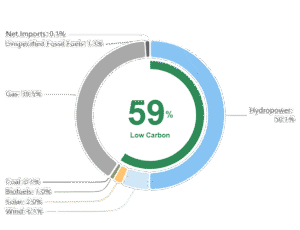
Peru’s electricity mix is shifting. In 2024, renewables accounted for arond 59% of electricity, with breakdowns of hydroelectricity at almost 50%, wind at around 6%, solar at almost 2%, and biomass at 0.8%.
The country boasts significant untapped renewable potential:
- Hydropower: Installed capacity stands at 5.7 GW (2020), with untapped technical potential of ~70 GW.
- Renewables Market Growth: In 2022, Peru’s renewables sector generated 34,727 GWh, valued at around $900 million, with moderate annual growth in both output and value.
Looking ahead, an IFC study predicts that by 2050, wind and solar could make up 45% of installed capacity in the country. This growth will be backed by investments in grid storage, which will help improve system resilience.
Other big investments show regional growth. For instance, Spain’s Zelestra is investing $1–1.5 billion in Peru’s renewable energy. This will support mining operations with a pipeline of 1 GW capacity.
How The Loan Could Change Peru’s Grid
The $600 million SLL from IFC is more than capital; it’s a catalyst for renewable energy growth in Peru. The key benefits include:
Increased Clean Energy: The financing helps deliver over 100 MW of additional wind and solar capacity, plus the country’s largest BESS, enhancing energy diversification.
Climate Action: IFC estimates the Intipampa expansion alone will save 61,461 tonnes of CO₂ equivalent per year by displacing fossil-based electricity.
Grid Modernization: Energy storage fosters a more flexible, renewable-friendly grid and supports off-grid electrification in rural areas.
Market Confidence: The SLL’s structure signals investor belief in Peru’s green energy potential and supports broader regional ambitions.
ENGIE’s expansion is part of a broader wave of renewable growth in Latin America. In Peru, ENGIE’s projects contribute to the broader energy transition—and set an example for public-private collaboration in sustainable infrastructure.
More notably, it forms part of the energy giant’s net zero goals.
ENGIE’s Global Renewable Energy and Net-Zero Strategy
The company’s global stance reflects increasing corporate commitment to clean energy infrastructure. The infographics below shows ENGIE’s decarbonization ambitions.
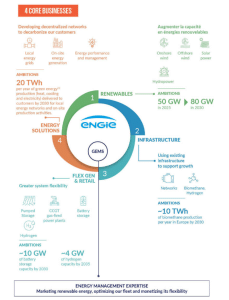
Globally, ENGIE has positioned itself as a leader in the clean energy transition. It aims to achieve net-zero greenhouse gas emissions by 2045. The company focuses on quickly increasing renewable energy capacity. It aims to phase out coal and expand energy storage solutions. This will help integrate more variable renewables.
By 2025, ENGIE targets 50 gigawatts (GW) of renewable capacity worldwide, growing to 80 GW by 2030. This expansion focuses on wind, solar, hydro, and green hydrogen projects, supported by digital tools for efficiency and performance monitoring.
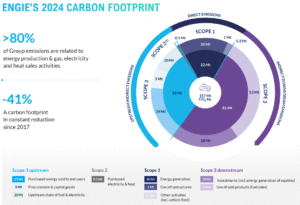
ENGIE has cut its direct emissions (Scope 1) by over 40% from 2017 to 2024. This change came mainly from retiring coal assets and switching to clean energy. Below is the company’s 2024 carbon footprint.
The company is investing in large energy storage, aiming for 10 GW of battery capacity by 2030. This will help keep the grid stable as more renewable energy comes online.
ENGIE’s climate roadmap includes Science Based Targets initiative (SBTi) validation, ensuring its emissions reduction pathway aligns with the Paris Agreement’s 1.5°C goal.
These global efforts reinforce ENGIE’s operations in Peru, showing how the company’s local renewable expansions contribute to a broader, coordinated push toward a carbon-neutral energy system worldwide.
Moreover, ENGIE supports strong carbon pricing policies and systems that encourage investment in low-emission technologies, energy efficiency, and reduced energy use.
As part of its path to net zero, the company plans to carry out internal carbon absorption projects and use carbon removal credits. These credits will follow the Integrity Council’s ten principles, with a focus on transparency, proving real additional impact, and ensuring that reductions last over time.
With IFC’s backing, ENGIE Energía Perú is poised to expand its renewable energy footprint significantly. The financing supports solar expansion, wind farm acquisition, and advanced energy storage. This boosts Peru’s clean energy pipeline, strengthening grid reliability, and contributing to national sustainability targets.
As Peru works toward a greener energy future, ENGIE’s investments may become a model for transformative growth across Latin America.
The post ENGIE Lands $600M from World Bank Group and Investors to Boost Peru’s Renewable Energy appeared first on Carbon Credits.

EU carbon credit claims changed on 27 September 2026, the day the Directive (EU) 2024/825 began to apply across the European Union. The change is narrow. It changes how a company can talk about the credits it buys. A product can no longer be called neutral on the strength of compensation alone; however, every specific, evidenced statement about what a company measured, reduced, and funded stays fully available.

The post Promoting Improved Cooking Practices in Nigeria appeared first on Terrapass.


-
Climate Change1 year ago
Guest post: Why China is still building new coal – and when it might stop
-

 Greenhouse Gases2 years ago
嘉宾来稿:满足中国增长的用电需求 光伏加储能“比新建煤电更实惠”
-
Greenhouse Gases1 year ago
Guest post: Why China is still building new coal – and when it might stop
-

 Climate Change2 years ago
嘉宾来稿:满足中国增长的用电需求 光伏加储能“比新建煤电更实惠”
-

 Renewable Energy12 months ago
Sending Progressive Philanthropist George Soros to Prison?
-
Climate Change2 years ago
Bill Discounting Climate Change in Florida’s Energy Policy Awaits DeSantis’ Approval
-
Greenhouse Gases1 year ago
嘉宾来稿:探究火山喷发如何影响气候预测
-

 Climate Change2 years ago
Analysis: China’s CO2 falls 1% in Q2 2024 in first quarterly drop since Covid-19