

Vattenfall Ad, NextEra’s US Wind Strategy
The crew discusses Vattenfall’s ad featuring Samuel L. Jackson and explore NextEra Energy’s strategies amid regulatory changes. They also highlight the importance of inspections and CMS and Rosemary’s takeaway from an Australian wind conference.
Sign up now for Uptime Tech News, our weekly email update on all things wind technology. This episode is sponsored by Weather Guard Lightning Tech. Learn more about Weather Guard’s StrikeTape Wind Turbine LPS retrofit. Follow the show on Facebook, YouTube, Twitter, Linkedin and visit Weather Guard on the web. And subscribe to Rosemary Barnes’ YouTube channel here. Have a question we can answer on the show? Email us!
Speaker: [00:00:00] You are listening to the Uptime Wind Energy Podcast brought to you by build turbines.com. Learn, train, and be a part of the Clean Energy Revolution. Visit build turbines.com today. Now here’s your hosts, Allen Hall, Joel Saxu,, Phil Totaro, and Rosemary Barnes.
Speaker 2: Welcome to the Uptime Wind Energy Podcast from the Queen City, Charlotte.
North Carolina. I have Phil Totaro in California, Joel Saxum’s back in Texas, and Rosemary Barnes is here from the great country of Australia where Joel and Rosemary, along with Matthew Stead, will be rolling along the countryside visiting with. Wind turbine operators here soon, right
Speaker 3: Yeah, so the, the 11th through the 14th, uh, we’re gonna be jumping down to Melbourne because of course that’s, that’s wind central for operators and, uh, ISPs in Australia.
And we’re gonna be talking about all kinds of stuff with, uh, anybody that listen to us talk. So if you’re listening here, uh, and you’re in [00:01:00] Australia, connect up, uh, joel.saxo at uh, wg lightning.com. Uh, we’ll get some meetings set ’cause we want to, we want to hear what issues are happening down there, right?
What can we help with? What can we solve? Of course, Alan and I on the lightning side here, Rosemary is an independent expert engineer for you name it, in turbines. Uh, and our friend Matthew Stat over at iLogic Ping in the CMS space. And amongst the three of us, we also have a huge network, right? So if we’re, if we’re, if we getting into conversation, getting a chance to chat, tell us what.
You got for problems and we’ll help you solve ’em. So we’ll be down there the 11th or the 14th of August. Uh, reach out.
Speaker 2: Yeah, so there’s a lot happening in Australia at the minute. It’s starting to come out a winter, getting into blade repair season that is, uh, about to fire up in Australia. A lot going on around the world.
And today is Wednesday when we’re recording. And this is the day where Vattenfall released their Samuel L. Jackson. Add, it’s about a minute long [00:02:00] and you see Samuel L out on the shoreline with a bag of what? Seaweed chips. Joel, is that what they are? Or crackers of some sort?
Speaker 3: Yeah, a hundred percent. I gotta be, I’ll be a little bit, little honest with you.
I had some of those, not the same ones, not the Vattenfall ones, but I had some the other day just to try ’em out. They’re not my flavor. I’m gonna be honest with you. Don’t they just taste like sea salt? They taste like seaweed.
Speaker 2: That’s what it is.
Speaker 3: I know, but they’re, they’re not that awesome.
Speaker 2: But these, uh, crackers were the output of the seaweed and all the things growing around the offshore wind turbines.
I, I assume it’s just seaweed, right, Joel? It’s not anything else but seaweed. There’s no fish involved in that. It’s kelp. But see, like kelp, so
Speaker 3: like offshore kelp farming is a complete industry. Right. It’s just like offshore fish farming. They put these lines out, it grows on the lines, and then they pull it in and they harvest it.
This is a regular thing, however, having infrastructure out in the water, IE turbine foundations helps with all of these things. It’s structure there that protects ’em from, um, [00:03:00] currents and it, and it’s also things to hook lines too. So there’s a. There’s a symbiosis of offshore wind farms and the kelp farming community, and they’re showcasing this in the VA Vattenfall ad, kind of showing the value add of turbines of outside of all of the decarbonization of the grid and things we’re doing for renewable energies.
There’s also things in the, uh, blue economy, blue economy is the term for like ocean.
Speaker 2: There was a lot blue with that ad and it had nothing to do with the ocean. We just played it for rosemary, the unedited version or the un bleep version. Rosemary, what did you think of that ad?
Speaker 4: I really liked the video and what made, what was most amusing to me was imagining the pitch meeting at, you know, like a, some boardroom in Sweden.
Somebody had to pitch that video. Not only selecting Samuel Jackson, I, it’s not, doesn’t immediately come to mind when I think of wind energy and yeah, I mean, people will have to watch a video for themselves to see why I think that’s so funny. But definitely well [00:04:00] worth that minute or so of your life that that will take up.
Speaker 2: Well, is it, is it something that American Clean power should have done about six weeks ago? I just thought it was odd that Vattenfall was the one to pick up the baton and run with it instead of who, who we would normally think as being the thought leader in the United States. American clean power.
Speaker 3: I was thinking about a CP back when that was happening, and I, and I thought, what, what’s, what’s their response gonna be?
And their response was, we put out a statement. Okay. What does that do? Like, what’s the point here? Like you’re putting out a statement like, I, I don’t know. What’s that gonna accomplish? What are you gonna do with this? What is the action out of it? What is the, where are you, uh, standing up on a soapbox or like trying to get something changed?
Like, it, it does nothing for me.
Speaker 4: Yeah. I, I imagine a CP would be too worried about offending somebody with that ad. I, I would find it actually more surprising to come from them than, than from Sweden or, um, yeah, any other country. [00:05:00] But also, I don’t know, I don’t, uh, I don’t see a lot of impact from a CP and maybe it’s just, you know, obviously they’re not my organization.
I’m not, I’m not in the us I’m not doing a lot of work in the US so, um, I’m probably out of the loop. But, you know, the events don’t seem particularly, uh, I don’t know, I don’t come away energized like I do when I go to a lot of European events and our own events that we do in, in Melbourne. I was also at another really great one in Australia last week, uh, about renewables and agriculture, and that was fantastically energizing with a totally, uh, diverse group of people from all kinds of backgrounds, sharing ideas and actually, um, you know, like raising problems that need to be solved and figuring out the ideas to do it.
People sharing success stories. It was, you know, like a, it was a conference that is. Like, that’s the reason why conferences should exist for that sort of thing. I met so many interesting people, some of [00:06:00] who I really want to get on the show to talk about things like, you know, what’s it actually like to have a wind farm built in, um, built through your property or transmission.
Um, and then yeah, as well as. You know, there was a dairy farmer who had a couple of micro wind turbines on her site, uh, for example, along with lots of people with solar power and batteries. And, um, yeah, I even visited a, a piggery that’s got biogas recovery and, uh, using that to power the, um, the pig sheds.
So it’s kind of like circular. Um, so much cool
Speaker 3: stuff there. Did you refer to the pig farm as a piggery?
Speaker 4: Yeah.
Speaker 3: I wanna make sure I got that correct.
Speaker 4: Is it
Speaker 3: what, not what do you call pig farms? What do you call pig farms? Pig farm. That you bring up. A good point there, because this, this happens to us in the states sometimes, like if you go to the same conferences, for the most part you see the same people at the same conferences.
You have a lot of the same conversations. It’s of course great to catch up. I’m talking, I’m talking from the. From, you know, the, the, the, the commercial role. It’s of course great [00:07:00] to catch up with people and have touch points and have your meetings ’cause everybody’s in the same spot. But it’s pretty rare anymore, like say in the wind industry, at least in the United States, that you go to an event and you leave there and you’re like, oh, I got all these.
These new people to talk to and I got all this new information and like this new technology, this new innovation, like that doesn’t happen that much. But I will, I’m gonna go back to what you said. When I go to win Europe and when I go to Hamburg, like I do leave those events feeling a little bit more like that because more it seems like more things, new people, new ideas, different ideas, different people.
Um, I don’t know. I, I mean, Alan, do you feel the same way?
Speaker 2: I enjoyed the event up in Canada. I went about a year and a half ago, just because it was different. New people, new concepts, new ideas, different approaches. Hamburg was the same way. And the Australia event was very similar to that, just really different approaches to a difficult problem as an engineer.
I love to hear that. And Rosemary, [00:08:00] I know you like to pick up all those new technology pieces. Was there anything good on the technology front at that conference?
Speaker 4: Uh, there wasn’t so much, uh, like new technology, but people using technology definitely. And just some, um, like annoying obstacles to using it well, but the most interesting thing for me and what I think that other.
Conferences can learn from. It’s like you, you guys are probably the same as me, where every conference you go to these days, they talk a lot, a lot, a lot about social license, community acceptance for new projects, and everybody is very sincere in believing that this is an important problem that the industry needs to solve.
Especially, you know, we’re developing new wind farms and also transmission, but I just hear the same, you know, the same executives saying over and over again how important it is. I don’t hear anything new ever. At this conference? Yeah. It just actually included people who have been through this process.
Like I talked to one guy who has five wind farms on his side. He’s like, it’s great. I love having the wind [00:09:00] farms, but gee, the construction process was a, a pain and they did some really annoying things. And you know, that’s the, that’s the people that we need to get, um, into the other kinds of conferences where the executives go to.
Like you don’t, you can bring the right people that you want to your conferences. You know, you don’t just have to just see who comes based on ticket sales. You can say, Hey, we wanna talk about community acceptance. We need to bring some people from rural communities that express, you know, all sorts of different problems so that executives and professionals can hear those problems.
And then, you know, like. We’re engineers. We’d love nothing more than to know about a problem and then solve it.
Speaker 3: I think it’s, that’s interesting too, Rosemary, when I went down to the Texas Senate and, uh, testified here back two, three months ago, I got to connect with a lot of people that I normally would never run into.
Some of them were landowners from out in West Texas and stuff, and they were talking about the benefits and like how things actually happen as a landowner and from our, from [00:10:00] basically most people in the industry, unless you’re a psych supervisor or a wind tech. You don’t actually run into these people that are, you know, regularly affected or regularly deal with these things day to day.
So I think it’s important to get their, their opinions, their thoughts on, you know, as affected landowners or non-affected landowners, right? To, to hear these people out. But it’s hard to get that, um. That audience? Correct? Like a, from an industry standpoint,
Speaker 2: are you worried about unexpected blade root failures and the high cost of repairs?
Meet Eco Pitch by Onyx Insight. The standard in blade root monitoring. Onyx state-of-the-art sensor tracks blade root movement in real time, delivering continuous data to keep your wind farm running smoothly and efficiently. With eco pitch, you can catch problems early, setting hundreds of thousands of dollars.
Field tested on over 3000 blades. It’s proven reliability at your fingertips. Choose Eco Pitch for peace of mind. Contact [00:11:00] Onyx Insight today to schedule your demo of Eco Pitch and experience the future of blade monitoring. Well some recent news from Next era. And as we all know, next era is the largest player in renewable energy in the United States.
And despite widespread. Industry concerns, uh, NextEra’s Energy’s executives, uh, are talking pretty optimistically about the next couple of years. On their second quarter earnings call, CEO. John Ketchum described the Trump administration’s one big, beautiful bill as tough but constructive for renewables.
Noting also that they have safe harbored enough equipment to get through about 2029. And I think Joel, what NextEra is planning to do is to meet the minimum criteria like Phil was talking about last week and. Qualify for PTC on some level. Maybe not at maximum, but at least in in part, which would [00:12:00]keep the projects rolling.
The safe harboring NextEra may be a little bit different than a lot of other operators. We have talked to operators that do have safe harbored turbines. There’s also a lot of operators that don’t, or that are just receiving turbines that are gonna be a little bit in trouble. The big players can win out because they can drive the demand for cranes and all the construction crews to help them first, the middle tier and the lower tier.
In terms of size, you’re gonna have trouble, right?
Speaker 3: Yeah. Basically, what you’re looking at here is NextEra, and this is not a new strategy for them. This is a NextEra regular. Operations as usual, right? They’re, if you look at their development and construction timelines as a Gantt chart across all projects, it is a lot of simultaneous operations, right?
So they’re starting one here. That one’s gonna start here and run to here. This one’s gonna start here, run to here. So like there’s, there’s not just one construction project going, because NextEra has the, the finances, the horsepower, the people, the [00:13:00] project managers, the, you know, and they have because they are who they are.
They have. The right hand of ge, they sell, they use a lot of GE turbines, so they have the forceful thing on ge and they have, like you said, down the ability to lock up EPC contractors for a long time and lock up cranes for a long time. So when everybody now here is with these new regulations coming into place, is scrambling to get things done.
The big boys, the, the next heirs in the room, they’re sitting in a pretty good spot because, um, if you’re looking at, you know, 2029 as the next possible administration change, like they’re gonna be good through 2029 here in, in the bullet points of what we’re talking about, they’ve signed 3.2 gig gigawatts of new contracts since April.
Now that’s probably across renewables. That’s not just wind. But 3.2 gigawatts. That is a massive amount of projects, right? That’s 3 30, 200 megawatts. Like if that was just turbines, that’s 1500 turbines, 1400 turbines. So, and that’s since April, right? We’re talking in the last three [00:14:00] months. It is going to be a squeeze for resources, especially with a, like the next of the world is gobbling up what they can, um.
I believe that you’ll see a very, it’s gonna be very hard to find a crane come October, November of this year.
Speaker 2: Phil, what are they doing on the financial side to hedge their bets a little bit? Are they, uh, planning projects a little bit differently? Are they, uh, going to be looking for a little investment to come in to.
Back fund, uh, the construction projects to provide additional funding to, to get the cranes on site. Cranes are gonna become a premium product here in a a couple of weeks. It seems like NextEra does have the way to do it, but they also are trying to de-risk projects from what I’ve seen lately.
Speaker 5: Is, is that the move?
Yes. And they’ve, they’ve already done a few things that are smart, as Joel talked about. One is that they’ve already safe harbored a lot, and the reason that that’s important is with the proposed changes to Safe Harbor. Uh. [00:15:00] It’s necessarily going to make it harder for developers to comply with startup construction.
So next era is ahead of the curve. With this, everybody else is gonna be scrambling to catch up. And not only are cranes gonna be in demand, but the OEMs are all gonna be, you know, in demand with pretty full order books here for the next few years, uh, assuming they can actually deliver turbines. To be safe harbored before the IRS rules change.
The problem with that now is we probably have less than six months because these IRS rules are gonna be changed probably by the end of the year. If you haven’t gotten your safe harbor in place already and you can’t guarantee that you’re gonna be able to physically receive the turbines. ’cause normally the safe harbor kicks in.
You spend, you know, the 5% of the total project CapEx, you actually have to receive the equipment. And if you can’t do that, if, if the OEMs can’t, [00:16:00]uh, supply you with equipment by the end of this year, which again is when we’re expecting these IRS rules to change, you’re, you’re pretty much done. And it goes back to what you’re saying before about, you know, what the heck is a CP doing?
This is supposed to be the lobby group that’s supposed to be facilitating the growth of the industry, or at least the, the stability of the industry and prevention of, of our decline. Um, you know, a rising tide is not lifting all boats here. They’re, I don’t know what the hell they’re doing while the rest of us are out here in the field trying to.
You know, steel in the ground.
Speaker 2: Don’t let blade damage catch you off guard. OGs, ping sensors detect issues before they become expensive. Time consuming problems from ice buildup and lightning strikes to pitch misalignment and internal blade cracks. OG Ping has you covered The cutting edge sensors are easy to install, giving you the power to stop damage before it’s too late.
Visit eLog [00:17:00] ping.com and take control of your turbine’s health today. Joel and I just concluded another webinar with Skys specs, and we’ve been doing monthly webinars for, what, five or six months at this point, Joel. They’re really interesting changing subjects, all about how operators can save a ton of cash and o and m as we talked
Speaker 3: about in the last few weeks with regulation changes and stuff here, we’re gonna have a different reality in, in what the wind world is here in the United States shortly.
Um. Of course globally it’s, everything’s changing as well, but we have something massive coming towards us. So you need to change your o and m attitudes, your o and m thought processes, uh, whether it’s innovation, whether it is a different way of looking at things. Like the old idea of just kinda like, ah, we’ll just manage these things and we’ll kind of do it.
This is status quo and it’s not gonna work anymore. Uh, and that’s one of the cool things that we’ve had on those skys specs, webinars, we’ve had a lot of. Guests from the industry, right? So people that [00:18:00] are from operators, we’ve had subject matter experts. Of course, some internal skys specs, people that know their solutions really well.
Uh, but I think one of the differences there with the Skys specs team is, uh, people know them as the inspection. Gurus, right? Uh, and they do have massive market penetration for inspections. However, there’s a lot of other things that they do there with repair vendor management. So they have their hands in with the ISPs helping, helping customers out.
They also have, um, you know, CMS monitoring and SCADA monitoring, performance monitoring. Now you’re looking at financial asset modeling. Um, so there’s a lot of intelligent ways, uh, that they’re helping customers. Cut their o and m budgets down.
Speaker 2: And we referenced Phil today during that webinar because the price point came up about what the average spend is per turbine for maintenance.
I, I, Joel, it’s roughly, or Phil, it’s roughly 50,000. Dollars per turbine per year. That was a rough number that I remember.
Speaker 5: It’s, [00:19:00] yeah, it’s a little bit up from that now. It’s now at around, um, 54,500, let’s call it. Um, but there, the, the thing that concerns. Us at Intel store with that kind of data is that you’re seeing more projects have significant overages, um, because they’ve, they may have budgeted, let’s say seven or eight or 10 million a year, and they’re having to spend more than what they thought just to get, um, you know, cat four and five repairs done and all the other mechanical systems and, and whatever else they need to do.
Um. Particularly in light of this whole change in the PTC, you’re, you’re now gonna see everybody having to be more, um, resource efficient, time efficient, cost efficient with what they have and the budget that they have for maintenance. If they’re not gonna be able to be as dependent on P TT C revenue as, as they have [00:20:00] been in the past, so.
There, everybody’s gonna have to, you know, really be on point and, and potentially slim down some of these budgets and, and some of these big overages. And if inspection is, is gonna help facilitate, you know, early detection. Um, if CMS is gonna help facilitate early detection of an issue before it escalates into a CAT four or five.
You need to take advantage of that.
Speaker 3: Yeah. I think this, this is a, so it’s a nasty little storm, right? Because a year and a half, two years ago, we were talking about this trend that we were starting to see of the operators taking, like the, taking management of the turbines in-house, right? Doing things in-house or, or getting an ISP.
They’re getting rid of the OEMs and the reason they’re getting rid of the OEMs, partially, even some of some places we hear about the OEMs are like, Hey, we don’t want this one anymore. We’re done. What we’re seeing now is this. This is why, what. Where these overages are coming from, that Phil’s talking about.
Some of these, not all, of course, this is, none of these are hard, fast rules, but [00:21:00] some of them are coming from the fact that you had an OEM that was managing, or pseudo managing this thing, you know, up against a contract to just barely try to avoid paying lds. And then all of a sudden that end of warranty, end of FSA, it got handed back to the owner and the owner’s like, what the, what did I just inherit?
What do I got going on here? And I, and then they had to fix all these problems and get this thing back up to snuff. So the o and m costs are skyrocketing ’cause they’re trying to get back in front of ’em. They realized that they want to be proactive, but they can’t even be proactive ’cause they have to fix the reactive stuff first.
And. And now like, like you said, like doing those webinars with Skyspace, we’re trying to introduce people to tools to help them out as they go along, to be resource efficient. Plan your inspection, uh, inspection and repair and maintenance seasons holistically across your fleet with real data. Like do these things ’cause there’s, there’s digital ways and innovative ways to do this stuff better than managing things on spreadsheets.
Speaker 2: No, and I think as we go forward over the next [00:22:00] six months to a year. There’s gonna be a lot of, uh, controls on o and m. Budgets and asset managers are gonna be asked to constrict their budgets. If you start running Phil’s number here on a hundred turbine farm it, you’re spending a little over $5 million a year on general o and m.
If you can cut that by 10%, that’s a half million dollars in savings. That’s a huge amount, and I think a lot of operators today. Can get to that 10% number, but they’re gonna need to bring in a couple of the tools, the Horizon CMS system, a, a lot of the smarter technology that is out there that hasn’t been implemented so much because things were good.
Are now gonna get a second look. And the, the list of attendees during the Sky Specs webinar today was. Eye-opening. Like I know that person, I know that person, site supervisor, asset manager. They are [00:23:00] actively engaging now with solutions. Strike tape being one of ’em, talking to in store, being in another, that is going to change the game.
So we’re gonna get leaner and meaner clearly. But at that’s, I think a lot of operations are just starting to figure this out, that they, they need to get a hold of some help. And that help is there. That help has been there for the last couple of years and has been honed and it’s ready to go into action.
I, I think that was one of the, the leading points today with the Horizon CMS system was that system is actively working and actively saving operators a ton of money. And if you’re not onto that train yet, you need to hop on. Now
Speaker 3: we were talking with, uh, Ben Rie from Sky Specs. One of, one of their products has got 20 gigawatts underneath it already.
That’s just one of their monitoring
Speaker 2: products. Like they, it, it’s there. It’s not new. It’s been there, it’s been vetted. You may not be familiar with it, but that’s [00:24:00] the point of the Sky Spec webinars. That’s the point of the podcast. And we were just talking to Jeremy Hanks with C-I-C-N-D-T, who was in Australia at the conference and is a great person.
I love talking to him ’cause he’s so full of technology and knowledge. He was also saying he’s getting flooded with requests to start looking at blades from an ultrasonic test standpoint to do NDT work because a lot of operators are starting to realize I need to validate a repair that’s been done. I don’t want to pay for this twice.
I need to take a quick look at a blade that’s on the ground before I install it. ’cause his point, and you’ll see this in the, in the podcast that comes out, which is there’s a lot of safe harbor blades that are broken. That have been under floods or been damaged in transport, that need to be looked at before you hang them to save yourself millions of dollars on a new installation.
I know we’re all gonna go crazy on installs, but boy, there’s a lot of money on the table that could be saved right now. Joel,
Speaker 3: this is a full circle conversation because why does, why does the [00:25:00] podcast exist? Why does the Uptime podcast exist? I don’t know, Rosemary, maybe Rosemary knows, but the idea here is, is that we can, we can become a hub.
We have become a hub for solutions innovation, lowering LCOE, lowering budgets and incre. Like that’s what we want to do here. We wanna help this industry thrive. And it we, we we’re really lucky to be honest with you, to have the conversations that we get to have with people all around the world about what are your problems for one, and then the people that have the solutions, what are your solutions?
What do you got going on? Like when we do our. Uptime spotlights. We have some of the best and brightest people on to solve these problems. Like a Jeremy Hanks that’s gonna be on next week. He’s the best guy in NDT in composites I’ve ever met. I mean, he’s worked on spaceships and fighter jets and race teams and F1 cars and all kinds of stuff.
So the horsepower and the skills and the innovation, the technology, it’s here. You just need to engage, right? If you’ve got [00:26:00] problems, call us. We’ll help you point you the right way. Hey, we have this issue,
Speaker 2: and that’s the point of of this discussion is, uh, if you don’t know where to go. Reach out to the podcast.
That is the whole point. It’s a totally free service. We do not charge for this. You can call Phil anytime. He’ll give you some insight. If you call Joel up, he will connect you. If you get Rosemary on the horn, she’ll do you blade analysis probably for free, right Rosemary? So it, it is a huge family that we put together over time, over time.
We do know who’s doing what and why they’re doing it, and who has the technology. There is a lot of savings to be had, and I think this is the moment everybody to go after it and grow this industry. Screw what Trump’s talking about. This industry’s gonna be here long after he’s gone. Focus everybody. Deep breath and focus.
I think that’s the important takeaway from, at least from this week for me,
Speaker 3: mother Farms. This is, um, this is actually time. Okay. So [00:27:00] the wind farm of the week, this week is actually a wind farm cluster of the week, the Tofa wind cluster. And it’s interesting that this, this, ’cause this was planned before the last conversation we just had.
Um, but this is a wind cluster in southern Spain, so near the Iberian Peninsula there. And why it became the Wind Farm of the Week is a little bit different than I normally am looking at things in kind of a community impact way and stuff, but I wanted to look at a technical issue. Um, and the technical issue there.
This wind farm cluster has been there for a long time, but they’re in the process of taking a whole bunch of old turbines, repowering them with new turbines, uh, that are much larger, right? Because some of these turbines are only like 300 kilowatts at this existing wind farm in the, in the, uh, the tar wind cluster.
And they’re repowering it with. These massive Nordics, N one 50 fives and N one 30 threes that are 4.8, 5.5, 5.7 megawatts. I love it. Exactly. So this is where the cool repower, um, innovation and technology [00:28:00] thing comes into play because Southern Spain, if you don’t know about Southern Spain, bad light. So they, those turbines that are there have been getting beat up by lightning.
They have a compounding effect with the sea salt spray and the fog and then, and the moisture on the blades and storms rolling through. But what they’ve done is they, they, this has been a testing ground for all kinds of different LPS systems, um, in these smaller turbines. But now they’re replacing these smaller ones with beasts, right?
With 120 meter rotor monsters that are 200 meters up in the air. So they’re in this wind farm, they’re being smart, and they’re with these nordex turbines. They’re actually putting advanced LPS systems on them. Um. Before they get them up in the sky. And this is what we were talking about here in the States, we’re working on a bunch of repower projects and people are calling us to put strike tape on before they go up.
So it’s, it’s an intelligent way to do things. Um, so the wind farm of the week this week is that Rifa Wind cluster. It’s Axion Energy is a big part [00:29:00] of it. And there’s even some crazy old names in there. Alstom still owns some turbines in there, uh, which I don’t if you, if you’re not a wind turbine vet, you don’t, haven’t heard of Alstom in a while.
Uh, but it’s an interesting little place where the climate and geography drive innovation. Uh, this is a lightning prone zone, but of course there’s other areas in the world that are LEP issues, erosion problems, these kind of things that we can learn from, we can learn from each other, uh, and we can do better for the industry.
Just connect up, um, and we’ve got the technology. So the Tofa wind cluster in southern Spain, right down there in the Iberian Peninsula. You are the Wind Farm of the week.
Speaker 2: That’s gonna do it for this week’s Uptime Wind Energy Podcast. Join us next week where we’ll get updates on the latest in wind energy developments and properly President Trump.
So we’ll see you here next week on the Uptime Wind Energy [00:30:00]Podcast.
https://weatherguardwind.com/vattenfall-nextera-strategy/

 Sad that it came to this, but not nearly as sad as I would if he gets away with all this criminality, and the rest of the world writes us of as avid supporters of crime and apathetic to rule of law.
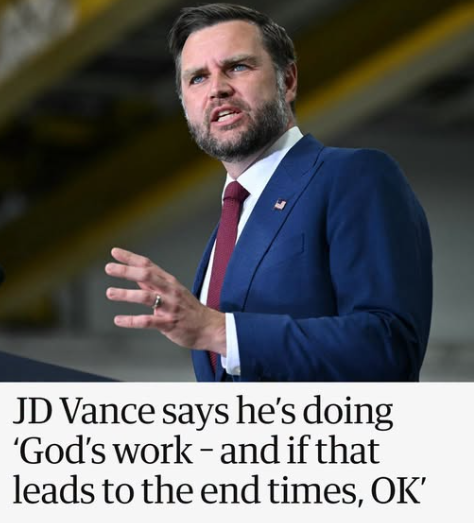 At left we see illustrated the core problem with the world’s theistic religions, i.e., that adherents are so certain of the rightness of their beliefs that they have no problem destroying the world.
FWIW, I have a friend who takes this even further: he is actively rooting for the apocalypse, and the prospect that all believers in God’s son Jesus will be raptured up to heaven to sit at the right hand of God.
He knows that I don’t believe any of this, but he remains confident that I’ll come around. As he told me, “God melts even the hardest of hearts.” He thinks I’m doing the devil’s work with my compassion for others and the effort I put out to achieve a peaceful and sustainable civilization.
We’d be living in tough times even without these fanatics, but religious dogma, especially of this sort, makes it all that much more difficult.
 We read a great deal about people who think that repairing the damage caused by Trump is going to be quick and easy.
Others are not nearly so sanguine, pointing out that many nations have gone to great lengths to create new trade relationships in their effort to cut the United States off without a penny.
Another question is how the people in other countries have come to regard Americans, as people of extremely low moral character–as crackpots, as racists, as gullible morons, as people incapable of critical thinking. That’s not going to change overnight, if it changes at all.



-
Climate Change1 year ago
Guest post: Why China is still building new coal – and when it might stop
-
Greenhouse Gases1 year ago
Guest post: Why China is still building new coal – and when it might stop
-

 Greenhouse Gases2 years ago
嘉宾来稿:满足中国增长的用电需求 光伏加储能“比新建煤电更实惠”
-

 Climate Change2 years ago
嘉宾来稿:满足中国增长的用电需求 光伏加储能“比新建煤电更实惠”
-
Climate Change2 years ago
Bill Discounting Climate Change in Florida’s Energy Policy Awaits DeSantis’ Approval
-

 Renewable Energy10 months ago
Sending Progressive Philanthropist George Soros to Prison?
-
Greenhouse Gases1 year ago
嘉宾来稿:探究火山喷发如何影响气候预测
-

 Carbon Footprint2 years ago
US SEC’s Climate Disclosure Rules Spur Renewed Interest in Carbon Credits