

Welcome to Carbon Brief’s DeBriefed.
An essential guide to the week’s key developments relating to climate change.
This week
Heat dome hits North America
100F: Temperatures in New York City reached 100F (38C) for the first time since 2013, as a heat dome “crushed” the eastern side of the US, reported the Associated Press. Baltimore, Philadelphia and Boston all also surpassed three-digit temperatures, it added.
CHIOS FIRES: More than 400 firefighters have been fighting wildfires on the Greek Island of Chios, with evacuation orders in place across the island, reported Reuters. Strong winds and 40C temperatures have made the fire “extremely difficult to control” amidst Greece’s first heatwave of the summer, added BBC News.
HEATWAVES: Japan is currently facing a two-week heatwave, driving up energy demand and keeping power prices high, reported Bloomberg. The Financial Times warned that temperatures could reach dangerous highs as “heat domes” continue to hit the US and Europe. The Daily Mail said the UK Health Security Agency had “activated the five-day alert amid concerns that there could be ‘a rise in deaths, particularly among those ages 65 and over or with health conditions’”.
Bonn climate talks close
BUDGET GROWTH: Reuters reported that more than 200 countries have agreed at the Bonn climate talks to increase the UN Framework Convention on Climate Change’s (UNFCCC) budget by 10% to €81.5m for 2026-27. (Carbon Brief has just published its in-depth summary of the Bonn intersessional.)
JUST TRANSITION: After talks stalled at COP29 last year, activists have welcomed progress on the just transition work programme (JTWP) in Bonn, reported Climate Home News. Campaigners hope the JTWP will lead to the creation of the Belém Action Mechanism at the upcoming COP30 in Brazil, helping to facilitate a just transition on the ground, the article added.
EYES ON COP30: As the two weeks of talks in Bonn came to an end, Bloomberg noted that “it’s still not clear what Brazil will need, or is aiming, to deliver” at COP30 in November. It added that, before the climate summit, most countries still need to submit new “nationally determined contributions”, detailing their plans to help meet the goals of the Paris Agreement, but, currently, less than 30 countries have done so.
Around the world
- DRILL, BABY, DRILL: US president Donald Trump has urged his government to “drill, baby, drill” as fears grew that the aftermath of attacks on Iran’s nuclear facilities could cause energy prices to spike, reported Reuters.
- GREENWASHING: EU countries have abandoned anti-greenwashing negotiations, after Italy withdrew its support for the bill, according to Politico.
- SOUTH AFRICA GRANT: South Africa’s national treasury has announced that the World Bank has granted it a $1.5bn loan to help it transition to a low-carbon economy, reported the Associated Press.
- MONEYPOINT: Ireland became Europe’s sixth country to end coal power with the closure of its last coal-fired plant at Moneypoint, according to the Irish Examiner.
- RECORD DEMAND: The Times reported on the Energy Institute’s annual statistical review, which showed global demand for every main type of energy hit a record high in 2024.
$525bn
Between 2000 and 2019, 55 climate-vulnerable economies lost approximately $525bn “because of climate change’s temperature and precipitation patterns”, according to a new report from the United Nations Development Programme.
Latest climate research
- Sea turtles will likely experience “substantial habitat redistributions” under future climate change scenarios, according to a new study in Science Advances.
- Warming of the tropical Indian Ocean can increase sea ice concentration in the Arctic during winter in the northern hemisphere, a study published in Climate Dynamics has found.
- According to a study published in npj Climate and Atmospheric Science, a 2C temperature increase over high-mountain Alpine regions would double the frequency of “extreme summer downpours”, compared to 1991-2020 levels.
(For more, see Carbon Brief’s in-depth daily summaries of the top climate news stories on Monday, Tuesday, Wednesday, Thursday and Friday.)
Captured
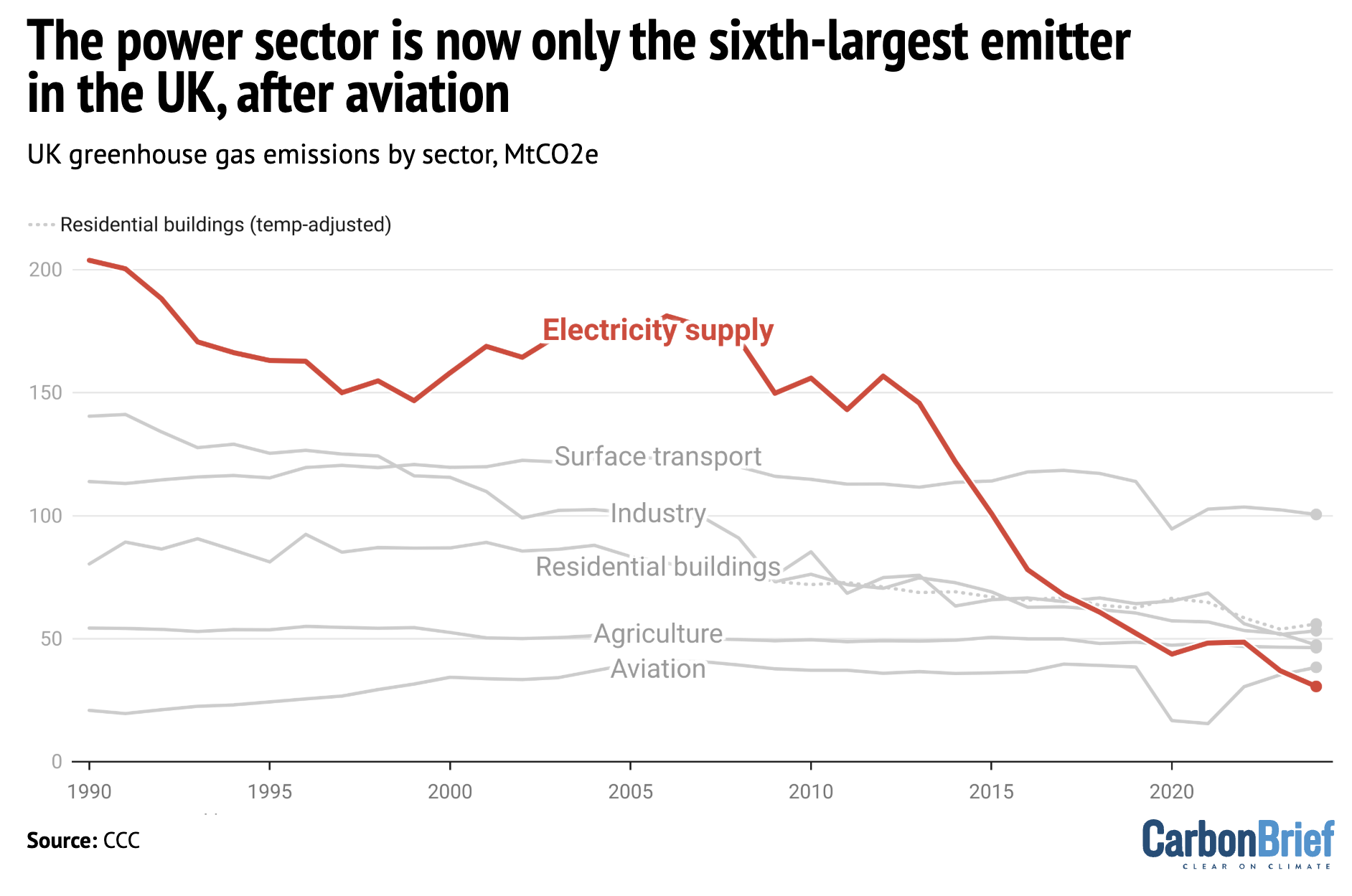
Emissions from the electricity sector in the UK have now fallen from being the largest emitter in the UK up until the mid-2010s, to the sixth-largest emitter, according to the Climate Change Committee’s latest progress report. As Carbon Brief’s chart above shows, this dramatic drop means that the electricity sector now produces fewer emissions than surface transport, industry, residential buildings, agriculture and – as of 2024 – aviation.
Spotlight
Gender clash at the climate talks
Negotiations in Bonn have laid bare divergent political and cultural stances as countries dispute gender terminology, reports Carbon Brief.
As technical discussions drew to a close in Bonn, Argentina inserted a footnote into one of the event’s many documents, defining “gender” as “two sexes, male and female”.
This seemingly innocuous move came at the end of a week-long terminology dispute, as nations debated a new “action plan” to centre gender equality in climate action.
Climate change often disproportionately harms women and can also have an outsized impact on other marginalised communities.
However, divergent political and cultural stances meant countries disagreed about the right ways to discuss these issues, ahead of a major decision later this year.
‘Global rollback’
UN climate talks are taking place amid a “global rollback” of rights for women and girls.
In some countries, notably the US and Argentina, this rollback has gone hand-in-hand with a rejection of so-called “gender ideology” and a reversal of trangender rights.
Right-wing populist leaders are also conflating environmental protection with efforts to protect women and marginalised groups.
For example, Argentine president Javier Milei has described “environmentalism”, “feminism” and “gender ideology” as “heads of the same beast” – namely, “wokeism”.
These views have manifested in unexpected places. Negotiations at a UN working group on pollution earlier this month saw the US insist that the output text stated: “Women are biologically female and men are biologically male.”
‘Strong divergence’
While the US was absent from Bonn, Argentina was a prominent voice in the gender sessions. This was despite the nation sending just one negotiator: Eliana Saissac.
Jennifer Bansard, who led the Earth Negotiations Bulletin (ENB) team that reported from within the Bonn talks, told Carbon Brief that Argentina took a “hard stance”:
“There’s definitely strong divergences on gender terminology and broader societal debates are affecting the talks.”

ENB’s reporting captures these disagreements. Argentina wanted to define “gender” based on a contentious 1998 statute of the international criminal court, referring to “two sexes, male and female”. Paraguay sought a similar definition.
Bansard noted that the divergence was “in both directions”, with some expressing more expansive views. Norway discussed “women and girls in all their diversity”, Canada referred to “gender-diverse people” and Iceland stated that it “[does] not support binary terms”.
Future plans
The talks also saw the Holy See – the governing arm of the Vatican City – make a rare intervention calling for a reference to “sex” rather than ”gender”. Saudi Arabia was among those flatly rejecting the notion of “gender diversity”.
These religiously conservative states have previously aligned in UN talks on gender. At COP29, they were among those reportedly blocking progress on the action plan.
In Bonn, they argued for cultural sensitivity and respect for nations’ differing laws. Claudia Rubio Giraldo, a lawyer who works with the Women and Gender Constituency, told Carbon Brief that she sympathised with this view:
“I think we all come here assuming that we are all on the same ground, understanding certain terminology…but there is a process of bridging that is necessary.”
Nevertheless, Giraldo championed an “intersectional” approach, backed by some nations, that benefits not only women, but also other marginalised groups.
NGOs also warned of parties attempting to roll back existing language on “gender mainstreaming” and “gender responsive” action.
Despite the disagreements, participants noted a constructive tone and agreed on an “informal note” to feed into future negotiations.
Yet, with the gender plan expected to be one of the more tangible outcomes from COP30, civil-society observers were cautious. Francesca Rhodes, a senior policy adviser at CARE International UK, told Carbon Brief:
“These negotiations are taking place in the wider context of a global rollback on rights and inclusive approaches to gender…Progress made must not be sidetracked by these efforts.”
Watch, read, listen
BESTING BIG OIL: The New Statesman had a feature on campaigner Sarah Finch and her victory in the supreme court in the UK last summer, which has “sunk billions of pounds worth of oil and gas projects”.
THIN ICE: Scientists at the University of Cambridge, including Prof Michael Meredith, discussed on The Naked Scientists podcast how the latest polar science is tracking climate change’s impact in Antarctica.
MAMDANI’S ‘GREEN ABUNDANCE’: The Jacobin examined how the focus of New York City mayor frontrunner Zohran Mamdani on lowering the cost of living can serve as a “blueprint” for embedding climate action in everyday life.
Coming up
- 7-25 July: 2nd Part of the 30th Annual Session of the International Seabed Authority, Kingston, Jamaica
- 11 July: IEA Oil Market Report publication
- 14-23 July: High-Level Political Forum on Sustainable Development 2025, UN Headquarters, New York
Pick of the jobs
- United Nations, national contractor for climate change mitigation | Salary: Unknown. Location: Baku, Azerbaijan.
- UNICEF, climate change negotiations consultant | Salary: Unknown. Location: Panama City, Panama.
- Chatham House, senior research fellow – energy transition and climate mitigation | Salary: £90,000. Location: London, England.
- Young European Greens, communications and campaigns intern | Salary: €1,500 per month. Location: Belgium.
DeBriefed is edited by Daisy Dunne. Please send any tips or feedback to debriefed@carbonbrief.org.
This is an online version of Carbon Brief’s weekly DeBriefed email newsletter. Subscribe for free here.


The post DeBriefed 27 June 2025: Heat domes; Bonn comes to a close; Gender clash in climate talks appeared first on Carbon Brief.
DeBriefed 27 June 2025: Heat domes; Bonn comes to a close; Gender clash in climate talks

Next week, diplomats from around the world will descend on Yerevan, Armenia, to negotiate a series of decisions under the UN Convention on Biological Diversity (CBD).
Between 19 and 30 October, 196 parties will gather to hammer out the precise wording of the dozens of legal texts that make up the decisions under the Conference of the Parties (COP) to the CBD.
This year’s summit is particularly significant, as it marks the halfway point between the agreement of the Kunming-Montreal Global Biodiversity Framework and the deadline for achieving its targets.
The CBD has found that countries are currently not on track to meet 22 out of the framework’s 23 targets.
During the fortnight, delegates will also be negotiating decisions relating to the two supplemental protocols to the CBD: the Cartagena Protocol, which covers biosafety; and the Nagoya Protocol, which covers access and benefit-sharing for the use of genetic resources.
(The Cartagena and Nagoya Protocols, which are each governed by a “meeting of the parties”, or “MOP”, have fewer parties than the CBD as a whole, with 173 and 141, respectively.)
Carbon Brief is tracking the progress of countries towards consensus on dozens of negotiating texts using the interactive table below.
The tracker includes texts from the COP, as well as the MOPs for the Cartagena and Nagoya protocols. It also includes draft decisions from the most recent subsidiary body meetings, as these form the starting point for the negotiations in Yerevan.
The CBD has three subsidiary bodies: the subsidiary body on scientific, technical and technological advice (SBSTTA), the subsidiary body on implementation (SBI) and the subsidiary body on article 8(j) and other provisions (SB8J).
SB8J focuses on issues related to the Indigenous peoples and local communities. It was established at COP16 in Cali, Colombia, in 2024.
The first two columns of the interactive tracker list the topic of each agenda item and the relevant body, with subsequent columns including dates, page counts and links to the original documents.
The table is searchable and can be sorted using the arrows in the header.
Areas of disagreement in UN draft texts are denoted by square brackets. Counting the brackets in a particular iteration of a text therefore gives a sense of how far parties are from reaching consensus.
The bracket column is colour-coded, with dark green indicating a low number of brackets and red indicating a high number of brackets remaining.
Texts can also present parties with choices using “options” or alternatives (“alt”), which are counted together in the sixth column of the table.
The key discussions in Yerevan will centre around two agenda items in particular. The first is the global review, which will assess progress towards the GBF and make recommendations for accelerating action.
The second is finance, which can be separated into two parts: resource mobilisation and the financial mechanism. On resource mobilisation, biodiverse global south countries are likely to push for an increased amount of international finance for conservation.
Disagreement over the creation of the financial mechanism led to the suspension of COP16 in Cali in October 2024, as parties failed to find agreement on the mobilisation of finance before the end of the summit.
Global south countries want the establishment of a separate financial mechanism under the control of the CBD; global north countries largely prefer to maintain the existing mechanism, which sits under the Global Environment Facility.
At the resumed session of COP16 in Rome in early 2025, countries agreed on a roadmap that would lead to the establishment of a permanent mechanism.
related
Analysis: Lula presidency saved at least 20,000km2 of Brazilian Amazon since 2022
Why land-use emissions have fallen by a third this century – in six charts

Analysis: 84% of nations miss deadline to identify ‘nature-harming’ subsidies by 2025
UK withdraws millions in funding from world’s second-largest rainforest in Congo
The post Interactive: Tracking negotiating texts at the COP17 biodiversity summit appeared first on Carbon Brief.
Interactive: Tracking negotiating texts at the COP17 biodiversity summit
A beacon of love
On an outer island of Fiji, two thousand nautical miles from Sydney, is a shining light of hope and resilience for our troubled world.
The island of Kioa is home to a Tuvaluan community who migrated from their atoll of Vaitupu in the late 1940s. It is a land of warm hearts, big smiles, and deep cultural roots; a place where the sound of a conch still summons the island together, where islanders paddle out to fish in carved outrigger canoes, and healthy happy children walk barefoot to school.
Here, culture is life. Kioans live sustainably through their traditional knowledge and practices. The island is alive with song, dance and the rhythms of a life tied to the tides, the winds, and the seasons.