

Founded in 1947 by J.I. Rodale, Rodale Institute is a nonprofit dedicated to helping the regenerative organic agriculture movement grow through research, education and farmer training.
In his study of regenerative organic farming, Rodale — who came up with the term “organic” — studied Indigenous agricultural practices, including those of communities like the long-lived Hunza Peoples of Northern Pakistan.
“A lot of people credit him really with being the preeminent thinker and leader in this modern day organic movement. J.I. Rodale coined the term ‘organic’ as it’s used today. He started a nonprofit in 1947 and ironically the original name for our organization was the Soil and Health Foundation, which I find to be so profound that this man had the vision to connect soil health with human health,” CEO of Rodale Institute Jeff Tkach told EcoWatch in an interview. “Fast forward to today — 77 years later — I think we all know that there is a fundamental disconnect in our society that human beings are divorced and disconnected from their food system, from nature. And I think it’s what’s leading to a chronic health epidemic. I think that we all are recognizing that our health begins in the soil, and how we farm matters. And so J.I. Rodale was way out in front, you know, doing that work.”

Before founding the institute, Rodale was an entrepreneur who started a company with his brother in New York City.
“He came from poverty, but one of the challenges in his life was his health. He came from a lineage where his father and his uncles didn’t live past the age of 57. And when he and his brother began to accumulate enough wealth, they decided to move their business out of New York City to rural Pennsylvania and he bought a farm,” Tkach told EcoWatch. “He had never farmed a day in his life. And he just had this sense that if he could control his food and where his food came from and how his food was produced that it would have an impact on his longevity. So he bought a 40-acre farm in Lehigh County, Pennsylvania, outside of Allentown, and started talking to all the experts in farming.”

J.I. Rodale. Photo courtesy of the Rodale family
After starting his farm in Pennsylvania, Rodale became curious about how the chemicals that were being used in agriculture after World War II were impacting the food people were eating.
“The representatives at the land grant universities like Penn State and Rutgers and Cornell… were all telling him about this amazing innovation in farming called chemical agriculture, [but] no one could really sufficiently answer his question around how those chemicals could yield healthy food. So he started looking to Indigenous populations,” Tkach told EcoWatch. “He was very concerned around where agriculture was headed if we stopped considering the power of nature… I think that was really his concern, that we were going to lose sight of the miracle of nature to heal us, to feed us, to nourish us in the name of innovation.”
Rodale Institute offers science programs and direct farmer support to facilitate change in food production and farming globally.
“As the birthplace of the modern Organic movement, Rodale Institute is filling the massive void of American land-grant institutions by revolutionizing farming and aiming to fix what is broken in our food system,” a press release from the institute said.
Rodale Institute co-founded the “regenerative organic” certification, which is the food industry’s highest standard. For 40 years, the institute’s farming educational and consulting programs — Farming Systems Trial — have been equipping thousands of farmers in the United States with the resources and knowledge they need to adopt regenerative organic agricultural practices.
U.S. consumer demand for certified organic products currently exceeds supply, which makes organic farming a potentially economically viable option for small and large farms.
Rodale Institute is planning to transition a million acres of farmland to regenerative organic agriculture in the next decade.
“We’ve just contracted with Organic Valley, and we’re working with a select number of their farmers to help them adopt organic practices and to do it more effectively, as well as to be able to help connect those farmers with more lucrative markets, so that they have a place to sell their crops at the highest value,” Tkach told EcoWatch.
Tkach said one of the roles Rodale Institute plays is assisting farmers with the barriers they face when transitioning to organic.
“‘Where am I going to sell my crop? How am I going to effectively embrace organic practices? How am I going to overcome pressures like weeds and pests?’ All these things that you and I don’t think about, but that farmers face every day,” Tkach said. “So Rodale is stepping in to help farmers. And in a lot of ways we’re acting as a land grant on a national scale for farmers, because our land grant system does not currently serve organic farmers. So the same challenge that J.I. Rodale faced 77 years ago, many of America’s farmers still face today.”
Rodale Institute’s philosophy is to always keep moving things forward through research and innovation.
“We pride ourselves in being an innovative organization, and even though we’re 77 years old, it feels like we’re a 77 year old startup right now because the world has finally embraced what Rodale has been espousing for a very long time,” Tkach told EcoWatch. “We see agriculture as a continuum, and we’re trying to help move farmers from conventional chemical farming down a path towards embracing better and better, healthier agricultural practices.”
Tkach said Rodale Institute helps farmers make the transition “by doing long-term science.”
“So I’m sitting today in my office, but my office is on a 400-acre farm. And when I walk out of my office, there’s research happening all over our farm,” Tkach said. “One study in particular is a 44-year study that is the longest running trial of its kind in the world, where we’re studying organic and conventional grain cropping systems, and we’re able to look at how these two ways of farming are very different and what their long-term implications are… I think the science is what sets us apart, because there’s really no other entity in North America that’s doing long-term research on organic agriculture.”
Tkach said the researchers are able to demonstrate that organic farming is not only “more ecologically sound” and better for the environment, but more profitable as well.

The Rodale Institute’s research team studies various weed management practices in their fields and in partnership with farmers. Photo courtesy of Rodale Institute
“If you want to heal the rural and the urban divide and begin investing in rural economies, our farmers are struggling in this country, they need to improve their bottom line. And organic agriculture is driving between three and six times more profits for farmers,” Tkach told EcoWatch. “Our science has proven that.”
Tkach said regenerative organic farming is not just for smaller family-owned farms, as larger farms are embracing the practices as well.
“Rodale has proven that organic regenerative organic agriculture can be scaled… Today, our national network of consultants that are Rodale employees have been called upon by some of the biggest food companies in the world,” Tkach said. “One example is General Mills. General Mills has recently hired Rodale Institute as a nonprofit to go out and work with 70 farmers in the upper Midwest that are producing oats and wheat — two of the biggest ingredients that General Mills grows.”
Tkach said the country’s need for certified organic products is outpacing its supply.
“So right now there is a greater demand for certified organic products in the United States than we can supply domestically. The U.S. is a net importer of organic food,” Tkach explained. “During this new administration I actually was in DC five weeks ago meeting with House and Senate leaders of the Ag Committee and, frankly, I received support from both sides of the aisle… So I always say that organic agriculture is for all of us. We all eat. We all want to live on a healthy planet. We all want to be healthy. And in order to do that, we need to come to grips that our current farming system is fundamentally broken. We have to transform agriculture in this country.”
“There’s something in organic that every one of us can be excited about. If you want to talk about onshoring our food system and creating a regional resilient food system, that’s what organic agriculture can do for us. If you want to talk about lowering our healthcare costs, well, it starts with what we’re eating. Food is medicine. And Rodale is saying that healthy food starts in healthy soil. And healthy soil is birthed on organic farms,” Tkach added.
Tkach said Rodale science has demonstrated that much of the world’s carbon emissions can be sequestered in the soil on organic farms.
“How we farm can actually become a carbon sink in agriculture,” Tkach said.
Rodale Institute was recently named one of the most innovative companies in the world for 2025 by the magazine Fast Company.
“I’ve actually been a reader of Fast Company for most of my adult life… It’s a magazine about innovation,” Tkach told EcoWatch. “My life was deeply touched by their content over the years… It was a huge honor… It’s kind of hilarious that a 77-year-old company is being named to that list, but it’s a testament to where we are in the world and how the innovation that we’ve been leading is finally getting recognized.”
Rodale is co-hosting the first Good Farmer Award in recognition and support of farmers who have been using organic practices for a decade or less.
“We are going to be co-hosting an award called the Good Farmer Award in partnership with our brand partner Davines… recognizing farmers that are at the early part of their journey and that are looking for some financial support,” Tkach told EcoWatch. “Some of the biggest barriers for young farmers is capital. Farming is a very capital-intensive business, and Rodale is going to be looking to honor and celebrate beginning farmers who are using organic and responsible practices, and we’re going to try to award them with some funding to help get them get their business off the ground. So we’re really excited about that.”
The first recipient of the award is Clarenda “Farmer Cee” Stanley.
“The award recognizes outstanding farmers making positive environmental and social contributions to agriculture through regenerative organic practices,” a press release from Rodale Institute and Davines Group said. “Clarenda Stanley, founder and CEO of Green Heffa Farms in North Carolina, stood out for her commitment to economic empowerment, education, equity, and ecological stewardship.”
I asked Tkach what individuals can do to support regenerative organic farming in the U.S.
“Right now, the word regenerative is being co-opted and greenwashed by the biggest food companies in the world. When we talk about regenerative farming in and of itself, that means everything and nothing,” Tkach told EcoWatch. “But Rodale helped to co-found the newest and highest bar certification in the food industry: regenorganic.org. That is what all consumers should be supporting. They should be looking for foods that have both the USDA organic and regenerative organic label on them, and supporting those farmers and those brands, because that’s the kind of food system we’re trying to usher in.”
“Robert Rodale, the founder of the Rodale Institute’s son, actually coined the term regenerative farming in the 1970s. And he believed that we regenerate when we begin to farm in a regenerative way. We start by healing the soil, but everything else in that system improves over time,” Tkach said. “And so we’re asking consumers to participate in a better food system.”
Tkach recommended that, in addition to supporting the certifications and brands, every consumer should “get to know a farmer.”
“We all should have a relationship with someone in our community that is growing healthy food and we should support them,” Tkach said. “If you’re even more courageous and adventurous, I always tell people they should try to plant something, you know, just grow one thing, whether it’s a potted plant on your windowsill or a raised bed garden… we all should become farmers and stewards of the earth.”
“The rhythm of nature changes you. It deepens your human experience, and it makes you a better human. And I think it starts with food,” he said.
Educational materials and resources on organic farming — including free webinars and courses — are available on Rodale Institute’s website.
“If we’re talking about a win that everyone can get behind, it’s organic farming. And it’s not a polarizing topic. It’s something that we can all agree on,” Tkach said.
The post ‘The Science Is What Sets Us Apart’: How the Rodale Institute Has Spent 77 Years Innovating Regenerative Organic Agriculture appeared first on EcoWatch.
https://www.ecowatch.com/rodale-institute-organic-agriculture-ecowatch.html

People are particular about their pillows — just like our mattress, a good pillow determines whether or not we have a great night’s sleep. Unfortunately, many pillows are made with synthetic materials and toxic finishes. Thankfully, there are a number of brands creating non-toxic and eco-friendly pillows that you can feel better about, and sleep better with.
Whether you’re looking for a travel pillow, body pillow, or sleep pillow, one of the eco-friendly pillow brands below is bound to have what you’re looking for.
What Goes Into a Sustainable & Non-Toxic Pillow?
When deciding if a pillow is sustainable, transparency is key. In general, if sourcing, materials, or production methods are unclear, the company is most likely not a sustainable one.
A sustainable pillow will be made from eco-friendly, non-toxic materials. This means no harmful chemicals or synthetic materials. The materials used will be sustainable and responsibly sourced, such as organic cotton and natural dye.
Sustainable pillows, and brands, will most likely have one or more of the certifications listed below. These certifications verify that the materials and production methods a company is using comply with trusted global standards.
Additionally, sustainable pillow companies will produce their products in a way that doesn’t involve exploitative labor. They will implement production methods that are eco-friendly and ethical – benefitting both their workers and the planet.
Non-Toxic Pillow Materials to Look for — and Materials to Avoid
These are the kinds of materials to look for for sustainable non-toxic pillows:
- GOTS-certified organic cotton
- Sustainably sourced organic kapok fiber
- GOLS organic certified latex
- Responsibly sourced or organic certified wool
- TENCEL Lyocell
- Hemp
- Buckwheat hulls
These are the materials we’d avoid.
- Synthetic polyurethane foam or memory foam
- Synthetic latex
- Polyester
Certifications for Eco-Friendly Pillows
Certifications add a layer of third-party accountability to a brand’s claims — though none of them are perfect on their own, so it’s worth knowing what each one actually covers.
- GOTS Certified = the fabric (like an organic cotton pillowcase) meets strict organic and safety standards, with labor protections built into the entire supply chain. This is the most rigorous certification for organic textiles specifically.
- GOLS Certified = verifies that latex filling is made from certified organic latex, grown and processed to strict environmental and safety standards. A latex-specific certification.
- USDA Organic = confirms that a grown material (like cotton or wool) was produced without synthetic pesticides or GMOs. This is a raw-material certification, not a finished-product one and it doesn’t cover dyes, fillers, or manufacturing chemicals added afterward.
- OEKO-TEX Standard 100 = tests the finished textile for harmful substances. OEKO-TEX actually offers several distinct certification tiers (STANDARD 100 being the most common), so it’s worth checking which specific OEKO-TEX label a brand holds rather than assuming they’re all equivalent.
- GREENGUARD Gold Certified = the finished product was tested for low chemical emissions, including VOCs. This is the stricter tier of GREENGUARD certification.
- eco-INSTITUT Certified = a German certification measuring a material’s chemical emissions and verifying responsible sourcing — similar in spirit to GREENGUARD, but based in the EU.
- MADE SAFE® = screens against a list of thousands of chemicals known or suspected to harm human health. One of the more comprehensive certifications available, assessed at the product level.
- FSC Certified = wood or paper-based materials (like packaging or textiles like viscose) came from responsibly managed forests. Not a chemical-safety certification.
- Fair Trade Certified = verifies that a factory meets standards for fair wages, safe working conditions, and ethical labor practices. This is a certification about how a product was made and by whom, not about the materials themselves.
- FLOCERT = the certifying body behind Fairtrade International’s certification — a different organization from Fair Trade USA (which issues “Fair Trade Certified”). Both cover similar ground (fair wages, ethical labor, transparent supply chains), but they’re separate certifying bodies with their own standards, so don’t assume a “FLO-Cert” claim and a “Fair Trade Certified” claim mean the exact same thing.
Where to Find Eco-Friendly Pillows
Note that some of the brands below are affiliates, meaning we’ll earn a commission at no additional cost to you if you choose to purchase through these links. As always, all brands meet rigorous criteria for sustainability and are brands we love — and that we think you’ll love too!
1. Circadian
Tested by CL&S Editor, Elizabeth
Sustainable Materials: Organic cotton, organic wool, USA-grown buckwheat, Dunlop latex, Kapok fibers
Based In: USA | Made In: USA
Price: $89 – $269
Crafted in their own New Jersey workshop for over four decades, Circadian knows organic pillows. And with six distinct natural pillow options, Circadian’s range fulfills most sleeping needs, whether you’re a side sleeper or back sleeper and whether you sleep hot or wake up with neck pain.
I’ve been having neck pain for months — even going to physical therapy for it — and the buckwheat pillow has been one of the most helpful things I’ve tried to alleviate neck pain. I tried memory foam, I tried a side sleeper pillow, but the firmness of the buckwheat has been the trick for me.

2. Avocado
Based In: USA | Made In: USA
Sustainable Materials: No chemical retardants; organic GOTS-certified cotton and kapok fiber, GOLS organic certified latex
Price: $25-$199
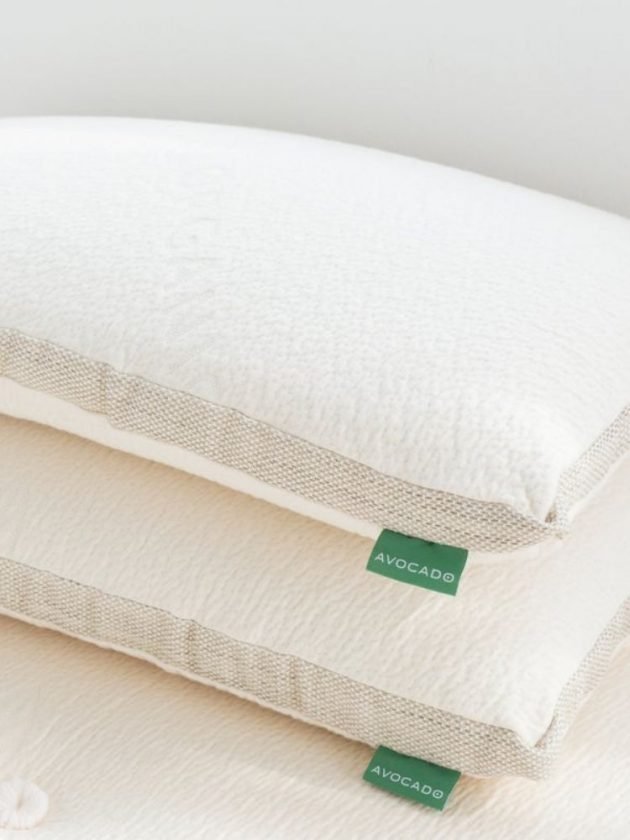
Avocado is one of the leading brands for eco-friendly pillows. They are a climate neutral B-corp that sources their materials from their own Fair-Trade farms in India and Guatemala. Each pillow is handcrafted in their local GOTS-certified factories.
Plus, Avocado has the trusted certifications you want like Gold Certified vegan, Eco-Institut certified and Made Safe certified.
3. Savvy Rest
Based In: USA | Made In: USA
Sustainable Materials: Organic wool, natural USDA and GOLS-certified Dunlop or Talalay latex, organic cotton, organic kapok fiber, natural dye
Price: $29-$239
*Use code CONSCIOUSSTYLE20 for 20% off*
Savvy Rest has a large selection of eco-friendly pillows, with eight different styles to choose from, including body and contour pillows. Savvy uses a variety of sustainable materials and even offers customizable filling options.
Savvy Rest is both a B Corp and a GOTS-certified organic company, as are their factories.

4. Coyuchi
Based In: USA | Made In: Sri Lanka
Sustainable Materials: GOLS Certified Organic Latex, GOTS certified Organic Cotton, sustainably sourced Down; reusable cloth bag packaging
Price: $68-$198
Coyuchi is a woman-owned, Made Safe Certified company. They produce four different types of organic latex pillows including a body pillow.
Coyuchi uses Fair-trade certified factories and a circular production process. They are also a 1% for the planet partner.

5. SOL Organics
Based In: US | Made In: India
Sustainable Materials: Certified 100% Organic cotton, 100% Canadian down, non-toxic dyes; pesticide & harmful chemical free, hypoallergenic
Price: $169
SOL Organics is a BIPOC-owned and family-run company. They are passionate about ethical production and only work with FLO, OEKO-TEX, GOTS, and Fair-Trade Certified manufacturers.
Responsibly made with care, you can sleep soundly on these sustainable down pillows.

6. Birch
Based In: USA | Made In: USA
Sustainable Materials: GOTS-certified organic cotton, organic birch wool, 100% natural Talalay latex, recycled polyester filling; chemical fire retardant free
Price: $75-$119
Birch offers two different non-toxic pillows. Their organic pillow comes with a 100 night trial and is Greenguard Gold and GOTS Certified.
Their eco-rest pillow is GOTS and Fair Trade certified. Both are handmade in a Fair Trade certified factory.

7. Sleep & Beyond
Based In: USA | Made In: Kyrgyzstan, India, China
Sustainable Materials: 100% natural or organic wool and latex; GOTS, Woolmark and OEKO-TEX Certified
Price: $49-$139
Sleep & Beyond is a BIPOC-owned company that offers nine different types of eco-friendly pillows, including a travel pillow. They have a handy comparison guide so you can easily find the best fit for you.
Sleep & Beyond produces everything in Fair-trade Certified and solar factories using zero waste production.

8. Buffy
Based In: USA | Made In: USA
Sustainable Materials: GRS or RCS certified BPA free Recycled PET filling, Eucalyptus Lyocell, hemp linen; packaging made from FSC certified recycled materials
Price: $49-$99
Buffy is best known for their “cloud-like” comforters but they also have an extensive pillow offering including travel pillows and body pillows.
Buffy is working toward closed loop and zero waste production and offsets their CO2 emissions.

9. Organic Textiles
Based In: USA
Sustainable Materials: 100% natural & organic latex, natural Australian wool, kapok fiber, natural down, GOTS and GOLS certified cotton
Price: $60-$117
Organic Textiles is a great company for finding sustainable pillows from a variety of materials. They even offer extra pillow fillings for a customisable feel.
All of their products are pesticide & toxic chemical free as well as hypoallergenic. Organic Textiles is Green America Approved Certified and uses Fair-Trade manufacturers.

10. Boll & Branch
Based In: USA | Made In: USA, India
Sustainable Materials: OEKO-TEX standard locally and responsibly sourced Down, 100% organic cotton, hypoallergenic synthetic down alternative; recycled packaging
Price: $58-$168
Another great husband and wife owned company is Boll & Branch. They offer harmful chemical free, non-toxic Down and Down alternative pillows.
You May Also Want to Check Out:
15+ Sustainable & Organic Bedding Brands — Sorted by Material
Eco-Friendly Bed Frames for a Sweet Sustainable Slumber
Non-Toxic Mattresses for a Sound & Sustainable Sleep
The post The Top 10 Non-Toxic and Eco-Friendly Pillows for a Safer Slumber appeared first on Conscious Life & Style.
The Top 10 Non-Toxic and Eco-Friendly Pillows for a Safer Slumber
One of my goals when moving into our house was to source the majority (about three fourths, give or take) of our furniture secondhand. It hasn’t necessarily been quick or easy to buy secondhand furniture for an entire home. But it has been worth the effort thus far both in terms of cost savings and the uniqueness of the pieces.
We also sold a few of our used furniture items when moving out of our apartment because there were some pieces that we didn’t need anymore. For example, we had counter stools in our apartment but the house we were moving into had no countertop to sit at.
Below I’m sharing my perspectives on the top places to buy secondhand furniture as well as sell it.
I started shopping secondhand because of the reduced environmental impact (check out my full guide to sustainable furniture here), but I also like to save money! And sometimes secondhand (particularly vintage) furniture can be pretty unaffordable. So that is a significant criteria in the ranking of this list.
There are also a couple of sources that I’ve scoured and considered but haven’t actually purchased from yet. (I’ll share why below.)
In these cases I will refer to reviews and my own in-depth research. (I’ve spent way too much time searching for used furniture!!) And if or when I do purchase from these sources, I’ll be sure to add in my personal reviews alongside the other user reviews.
Where to Give Away or Find Furniture for Free
In case you want to give away or find furniture for free, I’ll quickly share some ideas before getting into the paid options.
To find free furniture, try “stooping”. This is where you find furniture people put out on the curb. I’ve also found furniture (like a desk and ottoman) near our apartment complex’s dumpster. It’s sometimes unbelievable what people throw away, especially when they’re moving in a hurry.
I’d also suggest checking your local Buy Nothing group. Though I will say in my experience, it can be a pain to sift through so many low quality posts (like partially used coloring books and cleaning products).
In terms of giving away furniture, I generally would not recommend leaving your pieces on the curb if you want to ensure it’s getting a second life. I’ve also seen furniture that’s left outside get destroyed by rain and what was yesterday’s perfectly good furniture is today’s trash. (It’s a bit heartbreaking to be honest.)
Instead I’d recommend to list it in a Buy Nothing group; share it on a app like Craigslist, NextDoor, or Facebook Marketplace; or coordinate a furniture pickup/drop-off with a nearby charity that sells used furniture.
Alright now let’s get into buying and selling used furniture!
Secondhand Furniture Apps, Sources, and Stores Ranked (with Pros & Cons)
With any kind of listing like this, there are going to be points of subjectivity so I’m detailing the pros and cons from my vantage point alongside the listings so you can determine which one is right for you, based on what you are looking for.
For me price and the ability to find specific types of items are important. I’m willing to sacrifice some convenience (i.e. I don’t need something delivered to me; I’m ok picking it up) for a good find. That might not be true for you, so be sure to look at the details of each to decide your own pick for buying (or selling) secondhand furniture for your space.
Note that there are a few affiliate links in here, which means we’ll earn a commission if you choose to purchase through our links at no additional cost to you. As always, our recommendations are made independently and vetted for sustainability.
1. Facebook Marketplace

Pros for Buyers:
- Easy-to-use platform for searching and buying
- Vast selection updated frequently
- You can find great prices and negotiate prices
- I’ve bought from so many amazing, friendly sellers
- Many sellers have been willing to help lift (though not all are able to, so you might want to ask first if you require assistance)
Cons for Buyers:
- Not convenient: usually requires pick-up
- Some listings are for new items and ads can mimic actual listings
- Some sellers aren’t as easy to communicate with
Pros for Sellers
- Very easy to use
- Popular items can get sold quickly
- Low effort (no shipping or packing required)
Cons for Sellers
- Buyers may negotiate down significantly
- You can get spam messages
- You may have to give out your address to strangers
As much as I genuinely do not want to give a Facebook-run platform the top spot, the selection on Facebook Marketplace is unbeatable when it comes to buying secondhand furniture. It’s probably also the best place to find secondhand deals online (I say “online” because you can browse through the app, though you do typically have to pick up the furniture.)
Search Selection
You also can sell your used furniture quite quickly on the platform. I was able to sell gently used counter stools within 24 hours of listing them for my asking price!
Because so many people already use the site, there is a ton of volume of listings and it’s regularly updated. You can truly find anything and everything you’re looking for, and it’s a far better user experience than Craigslist in my opinion.
I’ve found that most sellers upload quite a few clear photos of the item and a decent number of listings (though certainly not all) also include solid descriptions so you have a good idea of what you’re buying.
It’s also incredibly easy to find what you’re looking for. Even when I search for specific terms like “MCM brown leather chair” or “MCM TV stand” there were many search results, and the search results were quite accurate. In fact the latter search led to the find pictured above!
What About Price?
Prices ranges vastly, as you might expect. Some people genuinely give you a great deal and others are clearly just trying to get however much they can. I’d recommend taking some time to get an understanding of the “going price” on an item before committing. I also sometimes ask the brand so I can look up how much that item costs new, if the seller has not shared that information. And if something feels like it’s priced too high, know that negotiating is very normal on the platform! They might say no, but there are a lot of options, so don’t let that deter you.
As a seller this means you will get people negotiating you down on price too. If you’re selling an in-demand good quality item, though, and you’re selling at a fair price you should be able to find a buyer willing to pay the listed price. In fact for the counter stools I sold on here, I got offers above asking price.
I also hypothesize that part of the reason for the great response to the used stools was because I posted the listing on a Saturday morning, rather than a weekday.
The Pick-Up Process
Something you may be uncomfortable with is going to other people’s houses or having others come to your house to pick up the used furniture. Here are some ways to navigate this:
- Coordinate a porch pick-up. I purchased a rug from a seller who left the rug on their porch and I paid via Venmo. To be honest, I might be nervous as a seller that the item could get taken without payment. But it worked quite well as a buyer.
- Suggest a pickup spot. This would require more effort on the seller’s side instead of just having the buyer pick-up at your place, but you might feel safer with this option.
- Opt for delivery. Some sellers offer free delivery or delivery for a fee, especially for large furniture items that buyers may not be able to pick up by themselves. As a buyer, you can always ask a seller (especially if the person is a frequent seller or small business) if they have delivery options.
If you prefer to avoid online searching completely, check out the next recommendation on this list. And if you want delivery, I suggest skipping ahead to #4.
2. Estate Sales
Pros for Buyers:
- There are some incredible, unique finds
- You can see the items in-person before purchasing
- You could have the option to buy an entire room’s worth of coordinating furniture
- You can find great deals if you go towards the end of the sale (especially the last day)
Cons for Buyers:
- Not as easy to find specific items
- Not convenient: sales are only on specific days and sometimes you have to wait in line
- Some items could be expensive on first day
- You have to lift the furniture yourself (it’s typical for sellers / estate sale companies to say they can’t help you for liability reasons)
Pros for Sellers:
- Liquidate all of your furniture at once when moving
- Convenient: no packing or shipping required
- It’s typical to hire an estate sale company, so it takes out a lot of the work
Cons for Sellers:
- You open up your home to crowds of people and have to publish your address online
- If you work with an estate sale company, they may take a decent portion of sales and you won’t have control of the prices
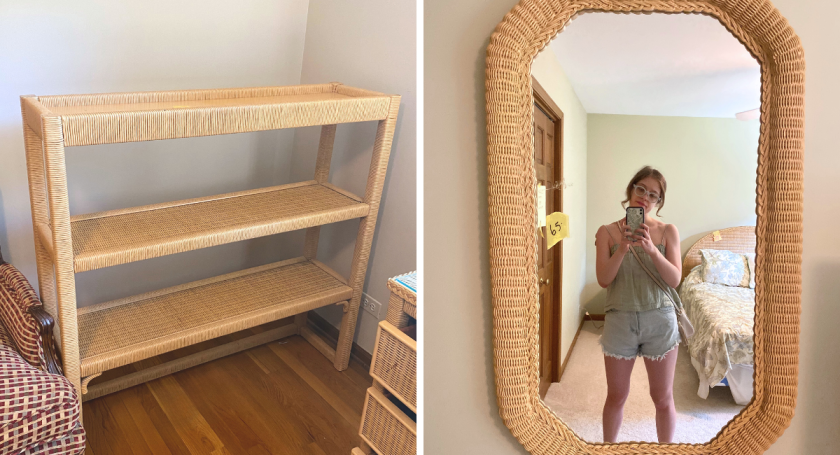
I have to come to LOVE estate sales! I find out about estate sales through EstateSales.net. My husband and I have found a Weber grill, wall mirror (pictured above), desk, plant stand, and more through local estate sales.
While there are some fabulous finds and good prices (more on that in a moment) shopping secondhand furniture at estate sales does require more work than Marketplace. That’s why it’s ranked number two on this list.
How Do Estate Sales Work?
First, you have to search for estate sales near you through a site like EstateSales.net. When you see one that looks like it’s selling items you like, you can find out the dates of the sale and when the sale gets closer, see the address as well.
If you find an in-demand item you love, you may have to go to the estate sale right when it opens. Sometimes there may even be a line if there are a lot of popular items. In this case you’ll have to put your name on a list typically and they will call in people one-by-one or in groups. Since many estate sales start on weekdays, like a Thursday or Friday, it might not always be possible for you to do this.
If there is an item that is less in demand, or you just want to browse the estate sale in general for deals, it’s best to go on the later days or last day of the sale. The later days of a sale are also typically on the weekend.
Expect to lift the furniture yourself (most estate sales specify that they will not help you). Some sales will let you claim an item (if you pay for it) so you can arrange a pick-up later that day or on the next day.
Be prepared that some estate sales can be picky how they take payment (i.e. cash only, no card; Venmo but not PayPal.. etc.) so be sure to check in the description of the sale before going!
My Experiences with Estate Sales
I purchased the mirror pictured above at a nearby estate sale along with the matching desk and an open-shelving storage unit at half off, since I went on the second day. So instead of paying $250 total, I paid $125. At that particular sale they were not going to let me pick it up later so it was a bit stressful! But it all worked out in the end.
I have been really happy with those purchases. They were unique finds that met the aesthetic I was going for in my office and I could get them at unbeatable prices. And as always with buying secondhand furniture, you have a great feeling afterwards that you saved furniture from the landfill.
The biggest con to estate sales for me is that I just can’t go to as many as I would like to because these sales often start on the weekdays (Thursdays or Fridays).
What is it Like to Sell Secondhand Furniture at an Estate Sale?
It is typical to hire a company to help you with your estate sale since it is a lot of work to price and photograph all of the items in a limited time. It is important to do your due diligence on the company to make sure it’s a good fit and you get what you want out of the sale, whether that priority is getting rid of all your stuff or making top dollar on your valuable pieces.
I’ve heard from people who have not had the best experiences with their estate sale companies. But there are also some quality estate sale companies out there.
And I will add that I’ve seen a range of professionalism on the buyer side. Some have been very helpful and organized while at one sale, the “cashier” was reading in a book and acted annoyed when I tried to ask a question!
You can find companies through EstateSales.net.
3. OfferUp
Pros for Buyers:
- Easy to use
- You can search for specific furniture
- You can find great prices and negotiate
Cons for Buyers:
- Some sellers can become unresponsive
- Not as many options as Facebook Marketplace
- Ads for new products can look similar to listings
Pros for Sellers:
- Easy to use
- Convenient if buyer comes to your place to pick up
- The selling timeline can be quite fast
Cons for Sellers:
- There are fewer buyers on OfferUp compared to Facebook Marketplace
- People may negotiate your listing down price significantly
OfferUp is an app to sell and buy secondhand furniture that I used a lot in the beginning.
My Best Purchase on OfferUp
We have found some incredible deals, like a barely used blue velvet MCM-style sofa that was originally over $3,000 that we bought for $800. This was my absolute favorite find in all of my secondhand furniture shopping! Despite the material (velvet) being a total pain to keep clean, I will love this beautiful couch until it is literally falling apart.
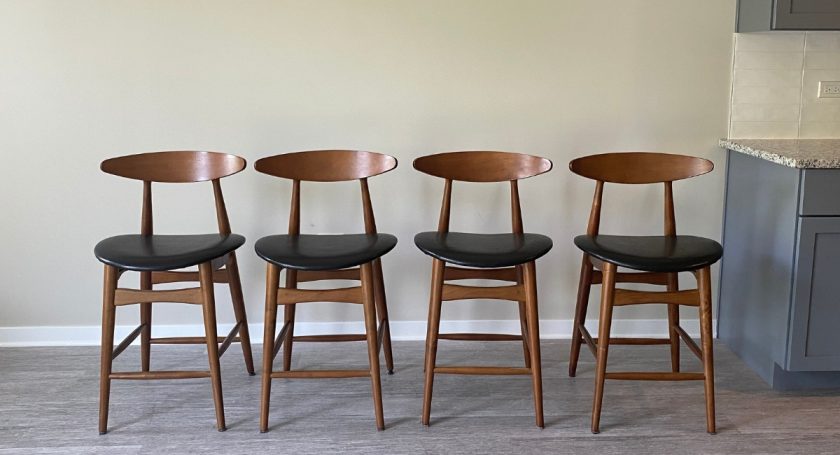
Another great purchase was the counter stools that I eventually sold on Marketplace. The counter stools were never used and we were able to buy them for half off since the person who originally bought them could no longer return them. They were perfect for our MCM-meets-contemporary aesthetic!
My Experiences Buying on OfferUp
My experiences with sellers have been pretty good thus far. The only bad experience I had was with the pickup of our coffee table. We ended up waiting over an hour in a parking lot because the seller got caught in a bad traffic jam. This was a bit out of their control but it’s worth noting because these sorts of things can happen with pickups so expect the unexpected!
There aren’t as many options on OfferUp as there are on Marketplace, but there are some finds on there that aren’t listed elsewhere, so I like to check both apps.
Similar to Marketplace, it can be annoying to see so many ads and fast furniture product listings among the used furniture listings. Unfortunately some of the ads have gotten very low quality on OfferUp to the point of borderline (if not outright) spam. So be mindful to not click on the wrong image when browsing the app!
The reason OfferUp is still listed as number three on my list despite these cons is because of the prices. There are some great deals and if you pickup the furniture you do not have to pay for shipping. Even if a local seller offers delivery, it is typically much less than the delivery of a furniture retailer that is shipping the furniture from farther away.
In terms of the pickup process, it’s quite similar to other local apps, like Marketplace so reference those tips above if you want them.
My Experiences Selling on OfferUp
As a seller, I sold a futon very quickly on OfferUp but had challenges selling the counter stools pictured above. When I put those very same counter stools on Marketplace, they sold the same day. After that experience I have been pretty much exclusively selling on Marketplace, but if you’re not getting any bites on there, OfferUp can be another solid option.
4. AptDeco
Pros for Buyers:
- Convenient: get the furniture shipped to you!
- Great selection of quality and in-demand brands at lower prices
- Find brands that aren’t as easy to find on apps like OfferUp or Facebook Marketplace
- Strong search functionality
Cons for Buyers:
- Shipping fees can be high (and some users have complained about unexpectedly higher shipping prices)
- Cannot see item in-person before purchasing
- Quality and damage disputes not honored after 24 hours
Pros for Sellers:
- Convenient: AptDeco’s professional team disassembles and picks up the furniture for you
- You won’t need to give out your address or meet up with buyers in-person
Cons for Sellers:
- AptDeco takes a significant share of the selling price
- AptDeco lowers earnings for sellers the longer an item takes to sell
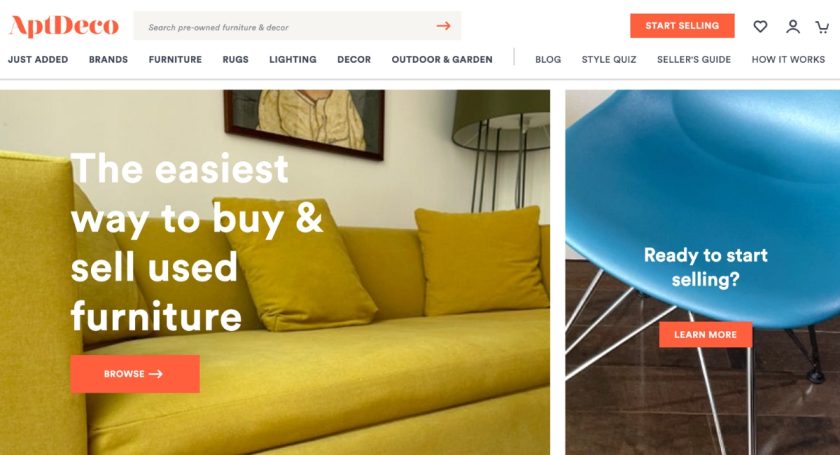
AptDeco has become a popular spot to sell and buy secondhand furniture online. I have browsed this site many times but I have not yet purchased from the site due to the high shipping fees. (As I mentioned, price tends to come above convenience for me at this point.)
Options and Searchability
From what I’ve experienced with searching for furniture on this site, the search functionality works quite well and there are a good number of results from popular brands like West Elm, Pottery Barn, and CB2. These are brands you don’t typically see many pieces from on apps like OfferUp or Marketplace!
There are also many filters you can use, like condition, color, material, dimensions, and brand.
Prices
I’ve seen the secondhand items sell for up to 75% off retail price with items that have a lot of use and wear to as little as 12% off retail price for new-in box items from stores moving inventory out. So you can find some fantastic deals on brands that rarely, if ever, go on sale.
Shipping Costs
The biggest thing to watch out for on AptDeco is the cost of shipping. Because AptDeco started and is headquartered in New York, a lot of the furniture sold on the site is shipping from New York or New Jersey.
I calculated the shipping cost to Chicago on some pieces selling from New York, and the shipping was between $300 – $400. That is in line with what brands like West Elm quote me for new furniture too, but still it can feel like a big expense if you’re accustomed to finding used furniture in store.
One nice feature on AptDeco’s site is you can filter to “Near” your zip code (the default is “Any”). When I tried out that feature I saw some pieces available for local pickup and delivery options under $200.
AptDeco does tell you, though, that shipping costs are estimates based on location and the final shipping cost may increase for larger items.
AptDeco’s Reviews
AptDeco has over 38,000 customer reviews and an average rating of 4.6 stars. One recent 5-star reviewer wrote “Great delivery service. Put it exactly where I needed it and were very careful not to damage anything in the surrounding area.” Others had mixed reviews, with one reviewer sharing “Delivery team was awesome very quick and efficient as well as careful. The couch had some bleaching marks that were not described as well as damage to the legs that was not captured in photos.”
5. Bonus: Open Box Collections from Brands
This option is for anyone looking to buy secondhand furniture that’s gently used, if at all. Open Box usually means returned items. So furniture pieces that someone purchased, didn’t like for some reason and returned. Often a brand cannot sell this product as new. While unfortunately a lot of companies have been known to landfill returns, there are some companies that sell these open box items at a lower price.
Prices can be anywhere from 20-50% lower than new depending on the condition and if the style is in-season or not.
Wayfair’s Open Box section has returned products. And they also have a (true) outlet in the Chicagoland area with returned items. Note that these products, like any other Open Box collection, are not eligible for returns.
West Elm Open Box Outlet Deals also offers up to 40% off on returned items. Since West Elm furniture rarely goes on sale, this can be one of the only ways to get a deal! My husband and I purchased a leather recliner from West Elm’s Open Box section and have been satisfied with it.
Medley Re-Lounge is my personal favorite because this secondhand option is from a sustainable furniture company! You can access their sofas for 25-40% off new prices, and they ship in 1-2 weeks instead of the two months it typically takes to receive made-to-order furniture.
Ikea has an “As Is” selection of returned or discontinued products. They do not ship these products, so you’ll have to check what’s available at the store near you. I have a TV stand and outdoor umbrella from Ikea’s As Is program — I simply reserved the products ahead of time online and then that day drove there to pick them up.
My final verdict on where to buy or sell used furniture
Overall when it comes to buying or selling secondhand furniture, there is no single “best” place, but there is a “best for you” place. It all comes down to your priorities.
Looking for convenience — and willing to pay a bit more for it? A furniture resale site is probably your best bet.
Are you willing to sacrifice some time and convenience to get the best price? An app like Facebook Marketplace, OfferUp, or NextDoor is probably the way to go. You might even find free furniture by stooping or by browsing a Buy Nothing group.
Are you looking for unique vintage items? Estate sales and curated online vintage sites are going to be the best resources for this.
I hope that sharing my experiences and curating reviews above can help you sort out which option(s) are most suitable for what you’re looking for!
The post 5 Best Places to Buy and Sell Secondhand Furniture — Reviewed (2026 Guide) appeared first on Conscious Life & Style.
https://www.consciouslifeandstyle.com/buy-sell-secondhand-furniture/?utm_source=rss&utm_medium=rss&utm_campaign=buy-sell-secondhand-furniture
Cozy sweaters are the cornerstone of any cool-weather wardrobe. So make it a conscious choice with our curation of sustainable sweaters.
Most of the conventionally available sweaters are made from cheap acrylic fibers that are often itchy, don’t keep you warm, and are yes: plastic. Since sweaters are often the kinds of investments you can wear season after season — often decades! — with the proper care, these are the pieces worth getting right.
With this in mind, we’ve rounded up some fashion-forward options of sweaters made from natural fibers and recycled fibers ranging from turtlenecks and crewnecks to cardigans and sweater vests, so you can find the right pieces for your cool weather wardrobe.
Note that the guide contains affiliate links. As always, we only feature brands that meet strict criteria for sustainability we love, that we think you’ll love too!
Why Choose Natural Fiber Sweaters?
Put simply, acrylic, polyester, and other synthetic knits are made from fossil fuels — and these kinds of fabrics are one of the leading causes of rising carbon emissions in this industry. Plus every time you wash a synthetic sweater, they shed microplastics into our waterways.
Natural fibers also tend to be more breathable and better at regulating temperature, so you’re less likely to shiver the second you step outside the door. (If you’ve worn an acrylic sweater, and then a wool one: you know exactly what I mean.) That said, “natural fibers” doesn’t automatically mean perfectly sustainable. How the fiber is farmed, processed, and dyed matters as much as what it’s made from. That’s why I’ve also included the relevant certifications, additional process information, or sustainability criteria for each brand below, so you know exactly what you’re getting.
Certifications Cheat-Sheet
Since natural fiber sweaters made from wool, cashmere, or cotton are only part of the sustainability picture, here’s how to make sure those fibers are responsibly sourced too.
GOTS (Global Organic Textile Standard) certifies that a textile contains a minimum percentage of certified organic fiber and meets environmental and social criteria through processing. It’s the standard for verifying a fabric is genuinely “organic,” not just marketed that way.
Regenerative Organic Certified (ROC) goes beyond standard organic certification by also requiring regenerative farming practices (soil health, biodiversity), high standards for animal welfare, and fair labor practices for farmers and workers. It’s currently one of the most rigorous certifications available, layering environmental, animal welfare, and social criteria into a single standard. But honestly right now it’s pretty rare to see this from a fashion brand! Only a few sweater brands have this.
B Corp certifies the company as a whole against social and environmental performance standards (labor, governance, environmental impact) — a business-level cert, not a product-level one, so it doesn’t speak to any single garment’s materials.
Fair Trade Certified
verifies that the specific factory/facility producing the item meets standards for labor conditions, wages, and worker safety, and that a Community Development Premium is paid to workers. It’s a labor and production-facility certification, not a materials one.
Where To Find Eco-Friendly Sweaters Made with Natural Fibers
1. Kotn
Best for: timeless sweaters with thoughtful details and polished silhouettes
Kotn has seriously stepped up its style game this season. They’ve always been on my list for sustainable basics (I have a turtleneck and sweatshirt from the brand that are great quality) but their recent sweaters and cardigans are elevated without losing their timeless, relaxed core aesthetic.
And with garments made of 100% direct trade cotton and 100% merino wool or alpaca in colors like Cardamom, Tawny Port, and Chocolate Plum, you don’t need to sacrifice color to shop your values. Note that some pieces include recycled nylon in a blend, so if you’re looking for fully natural fiber sweaters, those might not be for you.
Conscious Qualities: Ethically Made, Natural Fibers (Egyptian cotton, alpaca, merino wool), B-Corp Certified
Size Range: XS–XL
Price Range: $88 – $228

2. Outerknown
Best for: organic cotton sweaters for outdoor living
A brand built for coastal living, Outerknown’s minimalist sweaters in classic colors are perfect for throwing over, no matter the adventure. And if simple isn’t your style, their Nostalgic Sweater incorporating the ’70s rainbow is a fun retro piece.
Outerknown’s sweaters are made from natural fibers, like 100% organic cotton, 100% responsibly-sourced wool, or organic cotton/recycled cashmere blend. And the brand is equally committed to fair compensation with a compliance program accredited by Fair Labor Association and improving their purchasing practices.
Conscious Qualities: Lower Impact Materials, Ethically Made, Supply Chain Transparency, Resale Program
Size Range: XS–XXL
Price Range: $118 – $258

3. Toad & Co
Best for: bold-pattern sweaters with a give-back mission
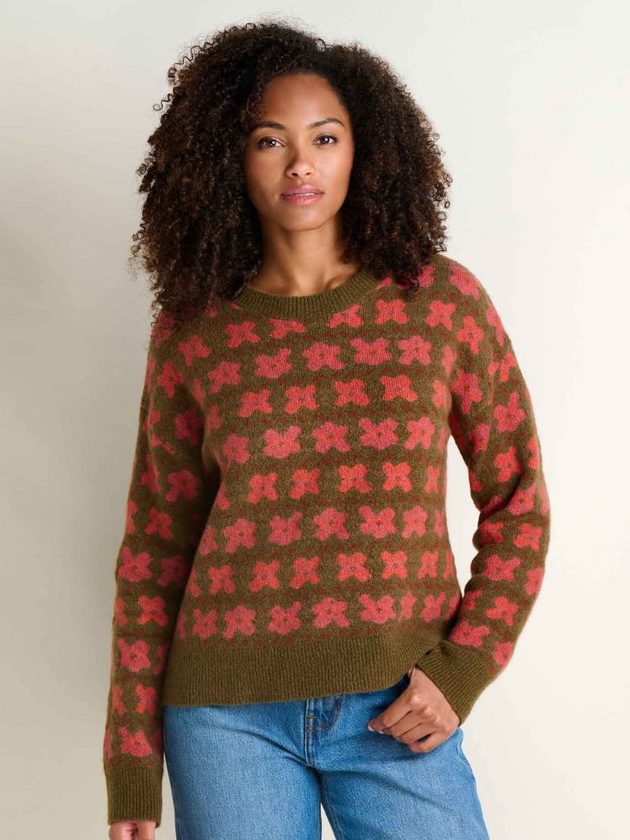
If your style leans a bit bolder or on the quirky side, the printed sweaters at Toad & Co might be right up your alley. Toad & Co’s sweaters feature everything from feminine florals to classic stripes — with some ’90’s inspired prints thrown in for good measure — in the classic sweater styles you’d expect: cardigan, crew sweaters, v-necks, sweater dresses, and sweater vests.
The brand uses materials like organic cotton, recycled cotton, RWS-certified merino wool. Note that some sweaters do contain a percentage of recycled synthetics mixed in.
Since the brand was founded in 1996, Toad & Co has partnered with a facility that employs and trains individuals with developmental disabilities, while facilitating outdoor adventures for them.
Conscious Qualities: Natural & Recycled Materials, Responsible Production Practices
Size Range: XS–XL
Price Range: $112-$240
4. Christy Dawn
Best for: luxurious organic cotton and alpaca knits
The coziest of natural fiber sweaters, Christy Dawn’s vintage-inspired organic cotton cardigans, oversized wool knits, and après-ski inspired pullovers will transport you to a countryside cottage.
The brand’s winter knits are made from alpaca wool sourced from the Peruvian highlands, organic cotton, and pima cotton and the yarns are colored with organic dyes. Each sweater is ethically hand-knit by makers earning living wages in Peru.
Conscious Qualities: 100% Natural Fibers, Non-Toxic Dyes, Ethically Made, Resale Program
Size Range: XS–XXL
Price Range: $138 – $478

5. Cottonique
Best for: comfy sweaters safe for those with skin sensitivities
Made from 100% GOTS-certified organic cotton in the brand’s own B-Corp and GOTS-certified factory, Cottonique’s organic sweaters are free from synthetic knit fibers, latex, synthetic dyes, bleach or other harsh chemical finishes. Even the label is 100% cotton and the cuffs are elastic free, to ensure comfort even for those with severe skin sensitivities.
I tried their close neck knitted sweatshirt in Natural and it was super comfortable, even when worn alone without a layer underneath. While limited in colors, I like that the brand doesn’t use synthetic dyes, and I found the natural cotton to be a beautifully warm soft cream color.
Conscious Qualities: B-Corp & GOTS-Certified Factory, 100% Organic Cotton
Size Range: S-XL
Price Range: $45 – $55

6. The RealReal
Best for: preloved designer sweaters
When it comes to finding quality secondhand pieces, The RealReal has been my personal go-to for years. Sort by anything from color and style to price and condition — and, of course, designer to find the perfect addition to your fall wardrobe.
Find everything from a classic Ralph Lauren crew neck to an eccentric, artful sweater from Marni, or just about anything in between, on The RealReal’s authenticated curation. Pro Tip: while you can’t filter by fiber on TRR, you can search terms like “100% cashmere sweaters” to help surface natural sweaters.
Conscious Qualities: Secondhand, Natural Sweater Options
Size Range: XXS–4XL
Price Range: $8 – $10,000+ (the range of secondhand!)
7. tentree
Best for: versatile everyday knitwear
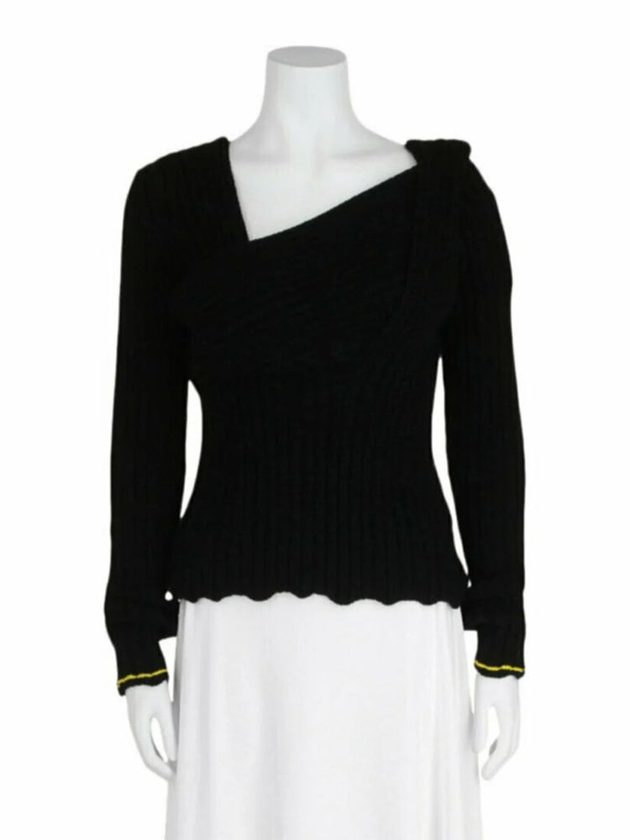
For classic sweaters — think turtlenecks, chunky cardigans, cable knit crew pullovers — tentree is a sure bet. Ideal for everyday wear, from lounging at home to going out for Sunday brunch, tentree’s sweaters are as versatile as they are cozy.
The brand’s sweaters are made from preferred materials like RWS-certified wool and organic cotton. Most pieces are primarily natural fibers blended with a percentage of recycled polyester, though there are a couple of 100% natural fiber pieces.
Conscious Qualities: Lower Impact Materials, Plants Trees
Size Range: XS–XL
Price Range: $88 – $148
8. Patagonia
Best for: cozy recycled wool sweaters for the cabin
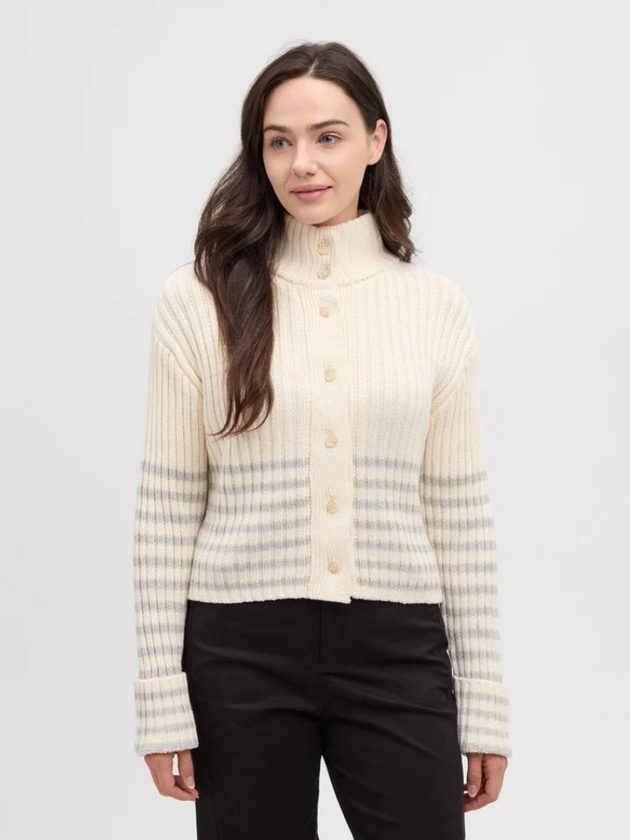
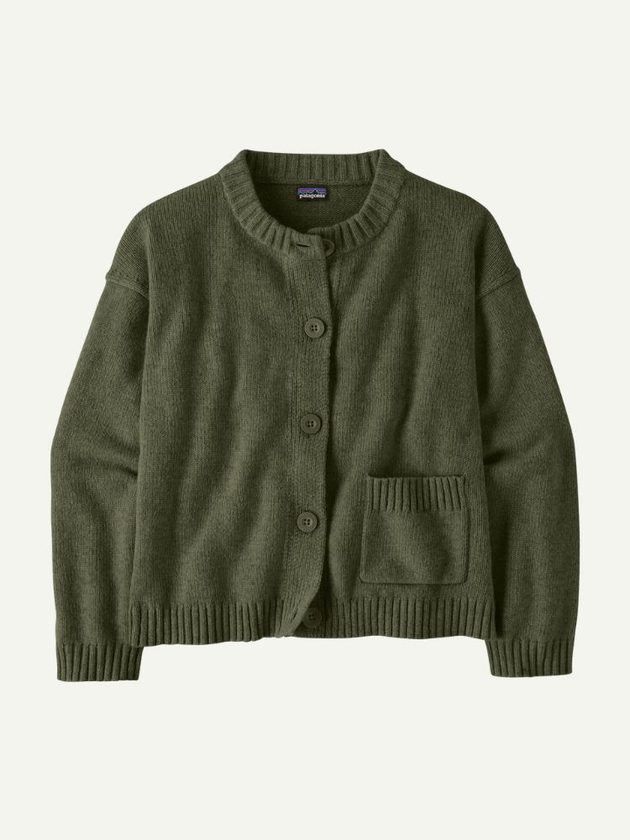
Imagine the sweater you’d thrown on to cozy up by the fireplace staying in a cabin surrounded by woodland. That is exactly what you’ll find in Patagonia’s sweater collection — from a Fisherman Cableknit made from recycled wool to a 100% Regenerative Organic Certified® cardigan with a “sweatshirt experience”. Several of the sweaters are also made in Fair Trade Certified factories.
Note that a few of the sweaters are blended with recycled nylon, while others are 100% natural fibers.
Conscious Qualities: Recycled Materials, Fair Trade Certified Factories, Secondhand & Repair Programs
Size Range: XXS–XXL
Price Range: $125 – $209
9. EILEEN FISHER
Best for: classic luxe sweaters in generous fits
Eileen Fisher is a contemporary brand with a commitment to sustainability from fiber to end-of-life. Most of the designer’s sustainable sweaters are crafted exclusively from natural fibers like Peruvian organic cotton, Italian cashmere/silk blends, and recycled cashmere — and many are made in Fair Trade Certified factories. (There are only a few pieces blended with recycled synthetics.)
And the brand has one of the longest standing resale programs in the industry, called RENEW, and a program to reuse unwearable or damaged textiles into wall art.
Conscious Qualities: Organic & Regenerative Fibers, 100% Natural Fiber Options, Fair Trade Certified Factories, Circular Fashion Practices
Size Range: XXS–3XL
Price Range: $268 – $548

10. Bare Knitwear
Best for: elegant natural alpaca sweaters
Minimalist yet sumptuous, Bare Knitwear’s Andes baby alpaca (certified by the Responsible Alpaca Standard) and Peruvian Pima cotton sweaters are ethically made in Lima, Peru. The natural sweaters are either left undyed or colored with OEKO-TEX Standard 100-certified dyes.
With understated styles and an exceptional attention to quality throughout the handmade process, Bare Knitwear’s sweaters are designed to last for many years to come.
Conscious Qualities: Slow Crafted, Ethically Made, Natural Fibers
Size Range: XS–L
Price Range: $200 – $556

11. Reformation
Best for: recycled cashmere sweaters in trendy styles
Using materials like traceable regenerative merino wool, recycled cashmere, and organically grown cotton, Reformation uses the crème de la crème of sustainable sweater materials.
But if you know Ref, you know that environmental consciousness doesn’t equal boring or crunchy. Their cropped crew sweaters, sheer cardigans, boyfriend sweaters, and cashmere turtlenecks are designed to turn heads. The brand does lean on the trendier side and releases new styles frequently, so they’re not a “slow fashion” brand per se, but I’ve added them to this list because their one of the most responsible mid-size to larger brands in the industry.
Conscious Qualities: Sustainable Materials, Supply Chain Transparency, Circular Practices
Size Range: XS–XL
Price: $98 – $398

 For More Slow Fashion Content:
More Cool-Weather Guides Like This:
Responsibly-Made Coats to Keep You Toasty
Sustainable Slippers to Get Cozy In
Bundle Up With These Cozy Conscious Winter Accessories
The post The Coziest Sustainable Sweaters Made with Natural Fibers appeared first on Conscious Life & Style.



-
Climate Change1 year ago
Guest post: Why China is still building new coal – and when it might stop
-

 Greenhouse Gases2 years ago
嘉宾来稿:满足中国增长的用电需求 光伏加储能“比新建煤电更实惠”
-
Greenhouse Gases1 year ago
Guest post: Why China is still building new coal – and when it might stop
-

 Climate Change2 years ago
嘉宾来稿:满足中国增长的用电需求 光伏加储能“比新建煤电更实惠”
-

 Renewable Energy11 months ago
Sending Progressive Philanthropist George Soros to Prison?
-
Climate Change2 years ago
Bill Discounting Climate Change in Florida’s Energy Policy Awaits DeSantis’ Approval
-
Greenhouse Gases1 year ago
嘉宾来稿:探究火山喷发如何影响气候预测
-

 Carbon Footprint2 years ago
US SEC’s Climate Disclosure Rules Spur Renewed Interest in Carbon Credits