

Not far from the hallowed spires and research labs of Oxford University, two workers in overalls and hard hats are searching for air travel’s “holy grail” – climate-friendly airline fuel made from nothing but carbon dioxide and green hydrogen.
That is how OXCCU chair Alan Aubrey describes the Oxford-based company’s mission to scale up its nascent production of so-called e-SAF, a synthetic hydrocarbon fuel that backers hope could one day become a viable, green alternative to traditional kerosene jet fuel.
“The beauty of this is that the inputs – CO2 and hydrogen – are at least theoretically unlimited,” the company’s CEO Andrew Symes told reporters during a visit to OXCCU’s experimental plant last year. “This industry – yes it starts small – but it can grow and scale and become very big.”

E-SAF can reduce planet-heating carbon emissions by up to 90% compared to conventional jet fuels. In contrast to more established forms of SAF, e-SAF does not require vast quantities of raw materials such as used cooking oil (UCO) or – more controversially – agricultural products such as sugar-based ethanol, soy or palm oil.
It is easy to see the fledgling industry’s appeal as airlines and governments fret over how to tackle air travel’s growing carbon emissions. They are closely watching the progress of startups such as OXCCU, whose backers include United Airlines, Saudi energy giant Aramco and Italy’s Eni.
Policymakers in the European Union and the UK are also taking note, and fuel providers are being mandated to supply growing amounts of e-SAF, starting with 0.2% in the UK in 2028 and 0.7% in the EU in 2030.
So far, e-SAF has only been used for a few high-profile test flights. In 2021, Dutch airline KLM used 5% SAF on a flight from Amsterdam to Madrid, and the British air force was the first to power a plane entirely on e-SAF when a two-seater made a short trip around a private airport.
But scaling up synthetic fuel production could be a long haul.
To fly or not to fly?
E-SAF remains prohibitively expensive to produce and so far its use has mainly been limited to demonstration projects, like OXCCU’s plant at Oxford Airport. Critics say it could be decades away from becoming commercially viable.
Producing green hydrogen from water to make the fuel requires huge amounts of renewable electricity, which the industry’s detractors say is a waste of scarce green power resources.
Such obstacles, they say, make it a distraction from the most obvious solution to aviation emissions: flying less.
Aviation’s Green Dream: Read our investigative series on Sustainable Aviation Fuel
“The idea that we can magic up this gigantic renewable capacity to produce e-fuel … it’s just not doable, it’s not going to be affordable, and it makes no sense from the perspective of using resources,” said Alethea Warrington, a campaigner on aviation issues at Possible, a UK-based NGO that promotes climate action.
Some climate campaigners are more positive about e-SAF. Aoife O’Leary, head of climate think-tank Opportunity Green, said there is a need to “deal with the unsustainable growth of aviation”, but that we should “also decarbonise the flights that exist”.
Acknowledging the huge renewable energy requirements needed to make green hydrogen, she said that “if paid for by the industry, then it would be additional to the renewable energy that exists otherwise”.
Aviation industry body IATA, the International Air Transport Association, urged governments in a recent statement to redirect into renewables “a portion of the $1 trillion in subsidies that governments globally grant for fossil fuel” and to develop policies“ to ensure SAF is allocated an appropriate portion of renewable energy production”.
The Possible group has called instead for measures to limit flight numbers, for example, a frequent flyer tax and efforts to promote rail transport.
But sweeping policies to reduce flying would be unpalatable for many governments and painful for passengers. Surveys from Europe and the US suggest that about a quarter of flights are taken to visit friends and relatives, and globally about 95% of flights are longer than 500 km (310 miles) – making other forms of transport less practical.
In the meantime, the world’s appetite for flying continues to grow, spurring efforts to find a way to tackle the carbon footprint of aviation – today the cause of about 2.5% of all energy-related emissions.
On its current trajectory, the aviation industry is on course to blow a big hole in the world’s goal to limit global warming to 1.5 degrees Celsius. According to the International Civil Aviation Organization, a UN agency, the sector’s emissions could double or even triple between 2015 and 2050.
That is partly because other sectors, such as road transport and power generation, are cutting their emissions by switching to renewable electric energy – still a distant technological prospect for commercial aircraft.
Fuel from air and water
Concern that plant-based SAF could increase competition for land and raise deforestation risks might boost efforts to ramp up e-SAF production.
New rules in the EU and the UK say only waste products such as UCO should be used to make SAF, but experts and industry insiders told an investigation by Climate Home News and its partner The Straits Times that in key UCO supplier Malaysia, unused or barely used palm oil is being passed off as waste oil.
In contrast, synthetic fuel is made by passing an electric current – produced with renewable electricity – through water, splitting it into hydrogen and oxygen gas. The oxygen is released harmlessly into the atmosphere, while the hydrogen is captured and mixed with carbon dioxide (CO2) to make the hydrocarbon jet fuel.

E-SAF producers such as OXCCU and US-based Twelve, which is set to supply Alaska Airlines and International Airlines Group, source their CO2 from industries that produce it as a waste product.
“It’s essentially getting two uses out of the carbon before it goes up into the atmosphere,” Symes said, adding that an even better option would be using technology to capture CO2 directly from the air, which would be fully circular and carbon neutral.
While OXCCU buys its green hydrogen, Twelve is planning to make its own at its factory in the US Pacific Northwest. “That’s something we’ve invested a lot of time and money into over the past few years,” the company’s vice president of business development Ashwin Jadhav told Climate Home.
Green hydrogen challenge
Scaling up green hydrogen production will be a “real challenge”, despite e-SAF’s “immense” potential, said Azim Norazmi, climate policy manager at IATA.
With the global aviation industry’s net-zero goal just 25 years away, he said plant-based biofuels – not e-SAF – will be the “biggest contributor” to meeting that target.

Aurelia Leeuw, Opportunity Green’s EU policy director, said one of the issues holding back e-SAF production is that airlines generally only want short-term contracts of around a year, while producers need longer-term certainty to justify investments in ramping up output.
The European Commission is expected to announce a sustainable aviation plan in the next few months. Leeuw and others are hoping this will help solve the problem by bringing international aviation into the EU’s Emissions Trading System (ETS) and using the funds raised from imposing charges on airlines to buy large quantities of e-SAF. An intermediary – such as the European Commission – would then sell the fuel on short-term contracts.
The idea under consideration would bring flights taking off in Europe that land outside the continent into the ETS, generating more funding from the aviation industry to support investment in e-SAF.
Leeuw said demand for e-SAF is also being held back by airlines and fuel suppliers assuming that the European Commission will water down its mandates and not fully apply penalties for fuel suppliers that do not meet them. The size of these penalties will depend on the price difference between conventional jet fuel, SAF and e-SAF – but are likely to be thousands of dollars per tonne, according to Brussels-based NGO Transport & Environment.
“The European Commission is saying the [e-SAF] targets are not up for debate. But the airlines and oil and gas incumbents are lobbying them hard and playing off the uncertainty that they themselves are creating,” she said.
“There must be no doubt that these… are the targets – and those are the penalties,” she added.
This article was developed with the support of Journalismfund Europe.

The post Air travel’s ‘holy grail’: Jet fuel made from CO2 and water prepares for take-off appeared first on Climate Home News.
Air travel’s ‘holy grail’: Jet fuel made from CO2 and water prepares for take-off

Next week, diplomats from around the world will descend on Yerevan, Armenia, to negotiate a series of decisions under the UN Convention on Biological Diversity (CBD).
Between 19 and 30 October, 196 parties will gather to hammer out the precise wording of the dozens of legal texts that make up the decisions under the Conference of the Parties (COP) to the CBD.
This year’s summit is particularly significant, as it marks the halfway point between the agreement of the Kunming-Montreal Global Biodiversity Framework and the deadline for achieving its targets.
The CBD has found that countries are currently not on track to meet 22 out of the framework’s 23 targets.
During the fortnight, delegates will also be negotiating decisions relating to the two supplemental protocols to the CBD: the Cartagena Protocol, which covers biosafety; and the Nagoya Protocol, which covers access and benefit-sharing for the use of genetic resources.
(The Cartagena and Nagoya Protocols, which are each governed by a “meeting of the parties”, or “MOP”, have fewer parties than the CBD as a whole, with 173 and 141, respectively.)
Carbon Brief is tracking the progress of countries towards consensus on dozens of negotiating texts using the interactive table below.
The tracker includes texts from the COP, as well as the MOPs for the Cartagena and Nagoya protocols. It also includes draft decisions from the most recent subsidiary body meetings, as these form the starting point for the negotiations in Yerevan.
The CBD has three subsidiary bodies: the subsidiary body on scientific, technical and technological advice (SBSTTA), the subsidiary body on implementation (SBI) and the subsidiary body on article 8(j) and other provisions (SB8J).
SB8J focuses on issues related to the Indigenous peoples and local communities. It was established at COP16 in Cali, Colombia, in 2024.
The first two columns of the interactive tracker list the topic of each agenda item and the relevant body, with subsequent columns including dates, page counts and links to the original documents.
The table is searchable and can be sorted using the arrows in the header.
Areas of disagreement in UN draft texts are denoted by square brackets. Counting the brackets in a particular iteration of a text therefore gives a sense of how far parties are from reaching consensus.
The bracket column is colour-coded, with dark green indicating a low number of brackets and red indicating a high number of brackets remaining.
Texts can also present parties with choices using “options” or alternatives (“alt”), which are counted together in the sixth column of the table.
The key discussions in Yerevan will centre around two agenda items in particular. The first is the global review, which will assess progress towards the GBF and make recommendations for accelerating action.
The second is finance, which can be separated into two parts: resource mobilisation and the financial mechanism. On resource mobilisation, biodiverse global south countries are likely to push for an increased amount of international finance for conservation.
Disagreement over the creation of the financial mechanism led to the suspension of COP16 in Cali in October 2024, as parties failed to find agreement on the mobilisation of finance before the end of the summit.
Global south countries want the establishment of a separate financial mechanism under the control of the CBD; global north countries largely prefer to maintain the existing mechanism, which sits under the Global Environment Facility.
At the resumed session of COP16 in Rome in early 2025, countries agreed on a roadmap that would lead to the establishment of a permanent mechanism.
related

Analysis: Lula presidency saved at least 20,000km2 of Brazilian Amazon since 2022
Why land-use emissions have fallen by a third this century – in six charts

Analysis: 84% of nations miss deadline to identify ‘nature-harming’ subsidies by 2025
UK withdraws millions in funding from world’s second-largest rainforest in Congo
The post Interactive: Tracking negotiating texts at the COP17 biodiversity summit appeared first on Carbon Brief.
Interactive: Tracking negotiating texts at the COP17 biodiversity summit
A beacon of love
On an outer island of Fiji, two thousand nautical miles from Sydney, is a shining light of hope and resilience for our troubled world.
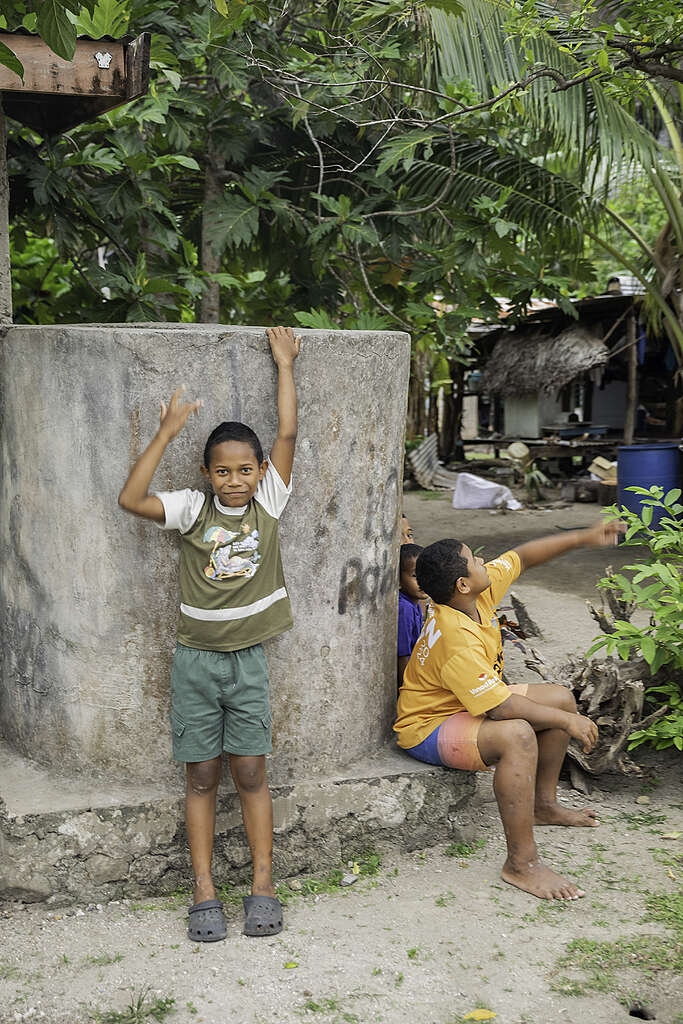
The island of Kioa is home to a Tuvaluan community who migrated from their atoll of Vaitupu in the late 1940s. It is a land of warm hearts, big smiles, and deep cultural roots; a place where the sound of a conch still summons the island together, where islanders paddle out to fish in carved outrigger canoes, and healthy happy children walk barefoot to school.
Here, culture is life. Kioans live sustainably through their traditional knowledge and practices. The island is alive with song, dance and the rhythms of a life tied to the tides, the winds, and the seasons.
Facing the future
Greenpeace has been lucky to have a relationship with Kioa for a number of years now, and we are continually learning from this remarkable community.
Last week, as part of our Voyaging Oceania project, we returned to the island. Our purpose was twofold —- to carry messages from the island to leaders gathering in Nadi this week for the Pacific Pre-COP, and to support the Kioa community in their efforts to improve water security for the island.
Unlike Tuvalu itself, with its eight atolls, Kioa is a mountainous, forested and richly fertile island. It will remain habitable far into the future. Kioans did not initially migrate from Vaitupu due to climate change, but the move was prophetic. They now have a lifeboat.
However, even Kioa faces challenges on our rapidly warming planet, in particular when it comes to water. Climate change is shifting once reliable rainfall patterns. On top of this, the island is already feeling the effect of this year’s intensifying El Niño event, which for Fiji means reduced rainfall and prolonged dry spells.
Right now, fresh water has to be carefully rationed, and is only available for a few hours a day. During last week’s visit aboard our campaigning ship Oceania, Greenpeace was privileged to work with the Kioa community on a new solar-powered water distribution project for the island.
Designed and led by the island, the project involves using a solar pump to move water from a reliable source to a storage tank and then using gravity to distribute the water around the village.
It was a lesson in how local knowledge and ingenuity can be the backbone of today’s climate solutions. To build a dam around the source, the local community knew the exact spot where they could gather gravel at low tide to mix with the cement. They took only what was needed, knowing that all resources must be carefully conserved. Kioa has no roads and no machinery, and it was an all-of-island effort to carry the materials up to the project site, including many heavy bags of sand and rock.
Such projects truly bring to life the vision of a resilient, locally-led, fossil fuel free Pacific.