


On April 2, 2025, President Donald Trump announced a series of tariffs, referring to the day as “Liberation Day.” These tariffs include a universal 10% levy on all imported goods and higher rates for specific countries, such as an additional 34% on Chinese imports, which now totals 54%, and 20% on those from the European Union.
The administration’s goal is to address trade imbalances and encourage domestic manufacturing. These measures will greatly affect the renewable energy sector and the clean energy transition.
The announcement also caused a massive sell-off on Wall Street, wiping out nearly $2.5 trillion in value from the U.S. stock market. The market drop shows that investors are worried. They fear that new tariffs might hurt the economy, strain trade relationships, and impact America’s shift to cleaner energy.
Clean Energy Progress at Risk?
One of the biggest concerns is how these tariffs could affect the clean energy transition. They are expected to have notable impacts on the renewable energy sector in the U.S.
The U.S. relies heavily on imported components for clean energy technologies, such as solar panels, wind turbines, and batteries. Many of these materials come from countries that are now facing higher tariffs, such as China.
Over 80% of solar panels installed in the U.S. come from Chinese companies or use components made in China. China dominates the solar photovoltaic (PV) cell market. It makes over 80% of the global supply. Also, it produces more than 95% of the world’s polysilicon wafers, which are key parts of solar panels.

In the battery sector, China refines around 60% of the world’s lithium, 80% of cobalt, and over 90% of manganese, all essential for electric vehicle (EV) batteries.
Additionally, China is the leading exporter of rare earth elements, which are used in wind turbines, EV motors, and energy-efficient technologies. Recently, the U.S. imported nearly 74% of its rare earth needs from China as of recent years. This heavy dependence makes the clean energy sector especially vulnerable to tariffs on Chinese imports.
A 54% tariff on Chinese goods would raise the cost of these items, making clean energy projects more expensive.
Industry experts express concern that these tariffs may disrupt supply chains and increase costs for renewable energy projects.
Vanessa Sciarra, vice president of trade and international competitiveness for the American Clean Power Association, stated that such policy changes could jeopardize access to affordable and reliable energy by severing established supply chains.
The New US Tariff Rate Globally

Markets Crash: Investors React Quickly
The broader economic implications of the tariffs are also significant. Following the announcement, stock prices dropped sharply. Investors feared higher costs for businesses and slower growth. The result was one of the worst market crashes since the 2020 pandemic.
The S&P 500 Index dropped by 4.8%, erasing approximately $2.5 trillion in market value. Companies with extensive supply chains in affected countries, such as Apple, experienced substantial stock declines.
Other tech giants also suffer heavy losses as seen below, including Nvidia, Amazon, Meta, Microsoft, Alphabet and Tesla.

Private equity firms and banks also slowed down deals. A huge drop in the IPO (Initial Public Offering) market is expected this year, according to analysts at Morgan Stanley.
Many are now putting deals on hold. According to analysts, the number of companies that had planned to go public in 2025 are rethinking their timelines following the tariff announcement.
Experts say the drop was caused by fears that Trump’s tariff plan could lead to higher prices for goods, more inflation, and possibly a new global trade war.
China’s Swift Countermove
China quickly responded. It has announced a 34% tariff on all U.S. goods, set to take effect on April 10, 2025. The Asian nation further announced export restrictions on key rare earth elements, widely used in defense, electronics, and clean energy technologies.
China, which controls around 90% of global rare earth production, will now limit exports of seven critical minerals and related products. This poses a major challenge to U.S. manufacturers like Lockheed Martin, Tesla, and Apple. These companies depend on those materials for their supply chains.
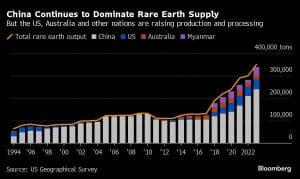
Analysts see this as a strategic countermove. It shows Beijing’s leverage and will intensify pressure on U.S. companies already reeling from tariff-driven cost hikes.
Energy Independence or Economic Isolation?
Many lawmakers, including some Republicans, are pushing back against the tariffs. They say the president may need approval from Congress to set tariffs this high.
There could also be legal challenges from industries, companies, or trading partners. The World Trade Organization (WTO) may review the new tariffs to see if they break global trade rules.
Some experts say the move could isolate the U.S. economically. It can also harm trust among allies, especially at a time when countries are trying to unite on climate change and energy security.
President Trump’s return to power has brought a sharp shift in U.S. trade and climate policy. His first term saw the U.S. exit the Paris Agreement and impose tariffs on steel and aluminum. His second term started off with even harsher trade barriers.
Trump’s 2025 tariff plan has already made a big impact—even though it hasn’t become law. It caused a major stock market drop, scared investors, and raised concerns about the future of clean energy. If put in place, these tariffs could change the way the U.S. trades, invests, and powers its economy.
As the world tries to move toward a cleaner, more sustainable future, the question is: Will these tariffs protect America—or isolate it?
- INTERESTING READ: Trump’s Tariffs and Climate Rollbacks: How 2025 is Shaking Copper Markets and Clean Energy Goals
The post Trump’s New Tariffs Wipe Out $2.5 Trillion: How Can It Stall America’s Clean Energy Future? appeared first on Carbon Credits.

EU carbon credit claims changed on 27 September 2026, the day the Directive (EU) 2024/825 began to apply across the European Union. The change is narrow. It changes how a company can talk about the credits it buys. A product can no longer be called neutral on the strength of compensation alone; however, every specific, evidenced statement about what a company measured, reduced, and funded stays fully available.

The post Promoting Improved Cooking Practices in Nigeria appeared first on Terrapass.


-
Climate Change1 year ago
Guest post: Why China is still building new coal – and when it might stop
-

 Greenhouse Gases2 years ago
嘉宾来稿:满足中国增长的用电需求 光伏加储能“比新建煤电更实惠”
-
Greenhouse Gases1 year ago
Guest post: Why China is still building new coal – and when it might stop
-

 Climate Change2 years ago
嘉宾来稿:满足中国增长的用电需求 光伏加储能“比新建煤电更实惠”
-

 Renewable Energy12 months ago
Sending Progressive Philanthropist George Soros to Prison?
-
Climate Change2 years ago
Bill Discounting Climate Change in Florida’s Energy Policy Awaits DeSantis’ Approval
-
Greenhouse Gases1 year ago
嘉宾来稿:探究火山喷发如何影响气候预测
-

 Climate Change2 years ago
Analysis: China’s CO2 falls 1% in Q2 2024 in first quarterly drop since Covid-19