

A federal election is taking place in Germany on 23 February, following the collapse of the coalition government at the end of last year.
Germans will vote to elect 630 members of the nation’s parliament.
Polling suggests there will be a political shift to the right, with the centre-right Christian Democratic Union (CDU) in the lead and far-right Alternative for Germany (AfD) set to make significant gains.
A “traffic light” coalition of parties has ruled since 2021, led by the centre-left Social Democratic Party (SPD), alongside the Green Party and the Free Democratic Party (FDP).
However, successive crises led to its breakup at the end of 2024, when the liberal, free market-oriented FDP split from the rest.
This prompted a vote of no confidence by the German parliament, which, in turn, triggered a snap election several months earlier than previously scheduled.
The coalition government has been plagued by ideological differences, particularly between the FDP and its two centre-left partners.
Climate policies were at the heart of many of the disputes.
The centre-left SPD and Greens have broadly favoured more public spending on climate issues, while the FDP is opposed to state intervention of any sort.
In the interactive grid below, Carbon Brief tracks the commitments made by each of the main parties in their election manifestos, across a range of issues related to climate and energy.
The parties covered are:
- Christian Democratic Union (CDU)/Christian Social Union (CSU): The centre-right CDU and its regional Bavarian “sister party”, CSU, has been the dominant political force in modern Germany and is currently polling highest ahead of the election.
- Social Democratic Party (SPD): The centre-left SPD has led the ruling coalition in Germany since the last election in 2021 and has traditionally been the other dominant party in the nation’s politics.
- Green Party: The centre-left and environmentalist Greens have been part of the coalition government since 2021.
- Free Democratic Party (FDP): The FDP is an economically liberal party that prioritises free markets and privatisation. It was part of the coalition government, but its departure at the end of 2024 ultimately triggered the federal election.
- Left Party: In recent years, this left-wing, democratic-socialist party has lost much of its support base in the east of the country.
- Alternative for Germany (AfD): The far-right party has become a major force in the country’s politics over the past decade, particularly in eastern Germany.
- Sahra Wagenknecht Alliance (BSW): The party was only founded last year, as an offshoot of the Left Party, but it has rapidly risen in popularity with a left-wing economic message and a conservative approach to some social and cultural issues.
Each entry in the grid represents a direct quote from a manifesto document.
Net-zero and climate framing
Climate action has become a divisive topic in German politics.
This is evident in the major parties’ manifestos, which range from supporting more ambitious net-zero goals to outright climate scepticism.
Germany is currently aiming to reach net-zero greenhouse gas emissions by 2045, with interim targets including a 65% cut by 2030.
Government climate advisors on the Council of Experts on Climate Change have stated that the nation is on track to miss the 2030 target.
Despite starting out with ambitious aims, the coalition’s climate progress has faltered, with the FDP successfully pushing for weaker climate policies. Moreover, a major court ruling curtailed the government’s climate spending by enforcing Germany’s limit on debt.
Amid these wider tensions, Germany’s two traditionally dominant parties still want to retain the nation’s headline climate target. The CDU, which is leading the polls in the run-up to election day, commits to meeting the Paris Agreement goals in its manifesto, saying its sights are “firmly set” on net-zero by 2045.
The SPD, which is currently third in the polls and likely to end up in coalition with the CDU, also supports the 2045 net-zero target, as well as the interim goals.
However, the two parties differ substantially in their approach to meeting the 2045 target. The CDU prioritises carbon pricing and rejects the tougher policies to decarbonise heating and transport favoured by the SPD. (See: Heating dispute and Combustion engine phaseout.)
Meanwhile, the AfD manifesto repeatedly questions the “supposed scientific consensus” on “man-made climate change”. The party, which is currently second in the polls, “therefore rejects every policy and every tax that is related to alleged climate protection”.
Mainstream German parties across the spectrum have long agreed to a “firewall” against far-right groups, meaning they will not form coalitions with the AfD. However, the CDU recently sparked controversy when it backed an anti-immigration policy with the AfD.
The Green Party also supports the 2045 net-zero target in its manifesto, emphasising Germany’s status as the EU member state with the highest emissions. The Left Party goes further, calling for a 2040 net-zero goal.
As for the FDP, its manifesto argues for the 2045 net-zero goal to be pushed back to 2050, stating that this would align Germany with the EU target. Prior to exiting the coalition government last year, the party had demanded this policy change, claiming that it would be a way to boost the German economy.
(Germany already revised its net-zero target, bringing it forward by five years, following a supreme court ruling in 2021 that its 2050 goal was insufficient. Moreover, even with a later goal, Germany would still need to align with wider EU targets, meaning its climate policies may not change much due to its “effort sharing” obligations.)
Finally, the BSW is not specific about when the net-zero goal should be achieved, but pushes for a “departure from the wishful thinking of quickly achieving complete climate neutrality”.
It does not reject climate policies outright, stating that climate change should be “taken seriously”. However, it frames many climate policies as being “extremely expensive and often unrealistic”.
Heating dispute
Home heating has become a major political issue in Germany. Along with transport, buildings make up one of the key German sectors that have repeatedly missed their decarbonisation goals, prompting the coalition government to take action.
Towards the end of 2023, the German parliament passed an amendment to the Building Energy Act, meaning that newly installed heating systems had to be powered by at least 65% renewable energy.
This covered heat pumps, “hydrogen-ready” gas boilers and other low-carbon systems. There are caveats to ensure the law is phased in gradually in different areas and types of homes, starting with new builds.
The amendment had been watered down compared to the coalition’s initial proposal, with allowances for people to keep gas boilers for longer. This followed relentless campaigning by the AfD and the right-leaning tabloid newspaper Bild, which dubbed the policy the “heizhammer” – or “heating hammer”.
There were also attacks from within the coalition, with the FDP criticising the law proposed by its partners in the Greens and SDP. Opponents framed the policy as an excessive burden on consumers.
These disputes are reflected in the election manifestos, with many parties outright rejecting the amended law. The CDU, FDP and AfD all say they would abolish it, as does the populist left BSW.
Meanwhile, the Green Party pledges to provide more government support for the installation of new heating systems by covering up to 70% of the price. The Left Party commits to covering 100% of the cost for low-income households.
(The current law covers 30% of the cost as a starting subsidy, with more available for low-income households and people who replace their boilers before 2028.)
Combustion engine phaseout
Several German political parties are pushing back against the EU-wide ban on the sale of new petrol and diesel cars, which is set to come into effect in 2035.
The CDU says the “ban on combustion engines must be reversed”, while the AfD says the “one-sided preference for electromobility must be stopped immediately”.
(EVs are “likely crucial” for tackling transport emissions, according to the Intergovernmental Panel on Climate Change [IPCC].)
The FDP and the BSW also argue that the 2035 phaseout date should be dropped, with less focus on the transition to electric cars. (This is in spite of Germany being the second-biggest manufacturer of electric cars in the world.)
These parties also favour getting rid of supposed “anti-car” policies. For example, they oppose speed limits on the German “autobahns” and support funding for alternative fuels, such as synthetic fuels.
The issue with ending the 2035 ban on new combustion-engine cars is that this policy is set at the EU level. Far-right and centre-right coalitions within the EU, including German parties, have been pushing hard to weaken the ban across the bloc.
However, the centre-left parties that may end up forming a coalition with the CDU, notably the SPD, stand by the 2035 phaseout date.
There is growing pressure on Germany’s car industry, linked to global competition and slow economic growth. Some German industry figures have stressed the need for consistent policy signals from the government, regarding the transition to electric vehicles.
Clean energy and fossil fuels
Broadly speaking, German parties on the left tend to be more supportive of renewables, while strongly opposing nuclear power. Those on the right are generally more open to nuclear and in some cases coal power.
Germany, which uses more coal than any other EU member state, has a coal power phaseout date of 2038. This is supported by the CDU and the FDP, but the Greens and the Left Party want a quicker phaseout by 2030.
(When the coalition government formed in 2021, the parties agreed to “ideally” move the coal phaseout date to 2030, but this has not happened formally. The SPD manifesto does not include any mention of coal power,)
Only the AfD advocates for the construction of new coal power plants, framing them as filling a gap until new nuclear plants are built.
Last year, Germany closed down its final nuclear reactors, bringing an end to a long-term plan to phase out the power source. However, nuclear power continues to be a politicised topic, with some arguing that its continued use is necessary to ensure the nation’s energy security.
Notably, the CDU suggests in its manifesto that it is open to reviving nuclear power in the future. It proposes an “expert review” around restarting closed plants and advocates for research on advanced nuclear technologies, such as small modular reactors.
Despite this wording, CDU leader Friedrich Merz has conceded that it is unlikely any old reactors will be restarted. This echoes views expressed by German utility companies and energy experts.
Both the CDU and the SPD support the expansion of renewables in their manifestos. The Greens include a specific target to achieve a net-zero electricity grid by 2035. By contrast, the AfD calls for an end to wind power expansion, in favour of other technologies.
Finally, both the far-right AfD and the BSW say the German government should repair the damaged Nord Stream pipelines in order to import what the BSW refers to as “cheap” gas from Russia. (The Baltic Sea pipelines were blown up in 2022 under mysterious circumstances.)
Germany has tried to wean itself off Russian gas since the country’s invasion of Ukraine, with considerable success. However, both the AfD and the BSW are more open to cooperating with Russia, and less supportive of Ukraine, than mainstream German parties.


The post Germany election 2025: What the manifestos say on energy and climate change appeared first on Carbon Brief.
Germany election 2025: What the manifestos say on energy and climate change

Drought and heatwaves occurring together – known as “compound” events – have “surged” across the world since the early 2000s, a new study shows.
Compound drought and heat events (CDHEs) can have devastating effects, creating the ideal conditions for intense wildfires, such as Australia’s “Black Summer” of 2019-20 where bushfires burned 24m hectares and killed 33 people.
The research, published in Science Advances, finds that the increase in CDHEs is predominantly being driven by events that start with a heatwave.
The global area affected by such “heatwave-led” compound events has more than doubled between 1980-2001 and 2002-23, the study says.
The rapid increase in these events over the last 23 years cannot be explained solely by global warming, the authors note.
Since the late 1990s, feedbacks between the land and the atmosphere have become stronger, making heatwaves more likely to trigger drought conditions, they explain.
One of the study authors tells Carbon Brief that societies must pay greater attention to compound events, which can “cause severe impacts on ecosystems, agriculture and society”.
Compound events
CDHEs are extreme weather events where drought and heatwave conditions occur simultaneously – or shortly after each other – in the same region.
These events are often triggered by large-scale weather patterns, such as “blocking” highs, which can produce “prolonged” hot and dry conditions, according to the study.
Prof Sang-Wook Yeh is one of the study authors and a professor at the Ewha Womans University in South Korea. He tells Carbon Brief:
“When heatwaves and droughts occur together, the two hazards reinforce each other through land-atmosphere interactions. This amplifies surface heating and soil moisture deficits, making compound events more intense and damaging than single hazards.”
CDHEs can begin with either a heatwave or a drought.
The sequence of these extremes is important, the study says, as they have different drivers and impacts.
For example, in a CDHE where the heatwave was the precursor, increased direct sunshine causes more moisture loss from soils and plants, leading to a drought.
Conversely, in an event where the drought was the precursor, the lack of soil moisture means that less of the sun’s energy goes into evaporation and more goes into warming the Earth’s surface. This produces favourable conditions for heatwaves.
The study shows that the majority of CDHEs globally start out as a drought.
In recent years, there has been increasing focus on these events due to the devastating impact they have on agriculture, ecosystems and public health.
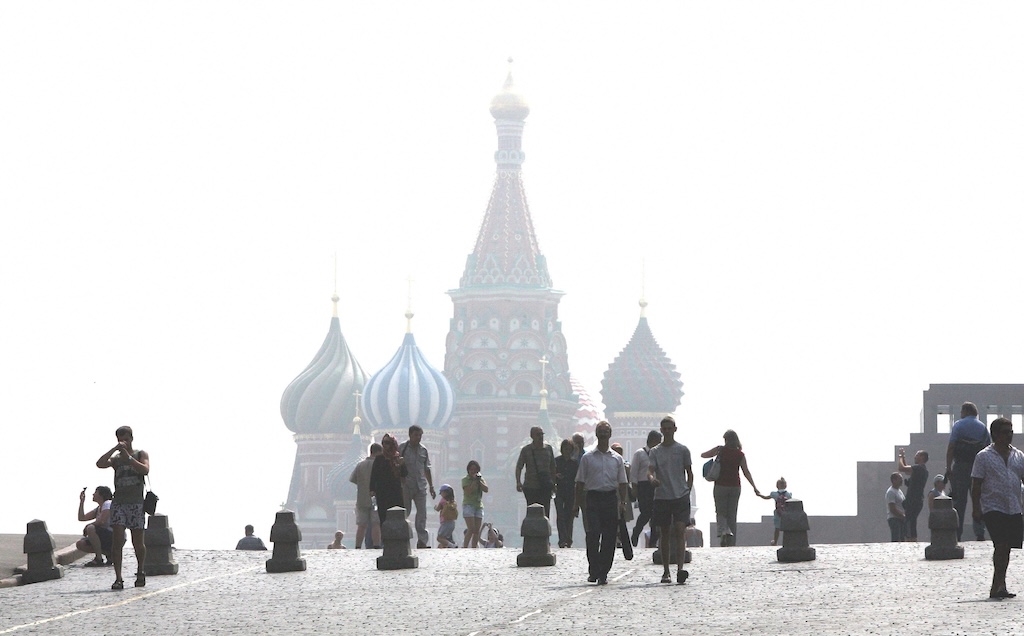
In Russia in the summer of 2010, a compound drought-heatwave event – and the associated wildfires – caused the death of nearly 55,000 people, the study notes.
The record-breaking Pacific north-west “heat dome” in 2021 triggered extreme drought conditions that caused “significant declines” in wheat yields, as well as in barley, canola and fruit production in British Columbia and Alberta, Canada, says the study.
Increasing events
To assess how CDHEs are changing, the researchers use daily reanalysis data to identify droughts and heatwaves events. (Reanalysis data combines past observations with climate models to create a historical climate record.) Then, using an algorithm, they analyse how these events overlap in both time and space.
The study covers the period from 1980 to 2023 and the world’s land surface, excluding polar regions where CDHEs are rare.
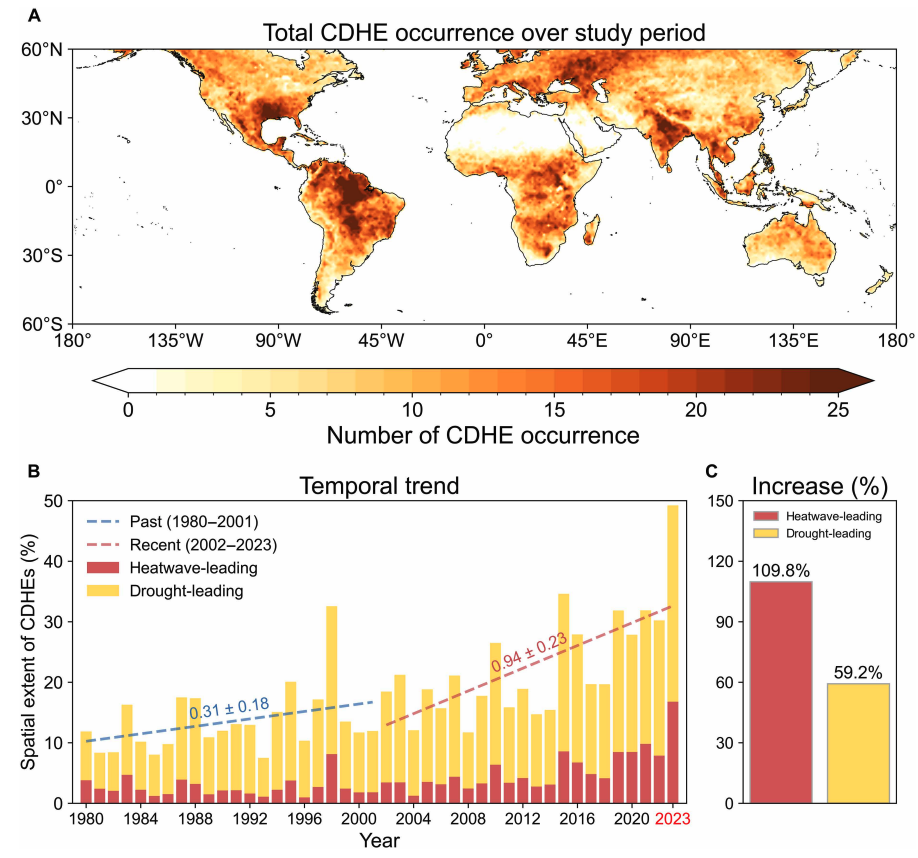
The research finds that the area of land affected by CDHEs has “increased substantially” since the early 2000s.
Heatwave-led events have been the main contributor to this increase, the study says, with their spatial extent rising 110% between 1980-2001 and 2002-23, compared to a 59% increase for drought-led events.
The map below shows the global distribution of CDHEs over 1980-2023. The charts show the percentage of the land surface affected by a heatwave-led CDHE (red) or a drought-led CDHE (yellow) in a given year (left) and relative increase in each CDHE type (right).
The study finds that CDHEs have occurred most frequently in northern South America, the southern US, eastern Europe, central Africa and south Asia.
Threshold passed
The authors explain that the increase in heatwave-led CDHEs is related to rising global temperatures, but that this does not tell the whole story.
In the earlier 22-year period of 1980-2001, the study finds that the spatial extent of heatwave-led CDHEs rises by 1.6% per 1C of global temperature rise. For the more-recent period of 2022-23, this increases “nearly eightfold” to 13.1%.
The change suggests that the rapid increase in the heatwave-led CDHEs occurred after the global average temperature “surpasse[d] a certain temperature threshold”, the paper says.
This threshold is an absolute global average temperature of 14.3C, the authors estimate (based on an 11-year average), which the world passed around the year 2000.
Investigating the recent surge in heatwave-leading CDHEs further, the researchers find a “regime shift” in land-atmosphere dynamics “toward a persistently intensified state after the late 1990s”.
In other words, the way that drier soils drive higher surface temperatures, and vice versa, is becoming stronger, resulting in more heatwave-led compound events.
Daily data
The research has some advantages over other previous studies, Yeh says. For instance, the new work uses daily estimations of CDHEs, compared to monthly data used in past research. This is “important for capturing the detailed occurrence” of these events, says Yeh.
He adds that another advantage of their study is that it distinguishes the sequence of droughts and heatwaves, which allows them to “better understand the differences” in the characteristics of CDHEs.
Dr Meryem Tanarhte is a climate scientist at the University Hassan II in Morocco, and Dr Ruth Cerezo Mota is a climatologist and a researcher at the National Autonomous University of Mexico. Both scientists, who were not involved in the study, agree that the daily estimations give a clearer picture of how CDHEs are changing.
Cerezo-Mota adds that another major contribution of the study is its global focus. She tells Carbon Brief that in some regions, such as Mexico and Africa, there is a lack of studies on CDHEs:
“Not because the events do not occur, but perhaps because [these regions] do not have all the data or the expertise to do so.”
However, she notes that the reanalysis data used by the study does have limitations with how it represents rainfall in some parts of the world.
Compound impacts
The study notes that if CDHEs continue to intensify – particularly events where heatwaves are the precursors – they could drive declining crop productivity, increased wildfire frequency and severe public health crises.
These impacts could be “much more rapid and severe as global warming continues”, Yeh tells Carbon Brief.
Tanarhte notes that these events can be forecasted up to 10 days ahead in many regions. Furthermore, she says, the strongest impacts can be prevented “through preparedness and adaptation”, including through “water management for agriculture, heatwave mitigation measures and wildfire mitigation”.
The study recommends reassessing current risk management strategies for these compound events. It also suggests incorporating the sequences of drought and heatwaves into compound event analysis frameworks “to enhance climate risk management”.
Cerezo-Mota says that it is clear that the world needs to be prepared for the increased occurrence of these events. She tells Carbon Brief:
“These [risk assessments and strategies] need to be carried out at the local level to understand the complexities of each region.”




The post Heatwaves driving recent ‘surge’ in compound drought and heat extremes appeared first on Carbon Brief.
Heatwaves driving recent ‘surge’ in compound drought and heat extremes
Greenhouse Gases
DeBriefed 6 March 2026: Iran energy crisis | China climate plan | Bristol’s ‘pioneering’ wind turbine
Welcome to Carbon Brief’s DeBriefed.
An essential guide to the week’s key developments relating to climate change.
This week
Energy crisis
ENERGY SPIKE: US-Israeli attacks on Iran and subsequent counterattacks across the Middle East have sent energy prices “soaring”, according to Reuters. The newswire reported that the region “accounts for just under a third of global oil production and almost a fifth of gas”. The Guardian noted that shipping traffic through the strait of Hormuz, which normally ferries 20% of the world’s oil, “all but ground to a halt”. The Financial Times reported that attacks by Iran on Middle East energy facilities – notably in Qatar – triggered the “biggest rise in gas prices since Russia’s full-scale invasion of Ukraine”.
‘RISK’ AND ‘BENEFITS’: Bloomberg reported on increases in diesel prices in Europe and the US, speculat