

Welcome to Carbon Brief’s DeBriefed.
An essential guide to the week’s key developments relating to climate change.
This week
Africa energy summit
CLOSING THE GAP: More than 1,000 people, including heads of state, gathered at the Mission 300 Africa Energy Summit in Dar es Salaam, Tanzania to agree on a road map for providing electricity to 300 million people in Africa by 2030, Nigeria’s Guardian reported. The Mission 300 initiative was launched by the World Bank and the African Development Bank last year, the newspaper said. About 600 million people in Africa “still lack access to reliable and affordable energy”, the Conversation noted.
SETTLING FINANCE: Reuters reported that the initiative aimed to “unlock” at least $90bn from multilateral development banks, development agencies, finance institutions, private businesses and philanthropies. According to Climate Home News, development banks have committed to collectively deliver $40bn under the initiative – a target that was raised this week to more than $50bn by contributions from other financial institutions.
Trump’s climate rollbacks
CONFUSION: Donald Trump’s administration introduced a widespread spending freeze this week, sparking “widespread confusion and frustration”, Politico reported. On Monday, the White House budget office ordered a pause to all grants and loans disbursed by the federal government, with climate mitigation and adaptation programmes likely affected, the outlet said. It added that a federal judge temporarily blocked the freeze on Tuesday, but this has done little to assuage concerns.
ENDANGERMENT: Trump is also making moves to call into question the “legality and applicability” of the “endangerment finding”, a rule that instructs the federal Environmental Protection Agency to regulate greenhouse gas emissions because they pose a danger to human life, the New York Times reported. The New York Times also reported that Trump wants to deploy a rarely used “god-squad” panel to carve out exemptions in the Endangered Species Act.
ALIGNMENT: Meanwhile, La Nación reported that Argentina’s far-right president Javier Milei is still “mulling over” emulating Trump by removing his country from the Paris Agreement. Rumours that Argentina could be the first country to follow the US in leaving the Paris Agreement first began at COP29 in Azerbaijan after Milei withdrew his delegation from the talks. However, the newspaper noted, Argentina is still subject to agreements, such as the EU-Mercosur deal, that mandate it to meet environmental clauses.
UK’s climate plans
CLIMATE PLEDGE: The UK government has formally submitted its international climate pledge, known as a “nationally determined contribution” (NDC), to the United Nations Framework Convention on Climate Change (UNFCCC), BusinessGreen reported. The UK is one of a handful of countries to have submitted ahead of the 10 February deadline and is pledging to cut greenhouse gas emissions by 81% compared to 1990 levels by 2035, the publication said.
ROSEBANK RULING: The decision by the UK’s previous Conservative government to greenlight two new oilfields in the North Sea has been ruled unlawful by a court in Edinburgh, the Guardian reported, as it does not take into account emissions caused by burning the oil and gas produced. BusinessGreen reported that burning all the oil from the larger project, Rosebank, would emit as much CO2 as running 56 coal-fired power stations for a year.
LAY OF THE LAND: The Guardian reported that UK environment secretary Steve Reed is to announce a consultation for a long-awaited land-use framework for England. As part of the framework, the government hopes to map the areas of England with the best quality farmland and most potential for nature recovery, with ministers “discouraged from planning developments on the areas marked as best for farming and nature”, the Guardian said.
Around the world
- LA ATTRIBUTION: Human-caused climate change increased the likelihood of the wildfires in Los Angeles by 35% and the intensity by 6%, according to a rapid attribution study from World Weather Attribution.
- HACKING RING RULING: ExxonMobil has been linked to a legal case involving hacking attempts aimed at climate activists, after the man charged alleged that the oil giant was involved, E&E News reported. ExxonMobil denied involvement.
- AI DEMANDS LESS: The surprise breakthrough of Chinese start-up DeepSeek suggests that artificial intelligence may require less energy than previously thought, exposing the “guesswork” on AI power demand, the Financial Times reported.
- CHINA’S RECORD: Record amounts of wind and solar were added in China in 2024, the Associated Press reported. It cited new Carbon Brief analysis showing the clean energy surge halted the rise of China’s emissions in the last 10 months of the year.
46%
The share of Australia’s power supply derived from renewables in the final quarter of 2024 – a new record, according to the Guardian.
Latest climate research
- A Science study, covered by Carbon Brief, showed that climate change played a key role in the “catastrophic” 2023 floods in Sikkim in India, when a “glacial lake outburst flood” led to cascading floods that killed 55 people.
- A study in Nature Medicine found that there could be an extra 2.3 million deaths from extreme temperatures in Europe’s main cities by 2099, in a scenario with little action to curb climate change and adapt to its effects.
- The survival rates of certain bird species dropped during “increasingly severe” dry seasons seen in the Amazon rainforest over the past three decades, according to a new study in Science Advances, “challenging the notion that pristine rainforests can fully protect their biodiversity under increasingly severe climate conditions”.
(For more, see Carbon Brief’s in-depth daily summaries of the top climate news stories on Monday, Tuesday, Wednesday, Thursday and Friday.)
Captured

Analysis by Carbon Brief has found that a forest twice the size of Greater London would need to be planted to offset the additional CO2 emissions from the planned expansion of Heathrow, Gatwick and Luton airports announced by UK chancellor Rachel Reeves this week. Reeves confirmed the government’s support for a third runway at Heathrow airport in order to “unlock further growth” in a speech on Wednesday. Earlier in the week, UK energy security and net-zero secretary Ed Miliband said that any expansion “must be justified within carbon budgets and, if it can’t be justified, it won’t go ahead”. The analysis was twice cited in parliament by MPs and covered by a range of media outlets.
Spotlight
East Africa’s climate refugees
This week, Carbon Brief speaks to a young female journalist from Kenya’s Dadaab refugee complex who is documenting how more people are arriving in her community because of climate change-fuelled drought and famine.
Hosting more than 300,000 people and stretching over 50 square kilometres, Dadaab in eastern Kenya is one of the largest refugee camps in the world.
More than 96% of its residents arrived or are descended from neighbouring Somalia. It has make-shift shops, hospitals and schools, but permanent structures are banned by the Kenyan government.
Fardowsa Sirat Gele is a young female journalist who was born and raised in Dadaab. Her mother – like most of the first wave of residents to arrive in Dadaab – fled to the camp in 1991 due to Somalia’s civil war.
Like many in the camp, Fardowsa is stateless and unable to leave the complex. She explained:
“I can say I’m Somali because of my appearance, my language. But I don’t have the courage to say I have a country, because I’ve never lived there. And I can’t say I’m Kenyan, because Kenya will not allow me a birth certificate. So, that hurts me.”
With an interest in sharing the stories of her fellow refugees, Fardowsa works as a journalist at Radio Gargaar, the camp’s radio station.
“Radio Dadaab”, a new film produced by the Environmental Justice Foundation (EJF), followed Fardowsa as she put together a radio programme exploring a new force driving growing numbers of people to arrive at the camp: climate change.
Drought injustice
In recent years, countries in the Horn of Africa have faced their driest conditions in four decades, with several consecutive rainy seasons failing. Then, when rain finally fell, it brought deadly floods that swept away homes and croplands.
In Radio Dadaab, Fardowsa travels to the outskirts of the Dadaab refugee camp to interview new arrivals, who tell her stories of their entire livestock being wiped out, their crops failing and ensuing starvation due to the drought.
A rapid “attribution” analysis found that this deadly drought was made at least 100 times more likely by human-caused climate change.
Despite facing steep climate impacts, East Africa is responsible for just 1.4% of global greenhouse gas emissions.

Fardowsa found that, despite fleeing starvation and the impacts of climate change, when people arrived at Dadaab they continued to suffer, with no access to toilets, medical care or houses.
Political tensions have caused issues with new arrivals being able to register at the camp, which, in turn, has caused difficulty accessing resources and help, according to Fardowsa’s reporting.
This has resulted in “refugees that were already in the camps and the new arrivals [having to share] the little aid [available],” she told Carbon Brief.
The future
Fardowsa expressed concern about how global politics will affect Dadaab.
When asked about her hopes for her future, Fardowsa said “there is no hope because Trump has come back and the US was the main country helping with aid”.
The US provides more foreign aid globally than any other country and, last week, following several climate policy rollbacks, the Trump administration ordered a “sweeping freeze” on new funding for almost all US foreign assistance.
Yet, Fardowsa is committed to uplifting the voices of refugees for whom climate change is a threat multiplier.
“The main aim [of the film] was to show the world that there are human beings suffering because of environmental problems, like drought and displacement. To show empathy for refugees was the main focus.”
Radio Dadaab is available to watch on YouTube.
Watch, read, listen
RENEWABLE REVEAL: The Financial Times looked at how, despite abundant fossil-fuel reserves, several Middle East countries have huge plans for renewable energy, making the area the fastest growing renewables market outside China.
STORY TIME: Three climate change “storytellers” featured in this week’s BBC Sounds’ Start the Week podcast, discussing writing the new climate talks-themed play Kyoto, Shetland’s windfarms and the art of agreeing.
NET-ZERO DADS: The Economist published a tongue-in-cheek look at how middle-aged men in the UK are becoming the unlikely early adopters of net-zero solutions.
Coming up
- 3-8 February: 78th meeting of the CITES standing committee, Geneva, Switzerland
- 7 February:Turks and Caicos Islands general election
Pick of the jobs
- Green Climate Fund, project officer, private sector facility | Salary: $87,000-$96,200. Location: Incheon, South Korea
- Nattergal, rewilding ecologist | Salary: £30,000-£35,000. Location: Remote with UK travel
- Greenpeace Africa, pan-African political strategist and responsive campaigner | Salary: Unknown. Location: South Africa, Cameroon, Senegal, Kenya or remote in Africa
- City, University of London, research fellow, centre for food policy | Salary: £42,632-£60,321. Location: London
DeBriefed is edited by Daisy Dunne. Please send any tips or feedback to debriefed@carbonbrief.org.
This is an online version of Carbon Brief’s weekly DeBriefed email newsletter. Subscribe for free here.


The post DeBriefed 31 January 2025: Closing Africa’s power gap; UK needs forest ‘twice size of London’ to offset airport plans; Kenya’s climate refugees appeared first on Carbon Brief.

Three countries have been named by the Paris Agreement’s compliance committee for failing to submit a nationally determined contribution (NDC) and repeatedly snubbing offers of help with their climate plans.
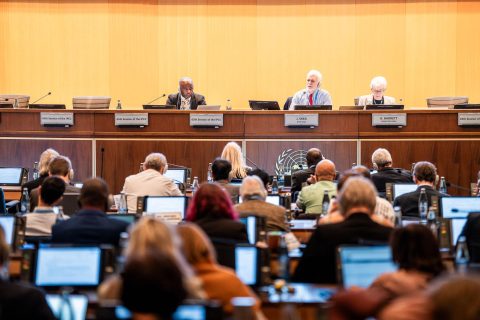
After months of internal debate over whether to identify serial non-responders, the Paris Agreement’s Implementation and Compliance Committee (PAICC) named the three countries which have failed to engage with it over their NDCs on Friday.
It named Democratic Republic of Congo, Senegal and North Korea in a footnote of its annual report, adding that it decided to name them “with a view to facilitating engagement”, adding that representatives of the three nations had been invited to its meeting in early 2027 “with the purpose of identifying any challenges and constraints”.
“The Committee noted the importance of Parties engaging with the Committee in a timely manner, while noting that some delays may be due to the national capabilities and circumstances of the Parties”, the report said.
-
Under US pressure, World Bank says it will back gas “where appropriate”
The US wants the World Bank to expand its gas support while climate campaigners are pushing for it to end – its head spoke this week of limited backing for the fossil fuel -
IPCC scientists vow to press on with climate reports despite political deadlock
After governments again failed to agree a timeline, nearly 120 IPCC authors pledged to complete their assessment on time and with full scientific rigour -
Paris Agreement committee snubbed over missing NDC climate plans
Many governments have still not submitted a nationally determined contribution to the UN, breaching a key requirement of the Paris Agreement


In July, PAICC said 12 countries had ignored its repeated attempts to discuss why they had not published an NDC as required every five years under the 2015 Paris accord.
Members of the committee had been divided over whether to name them, but at a September meeting decided to do so in their annual report to the annual climate COP summit.
By the time the report was published on Friday, only Congo, Senegal and North Korea “had not communicated an NDC or submitted a [Biennial Transparency Report] and had not yet responded to any of the Committee’s notifications, despite several reminders issued by the Committee in this regard”.
Rainforest and renewable energy ambitions
The silence from Congo and Senegal is notable because the former is home to much of the Congo Basin rainforest while the latter has sought billions of dollars in climate finance to support its renewable energy ambitions.
After Brazil, Congo has more rainforest than any country in the world. This forest, and the country’s peatlands, absorb huge amounts of greenhouse gas but are fast being lost to expanding farmland, charcoal production, logging and mining.
Senegal signed a Just Energy Transition Partnership with Canada and wealthy European nations in 2023, to help it meet its renewable energy targets under the-then government of Macky Sall. It was chair of the Least Developed Countries group between January 2022 and December 2023.

Tejas Rao, who is researching the PAICC as part of a doctoral thesis at Cambridge University, said the governments of the three countries should engage with the committee.
“Engagement costs these governments very little and the committee has shown it will listen,” he said.
“Silence leaves the committee with no basis to help, and it leaves the [governments] exposed to the narrative that they are simply disengaged,” he told Climate Home News.
Paris Agreement requirement
The 2015 Paris Agreement requires all parties to publish an NDC every five years outlining their emissions reduction targets, with each plan meant to be more ambitious than the country’s last NDC.
The latest set – the third round of plans, with new targets for 2035 – was due in February 2025. While most countries missed this deadline, all but around 30 – mostly small emitters but including Egypt, Vietnam and Argentina – have now submitted them.
Over the year, the PAICC – which is made up of government climate officials from developed and developing countries – has been communicating with governments that have not submitted NDCs and trying to overcome barriers to them doing so.
Some nations have cited exceptional circumstances as the reason for not submitting an NDC, a process that requires a significant amount of work in tracking emissions and consulting on how to curb them across the economy. For example, a letter from a Sudanese official to the PAICC, seen by Climate Home News, said that the country’s civil war had led to the suspension of its NDC preparation.
-
IPCC scientists vow to press on with climate reports despite political deadlock
After governments again failed to agree a timeline, nearly 120 IPCC authors pledged to complete their assessment on time and with full scientific rigour