

Weather Guard Lightning Tech

Why Blades Fail Early w/ Morten Handberg of WInd Power LAB
Wind Power LAB’s blade expert Morten Handberg explains a critical wind industry problem: new turbine blades are failing years too early. These massive blades – now stretching over 100 meters – are experiencing unexpected structural damage due to complex aerodynamic forces. Handberg shares Wind Power LAB’s essential strategies for detecting and preventing these costly blade failures before they shut down your turbines.
Fill out our Uptime listener survey and enter to win an Uptime mug! Register for Wind Energy O&M Australia! https://www.windaustralia.com
Sign up now for Uptime Tech News, our weekly email update on all things wind technology. This episode is sponsored by Weather Guard Lightning Tech. Learn more about Weather Guard’s StrikeTape Wind Turbine LPS retrofit. Follow the show on Facebook, YouTube, Twitter, Linkedin and visit Weather Guard on the web. And subscribe to Rosemary Barnes’ YouTube channel here. Have a question we can answer on the show? Email us!
Pardalote Consulting – https://www.pardaloteconsulting.com
Weather Guard Lightning Tech – www.weatherguardwind.com
Intelstor – https://www.intelstor.com
Allen Hall: As wind turbines reach unprecedented heights and blade lengths stretch beyond 100 meters, unexpected challenges are emerging from the field. This week we welcome back Morten Handberg. The renowned Blade Whisperer from Wind Power LAB. In this eye-opening discussion, Morten reveals why modern blade designs are showing structural issues earlier than expected and what operators need to watch for to protect their turbines.
Stay tuned.
Welcome to Uptime Spotlight, shining Light on Wind Energy’s brightest innovators. This is the Progress Powering tomorrow.
Allen Hall: Morten, welcome back to the show.
Morten Handberg: Thanks, Allen. It’s great to be, be back again.
Allen Hall: You are one of our most popular guests. You are the Blade Whisperer. And any time I’m at a trade show, people ask, how’s Morten doing? How’s the Blade Whisperer doing? Like, well, Morten’s great. Morten’s super busy, but Morten is great.
And they want to have you back on. So here we are. We’re back on again. And. The topic of today’s discussion is about aerodynamic stresses that happen to blades, and we’re seeing more problems with that than some of the quality issues. I think it’s a combination of quality and aerodynamic issues. What is happening in the field right now with aerodynamic loading on some of these new, longer, more flexible blades?
Morten Handberg: Well, it’s, it’s something that’s been been happening over time. So if we look 10, 15 years back, then the blades were of course shorter. The and they were a lot stiffer than they were today. They were heavily reinforced and you could say maybe they were. They were under optimized that they had a lot more load capacity and that were then what they needed.
And, and in, in process of the, in, in, as the blades have been become longer than the, then that buffer have gone away, so, because the, in order to build a logger blade, you had to reduce the the, the thickness of your laminates to avoid an overly, you know, bulky structure, but something that could harness the wind in a more efficient way So that leads to slender, thinner blades that are a lot softer.
And we can see that in the natural frequency that the, that the flap wise and edge wise frequencies, they have kind of gone down. And that’s because the blades become softer. And that also means that the way that the blade behaves with the wind direction means that the gravity loads are still a major, a major component, but Aeroelastic loading, which adds to shear and torsion loads, have become much more prominent loading conditions on the blades that we see today.
Allen Hall: That’s interesting. Yeah, obviously the blades are lighter than they ever been for the length. I remember being at DTU a year or so ago and looking at one of the first offshore wind blades that Vestas had made, and it was beautiful. back into DTU’s laboratory being examined. And that blade was so stiff and so overdesigned that it could have lasted, it had, it could last another 20 years.
It had been out in service for 20 years. It could have lasted easily another 20, maybe another 30 years because of the way it was designed, how stiff it was, how short it was. It was like a 20 meter blade. It wasn’t that big. But today when we’re talking 60, 80, 100 meters, those blades are just Dynamically different.
Is it a combination of just trying to lower the cost of the blade or just the mere fact that the weight is so high? We’re trying to transport it. What’s driving down the margins here in terms of the blade design and making them a lot more flexible?
Morten Handberg: Well, it is, it is an effective of well, by increasing the length, you also increases the power that you can harness from the blade.
You know, that so, so it is a, it is a desire to create larger turbines and one of the. Easiest ways to do that is simply by making the blade longer because you have to, it, you can do it. It’s, it’s compared to increasing the sweat barrier or optimizing. And in other ways, it is a, it is a low hanging fruit and by lowering the rate of the blades, you can also live with a lighter drive train, less steel in the tower, smaller foundation.
So all of these things play in into why that the blade is such a, so much in focus in terms of. Driving down cost overall is by reducing the the weight of the blades. And that comes as a consequence of it being more it, yeah, it has, has less design buffer and it also will have less lifetime compared to the, to the more conservative blades that we’ve seen before.
You can say that, you know, some of the two megawatt turbines, I wouldn’t be surprised if you can from a blade perspective that you can, you know elongate the lifetime to 30, 40 years, because they’re, they’re so conservatively designed compared to what we see today.
Allen Hall: Okay, so adding a kilogram to a blade has consequences all the way down to the foundation, which makes sense when you say it.
Okay, so that just adds cost and complexity to every other component in that wind turbine. So the drive then is to lighten the blades and also lengthen the blades at the same time. Now, when we do that, I, as I talk to operators around the world, they come back and say to me, okay, yeah, sure we’re using longer blades, of course it creates more power, but they’re all being qualified.
They’re all being tested, right? So we shouldn’t have anything to worry about what they’re in service. Has the test standards kept up with the rapid design changes that have been made? Not at all.
Morten Handberg: As I said before, you know, gravity loads was the predominant load on all the blades. And that was also what did.
Testing and certification standards focused on. And that’s still what it’s, what’s being, being done today. There are, you know more being done on hybrid loading, combining stepwise and edgewise, but that’s still gravity based loads. We’re not taking into account aeroelastic loads when, when, when testing and certifying, but that’s all only done in simulation.
And then we learn about what have, what’s happening in, in operation. In operation. So. So the testing and certification has not kept up with the with, with the load conditions that are, that, that, that we see on, on the modern blade.
Allen Hall: So I have a existing OEM that I like using, and I just want to go to the next generation of wind turbines, which is what is happening today.
That design of that new wind turbine may not have the same robustness as the one you are used to using, particularly if you’d let 5, 10 years go by. And so then if you’re thinking about the blade design, you’re trying to evaluate blade design, you really don’t have the data in front of you then. If they haven’t tested that for torsional loading, aero loading effects, you really don’t know what the history of that blade will be.
Just because you don’t have the data, right? You
Morten Handberg: have no idea what the, what the fatigue lifetime is from these new combined loads and, and we are seeing, you know blades, structural blade damages, blade failures happening on, on wind farms. From a variety of wind turbine types, where there is no, no, no sign of manufacturing defects, there is no lightning strike, there is no sign of transport damage or failed repair.
So, you know, it’s very difficult to prove exactly what kind of load it is without having the exact model or having other kinds of other types of data. But, you know, When leaving everything out, then you are starting to think about, is there something, some load condition going on here since we’re seeing these buckling related failures in areas where they, the blade simply shouldn’t shouldn’t have any kind of structural damage.
We’re seeing a lot on On on shell sandwich panels where we, where we see deformation the damage and related to deformation defects. And very early on, actually, you know the blades are designed for 25 years, but in a wind farm, we can see, you know, multiple blades with long transverse cracks over the, over the, the, the shell panels, and there’s nothing to suggest any kind of manufacturing issue.
otherwise that would have allowed for this defect to develop. And that’s again, one of the, one of the things that I think we need, we need to be mindful of with these new, new turbines. So how prevalent is this issue? What should I be looking for in the field? The need for inspection. We’ve been saying this for many years, also for the older blades, but it’s, Absolutely equally true.
So you need to do, at least yearly inspection, maybe in the early years, do it a bit more often, you know, and do both internal and external because whatever you see on the outside, on the outside will likely have started on the inside. So doing an internal inspection is a really really important in order to, to capture the defects in time.
And, and we need to look again, what we’re looking for is not, not different from what we did on, on the traditional blade. It, they just develop earlier and faster. So, so looking for, for structural cracks, looking for debonding, that’s typically what you would see. It just develops in the shield laminates.
I am less concerned about beam structures in the new blades than I was before. Gravity loads are pretty well understood and the spar caps and, and beam structures, they’re there to handle those kinds of loads. So they’re not really as concerned anymore. If you have manufacturing defects, you know, wrinkles in them, that’s still a problem, of course, but when we’re talking just.
Pure, you know, operation, lifetime fatigue, then it’s the shell structures that, that, that we need to have more, more in focus, which is, you know, opposite because earlier, you know, the shell was rarely something we even considered as an important part of the structure. So it was now rarely in focus because we never redesigned the defects.
They aren’t like, unless they were made to lightning strike or otherwise, but they have started to, to show the defects early on. And that’s because that’s the weak structure. That’s the weak structure from aerodynamic loads.
Allen Hall: Okay, that’s interesting. So we’re seeing more failures early on, probably within the warranty period in a lot of blades, but they’re showing up where they normally wouldn’t show up.
So if I’m an operator, I may not even be looking for this because I wouldn’t assume that the, the shells are the weak point necessarily. I would look for more internal structure issues. What I think is The general method of inspection right now is going to get to the structure. So, if you’re looking for changes in core or wrinkles on the outside of these blades in places that you would not normally normally see them, that’s your first alarm bell that maybe this is not a des necessarily a design issue as, as much as an error load issue that wasn’t evaluated during the qualification phase.
Exactly.
Morten Handberg: I mean, you would do simulations from the OEM, but, but, you know, are they, are they accurate enough compared to the wind loads that we’re seeing out there? And with the buffer gone, then, you know, you might, you might do a simulation for a certain set of certain conditional wind loads, depending on your wind class.
But is that actually then equivalent to, to the, to the low conditions we see on site? Is ice loading really considered? You know, ice loading in a gravity, from a gravity sense load, that’s not that big of an issue. They can handle that. But when you change the the inertia of the blades, then you also change the airline, the, the, the share and the torsion load.
And again, the shell structures and areas that are, that are. susceptible to that kind of loading, they might see then an overloading that you otherwise wouldn’t have.
Allen Hall: I want to ask maybe a controversial question here because I’ve been intrigued about this. When I see a lot of these longer, newer blades being installed offshore and they’re failing, it seems to happen during the construction phase when they’re not in operation.
Is that because the Turbines maybe not be pointing in the right direction. The yaw is not engaged and maybe you have two or the three blades on or something that the aero loading is then different than what it would be in operation, which is creating unique conditions that overload the basic design of the blade.
Is that the philosophy is what’s happening in offshore right now?
Morten Handberg: I mean, any kind of loading that is where the yaw where the yaw is off. So the wind is not coming directly towards the blade. is a, is a problematic situation on any account because the blades are designed for the, for the heaviest load coming, you know, from the front of blade leading edge inward.
But having loads coming in, you know, from it on the on the, on the pressure side, suction side shell or the trailing it can create load conditions or can create vibration conditions that cause the blade to go into resonance. which can lead to very rapid failures. I guess that, you know, that they can be your situations that don’t necessarily lead to a blade failure.
That’s fine. But again, we’re flying blind if we’re just allowing the turbine to get wind directions from backwind, sidewind, all of that, then we don’t really know when and if, you know, the, the, that we reach a critical situation. So I would always be concerned. And you could also say, well, the blade was yards 15 or 50 degrees off from and, but the blade didn’t break.
So obviously the turbine was designed for that. That’s not true. You could have just created an overload situation that meant that you shaved off, you know, a few years or five years of your lifetime. That doesn’t show as an immediate defect, but you, but the blade was still fatigued more than it was supposed to.
So you, you lost a lot of lifetime in that event, but it didn’t break. But that’s still an issue.
Allen Hall: Oh yeah, it definitely is. So weather forecasting during the construction phase is becoming critical then.
Morten Handberg: Yeah. Yeah. I mean, it’s, it’s always been an issue, you know, that, you know, when the, when the rotary is locked that, you know, you need to get the turbine installed and commissioned as fast as possible.
So it can, it can start to operate as it’s, as it’s supposed to be. But with. Lower design margins problem have have increased in significance. You could say
Allen Hall: that would explain some onshore things that I’ve seen also. All right. This, this is fascinating. So we have a problem out in the field. It’s really early still.
What are some of the approaches to deal with it? Obviously inspection, probably more frequent inspection, probably during the warranty period, cause it’s going to happen earlier. But what are the, some of the things that Winpower LAB and you are recommending right now?
Morten Handberg: So we’re, we’re recommending at least yearly inspection.
And there are, you know, there are some turbines, wind farms that are receiving, inspections two times every year. Some even more often depending on what kind of conditions that they’re seeing. All of that makes a lot of sense because until we have some more data on how, on, on how these defects develop and what we’re seeing, then, you know, it, it is important to have, to have a data set because we’re, we’re dealing with a new generation of turbines where we don’t have a lot of historical data to lean on, on, on how defects would develop or, Under what circumstances.
So having more frequent inspections is something that we do recommend. And, you know, or previously we would recommend an end of warranty inspection and that would be fine, you know, that, you know, then you’re pretty much good to go, but, but today, you know, it’s, you should, if you’re, if you’re building a new wind farm today, you should do yearly inspections from day one in order to, to, to to avoid critical failures, at least.
Allen Hall: Let me ask you this question, and I’ve heard it discussed on certain wind farms, large wind farms, where in windy areas, when the blades are even on the ground. Is there a chance that those blades can get torsional loading that is unnatural or that it wouldn’t like to see and could decrease a lifetime?
Morten Handberg: It’s actually an interesting, an interesting topic. I mean, when the blades are being transported, when they’re in storage, they are still introduced to to, to wind to winds, right? So there is still an interaction with the wind. That can create its own set of vibrations. It might not be the same resonance that you would, that you would see on a, on a, on an erected turbine, but it still is a factor.
It’s really not well understood how much of an impact it has on the lifetime of the blade the storage conditions and something, you know, early on, it was just not considered. And again, that would, that would have been completely fair because the blades were stiffer. They were more robustly designed but today it might actually matter.
But I think right now we can’t really say anything with certainty, but you know, yeah, it is something to look out for. I would definitely say that, but it’s not something I can add a lot of details to, unfortunately, because it’s, it’s something we’re still, you know, trying to figure out what, what it actually means for, for, for the blade.
Allen Hall: Well, would that explain why some of the OEMs and some independent inventors are coming up with these sock designs that go over the blade for a significant portion, probably the outer third of the blade, to disrupt the airflow over the blade so it’s not creating lift and maybe not creating torsion in the blade?
I’ve seen a lot more of those. Recently is, is that the rationale for those?
Morten Handberg: It is, it is definitely a part of the rationale or something we’ve seen also during construction that they were, they were applied and that it’s typically something you would do if you, if you know, as a constructor, that a high wind system is coming in that is without within the limit that can cause edgewise via vibration.
Then you can apply one of these socks or nets or however they look. And that will, that will create a disruption of the blade. So it’s not allowed to move as freely as it, as it would, if it had just been on its own. So that is absolutely something, but yeah, it, it, yeah. I mean, they are, of course, if you can prevent the blade failure, it’s absolutely worth it.
But you have to be mindful, you know, it’s, it’s something that adds to the cost. It, it’s not, it’s not a, it’s not a trivial thing just to apply a 50 meter Saco over a blade, not at all. And what we’ve seen in, in, in Scandinavia where we have icing conditions is that ice can actually then start to build up on, on, on the net and start, you know, hammering in on the, on the blade.
And that can create some structural damages on it, on it, on its own. I would. in general argue that, you know, these damages are lesser than what you would have suffered as if you had seen resonance from edge wise vibrations. The problem is though that then instead of having, you know, a few cases of a really damaged blade, you then see a wide sweep of damages across your entire fleet suddenly because these nets pick up a lot of things and and create some some damages to the blade on their own.
So, It’s not a perfect solution, but it’s a solution to a, to a problem that, that we do recognize that we do know no, no, no one knows there. So yeah I, I would probably still apply them if it was, if I was the owner. But I would also, you know, open my eyes to that. Okay, doing this, but I’m also looking into a repair campaign afterwards anyway.
That’s just, you know, to be expected, especially if you’re in Scandinavia. And I presume some of the, you know, Canada and some of the Midwestern states, they would have similar conditions.
Allen Hall: They do. Does continuous monitoring systems play into this detection at all? Can they pick up some of these aero loading effects, the vibrational effects, in them and detect what they are and give an early warning that maybe you have a problem?
Morten Handberg: You can absolutely see if something is going on. So, so I mean, I would generally say any kind of condition monitoring is better than no condition monitoring. Obviously if we want to learn about blade, the blade behavior that we have, that, that, that, that we have within the wind farm, we want to have sophisticated detection of damages early on.
And we, if we want to get to a point where we can understand, What kind of wind conditions actually drive lifetime fatigue? Then we need to go for a more sophisticated system that monitors vibration or loads or otherwise. But right now, you know, it’s, it’s. Condition monitoring is not a given, and I think for older turbines, it’s definitely a good value proposition, but it’s really essential for the newer ones because we can, because if you have some kind of damage detection, there’s some, some kind of condition monitoring you can, you can prevent that you suffer from a complete blade failure.
Not a perfect system. There can still happen things, but your, but your risk is lower significantly. But I would, if you’re, if you’re, if you’re, if you have a larger set of turbines and you want to go into more how do you say proactive operation maintenance and understand what yeah, what, what kind of things are actually driving the damages that I’m seeing.
You need to have a really sophisticated either by vibration sensor or low load sensor that can tell you, well, I got this damage and this was how, but this, this is how the blade behaved before before, before the event or during these kind of wind conditions, my vibration signal is tripling or quadrupling.
And, and this is something that is that is driving the, my, my, my lifetime,
Allen Hall: fatigue. I want to tap into that Lifetime piece, Morten, if Blades are not properly aligned in pitch, or they have a lot of leading edge erosion where the, the air flow over a significant portion of the blade is not normal, not based on what the engineers had on their computer at the time.
Does that change error loading enough where I start to worry as blades age that the error loading is changing and that I may then induce Vibrations or loads later on in life that I maybe wouldn’t have seen in year one or two. And do I need to be monitoring for that also?
Morten Handberg: If you have leading edge erosion, then you are creating more turbulence around your blade.
So from a logical perspective, I would say, yeah, that is something that is driving load. I would assume, I would assume that if it, what the magnitude is, that’s difficult to predict again without having any kind of load condition monitoring. Then. Where, yeah, we, we, we have no way of quantifying this.
So that, and that’s also why it’s so important that we, because that it becomes more of a, a must have instead of a nice to have these kind of monitoring system. And I would say that both for lightning, but also, but especially for condition monitoring, given, given what, what, what, what, what we’re seeing in the industry today.
Allen Hall: Wow, there’s a lot happening in blade design at the minute and then out in the field. It sounds like we have to be more vigilant than ever with these new designs. So Morten, this is fascinating because I’ve learned a ton here and I’m trying to absorb it all. So I’m going to watch this episode on YouTube probably several times after we complete it just to, you know, Learn all the things you’re trying to explain to me because I’m an electrical person.
A lot of people you get out in the field also are mechanically inclined. They’re not aerodynamically inclined. They’re not blade structures people. If they want to get a deeper understanding of what’s happening and get some insights from you, how do they do that?
Morten Handberg: You can reach me at well, I would say Intim, not anytime, but you can reach me at Wind Power LAB and we’re always happy to set up a meeting or or call with people.
Owners or insurers who want to learn more about the the blade problems that they’re, they’re facing. And in wind power, we’re all about, you know, knowledge sharing and about raising the bar in the industry so that, you know, we all progressively, you know, learn what it is actually that we have to deal with for the next 25 years.
And I think if we can do that. We also, we have a chance that these newer turbines, that they are, we can, we can, we can increase the lifetime compared to what we would likely look into if we don’t. Yeah, as you say, become more vigilant in our approach to operation and maintenance.
Allen Hall: So you need to reach out to windpowerlab. com. That’s their website. A lot of great information on that website, windpowerlab. com. And you can reach out to Morten via LinkedIn. He’s available. He’s on there. Just reach out to Morten Handberg. Morten, thank you so much for being on the podcast. I really appreciate you coming back. You are our official Blade Whisperer.
Love having you on. Fantastic being here and thank you so much.
https://weatherguardwind.com/blades-fail-wind-power-lab/

 Have you ever wondered why every dictator in human history follows the exact same playbook? Check this out
Plato nailed this 2400 years ago, and it’s been on “rinse/repeat” ever since.
 On average, I meet perhaps 50 K-12 teachers each year, and I often ask them: What is the biggest challenge you face that impacts your ability to connect with and educate your students?
Here’s a rough tabulation:
Screen time, how it robs kids of their ability to pay attention, impedes social interaction, and makes parenting more difficult: 80%
Everything else combined: 20%
Maybe this is a cynical viewpoint, but it seems like that world of today revolves around the mega-corporations profiting by punishing their customers.
In this case, we have the tech giants ruining the lives of our children. Elsewhere, we have healthcare industry driving people into bankruptcy, Big Oil ruining our planet, the gun lobby murdering our kids, and, of course, an ultra-corrupt government looting our treasury to pay off billionaire donors.
Note that this wasn’t the case when we boomers were growing up 60 years ago. This is a distinctive shift from the 1960s when corporate America was focused on things like color TVs and the Ford Mustang.
Renewable Energy
Is a Team of Is a Bunch of MAGA Thugs Beating the Snot Out of a Woman a New Low, or Is it What We Now Need to Expect?
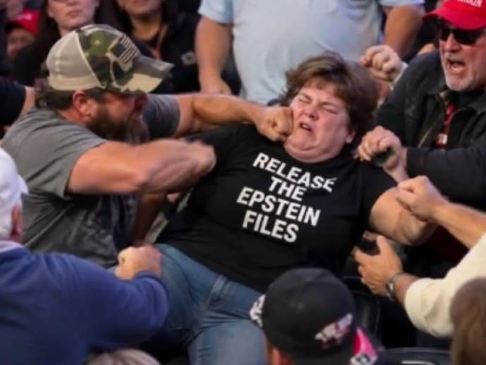 Just when we think there is a bottom, the United States sinks just a bit lower. It’s our brand nowadays.
That’s quite a left cross this thug delivered to this helpless female protestor.
It wasn’t too long ago that beating up women was taboo in America. My 11-year-old, sixth-grade son saw a male classmate of his badly bruise a girl by pushing her hard down to the ground–and proceeded to punch him in the mouth. A fellow father witnessed the scene and told me, “Your son’s fist was in that kid’s teeth within a fraction of a second.”
I had brought him up to avoid violence and achieve peaceful resolutions to conflicts, but I couldn’t fault him here.
What a disgusting bunch of turds we’ve become.



