

Europe’s solar energy industry achieved remarkable milestones in 2024, marking a record-breaking year for generation and capacity expansion. Solar energy continues to play a pivotal role in the EU’s green transition, driven by innovations, investments, and policy efforts.
This article explores Europe’s solar achievements in 2024, highlighting key areas of growth and developments according to data reported by energy think tank Ember.
2024: A Record Year for Solar Growth
In 2024, Europe’s solar industry saw unprecedented growth, with annual solar generation increasing by 54 TWh (+22%) compared to 2023. This marked an acceleration from the previous year, which saw a 40 TWh increase.

The EU also set a record for capacity additions, installing 66 GW in 2024—equivalent to more than 450,000 solar panels per day. This rapid expansion pushed total installed solar capacity to 338 GW, keeping the EU on track to meet its REPowerEU interim goal of 400 GW by 2025.
If this growth continues, the EU’s ambitious 2030 target of 750 GW will be within reach. However, the pace of deployment is already surpassing what many national targets require.

Importantly, solar energy growth occurred across every EU country in 2024. Sixteen countries generated over 10% of their electricity from solar power—an increase from 13 in 2023.
Innovative approaches, such as balcony solar panels in Germany and agri-PV systems that integrate solar with agricultural land use, are expanding the reach of solar energy beyond traditional rooftops and fields. Residential rooftop installations, which faced significant losses, were overtaken by utility-scale solar, the largest market segment in 2024, per Solar Power analysis.
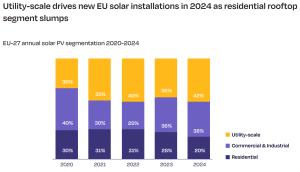
Capital investments in EU solar PV had steadily climbed from €19 billion in 2020 to €60 billion in 2023. However, this upward trend shifted in 2024.
- RELATED: Solar Energy Developer Secures $415 Million to Power the World’s Largest Direct Air Capture Plant
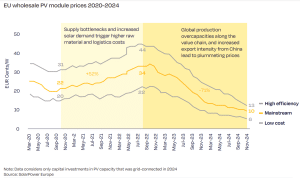
European wholesale module prices hit record lows, declining by 35% between January and November 2024, following a 50% drop the previous year as seen below. This sharp price reduction was driven by falling supply chain costs and overcapacity in the market.
Solar Meets Demand Like Never Before
The success of solar energy is reflected in its ability to meet growing electricity demands across the EU. In 2024, 12 EU countries reported solar meeting at least 80% of their electricity demand during peak hours on multiple occasions.
Notably, Hungary saw an incredible leap, with solar meeting over 80% of demand on 70 days in 2024—up from just 10 days in 2023.
This trend underscores the potential of solar energy to displace expensive and polluting fossil fuels during daylight hours. However, achieving consistent reliability requires integrating clean flexibility solutions, such as battery storage, expanded grids, and smart electrification.
These technologies can store excess solar energy during midday production peaks and distribute it during evening demand surges, reducing reliance on fossil fuels for power balancing.
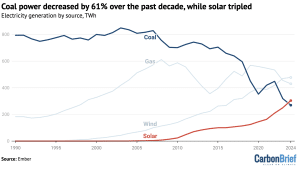
Notably, the EU’s shift to solar, alongside wind, has cut coal-fired electricity generation by nearly two-thirds over the past decade. This is despite a brief rise after Russia’s 2021 invasion of Ukraine.
Clean Flexibility: The Backbone of Solar’s Future
Clean flexibility is central to ensuring the continued growth of solar energy in Europe. Batteries, in particular, play a critical role in shifting energy supply to match demand. By storing excess energy generated during sunny hours and delivering it when demand peaks, batteries stabilize the grid and maximize solar’s value.
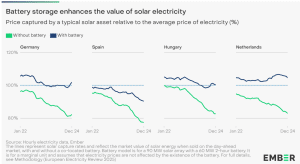
Co-locating batteries with solar plants is quickly becoming an industry standard. This practice enables solar producers to avoid selling electricity at low midday prices and instead capitalize on higher prices during evening peaks. It also strengthens the financial case for solar energy by ensuring profitability even in periods of surplus generation.
In 2024, the deployment of battery storage continued to grow rapidly. EU-installed battery capacity doubled from 8 GW in 2022 to 16 GW in 2023.
However, this growth remains uneven, with 70% of capacity concentrated in Germany and Italy. To fully realize the potential of batteries, the EU must address barriers like double grid charging and restrictive market participation rules.
Solar Savings: Economic Wins and Consumer Perks
Solar energy’s rapid growth delivered significant economic benefits in 2024, particularly through reduced electricity prices. Abundant solar generation during midday hours frequently drove hourly power prices to zero—or even below.
- Negative or zero-price hours doubled in 2024, occurring 4% of the time across the EU, compared to 2% in 2023.
These price dynamics create opportunities for consumers and market participants alike. Consumers can save money by using smart electrification technologies to shift energy use to periods of lower prices.
Meanwhile, market players, such as battery operators, can earn additional revenue by purchasing power at low midday prices and selling it during high-demand evening hours.
Despite the successes of 2024, significant challenges remain, however. One major barrier is the lack of infrastructure to support flexible energy use. For example, smart meters are essential for giving consumers real-time control over their energy usage, but adoption remains low.
In 10 EU countries, fewer than 30% of households have smart meters, and six countries report penetration below 10%. Additionally, the prevalence of fixed-price electricity contracts limits consumers’ ability to take advantage of low-cost solar energy during midday hours.
Grid expansion and modernization are also critical. While solar growth has exceeded expectations, national targets for grid development remain outdated. Expanding cross-border interconnectors will allow countries to share surplus solar energy, reducing reliance on fossil fuels and improving grid stability across the region.
The year 2024 was a milestone for solar energy in Europe, highlighting the industry’s ability to drive decarbonization and lower energy costs. With the right mix of technological advancements, grid modernization, and supportive policies, Europe could meet its 2030 solar targets. By doing so, the region can lead the global transition to clean, reliable, and affordable energy.
The post Europe’s Solar Industry Saw Record Growth and Innovations in 2024 appeared first on Carbon Credits.


Most businesses that decide to act on their net-zero targets reach the same point of friction. Buying carbon credits has meant tracking down brokers, sitting through sales calls, and requesting a quote just to learn a price, sometimes with limited proof of what you are buying.

The earnings calls that quietly reframed climate from sustainability question to operating risk.
Three earnings calls in the last 18 months tell the story without any help from a press release.
Hershey, May 2024: cocoa price exposure compresses margin, and the company attributes part of the cost shock to West African weather. Olam, July 2024: coffee climate exposure quantified in the annual report. JBS, January 2025: supply chain climate disclosures expanded materially in response to investor pressure and regulatory expectation. None of these companies issued the announcement as climate news. They issued it as financial news. The climate-linked supply chain risk did not arrive with a sustainability framing; it arrived as a P&L line.
You are probably reading this article because you suspect the same thing is happening to your business. This piece walks through what is showing up on which earnings calls, how procurement and finance leaders are quantifying the exposure, and what serious corporates are doing about it before the regulator asks.
Where climate risk has already appeared in earnings
The pattern is consistent across resource-intensive sectors. A weather event compresses supply, the price spikes, the cost flows through the income statement, and the analyst on the call asks whether the event is anomalous or structural. Increasingly, the honest answer is the second one.
Cocoa is the cleanest example. The 2023 to 2024 West African harvest fell sharply on the back of erratic rainfall and disease. Cocoa futures more than tripled. Companies with concentrated West African sourcing absorbed the cost; companies with diversified sourcing absorbed less. The exposure was not climate as ESG topic. It was climate as cost of goods.
Coffee follows the same pattern. Brazilian and Vietnamese harvests have moved on weather more sharply across the last several seasons. Roasters with long-tenor supplier relationships and origin diversification have managed the volatility; roasters with spot-market exposure have not. Wheat, sugar, palm oil, beef: the same dynamic in different commodities, a pattern the IPCC AR6 Working Group II report projects will intensify across agricultural systems through mid-century.
What this means: climate risk is no longer a footnote in the 10-K. It is a line item the CFO has to explain on the call.
The three commodity exposures that hit margin first
For most companies with material Scope 3 exposure, three exposures dominate the near-term P&L risk.
- Concentrated single-origin sourcing in a climate-vulnerable region. If your tier-one supply for any material commodity sits in one geography, you have a concentration risk that climate amplifies. Diversification across origins is the obvious hedge, but it takes years to build and requires relationships you cannot acquire by tender.
- Supplier financial fragility under climate stress. Smallholder farmers, who supply a large share of the global cocoa, coffee, and palm oil market, do not carry the balance sheets to absorb yield shocks. When yields collapse, they exit. When they exit, your supply base shrinks, and the surviving suppliers raise prices. The risk is structural, not cyclical.
- Logistics and storage exposure to extreme weather. Hurricane disruptions to Gulf shipping, drought-driven Panama Canal restrictions, flooding in European inland waterways: each of these has moved input costs in the last three years, a pattern documented in Munich Re’s natural catastrophe data. The exposure shows up as a one-quarter event in the financial press but accumulates over time on the cost line.
TCFD and ISSB disclosure changes
The disclosure architecture has now caught up with the risk. The Task Force on Climate-related Financial Disclosures, whose recommendations are now embedded in the ISSB’s IFRS S2 climate standard, requires companies to disclose climate-related risks across physical and transition categories, with quantification where possible.
For physical risk specifically (the climate-linked supply chain risk you are reading about), the disclosure must address both acute exposures (extreme weather events) and chronic exposures (gradual changes in temperature, precipitation, and growing seasons). The disclosure must address the time horizon over which the risk is material, the parts of the value chain exposed, and the financial impact under different scenarios.
The CSRD imposes similar requirements under European law, with double materiality (both financial and impact materiality) embedded in the assessment. The practical effect: your auditors and your investor relations team now need a defensible answer to the climate-linked supply chain risk question, and the answer needs to be quantified.
What procurement and finance can do now
Three actions matter near-term.
Map your exposure. Most companies do not have a clear view of which tier-one and tier-two suppliers sit in which climate-vulnerable geographies. Without the map, you cannot quantify the risk, and without the quantification, you cannot disclose it credibly. The map is the foundation, and World Resources Institute climate risk research provides useful public tooling to start.
Diversify and deepen, in that order. Diversification across origins reduces concentration risk, but the deeper move is to invest in the resilience of the suppliers you already have. Regenerative practices, agroforestry, soil health interventions: these reduce yield volatility under climate stress and protect your input cost trajectory.
Embed the climate spend inside procurement, not outside it. Treating climate risk as a sustainability cost line subordinates it to the ESG budget. Treating it as a procurement and resilience investment puts it in the budget that matters, which is the cost-of-goods budget that the CFO defends quarterly.
Nature-based supply chain investments are the asset class designed for exactly this purpose. They sit inside the value chain, they reduce climate-linked supply risk, they generate verifiable Scope 3 reductions, and they produce the documentation an auditor and a regulator can both test.
If you are quantifying climate-linked supply chain risk in advance of the next earnings cycle or the next disclosure period, the carbon and sustainability experts at Carbon Credit Capital can help you map your exposure and structure a Dual-Value Model response that addresses reduction, resilience, and disclosure-readiness in a single program. Schedule a consultation.

More and more small and medium-sized businesses are hearing the same question from their larger customers: What is your carbon footprint? That question now travels down entire supply chains, and it arrives next to tender requirements, certification criteria, and rising customer expectations.




-
Climate Change1 year ago
Guest post: Why China is still building new coal – and when it might stop
-

 Greenhouse Gases2 years ago
嘉宾来稿:满足中国增长的用电需求 光伏加储能“比新建煤电更实惠”
-
Greenhouse Gases1 year ago
Guest post: Why China is still building new coal – and when it might stop
-

 Climate Change2 years ago
嘉宾来稿:满足中国增长的用电需求 光伏加储能“比新建煤电更实惠”
-

 Renewable Energy11 months ago
Sending Progressive Philanthropist George Soros to Prison?
-
Climate Change2 years ago
Bill Discounting Climate Change in Florida’s Energy Policy Awaits DeSantis’ Approval
-
Greenhouse Gases1 year ago
嘉宾来稿:探究火山喷发如何影响气候预测
-

 Carbon Footprint2 years ago
US SEC’s Climate Disclosure Rules Spur Renewed Interest in Carbon Credits