


Meta Platforms, the company behind Facebook, Instagram, and WhatsApp, is making huge strides in clean energy to meet the growing demands of its data centers while staying environmentally friendly.
Recently, Meta announced a deal to purchase green credits from four massive solar energy projects in the U.S. This move reinforces the world’s largest social media company’s commitment to sustainable operations.
Solar Power Meets Social Media: Meta’s Bold Clean Energy Play
Meta’s agreement is with Invenergy, a Chicago-based energy developer, to support projects that will generate 760 megawatts of solar power. This amount of energy is enough to supply around 130,000 homes.
The projects will connect to the power grid between 2024 and 2027 and will be located in Ohio, Texas, New Mexico, and Arkansas.
Instead of directly using the electricity, Meta will purchase clean energy credits. These credits represent the environmental benefits of renewable energy and allow Meta to offset its carbon emissions.
These green or clean energy credits are officially called renewable energy certificates or credits (RECs). They are market-based instruments certifying ownership of one megawatt-hour of electricity generated from renewable sources like solar, wind, or hydropower.
RECs represent the clean energy attributes of renewable electricity but are distinct from buying electricity itself. Businesses often buy RECs with their electricity to verify renewable energy use.
- In 2023, the global REC market was valued at nearly $13.71 billion in 2023 and is projected to reach $127 billion by 2023.

These renewable credits are created when one megawatt-hour (MWh) of electricity is generated from a renewable energy source and delivered to the power grid. In the case of the Meta and Invenergy deal, 760 credits will be generated from the solar projects.
Urvi Parekh, Meta’s head of global energy, highlighted the importance of this partnership, stating,
“These projects will help us continue our commitment to support all of our operations with 100% clean energy.”
By buying clean energy credits, Meta is not just offsetting its emissions but also driving demand for renewable energy. These credits encourage the development of more green energy projects, helping transition the U.S. energy grid away from fossil fuels.
However, this approach also means that Meta’s operations don’t directly rely on renewable energy but rather on the broader market’s clean energy contributions. This strategy allows the company to support sustainable energy development without waiting for renewable energy to reach every location it operates in.
From Data to Decarbonization: Meta’s Sustainability Push
Meta’s operations, especially its data centers, consume vast amounts of electricity as the company scales up to handle the increasing demands of social media, artificial intelligence (AI), and virtual reality.
Data center power demand alone will skyrocket by 2030, as shown in the chart below.

By investing in those solar energy projects through renewable energy credits, Meta offsets the emissions caused by its power consumption. It will also support the development of clean energy infrastructure in the U.S.
This solar deal is just one part of Meta’s larger effort to minimize its environmental impact while growing its business. The company has already made several other significant investments in clean energy:
- Other Solar Projects: Meta has agreements with additional solar energy initiatives to ensure sustainable operations.
- Geothermal Energy: Earlier this year, Meta partnered with a geothermal startup to explore using underground heat for clean power.
- Nuclear Energy Proposals: In a forward-thinking move, Meta has invited proposals from nuclear energy developers for 1 to 4 gigawatts of new nuclear capacity in the U.S. by the early 2030s.
Meta views nuclear energy as a potential solution for meeting the robust energy demands of technologies like AI while maintaining its commitment to sustainability. The social media giant shared this in a recent blog post:
“We are taking an open approach with this RFP so we can partner with others across the industry to bring new nuclear energy to the grid.”
- SEE MORE: Meta Bets Big on Nuclear Power and $10B on AI Data Center to Meet its Sustainability Target
Solar Energy’s Role in Meta’s Environmental Commitment
As technology companies like Meta, Google, Apple, and Microsoft grow, their energy needs are skyrocketing. Data centers, which process vast amounts of information, are among the most energy-intensive facilities. Companies must find ways to ensure their growth doesn’t come at the expense of the planet.
Solar power offers a viable, scalable, and environmentally friendly solution to meet these growing needs while aligning with sustainability commitments. Notably, solar power generation capacity is projected to grow fourfold by the end of the decade.
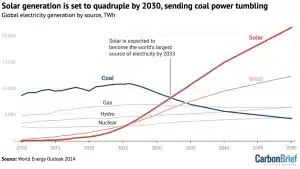
The solar energy projects Meta is backing not only help meet this need but also set an example for other corporations. These efforts are crucial to advancing the tech titan’s renewable energy technologies, reducing carbon footprints, and combating climate change.
Meta has long promised to power all its operations with 100% clean energy, a goal it has steadily pursued through deals like this one. Moreover, the company’s dedication to sustainability is evident in its impressive progress toward slashing carbon emissions.
Since 2021, the company has successfully cut its total emissions by an astounding 16.4 million metric tons of CO2e, showcasing the significant impact of its renewable energy initiatives.
In 2023 alone, Meta reported net emissions of 7.4 million metric tons of CO2e, adhering to the Greenhouse Gas Protocol to ensure transparency and accountability. Through its renewable energy purchases, the tech company managed to slash operational emissions by 5.1 million tons of CO2e.
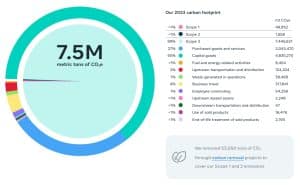
Additionally, by leveraging RECs, the company addressed Scope 3 emissions related to fuel use, consumer hardware, and remote work. Overall, it helps reduce Meta’s value chain emissions by 1.4 million tons of CO2 equivalent during the same year.
Clean Energy for Green Goals
Meta’s strategy to meet its ambitious climate goals includes reducing Scope 1 and 2 emissions by 42% by 2031 compared to 2021 levels. Additionally, the company requires two-thirds of its suppliers to adopt science-based emissions targets by 2026.
Meta also aims to maintain Scope 3 emissions at or below 2021 levels by 2031. These targets highlight the company’s proactive approach to curbing its carbon footprint.
As the world increasingly shifts toward renewable energy, Meta’s proactive measures underscore its role in promoting sustainability. This solar deal, combined with its other green energy initiatives, not only supports Meta’s clean energy goals but also contributes to broader efforts to reduce reliance on fossil fuels.
The post Meta Invests in 4 Big U.S. Solar Projects to Power its Growing Energy Needs appeared first on Carbon Credits.

Carbon credit providers vs marketplaces is the first comparison many buyers try to make. In this comparison, a carbon credit provider is the project developer: the company that originates credits from its own projects and sells them directly. A carbon credit marketplace is a platform that lists credits from many projects at published prices.

Carbon Footprint
Democrats who call climate change an emergency should not defend a permitting system too slow to build the clean energy that would address it.”
Democrats, Take The Deal. New York Times editorial, Nov. 12.
Insetting program design starts with your supplier map. The carbon claim comes much later.
Consider a coffee procurement team that funds a farm intervention before checking its sourcing data. The supplier aggregates coffee lots from several regions. The buyer lacks farm-level traceability. Another purchaser expects to report the same outcome. A more attractive project brochure solves none of these problems.
If the distinction between a value-chain intervention and a purchased credit is still open, read CCC’s Insetting vs Offsetting guide before you set the brief.
Insetting program design begins with the purchasing relationship and works outward. You need to decide 1) where an intervention belongs, 2) what business problem it addresses, 3) who pays for it, 4) how results will be measured, and 5) what the evidence will let you say about them. This five-step playbook turns that sequence into a procurement plan.
Step 1: Insetting program design starts with supplier mapping
Start with the commodities that matter most to your Scope 3 inventory and sourcing continuity. Ask finance for spend by supplier, sustainability for the emissions baseline, and category managers for origin and volume records. Then identify which suppliers can trace material to a jurisdiction, sourcing region, producer group, or individual land-management unit.
The level of traceability affects what you can account for. Under the GHG Protocol Land Sector and Removals Standard, the spatial boundary for purchased land-based products depends on the traceability associated with each volume. Farm-specific factors or removals require physical traceability through an acceptable chain-of-custody model. A contract with a tier-one trader, by itself, does not establish a link to the farms behind its deliveries.[1]
Build a first-pass table with five columns: commodity and annual volume; supplier and origin; current traceability level; land-use and production risks; and the business owner who can change the purchasing terms. Mark missing data plainly. A blank cell is cheaper to fix before a program starts than after a claim is drafted.
If your company sets an SBTi Forest, Land and Agriculture target (FLAG), keep its land-related target boundary separate from energy and industry emissions. The current FLAG guidance also requires relevant companies to assess primary deforestation-linked commodities in their value chains.[2]
Step 2: Choose a commodity and jurisdiction for a pilot
Select one supply corridor where the sourcing connection can be established and procurement has a reason to stay. A useful pilot has repeat purchases, suppliers willing to share records, an intervention matched to a diagnosed problem, and a defined plan to measure the result. Carbon potential alone is a poor selection rule if the supplier cannot deliver the crop your business needs.
Compare candidate regions on land-use risk, supplier concentration, local rights and tenure, the availability of baseline data, and exposure to drought, erosion, or forest conversion. Check the relevant legal requirements separately. A nature project does not satisfy a due-diligence obligation merely because it has a carbon method attached.
Consider a coffee buyer sourcing from two districts. In the first, producer-group records identify the farms, while recent dry seasons have increased rejected green coffee lots. In the second, deliveries pass through several intermediaries and farm origins are unknown. Pilot shade management in the first district, with local agronomic advice and quality checks built into the plan. The buyer can trace purchases there and test the intervention against a defined sourcing problem.
Use a short decision memo to record why the selected corridor beats the alternatives, what remains uncertain, and what would stop the pilot. That memo is the first control against a project drifting toward whatever happens to photograph well.
Step 3: Design the supplier engagement and commercial model
The intervention needs an owner on each side of the contract. Decide who supplies planting material or training, who maintains the practice, who bears the cost if a harvest disappoints, and how long the buyer expects to purchase from participating suppliers. Where smallholders participate, budget cash flow and technical support for practices that offer a later return.
Put these terms in a supplier agreement or pilot addendum. It should cover eligible farms and volumes, consent to data collection, access for monitoring, any land or carbon rights that matter, benefit sharing, and what happens if the purchasing relationship ends. Ask local counsel and producer representatives to review the arrangement. The Accountability Framework is a useful reference for supply-chain work involving forests, ecosystems, and human rights.[3]
Avoid assigning an automatic carbon benefit to the buyer. The contract should say which party has the right to report each outcome, how overlapping claims will be checked, and how any issued credits will be handled. A reduction reported in a buyer’s inventory cannot simply be sold for someone else’s offset claim without an accounting review. SBTi FLAG guidance excludes purchased credits used as offsets from near-term FLAG target achievement.[2]
Set commercial measures beside environmental ones: delivered volume, rejection rate, supplier retention, and procurement cost. They tell you whether the program works as a supply-chain investment, even if carbon accounting takes longer to resolve.
Step 4: Build monitoring, reporting, and verification before rollout
Agree on the baseline and data flow before paying for a full rollout. Identify the land units or sourcing regions in scope, the practices that change, the records suppliers already keep, and the additional measurements the program requires. Decide which data can come from field visits, transaction records, or remote sensing, and who checks each source.
For carbon, separate three questions. Did the practice happen? Did emissions or removals change under an applicable method? Can the buyer attribute a defensible share to its purchased goods without double counting? The GHG Protocol’s 2026 guidance includes dedicated chapters on spatial boundaries, data and methods, evaluating actions, credited outcomes, and assurance.[1] These are distinct jobs. A photograph of a planted tree answers only part of the first.
CCC’s MRV and Additionality article explains the separate evidence questions a project reviewer will ask.
Create an evidence file for every reporting period: dated supplier and farm records, purchase volumes, methods and emission factors, uncertainty, quality checks, and changes from the baseline. Specify who can challenge the data and how corrections are recorded. If a project also seeks credit certification, keep project accounting and corporate inventory accounting separate. The GHG Protocol says its land standard focuses on entity-level inventories and does not set the rules for credit certification.[4]
Start with the minimum viable measurement design that can survive review. Add complexity when the pilot tells you which data actually changes a decision.
Step 5: Decide what can be reported and claimed
Insetting program design needs reporting rules before the marketing copy. Procurement, sustainability, finance, and legal should agree on four distinct outputs: operational performance; observed land or nature outcomes; inventory effects, if the accounting criteria are met; and any separately issued credits. One dashboard can display them, but they should not share a single unqualified headline.
SBTi FLAG guidance allows certain land-based removals within a company’s operations or supply chain to contribute to FLAG pathways, subject to criteria including permanence, traceability, data quality, and allocation. It does not allow purchased offsets to meet near-term FLAG targets.[2] Eligibility therefore depends on evidence and the applicable target rules, not on calling an activity “insetting.”
Draft a claims register. For each proposed sentence, record the period, boundary, data owner, calculation method, reviewer, and whether the result is measured, estimated, or still a goal. If the evidence supports only “we funded a pilot with 200 farms,” say that. Do not turn a funding fact into a verified emissions reduction.
What good looks like by year three
Treat year three as a review point, not a promised payback date. A mature pilot should have mapped participating supply volumes, a stable supplier agreement, a repeatable data collection process, and a comparison of commercial and environmental results against the baseline. It should also have a documented answer for outcomes that cannot be included in the buyer’s inventory.
Scale only where the pilot improves a sourcing decision and the evidence can follow the product. If neither condition holds, redesign the intervention or change the corridor. A disciplined program can conclude that a site is unsuitable. That is useful procurement intelligence.
Discuss your insetting program with CCC
Carbon Credit Capital designs nature-based supply chain investments around sourcing needs and measurable sustainability outcomes. Schedule a consultation with our carbon and sustainability experts to map your tier-one supplier network, FLAG exposure, and first pilot decision.
Sources
[1] GHG Protocol, Land Sector and Removals Standard, version 1.1, and companion Guidance, June 2026: https://ghgprotocol.org/land-sector-and-removals-standard ; https://ghgprotocol.org/land-sector-and-removals-guidance
[2] Science Based Targets initiative, Forest, Land and Agriculture Science-Based Target-Setting Guidance, version 1.2, March 2026, especially pp. 16–17, 37, and 41: https://sciencebasedtargets.org/resources/files/SBTiFLAGGuidance.pdf
[3] Accountability Framework initiative, Accountability Framework and guidance for companies: https://accountability-framework.org/
[4] GHG Protocol, Frequently Asked Questions: Land Sector and Removals Standard, questions 10 and 18: https://ghgprotocol.org/blog/frequently-asked-questions-land-sector-and-removals-lsr-standard



-
Climate Change1 year ago
Guest post: Why China is still building new coal – and when it might stop
-
Greenhouse Gases1 year ago
Guest post: Why China is still building new coal – and when it might stop
-

 Renewable Energy1 year ago
Sending Progressive Philanthropist George Soros to Prison?
-
Greenhouse Gases1 year ago
嘉宾来稿:探究火山喷发如何影响气候预测
-

 Climate Change2 years ago
Analysis: China’s CO2 falls 1% in Q2 2024 in first quarterly drop since Covid-19
-

 Climate Change1 year ago
嘉宾来稿:探究火山喷发如何影响气候预测
-

 Renewable Energy5 months ago
Send a Bible to a Starving Child
-