“The plain fact is that the planet does not need more “successful” people. But it does desperately need more peacemakers, healers, restorers, storytellers, and lovers of every shape and form. It needs people who live well in their places. It needs people of moral courage willing to join the fight to make the world habitable and humane.” –David Orr, What is Education For? 1991
I first read this quote in a graduate course studying environmental education in 2013. While it struck me at the time, I didn’t quite realize that it would become my compass. The phrase “live well in their places” has rung through my head at important choice points over the last decade- in my education and professional practice, am I helping those around me live well in their places? As a consumer and planet dweller, am I living well in my place? As a community member to humans and nonhumans, am I contributing to others to be able to live well in their place?
Having a deep sense of place or home has always been a part of me. Growing up in South Minneapolis 8 blocks away from where my mother and her six siblings grew up meant I always heard generational stories about my neighborhood. Uncle Jimmy played hockey there, mom got into a fight on the steps of that school, and everyone biked to the Dokken’s for candy. I continued exploring the city with my friends throughout elementary, middle, and highschool, widening our radius of travel the older we got and further we could bike. The phrase “sense of place” didn’t mean anything to me then, but now I see how fortunate I was to develop a deep sense of place at a young age.
In Minneapolis, my sense of place was very much rooted in the spatial geography, physical landmarks, and relationships with kin. 10 years ago I moved to the North Woods of Minnesota, studying to become a Naturalist. During those studies, I expanded my understanding of a sense of place through an intentional practice encouraged by our mentors to slow down and pay attention.
While it sounds simple, it is one of the hardest practices to make a habit, but my world expanded. I learned to notice the differences between fir and spruce trees; I followed lynx tracks through the deep snow and saw the imprint where it had bedded down for a nap (just like my cats!); and I felt the awe of realizing it was the chickadee who greets me with that familiar call, “Heeeyy Sweeet-eee,” reminding us that spring is on its way. My year of intensive Naturalist studies ended in a revelation- my connection to place in Minneapolis isn’t so different from the North Woods. Both require the practice of noticing my surroundings, building relationships, and being present—all of which can be applied wherever I go.
I decided to stay in that forested town of 300 people in Northern Minnesota and have been here ever since. Through observation, I’ve experienced the natural cycles of plants, animals, and seasons. I’ve learned the history of this land- stories of sorrow, collaboration, and “sisu” (Finnish for determination). I’ve worked with folks who have a deep love of this place; they’ve shown me the power of showing up in community, especially when things are tough. I will never be “from here,” as that phrase is reserved for the families that have lived here for generations, but I can definitely call this place home.

What climate change threatens is the ability for all living beings to not only have a home but to feel that sense of place that allows for inner peace and connection to community. Climate change has made it harder to understand and predict the natural cycles around us. I feel uneasy when it is 45 degrees in December, not only because I love winter more than anything, but because my sense of place has thus far relied on being able to anticipate the seasons that govern my life. While this disturbs me on an emotional level, these seasonal unpredictabilities have physical and deadly effects on the nonhuman beings that use temperature cues to know how and when to live their lives.
The region I live in has been named a climate refuge, a place where those displaced by the impacts of climate change may move to. I’ve benefited from those before me welcoming me to this place, and I’m honored to be in a position to welcome others.
However, I’ve noticed a trend that so far, those moving here are not those in need of a new, healthy home. Rather, it is those who want a second home to use for vacation or to “escape to when things get really bad”- a quote I’ve heard from many. Migration has been and will always be part of human history. And, let me be clear, I am someone who has benefited from being able to relocate. What bothers me is this feeling that some folks who move here or other places like this in the world, consider it to be “empty” because there are fewer people and structures than they are used to. This makes it much easier to feel that actions in these rural areas have no impact. Practicing a sense of place can teach us otherwise and help us not only live well in our places but also move well to others.
While those with excess and wealth buy up the housing stock only to sit empty, families who live here are becoming a different type of displaced from rising property taxes and unaffordable homes. If this continues, there is no way this place will be a climate refuge for those truly impacted by the impacts of climate change. Climate change has and continues to be a product of rampant capitalism. Its impacts will allow those with the most to continue to benefit at the expense of those with the least.
Unless, of course, we do something about it.
I see solutions all around me from folks working to create regional food systems, to communities protecting and preserving their housing stock, to educators teaching their students how to live well in their places.
It is this moral courage that inspires me to continue to show up, even when things are hard, working together one project, class, or conversation at a time, to leave behind a habitable and humane world for future generations to one day call home.

Danielle strives to bring people together to co-create a thriving future. Growing up in South Minneapolis, a stone’s throw away from where her mother’s family was raised, Danielle was fortunate to develop a deep love for people and place throughout her childhood. Through being a naturalist and active community member she has learned the value of slowing down, paying attention, and participating in her surroundings. Having a Master’s in Teaching focused on community-centered climate solutions and formerly being a director of a graduate program in environmental education, Danielle has a passion for pedagogy and helping educators offer a promising future for their learners. Living in Finland, Minnesota surrounded by a robust community (human and natural) is inspiring. She loves spending time nesting in her home, cooking elaborate meals, connecting with fellow humans, and moving her body.
The post A reflection on living well in a place appeared first on Climate Generation.

For the first time, new-energy vehicles (NEVs) made up 67% of new car sales in China in September, according to the latest data from the China Passenger Car Association (CPCA).
The figures show that NEVs, which include battery electric cars and plug-in hybrids, captured a record share of sales, even though fewer were sold than last year.
This is because sales of combustion-engine cars are falling steeply, a trend that the CPCA has attributed to rising petrol prices following the start of the Hormuz crisis.
Indeed, sales of fuel-only cars were down 31% year-on-year in the first nine months of 2026, with plug-in hybrid sales down 26% – whereas battery EV sales were only down 4%.
One analyst tells Carbon Brief that China’s rapidly growing EV fleet has offset demand for 143m barrels of oil since the start of the Hormuz crisis.
Another says that the crisis is “reinforcing China’s electrification of road transport”.
Meanwhile, amid slowing domestic sales, Chinese carmakers’ exports of NEVs more than doubled [in 2026 to date / in September] from a year earlier.
NEV record
A record two out of every three cars sold in September in China were NEVs, according to CPCA data, as shown in the figure below.
(NEVs predominantly include battery electric vehicles – BEVs – and plug-in hybrids – PHEVs. BEVs only run on electricity, whereas PHEVs also have a combustion engine.)
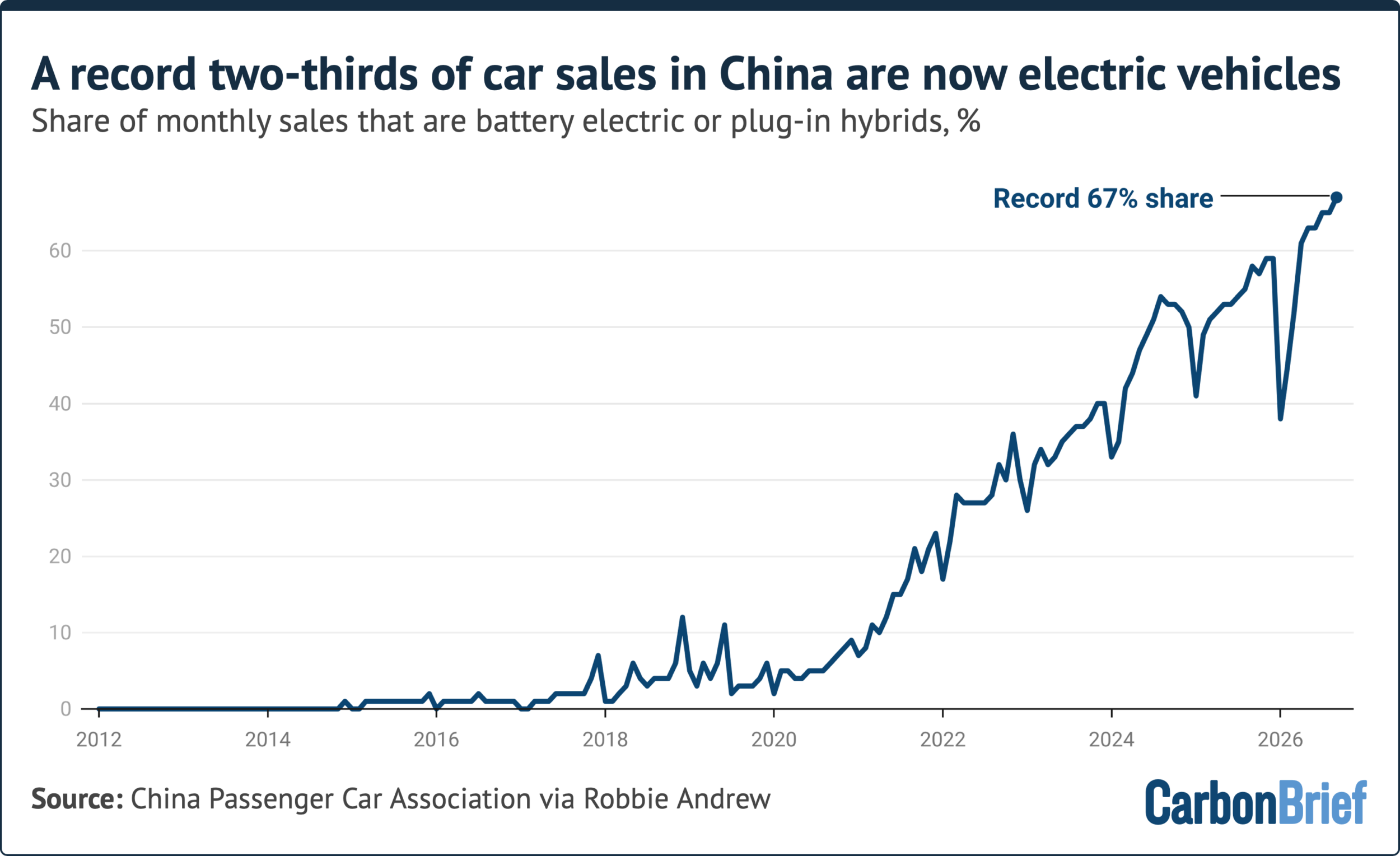
This marks a rapid rise for NEVs from just 6% of new car sales in 2020 up to 58% in 2026 to date – and a record 67% in the month of September.
This year, NEVs’ share of sales has also bounced back from a low of 39% in January, after the full purchase tax exemption that had been in place for more than a decade came to an end in December 2025.
The gain in NEV share in 2026 has come amid a slowdown across the wider domestic passenger-car market, which has hit sales of combustion-engine vehicles particularly hard.
This September, passenger-car retail sales across all categories declined, with overall sales volumes falling 28% year-on-year.
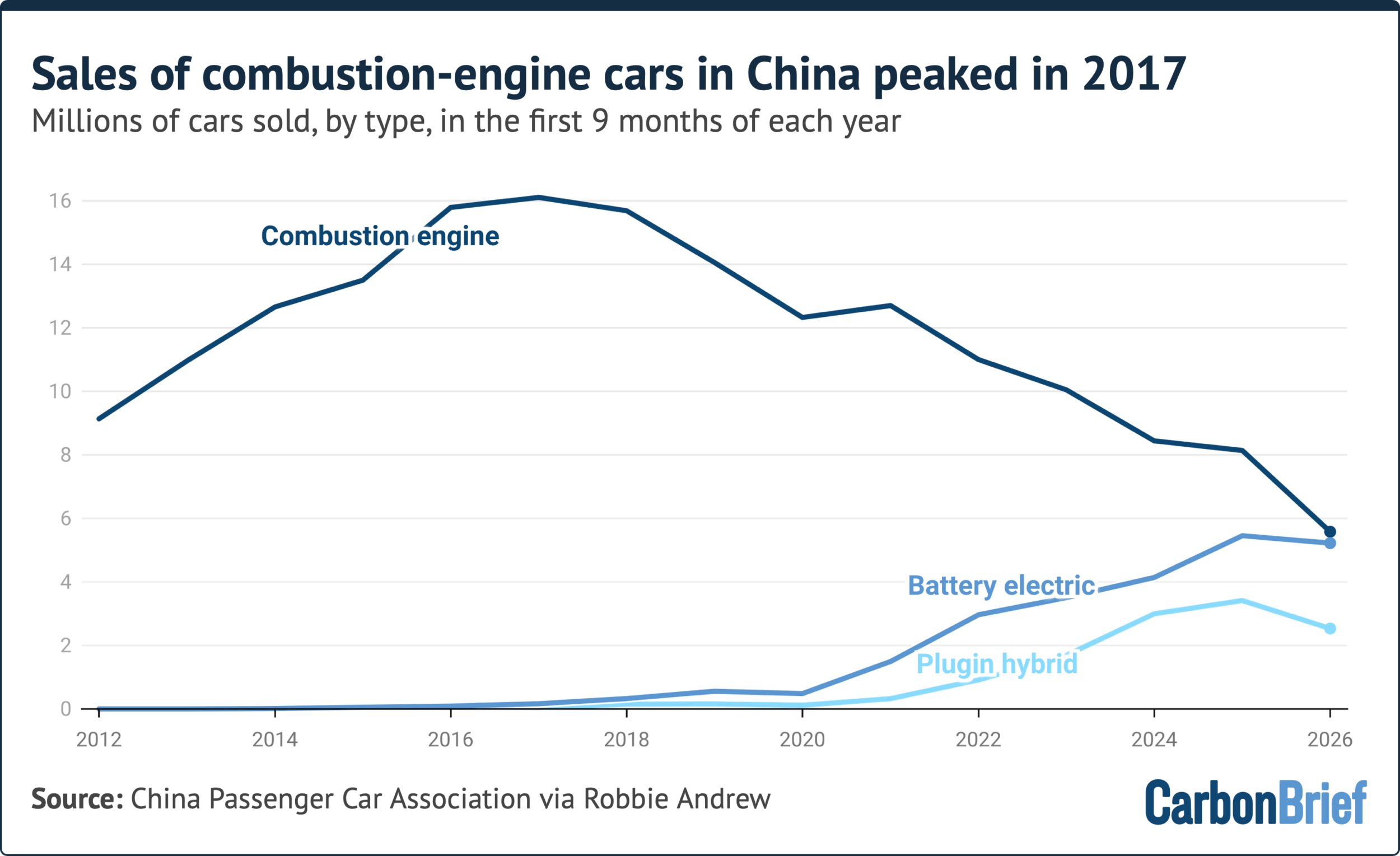
The contraction was led by combustion-engine vehicles, which saw sales fall 43% year-on-year in September and 31% in 2026 to date.
However, sales of PHEVs also fell by 36% year-on-year in September and by 26% in 2026 to date. By comparison, BEVs performed better, although sales still declined 8.5% from a year earlier in September and 4% in 2026 to date.
As a result, NEV sales overall fell by 17% in September and 13% in 2026 to date.
While the market changes in 2026 to date were particularly dramatic, they reflect a broad continuation of trends seen over the past decade.
Indeed, sales of combustion-engine cars in China peaked in 2017 and they have been declining ever since, shown in the figure below.
Impact of Hormuz
Part of the reason for the advance of NEVs in 2026, said Chinese technology news outlet OFweek, was petrol cars “giving up market share” as they were outperformed by electric alternatives.
Cui Dongshu, secretary-general of the CPCA, cited higher petrol prices as an explanation for September’s weak combustion-car sales, in comments to financial news outlet National Business Daily.
Imports of oil into China in January-September have fallen 15% compared to 2025, equivalent to 470m barrels, as ongoing conflict tightened supply and drove up prices.
China’s passenger-car NEV fleet has displaced 143m barrels of oil so far during the strait of Hormuz crisis, Euan Graham, senior energy analyst at thinktank Ember, tells Carbon Brief.
EVs “accounted for 12% of the decrease in China’s oil use post-Hormuz”, according to an estimate provided to thinktank the Brookings Institute by an unnamed analyst.
Erica Downs, a senior research scholar at Columbia University’s Center on Global Energy Policy, tells Carbon Brief that the strait of Hormuz crisis and higher oil prices are “reinforcing China’s electrification of road transport”.
She says the “world’s largest oil supply disruption” vindicates China’s early bet on EVs, which was partly driven by concerns about oil-supply security.
NEV demand down
Nevertheless, NEV sales have fallen year-on-year, albeit at a slower rate than overall car sales. The growth in NEV market share has also been decelerating.
Zhang Yichao, a partner at consulting firm AlixPartners, tells Carbon Brief that NEVs benefit from government trade-in policies and a “strong pipeline” of new models, particularly those involving innovation.
He says these factors help explain why NEVs sales have fallen at a slower rate to their combustion-car counterparts.
Cui told the state-run China National Radio that the fall for NEVs and for cars overall in September 2026, is also due to a high baseline of sales from the same month in 2025, as well as changes to trade-in policies and disruptions from the holiday period.
Other factors, says consulting firm Wood Mackenzie, are the weakened demand due to “demand pull-forward” in 2025 caused by the end of subsidies, as well as “tighter financing conditions”.
Zhang tells Carbon Brief he does not “see much more room ahead” for further growth in NEVs’ market share.
He adds that, in his view, their share in China is unlikely to exceed 80%, as some premium-market segments and specific use cases will continue to require combustion-engine vehicles.
Exports surge
Meanwhile, while domestic NEV retail sales fell 17% in September 2026, exports more than doubled, increasing 164% year-on-year, according to the CPCA.
This extends the decline in domestic sales and very strong growth in exports seen across 2026 to date, as shown in the figure below.
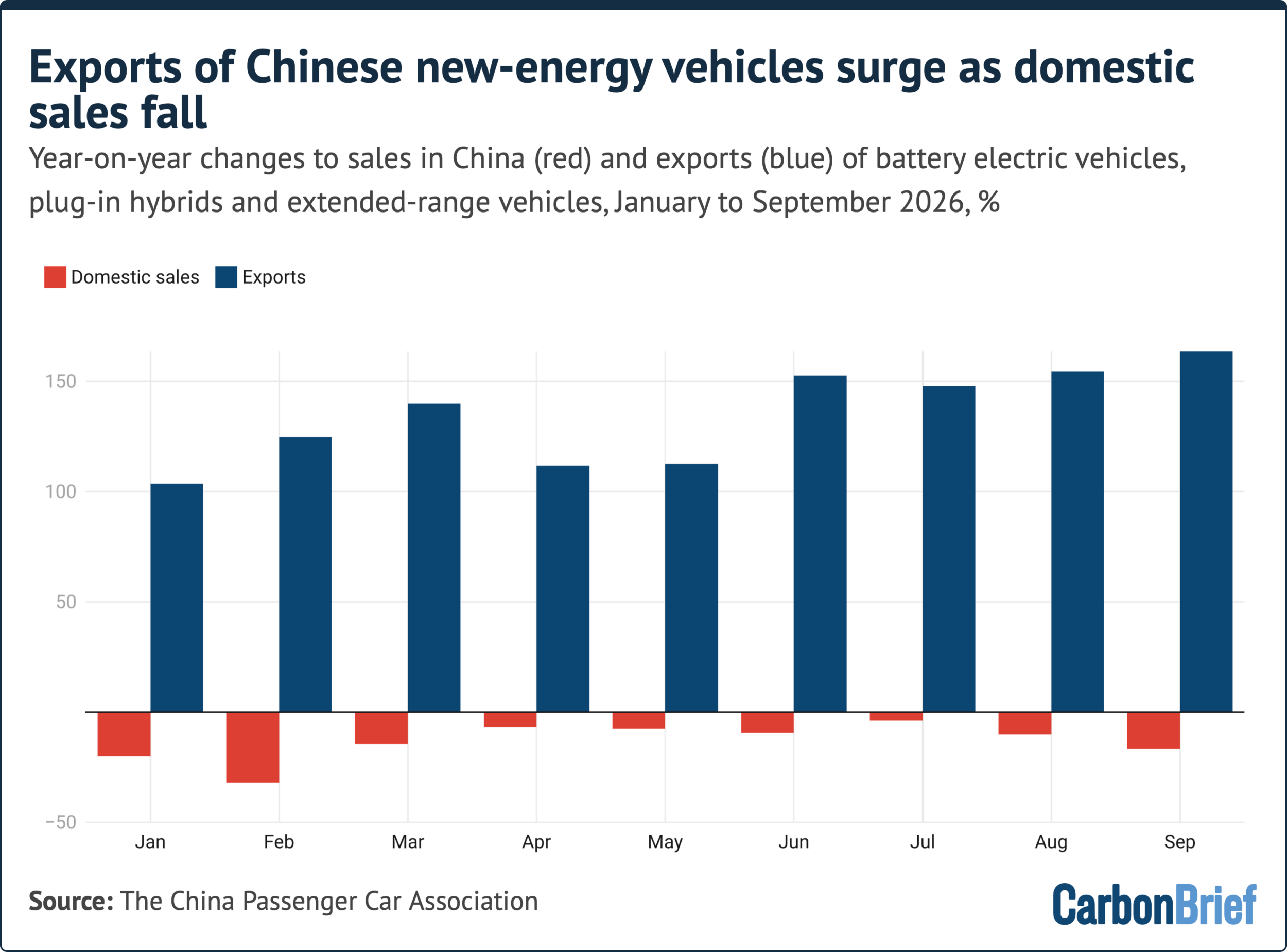
In September, 1,084,000 NEVs were sold domestically in China, while 558,000 NEVs were exported.
Exports are becoming increasingly important to Chinese carmakers, in the face of weaker domestic demand and cut-throat industrial competition.
The CPCA says exports have become “a core priority” for some carmakers.
However, the surge in exports from China has created concern in the EU, which has placed tariffs on imports of EVs from China and recently agreed plans to cut imports of hybrids.
Countries including Mexico and Turkey have also placed tariffs on Chinese EV imports.
At the same time, the Chinese government is putting policies in place that might be expected to disincentivise exports, such as cutting VAT export rebates.
Analysts differ on what impact this policy shift will have, with some saying it will be limited, while others believe it could cause the price of exported cars to rise.