

Climate Home News is looking for an editor to lead its award-winning team.
This is a unique opportunity to set the news agenda internationally on a topic of intense public interest.
Since 2012, Climate Home News has built a reputation as the go-to news source for original reporting on the international politics and diplomacy of the climate crisis.
Climate Home’s core audience includes climate diplomats, policymakers, researchers, practitioners and activists across the globe. We reach hundreds of thousands of generalist readers too.
Initially centred on the UN climate negotiations, our beat broadened to how the Paris Agreement is playing out in the real world. As climate journalism entered the mainstream, we honed our focus on where we could add value: authoritative reporting on multilateral affairs and collaborative investigations.
The successful candidate will build on this legacy and steer Climate Home through its next phase. You will navigate industry-wide trends such as news avoidance, stagnating social media engagement and the rise of AI tools. You will have big ambitions for climate journalism and a track record to back them up.
Location: Remote
Salary: £50,000 – £70,000 FTE depending on experience and location
Terms: Full time or part time/job share negotiable
Contract type: Permanent
Start date: As soon as possible after 2 January 2024
Responsibilities
- Lead the editorial strategy for Climate Home News
- Manage a team of journalists
- Maintain the high quality of journalism for which Climate Home is known
- Uphold industry best practice in ethical and responsible reporting
- Mitigate legal risks
- Work with the CEO and operations manager to secure resources to sustain Climate Home’s original journalism
Role Requirements
Essential
- A minimum of five years’ journalism experience, including at least two years in an editorial capacity
- A vision for advancing independent climate journalism
- Keen interest in the climate crisis, its causes and solutions
- A track record of producing hard-hitting news and investigative stories
- Proven ability to secure resources to sustain quality journalism
- Networking prowess
- Awareness of audience trends and their implications for news publishers
- Understanding of media law and industry standards
- Excellent written and spoken English
- Willingness to work remotely
Desirable
- Deep knowledge of the climate crisis and multilateral efforts to tackle it
- Existing networks in the climate journalism space
- Experience of managing people
- Multimedia experience
- Additional languages
Application process
To apply for this role, please send a CV and one-page covering letter to md@climatehomenews.com outlining your editorial vision for Climate Home News and how your experience equips you to deliver it. Attach or link to published work that you have reported or edited. Include contact details for two referees, who will only be contacted with your prior permission. Shortlisted candidates will be invited to interview with CEO and publisher James Ramsey, editor Megan Darby and an external panel member tbc.
Deadline for applications: 09:00 GMT, Monday 6 November 2023
Interviews will take place the week beginning: 13 November
The post Could you be the next editor of Climate Home News? appeared first on Climate Home News.

Three countries have been named by the Paris Agreement’s compliance committee for failing to submit a nationally determined contribution (NDC) and repeatedly snubbing offers of help with their climate plans.
After months of internal debate over whether to identify serial non-responders, the Paris Agreement’s Implementation and Compliance Committee (PAICC) named the three countries which have failed to engage with it over their NDCs on Friday.
It named Democratic Republic of Congo, Senegal and North Korea in a footnote of its annual report, adding that it decided to name them “with a view to facilitating engagement”, adding that representatives of the three nations had been invited to its meeting in early 2027 “with the purpose of identifying any challenges and constraints”.
“The Committee noted the importance of Parties engaging with the Committee in a timely manner, while noting that some delays may be due to the national capabilities and circumstances of the Parties”, the report said.
-
Under US pressure, World Bank says it will back gas “where appropriate”
The US wants the World Bank to expand its gas support while climate campaigners are pushing for it to end – its head spoke this week of limited backing for the fossil fuel -
IPCC scientists vow to press on with climate reports despite political deadlock
After governments again failed to agree a timeline, nearly 120 IPCC authors pledged to complete their assessment on time and with full scientific rigour -
Paris Agreement committee snubbed over missing NDC climate plans
Many governments have still not submitted a nationally determined contribution to the UN, breaching a key requirement of the Paris Agreement

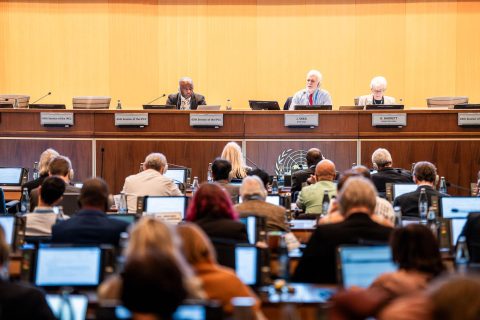

In July, PAICC said 12 countries had ignored its repeated attempts to discuss why they had not published an NDC as required every five years under the 2015 Paris accord.
Members of the committee had been divided over whether to name them, but at a September meeting decided to do so in their annual report to the annual climate COP summit.
By the time the report was published on Friday, only Congo, Senegal and North Korea “had not communicated an NDC or submitted a [Biennial Transparency Report] and had not yet responded to any of the Committee’s notifications, despite several reminders issued by the Committee in this regard”.
Rainforest and renewable energy ambitions
The silence from Congo and Senegal is notable because the former is home to much of the Congo Basin rainforest while the latter has sought billions of dollars in climate finance to support its renewable energy ambitions.
After Brazil, Congo has more rainforest than any country in the world. This forest, and the country’s peatlands, absorb huge amounts of greenhouse gas but are fast being lost to expanding farmland, charcoal production, logging and mining.
Senegal signed a Just Energy Transition Partnership with Canada and wealthy European nations in 2023, to help it meet its renewable energy targets under the-then government of Macky Sall. It was chair of the Least Developed Countries group between January 2022 and December 2023.

Tejas Rao, who is researching the PAICC as part of a doctoral thesis at Cambridge University, said the governments of the three countries should engage with the committee.
“Engagement costs these governments very little and the committee has shown it will listen,” he said.
“Silence leaves the committee with no basis to help, and it leaves the [governments] exposed to the narrative that they are simply disengaged,” he told Climate Home News.
Paris Agreement requirement
The 2015 Paris Agreement requires all parties to publish an NDC every five years outlining their emissions reduction targets, with each plan meant to be more ambitious than the country’s last NDC.
The latest set – the third round of plans, with new targets for 2035 – was due in February 2025. While most countries missed this deadline, all but around 30 – mostly small emitters but including Egypt, Vietnam and Argentina – have now submitted them.
Over the year, the PAICC – which is made up of government climate officials from developed and developing countries – has been communicating with governments that have not submitted NDCs and trying to overcome barriers to them doing so.
Some nations have cited exceptional circumstances as the reason for not submitting an NDC, a process that requires a significant amount of work in tracking emissions and consulting on how to curb them across the economy. For example, a letter from a Sudanese official to the PAICC, seen by Climate Home News, said that the country’s civil war had led to the suspension of its NDC preparation.
-
IPCC scientists vow to press on with climate reports despite political deadlock
After governments again failed to agree a timeline, nearly 120 IPCC authors pledged to complete their assessment on time and with full scientific rigour -
Under US pressure, World Bank says it will back gas “where appropriate”
The US wants the World Bank to expand its gas support while climate campaigners are pushing for it to end – its head spoke this week of limited backing for the fossil fuel -
Who shapes climate science? The equity question facing the IPCC
Early completion of the next global climate science assessment reports risks excluding research from the Global South, which is key to ensuring the findings are fair
The US and Iran are not signed up to the Paris Agreement and so do not have active NDCs, nor does Taiwan, which is not a UN member state.
Rao said that because the PAICC is “facilitative and non-punitive”, naming the countries “is meant to open a door, not close one – the invited consultation is the point”.
“In recent months, governments that explained their constraints, whether capacity, finance or domestic process, have been met with follow-up and support rather than sanction, and the number of silent governments has fallen sharply,” Rao said.
The post Paris Agreement committee names three countries snubbing it over NDCs appeared first on Climate Home News.
Paris Agreement committee names three countries snubbing it over NDCs