Spiking food prices have made headlines around the world this year, from eggs in the US to vegetables in India.
The UN Food and Agriculture Organization’s Food Price Index has been slowly increasing over the past six months following declines over much of 2023.
For example, the price of orange juice concentrate in the US was 42% higher in April than it was a year ago, while the price of fresh orange juice in the UK has risen 25% over the last year.
In Greece, the price of olive oil rose by nearly 30% over 2023 and by more than 63% in April of this year.
No single factor alone can explain the rising prices.
But geopolitical conflict, extreme weather events, high input costs and increased demand are all playing a role.
The FAO’s recent Food Outlook report finds that, despite positive forecasts, “global food production systems remain vulnerable to shocks stemming from extreme weather events, geopolitical tensions, policy changes and developments in other markets”.
Carbon Brief has asked a range of scientists and policy experts from around the world what they think are the biggest factors driving spiking global food prices.
These are their responses, first as sample quotes, then, below, in full:
- Prof Elizabeth Robinson: “Whilst one can argue that food crises are not primarily caused by climate or weather, often food price spikes are due to a combination of weather and non-weather related factors.”
- Levi Sucre: “The overexploitation of agricultural lands and the intensive use of agrochemicals have led to a growing need for fertilisers to maintain production, which further increases production costs.”
- Dr Álvaro Lario: “Most food commodity markets present a stable outlook for 2024-25, which should help contain prices for consumers. However…many factors can tip the delicate demand-supply balance.”
- Siraj Hussain: “For long-term and stable food security, the yield has to go up and food losses have to come down.”
- Prof Andrew Challinor: “Put plainly, climate change is beginning to outpace us because it is interacting with our complex interrelated economic and food systems.”
- Dr Rob Vos: “Food prices in global markets are most sensitive to weather conditions and supply disruptions in major producing countries.”
- Prof Alan Matthews: “The rapid recovery of consumer demand following the disruptions caused by the measures to contain the Covid-19 pandemic, extreme weather events, animal disease outbreaks and tight global markets all contributed.”
- Xiomara Paredes: “In short, every time a new regulation is created, it increases production costs, makes market access difficult and thus makes food products more expensive.”
- Dr Manuel Otero: “Food prices have experienced significant increases due to various interrelated economic, social, environmental and political causes.”
- Dr Shouro Dasgupta: “Conflicts are one of the main reasons behind price shocks…Many of these events have also disrupted supply chains and infrastructure.”
 Prof Elizabeth Robinson
Director, Grantham Research Institute on Climate Change and the Environment.
London School of Economics and Political Science
Back in 2008, broad underinvestment in the agriculture sector, increasing demand for biofuels, changing diets and speculation – encouraged by declining global food stocks – were already putting longer-term upward pressure on food prices.
The 2008 food crisis was triggered by sequential poor wheat harvests in Australia, a breadbasket country. However, the extreme spike in wheat and rice prices was driven by a combination of export restrictions, panic buying and increased speculation, which amplified the short-term harvest shocks and the longer-term pressures.
More recently, the changing climate, the Covid-19 pandemic and Russia’s invasion of Ukraine have disrupted food production and globally integrated food supply chains, putting rapid upwards pressure on food prices. Whilst one can argue that food crises are not primarily caused by climate or weather, often food price spikes are due to a combination of weather and non-weather related factors.
Earlier this year cocoa prices rapidly increased, a consequence of extreme weather conditions, linked in part to El Niño, resulting in multiple poor harvest seasons in west Africa, combined with longer-term pressures, including disease and ageing cocoa trees, and short-term pressures, particularly speculation, exacerbating the situation further.
Given the changing climate, and in particular increasing extremes of heat and precipitation, food price spikes are likely to be an increasingly common feature of our highly integrated global food systems, in which shocks in one part of the world can relatively easily be amplified and transmitted around the globe.
 Levi Sucre
Coordinator
Mesoamerican Alliance of Peoples and Forests
There are several factors causing the increase in food prices worldwide.
Firstly, the high dependency on oil, whose price keeps rising, drives up the costs of food production and transportation. Agricultural machinery, fertilisers and product transportation rely heavily on oil, so any increase in its price directly affects the final cost of food.
Additionally, the overexploitation of agricultural lands and the intensive use of agrochemicals have led to a growing need for fertilisers to maintain production, which further increases production costs.
Monocultures are also degrading the soil, reducing its capacity to produce food sustainably. The lack of crop rotation depletes soil nutrients, diminishing its fertility and forcing farmers to use more fertilisers and pesticides. This not only increases costs but also has negative effects on the environment and health.
The effects of climate change are impacting agricultural production; for example, rising temperatures are disrupting previously predictable agricultural seasons, making crop production more difficult. High temperatures in Mesoamerica continue to destroy crops and reduce food reserves, worsening shortages and driving up prices, affecting nearly 8 million people in El Salvador, Guatemala, Honduras and Nicaragua.
Furthermore, economic injustice, inequality and lack of equity exacerbate the situation. The people with the least resources are the most affected by rising food prices, putting their food security at risk. On the other hand, small-scale producers, who do not use harmful soil practices, do not receive the necessary support to increase their production. These farmers cannot compete with large companies that dominate the market with their monocultures.
 Dr Álvaro Lario
President
International Fund for Agricultural Development
International food prices have declined since their historic peak after the start of the war in Ukraine. According to the recently released biennial FAO Food Outlook, most food commodity markets present a stable outlook for 2024-25, which should help contain prices for consumers. But as the report reminds us, many factors can tip the delicate demand-supply balance, impacting food prices and global food security.
The drop in global food prices does not automatically mean that prices have decreased in real terms in local markets, especially considering the strong depreciation of local currencies in most low- and middle-income countries against a robust US dollar.
This is also true for rural communities in these countries, where 80% of the world’s poorest live. In these areas, people can spend up to 70% of their income on food, leaving them with no capacity to absorb any price hikes and pushing them into poverty and hunger. Since Covid-19 emerged, we have seen multiple crises, such as climate change, conflict and record-high food prices, have compounded to push 122 million more people into hunger.
And, despite the current trend, we must remember how fragile our food systems are. They are increasingly threatened by more frequent and intense weather extremes, and volatile geopolitics. Our food systems are overly concentrated on a few crops, countries and producers, and are inefficient, with significant food losses along the value chain and high levels of food waste at the consumer level.
 Siraj Hussain
India’s former agricultural secretary. Trustee.
World Food Programme Trust for India
Food inflation has been a source of major concern for a vast majority of Indians.
It is quite an enigma that even cereals, in which India is surplus, have seen double-digit inflation in the last year. Despite the erratic monsoon in 2023, India produced 137m tonnes of rice. Yet in every month since April 2023, the consumer price index inflation for rice was 11-13%.
In the case of wheat, inflation was more than 12% from April to July 2023. The Indian government released 10m tonnes of wheat under an open market sales scheme to cool down wheat prices and the intervention was quite successful as inflation has come down to about 3-7% since July 2023.
The reasons behind inflation in basic cereals of wheat and rice are not well understood. Despite low monsoon rains in 2023-24 due to El Niño, the production of both was not too low in 2023-24. As per the Indian government, wheat production was 113m tonnes.
The real concern in the basket of food inflation comes from vegetables, where inflation in the last year has reached more than 25%. This is attributed to losses in the supply chain from harvesting to marketing. India’s food surpluses are quite small except for rice and sugar. For long-term and stable food security, the yield has to go up and food losses have to come down.
 Prof Andy Challinor
Professor of Climate Impacts.
University of Leeds
Every five years, the UK is mandated to report on climate change risks. The scientific evidence for the second of these reports was published in 2017. It highlighted risks from weather-related shocks to international food production and trade as a key risk.
The final report, which is the responsibility of the government, not scientists, endorsed all the conclusions of the evidence report “with the exception of some of those on food security”. The reason? It said: “The government takes a more optimistic view of the levels of resilience that are achieved through functioning markets and diverse sources of supply.”
In the same month that the government response was written, reports of a UK courgette deficit, resulting from climate extremes abroad, soon deepened into wider concerns across a range of vegetables and rationing was commonplace across supermarkets. The World Economic Forum’s 2017 report on global risks identified extreme weather events – already ranked as the most likely global risk in every WEF report since 2014 – as both the most likely and most impactful risk, after weapons of mass destruction.
Skip forward to 2022, when the evidence for the new UK assessment was published. Amongst other additions, an increased underlying vulnerability to climate risk was identified along with a new specific risk of “risk amplification from the interactions and cascades of named risks across systems and geographies”.
The way we as a society (consumers, citizens, government, businesses) choose to set up our food systems has huge implications for stability and resilience – or lack thereof. The 2022 report makes clear that the UK is struggling to keep pace with climate change impacts because of both the pace of change and the way in which the many potential risks to food systems interact with each other.
Put plainly, climate change is beginning to outpace us because it is interacting with our complex interrelated economic and food systems. Until we find ourselves able to look at the big picture and adjust accordingly, we can expect more of the same.
 Dr Rob Vos
Director for Markets, Trade and Institutions.
International Food Policy Research Institute
The war in Ukraine caused world market prices for staple foods, especially wheat and vegetable oils, to skyrocket in the first half of 2022. Since then, however, those world market prices have come down to pre-war levels.
At the same time, consumers around the world have felt soaring domestic food price inflation well into 2023. People in some low- and middle-income countries, such as in Argentina, Egypt, Ethiopia, Gaza, Haiti, Sudan, Ukraine and Venezuela, are still seeing the cost of their daily bread and meals going up at high rates today.
What is driving these price fluctuations in global food markets and why are consumer prices not following the same pattern?
Food prices in global markets are most sensitive to weather conditions and supply disruptions in major producing countries. For instance, floods in India caused by the El Niño phenomenon disrupted rice production in India during 2023, pushing up rice prices worldwide.
The war in Ukraine caused shortages in global wheat, maize, sunflower seeds and fertiliser supplies as both Russia and Ukraine are major producers, pushing up wheat, vegetable oil and fertiliser prices.
I should add that the Ukraine war was not the only factor and, in fact, just exacerbated the surge in international food and fertiliser prices induced by the global economic recovery from the Covid-19 recession and the supply chain disruptions (recall the containership pile-up at harbours) that sent oil prices and shipping costs soaring and increasing the cost of farming and food trade worldwide.
Global market prices are further sensitive to misguided policy responses. Governments often respond to expected food supply shortages and price surges by imposing restrictions on exports (such as India’s bans on rice exports in 2023) or lowering import restrictions (as many rice-importing countries did in 2023). While trying to protect their consumers, these “insulation” measures end up just magnifying the price increase.
Why do domestic food prices not necessarily follow the same pattern?
In fact, most countries are relatively insulated from global price shocks as they rely predominantly on their own food production to feed their populations; typically, only 10-15% or less of food consumption is imported.
Domestic conditions for food production and distribution systems thus matter more than global prices. These conditions vary across countries, but countries with the highest rates of consumer price inflation have seen food systems disrupted by intensified conflict (as in Ethiopia, Gaza, Haiti and Sudan, for instance) and those suffering macroeconomic constraints and weak currencies that have kept both general and food price inflation high (e.g. Argentina, Venezuela, Turkey, and many highly indebted low-income countries).
 Prof Alan Matthews
Professor Emeritus of European Agricultural Policy
University of Dublin Trinity College
Food prices in the EU rose dramatically in 2022 and 2023. EU food prices were 41% higher in May 2023 relative to the price level in 2015, while the overall price level rose by just 26% during this period. The monthly annual rate of food price inflation peaked at 19.2% in the EU in March 2023.
Even higher rates were recorded in central and eastern Europe, with Hungary a particular outlier, with food price inflation of 46% in February 2023. Since then, food prices have not fallen, but are now increasing at a rate below the general inflation rate for the first time in two years.
There have been multiple drivers of this food price inflation. The rapid recovery of consumer demand following the disruptions caused by the measures to contain the Covid-19 pandemic, extreme weather events, animal disease outbreaks and tight global markets all contributed.
For Europe, the impact of the Russian invasion of Ukraine has been particularly important. There was a direct impact through the increased price of energy, and thus fertilisers and fuel, given the EU’s dependence on imports particularly of Russian gas, but also an indirect impact through the knock-on effect of higher world market crop prices due to the subsequent curtailment of Ukrainian exports to the world market.
Extreme weather events have contributed to food price increases. High temperatures and drought badly affected olive oil production in 2022-23 as well as production of cereals in southern Europe, while heavy rains and wet weather have delayed planting and harvests and damaged fruit quality in northern Europe.
Despite these production losses, a March 2024 study in Communications Earth & Environment estimated that the 2022 extreme summer heat had increased food inflation in Europe by 0.43-0.93 percentage points – so making a relatively minor contribution to the overall 19% increase in food prices at that time. Nonetheless, in more normal times that would cause a more noticeable uptick in food prices, and the authors suggest that the warming projected for 2035 could amplify these numbers by 30-50%.
Xiomara Paredes
Executive Director, Latin American and Caribbean Coordinating Association of Small Fair Trade Producers and Workers
The new regulations that the EU has recently implemented, such as the deforestation-free regulation, changes in organic regulation, human rights and environmental due diligence, entail the investment of additional resources, thus raising production costs.
For example, to comply with the deforestation-free regulation, producers must first invest in geolocation equipment and have technical staff who can survey the points or polygons on the plots of each producer member of the organisation. Geolocating all the producers’ plots also takes time and effort that must be diluted in the installed capacity of the producer organisations.
In short, every time a new regulation is created, it increases production costs, makes market access difficult and thus makes food products more expensive.
 Dr Shouro Dasgupta
Environmental Economist
Fondazione CMCC
Visiting Senior Fellow
Grantham Research Institute, LSE
The issue of increasing food prices is multifaceted and is due to a complex set of reasons including conflicts, climate change and supply chain disruptions.
Conflicts are one of the main reasons behind price shocks. For instance, Russia’s invasion of Ukraine, known as the breadbasket of Europe, has substantially reduced exports of wheat, maize and sunflower, resulting in food price fluctuations. While global food prices have decreased from their peak levels at the onset of the conflict, they remain higher than the pre-conflict levels.
Climate change, manifested by increasing temperatures and the increasing intensity and frequency of extreme events such as heatwaves, droughts and floods, has led to crop failures and reduced yields in many parts of the world. This, in turn, has pushed up food prices through supply shocks.
Many of these events have also disrupted supply chains and infrastructure, such as roads, and lowered water levels of major rivers such as the Rhine. Whether due to conflicts or climate change, several countries have imposed export bans on major agricultural commodities (for example, India, Myanmar and Russia on rice; Thailand on sugar; Argentina on beef). These restrictions affect countries that are highly dependent on imports the most.
Several policy failures in the global food system also contribute to food inflation. One such issue is the inadequacy of storage facilities, especially in low- and middle-income countries. Another is the concentration of food production in certain regions and on selected crops (60% of the plant-based calorie intake is provided by rice, wheat and maize) and the fact that global food chains are dominated by a small number of multinational corporations.
Dr Manuel Otero
Director-general, Inter-American Institute for Cooperation on Agriculture
In recent years, food prices have experienced significant increases due to various interrelated economic, social, environmental and political causes. Armed conflicts have disrupted supply chains and food production and distribution, exacerbating shortages and driving up prices. These conflicts have also displaced millions of people, affecting their ability to produce and access food.
Economic shocks, such as the Covid-19 pandemic and its repercussions, plus the slowdown of economies, have reduced consumers’ purchasing power, decreasing incomes and increasing unemployment, which has raised relative demand and prices.
Extreme weather events, such as droughts and storms, have affected agricultural production, reducing supply and increasing production costs, resulting in higher prices for consumers. Volatility in fertiliser markets, driven by trade restrictions and armed conflict, has also increased agricultural production costs, reflected in higher prices for food products.
Trade restrictions, such as export bans, have exacerbated the global food crisis, limiting international food trade and further driving up prices in global markets. According to our Observatory of Public Policies for Agrifood Systems tool, since the pandemic, food inflation has reached 28% annually on a global average – compared to a general inflation of 19% annually.
This is despite the fact that international food prices fell 9% annually for the same comparison period, suggesting that other economic, political and environmental factors contribute to food inflation.
Latin America and the Caribbean is home to 16 net-exporting and 16 net-food-importing countries, so the region has benefited from the increase in international food prices, but has also been one of the most affected by food insecurity due to factors such as increasing poverty.


The post Experts: What is causing food prices to spike around the world? appeared first on Carbon Brief.
Experts: What is causing food prices to spike around the world?

Drought and heatwaves occurring together – known as “compound” events – have “surged” across the world since the early 2000s, a new study shows.
Compound drought and heat events (CDHEs) can have devastating effects, creating the ideal conditions for intense wildfires, such as Australia’s “Black Summer” of 2019-20 where bushfires burned 24m hectares and killed 33 people.
The research, published in Science Advances, finds that the increase in CDHEs is predominantly being driven by events that start with a heatwave.
The global area affected by such “heatwave-led” compound events has more than doubled between 1980-2001 and 2002-23, the study says.
The rapid increase in these events over the last 23 years cannot be explained solely by global warming, the authors note.
Since the late 1990s, feedbacks between the land and the atmosphere have become stronger, making heatwaves more likely to trigger drought conditions, they explain.
One of the study authors tells Carbon Brief that societies must pay greater attention to compound events, which can “cause severe impacts on ecosystems, agriculture and society”.
Compound events
CDHEs are extreme weather events where drought and heatwave conditions occur simultaneously – or shortly after each other – in the same region.
These events are often triggered by large-scale weather patterns, such as “blocking” highs, which can produce “prolonged” hot and dry conditions, according to the study.
Prof Sang-Wook Yeh is one of the study authors and a professor at the Ewha Womans University in South Korea. He tells Carbon Brief:
“When heatwaves and droughts occur together, the two hazards reinforce each other through land-atmosphere interactions. This amplifies surface heating and soil moisture deficits, making compound events more intense and damaging than single hazards.”
CDHEs can begin with either a heatwave or a drought.
The sequence of these extremes is important, the study says, as they have different drivers and impacts.
For example, in a CDHE where the heatwave was the precursor, increased direct sunshine causes more moisture loss from soils and plants, leading to a drought.
Conversely, in an event where the drought was the precursor, the lack of soil moisture means that less of the sun’s energy goes into evaporation and more goes into warming the Earth’s surface. This produces favourable conditions for heatwaves.
The study shows that the majority of CDHEs globally start out as a drought.
In recent years, there has been increasing focus on these events due to the devastating impact they have on agriculture, ecosystems and public health.
In Russia in the summer of 2010, a compound drought-heatwave event – and the associated wildfires – caused the death of nearly 55,000 people, the study notes.

The record-breaking Pacific north-west “heat dome” in 2021 triggered extreme drought conditions that caused “significant declines” in wheat yields, as well as in barley, canola and fruit production in British Columbia and Alberta, Canada, says the study.
Increasing events
To assess how CDHEs are changing, the researchers use daily reanalysis data to identify droughts and heatwaves events. (Reanalysis data combines past observations with climate models to create a historical climate record.) Then, using an algorithm, they analyse how these events overlap in both time and space.
The study covers the period from 1980 to 2023 and the world’s land surface, excluding polar regions where CDHEs are rare.
The research finds that the area of land affected by CDHEs has “increased substantially” since the early 2000s.
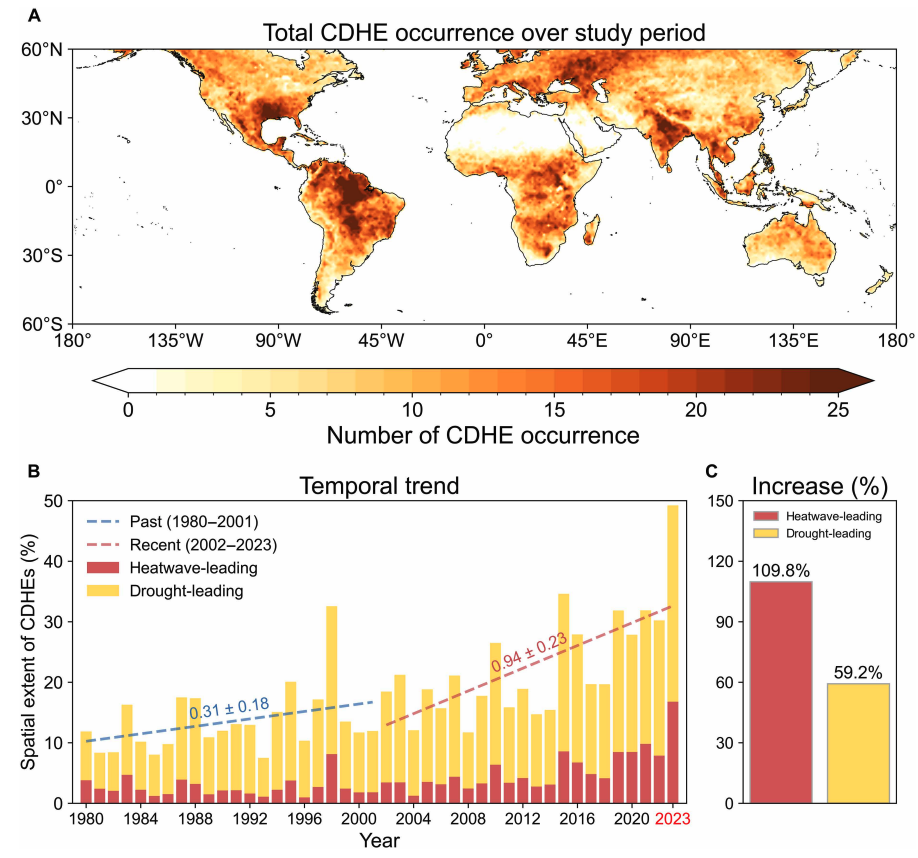
Heatwave-led events have been the main contributor to this increase, the study says, with their spatial extent rising 110% between 1980-2001 and 2002-23, compared to a 59% increase for drought-led events.
The map below shows the global distribution of CDHEs over 1980-2023. The charts show the percentage of the land surface affected by a heatwave-led CDHE (red) or a drought-led CDHE (yellow) in a given year (left) and relative increase in each CDHE type (right).
The study finds that CDHEs have occurred most frequently in northern South America, the southern US, eastern Europe, central Africa and south Asia.
Threshold passed
The authors explain that the increase in heatwave-led CDHEs is related to rising global temperatures, but that this does not tell the whole story.
In the earlier 22-year period of 1980-2001, the study finds that the spatial extent of heatwave-led CDHEs rises by 1.6% per 1C of global temperature rise. For the more-recent period of 2022-23, this increases “nearly eightfold” to 13.1%.
The change suggests that the rapid increase in the heatwave-led CDHEs occurred after the global average temperature “surpasse[d] a certain temperature threshold”, the paper says.
This threshold is an absolute global average temperature of 14.3C, the authors estimate (based on an 11-year average), which the world passed around the year 2000.
Investigating the recent surge in heatwave-leading CDHEs further, the researchers find a “regime shift” in land-atmosphere dynamics “toward a persistently intensified state after the late 1990s”.
In other words, the way that drier soils drive higher surface temperatures, and vice versa, is becoming stronger, resulting in more heatwave-led compound events.
Daily data
The research has some advantages over other previous studies, Yeh says. For instance, the new work uses daily estimations of CDHEs, compared to monthly data used in past research. This is “important for capturing the detailed occurrence” of these events, says Yeh.
He adds that another advantage of their study is that it distinguishes the sequence of droughts and heatwaves, which allows them to “better understand the differences” in the characteristics of CDHEs.
Dr Meryem Tanarhte is a climate scientist at the University Hassan II in Morocco, and Dr Ruth Cerezo Mota is a climatologist and a researcher at the National Autonomous University of Mexico. Both scientists, who were not involved in the study, agree that the daily estimations give a clearer picture of how CDHEs are changing.
Cerezo-Mota adds that another major contribution of the study is its global focus. She tells Carbon Brief that in some regions, such as Mexico and Africa, there is a lack of studies on CDHEs:
“Not because the events do not occur, but perhaps because [these regions] do not have all the data or the expertise to do so.”
However, she notes that the reanalysis data used by the study does have limitations with how it represents rainfall in some parts of the world.
Compound impacts
The study notes that if CDHEs continue to intensify – particularly events where heatwaves are the precursors – they could drive declining crop productivity, increased wildfire frequency and severe public health crises.
These impacts could be “much more rapid and severe as global warming continues”, Yeh tells Carbon Brief.
Tanarhte notes that these events can be forecasted up to 10 days ahead in many regions. Furthermore, she says, the strongest impacts can be prevented “through preparedness and adaptation”, including through “water management for agriculture, heatwave mitigation measures and wildfire mitigation”.
The study recommends reassessing current risk management strategies for these compound events. It also suggests incorporating the sequences of drought and heatwaves into compound event analysis frameworks “to enhance climate risk management”.
Cerezo-Mota says that it is clear that the world needs to be prepared for the increased occurrence of these events. She tells Carbon Brief:
“These [risk assessments and strategies] need to be carried out at the local level to understand the complexities of each region.”