By Naomi Krauzig (GEOMAR)
As the research vessel METEOR heads north toward Germany, the CTD Lab has become quiet.
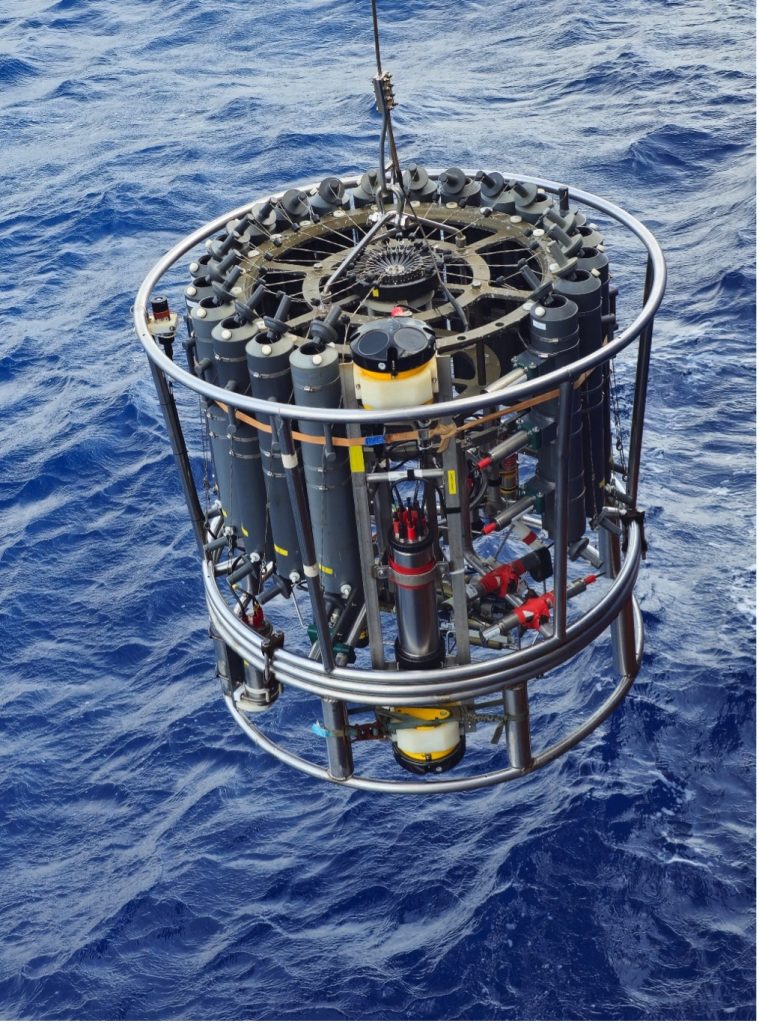
For the past four weeks, the CTD rosette (named after the three core variables it measures: conductivity, temperature, and depth) has been one of the busiest instruments on board. Day and night, it disappeared beneath the waves and returned with information about the entire water column.
Now the final station has been completed and the CTD rosette has been stored away for the last time. It feels like the right moment to reflect on a tool that has accompanied generations of oceanographers -and on a ship that has done the same.
Introduced in the 1970s, Conductivity-Temperature-Depth (CTD) systems revolutionized ocean observation by providing continuous measurements throughout the water column. When METEOR III entered service in 1986, the CTD was already the workhorse of physical oceanography. In the 1990s, it gained a trusted companion: the Lowered Acoustic Doppler Current Profiler (LADCP), capable of measuring ocean currents from the surface to the seafloor.

Aboard METEOR, the CTD rosette now also carries a suite of additional sensors measuring oxygen, chlorophyll, turbidity, photosynthetically active radiation, nitrate, and even particles and plankton through an Underwater Vision Profiler. At the same time, its Niskin bottles collect seawater samples for analyses of oxygen, nutrients, salinity, and other properties, providing a detailed picture of the water column.
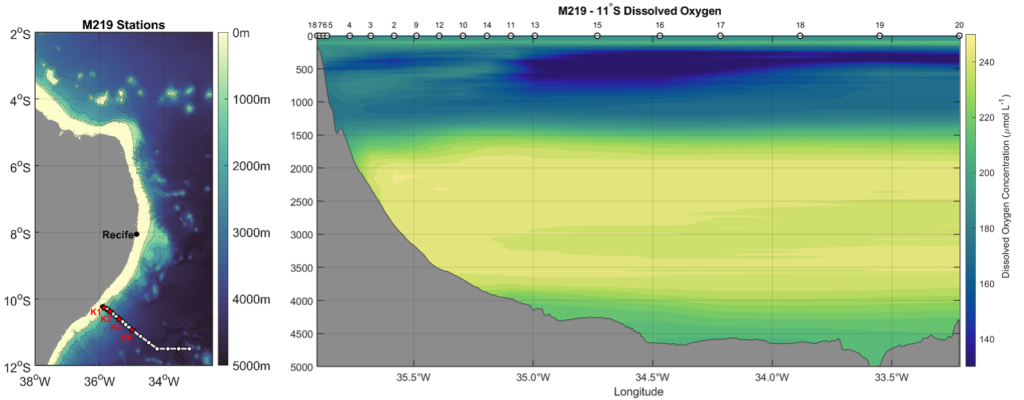
During M219, this classic CTD/LADCP system helped us reveal some of the hidden “highways” of the tropical Atlantic. Along the 11°S section off Brazil, a key location for monitoring the Atlantic Meridional Overturning Circulation, CTD measurements identified distinct water masses through their temperature, salinity, and oxygen signatures. At the same time, the LADCPs captured the currents carrying them: the warm, northward-flowing North Brazil Undercurrent in the upper ocean and the colder, southward-flowing Deep Western Boundary Current nearly two kilometers below.
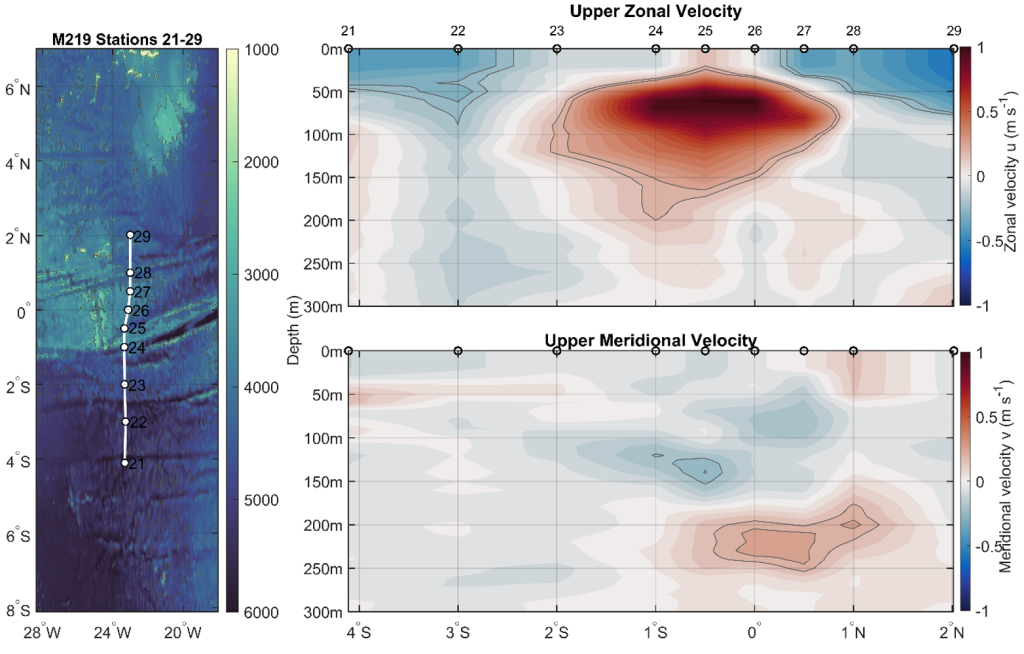
Further north, along 23°W, we crossed the equator and encountered one of the strongest subsurface currents in the world ocean: the Equatorial Undercurrent. Hidden just beneath the surface, this powerful eastward-flowing jet transports enormous amounts of water, heat, oxygen, nutrients, and carbon across the Atlantic: roughly one hundred times the discharge of the Amazon River!
While these observations allow us to investigate water masses, currents, and the circulation of the tropical Atlantic, they also carried an additional meaning for many on board.
For four decades, CTD rosettes have been lowered from the deck of METEOR III in every ocean of the world, helping scientists understand complex ocean processes, monitor changes, and train generations of oceanographers. During more than 11,940 days at sea, thousands of stations have been completed from her deck. Countless students, technicians, crew members, and scientists have contributed to these observations, and many have built their careers around the data collected aboard this vessel.
To take part in the final cruise -and the final CTD cast- of METEOR III was a privilege. Over the course of this voyage, it became impossible not to notice the connection many people have with this vessel. For some, METEOR has been a second home for years. Colleagues became lifelong friends, sometimes even family, and countless memories were made during deployments, watches, and transits at sea. The research vessel, the discoveries, and even the familiar CTD rosette hold a special place in many hearts.
As we pack the last equipment and the laboratories become emptier, it is difficult not to wonder what comes next. METEOR IV will soon continue the tradition, equipped with new capabilities and ready to tackle the scientific questions of the coming decades. New technologies will undoubtedly expand how we observe the ocean, yet some traditions are likely to endure.
https://www.oceanblogs.org/m219/2026/06/27/no-cruise-without-a-ctd/
Ocean Acidification
Counting Snowflakes in the Darkness of the Deep Ocean
By Joelle Habib (Laboratoire d’Océanographie Villefranche)
When I was a kid, I wanted to be a photographer. I still do, actually. But somewhere along the way, science intervened, and it gave me something I never expected: the chance to be an underwater photographer. Not the National Geographic kind who chases polar bears or waits weeks for a penguin to do something interesting. My subjects are smaller. Much, much smaller. I get to photograph the invisible life of the deep ocean, the tiny animals and sinking particles that most people never know exist. And the camera I use to do it descends to 6000 meters below the surface.
This instrument is called the UVP, or Underwater Vision Profiler. On this cruise, we deployed a UVP6 attached to the CTD rosette, profiling down to 4000 meters depth. The instrument activates automatically once its pressure sensor detects it is moving downward, takes up to 20 pictures per second all the way to the bottom of the cast. But before we talk about what the UVP gives us and why it matters, we need to talk about what it actually photographs: zooplankton and particles.
If you have ever watched SpongeBob SquarePants, you already know a zooplankton. Sheldon J. Plankton, the tiny villain who is perpetually trying to steal the Krabby Patty formula, is one. And funnily enough, the most abundant zooplankton across all the world’s oceans, is indeed this small crustacean: the copepod.
Here is the basic idea: a plankton is any organism that drifts with the ocean currents rather than swimming against them. If it photosynthesizes like a plant and contains chlorophyll pigments, it is a phytoplankton. If it is an animal, it is a zooplankton. A jellyfish is a zooplankton, just a very large one. Zooplankton graze on phytoplankton, on each other, and on anything small enough to eat. Now for the process that connects all of this to climate, to carbon, and to why we are out here on a research vessel in the middle of the equatorial Atlantic: the biological pump.
The biological pump is the ocean’s mechanism for pulling carbon out of the atmosphere and locking it away in the deep sea. Here is how it works: phytoplankton at the surface absorb CO₂ from the atmosphere and convert it into organic matter through photosynthesis. When they die, or when zooplankton eat them, defecate, excrete, and die themselves, all of that organic carbon does not simply disappear. It becomes marine snow! Yes, it snows in the ocean!!! Marine snow consists of a continuous rain of particles, aggregates, fecal pellets, shed exoskeletons, … Every flake of marine snow is a fragment of life that once existed at the surface, now on a one-way journey into the deep. This is the gravitational pump, one of the most important carbon sinks on Earth, and it is one of the pumps that the UVP was built to observe.

Marine snow seen by PELAGIOS (Pelagic In situ Observation System) in the Tropical Atlantic; 23°W; 100 m depth. Photo Credit: Henk-Jan Hoving
So why image and count particles rather than simply collecting water samples or relying on sediment traps? Because the abundance and size distribution of marine particles are two of the major factors controlling biological carbon sequestration in the ocean, and traditional methods cannot capture them at high resolution throughout the water column. Vertical profiles of particle images can reveal the processes that determine particle size, type, and distribution, and combined with information on carbon content and sinking velocity, they provide high-resolution information on how the biological pump operates at depth. The UVP allows for the remote collection of large datasets on particle abundances and their size distributions, enabling much higher spatial and temporal resolution than traditional methods. But particles are only one part of the story, the UVP also tracks zooplankton and their daily migrations: every night, zooplankton rise from the deep to feed near the surface, then sink back down before dawn, actively carrying carbon into the deep ocean in their own bodies. Without imaging tools like the UVP, this active carbon flux is nearly impossible to quantify.

Each image you see here was taken in complete darkness, somewhere between the ocean surface and 4000 meters below. The UVP6 illuminates a tiny volume of water, with a single red flashing light, capturing only the particles and organisms that happen to drift through that small window at that exact moment.
The instrument captures everything larger than 100 micrometers, roughly the width of a human hair. In the images you will see two types of things: fuzzy, irregular blobs of varying sizes: Marine snow aggregates. And more defined, structured shapes, sometimes with appendages, antennae, or transparent shells. Those are the zooplankton.
Every image is a small portrait of a world that already existed long before we had the tools to see it. I am so lucky I am able to see parts of that hidden life in this lifetime.
Ocean Acidification
Deep-Sea Animals That Look Like Aliens
Far below the ocean’s surface—where sunlight disappears, pressure skyrockets and temperatures plunge—some of the strangest animals on the planet have evolved to survive. Transparent heads. Glowing bodies. Needle-like teeth. Tentacles that seem straight out of science fiction.
And yet, these bizarre sea creatures are very real.
An estimated one million deep-sea species remain undiscovered. In fact, many deep-sea creatures have only been seen a handful of times because their habitats are so vast and difficult to explore.
Here are seven ocean animals that prove our blue planet can be just as strange as outer space.
1. The Vampire Squid

Despite its dramatic name, the vampire squid does not want to suck your blood. This deep-sea animal earned its spooky reputation because of its dark color, glowing eyes and cloak-like webbing stretched between its arms.
Unlike many squid species, vampire squid don’t actively chase prey. They have the ability to match the density of surrounding seawater to avoid constantly swimming by hanging suspended or drifting. They then use long, filament-like appendages to feed on “marine snow”—tiny drifting particles of organic material.
To avoid predators in the darkness, vampire squid rely on bioluminescence. Light-producing organs, called photophores, help them blend into faint light filtering down from above. When threatened, photophores near the tips of their arms create bursts of light that may confuse or distract predators long enough for the squid to escape.
2. The Barreleye Fish

If aliens wore fishbowls on their heads, they might look something like the barreleye fish.
This bizarre fish has a transparent head filled with fluid, allowing us to see its bright green eyes rotating inside its skull. Barreleye fish eyes can point upward to search for prey silhouetted against faint sunlight—or rotate forward when it’s time to feed.
For decades, scientists misunderstood how barreleyes actually looked, likely because damaged specimens lost the transparent tissue around their heads during the collection process. That was the case until researchers at the Monterey Bay Aquarium Research Institute were able to observe one alive.
Barreleyes serve as good reminders that we still have so much to learn about life beneath the waves.
3. The Giant Isopod

Imagine a roly-poly the size of a housecat. That’s basically a giant isopod.
These enormous crustaceans live deep on the ocean floor, up to 7,000 feet down, and they can grow more than a foot long! Their segmented armor, multiple legs and glowing eyes give them a prehistoric appearance—fitting, as the first recorded isopod fossil is more than 300 million years old.
Because food is scarce in the deep sea, giant isopods are built for survival. They can go surprisingly long periods of time without eating—sometimes years—and often scavenge remains that drift down to the floor.
4. The Anglerfish

Few creatures scream “deep-sea alien” more than the anglerfish.
With oversized teeth, expandable stomachs and a glowing lure dangling from its head, the anglerfish looks like something designed for a science-fiction movie. The glowing lure is actually bioluminescence—a natural chemical light used to attract prey in the darkness of the deep ocean.
Anglerfishes hunt using their bright lures to entice fish and crustaceans to draw close. Only females have the lures, however (you go, girl!). They also use this method to attract males.
In a habitat that sunlight never reaches, producing light can mean the difference between survival and starvation.
5. The Dumbo Octopus

Yes, the dumbo octopus is actually named after Disney’s Dumbo. Dumbo octopuses are, in fact, adorable and measure an average of just 8-12 inches in length.
Dumbo octopuses have ear-like fins extending from the sides of their heads that flap through water like tiny wings. They live at extreme ocean depths, 1,000-13,000 feet beneath the surface, making them one of the deepest-living octopus species scientists know about.
Unlike some octopus relatives, dumbo octopuses don’t ink when threatened. With predators limited that far down in the ocean, they don’t possess a defensive ink sack like other octopuses do.
Their cute appearance may seem less alien than some deep-sea creatures but make no mistake: An octopus flying through total darkness thousands of feet underwater is still pretty otherworldly.
6. The Goblin Shark

Nicknamed a “living fossil,” the goblin shark looks unlike almost any other shark species alive today.
Goblin sharks have semi-translucent skin, and their blood vessels can be seen through it. That’s why the goblin shark may look different colors in photos—sometimes a pale white, grey or pink. Its long, flattened snout and protruding jaws create an unmistakable profile. Even stranger? Those jaws can rapidly shoot forward to snatch prey before retracting again.
The mysterious allure of goblin sharks remains strong, as information is sparse, and photos of the species are extremely rare. Encounters with humans, through observation or accidental catch, are limited. What’s more alien than that!?
7. Gelatinous Deep-Sea Creatures

Some of the ocean’s strangest residents aren’t even solid.
Gelatinous animals include glowing jellies and drifting organisms that appear almost holographic underwater. Some pulse with neon colors. Others trail unbelievably long tentacles.
Sea jellies date as far back as 500 million years ago—if not longer. They are soft-bodied creatures consisting of at least 95% water, possessing a simple structure and a noticeable lack of almost everything that distinguishes plant from animal—including blood, a heart and a brain. Talk about out of this world!
Get Ocean Updates in Your Inbox
Sign up with your email and never miss an update.
It’s easy to think of deep-sea creatures as mysteries, but these animals are essential parts of our ocean ecosystem. The deep ocean regulates climate, stores carbon and supports biodiversity on a massive scale.
Yet much of it remains unexplored.
That’s why Ocean Conservancy is committed to protecting our entire ocean—and all the creatures that dwell there, no matter how mysterious they may be. The truth is, some of the most incredible discoveries on our planet may still be waiting in the dark depths below.
And honestly? That’s way cooler than science fiction!
The post Deep-Sea Animals That Look Like Aliens appeared first on Ocean Conservancy.
Ocean Acidification
Ocean of Data
By Qi-Fan Wu (Niels Bohr Institutet, University of Copenhagen)

In 1943, when Warren McCulloch and Walter Pitts showed that neurons could be represented by simple electrical circuits, they laid the first foundation for machines that could learn, adapt, and predict. In 2023, when ChatGPT became widely used, my Introduction to Python professor found that it could answer every question correctly on his course exam. In the history of machine learning, there has been a repeated oscillation between “extremely high expectations” and “deep skepticism.” What is machine learning? What should we expect from machine learning, and when should we be skeptical about it? Should the same principle also be applied to other numerical models?
The goal of machine learning is to make computers “learn” from “data”. From an end user’s perspective, it is about understanding your data, making predictions and decisions. Intellectually, it is a collection of models, methods and algorithms that have evolved over more than a half-century now [e]. Just as the human brain, neural networks, as one of the most popular machine learning methods, are theoretically capable of learning complex relationships from data. Theoretically, Neural Networks can compute any function in the world. No matter what the function is, there is guaranteed to be a neural network so that for every possible input x, the output value f(x) (or some close approximations) is output from the network (Figure 1). This result holds even if the function has many inputs and many outputs [a]. However, universal approximation only describes what neural networks are capable of, while the actual goal of machine learning is to fit an unknown function from a finite set of samples, ideally faster than traditional numerical methods.

In this blog, however, I do not want to focus on large language models that help with writing, coding, and basic background research. Instead, I want to discuss the training and use of special-purpose AI models, such as neural networks, for solving problems in physics, which is also the main topic of my PhD project. Nowadays, an increasing number of scientists are working on AI-related topics, including climate physics. If we think of the physical world as a forward dynamics model, then given the current state and the action to be taken, machine learning aims to predict the next state, while the entire world can be viewed as a huge digital database.
However, after the initial “extremely high expectations,” machine learning has also raised “deep skepticism”. In physics, especially climate physics, the “close approximations” mentioned earlier, together with the lack of standardized workflows, are often the source of trouble. The figure below shows rather discouraging results from reproducing ML-for-PDE-solving studies using stronger baselines.

As the quote attributed to von Neumann goes, “With four parameters I can fit an elephant, and with five I can make him wiggle his trunk.” All models are wrong, including physics-based numerical methods and climate models, but many are useful because different well-performing models can still reveal different aspects of the same physical system [c]. The physicist Paul Dirac reached a similar conclusion long ago: due to the limitations of human cognitive ability, scientific theories cannot be both closed and complete at the same time [d]. This means that we cannot have perfect, exact theories. He saw that theories based on approximations could sometimes have a considerable amount of beauty in them, and he began to infer that perhaps all theories of nature are, ultimately, only approximations [d]. Personally, I think the same rule could apply to machine learning models, and indeed to all models.
My journey on the METEOR made me appreciate the importance of data even more from a modeler’s perspective, and it deepened my belief that the people who create datasets deserve more applause and respect from the entire scientific community. Because of model uncertainty, data, especially observational data, become extremely important for understanding reality. Nature itself is the ultimate database, and its ocean of data is too vast to be compressed into a single dataset.
Machine learning models and climate reanalysis systems require these high-quality data to be reliable in real-world applications. Traditional numerical weather prediction and climate models, including general circulation models, have comprehensive physical foundations but require enormous computational resources, have limited spatial resolution, and struggle to integrate multi-source observations such as station, satellite, and radar data [e]. Although AI-based weather models have developed rapidly in recent years, they still suffer from inconsistent training datasets, time periods, and regions, varying evaluation metrics, and a lack of standardized code and experimental workflows – issues similar to those previously mentioned for AI-based approaches to solving PDEs in fluid mechanics [e]. Under these circumstances, data collected by METEOR, along with all observational data, are necessary for accurately modeling weather and climate, as well as for developing model architectures for them (Figure 3). A good model should embody a trinity of observational results, physical insight, and mathematical formalism. These three aspects should correspond perfectly, with no redundancy.

But what exactly can we do to make progress under data-limited conditions? And which scientifically important problems can be clearly formulated and addressed within an analytical modeling framework? These questions remain like dark clouds hanging over scientists working in related fields. A model that is mathematically beautiful and physically simple may still be inconsistent with observations. Some models considered correct may be mathematically unattractive, and their physical mechanisms may not be clearly explained either. My personal opinion is that, when dealing with this kind of situation in the age of AI, we may still need to rely on our own intuition (and even guessing), trying to understand reality with the help of many scientists who use observations and models to sail by night and expand the boundaries of human knowledge through tiny steps.
Note: Artificial Intelligence’s (AI) stated goal is to mimic human behavior in an intelligent manner, and to do what humans can do, which includes artificial “creativity” like driving cars, playing games, responding to consumer questions, etc. In that sense, AI seeks to create muscle and mind of humans, and mind requires learning from data, i.e. Machine Learning. However, Machine Learning helps learn from data beyond mimicking humans. Having said that, the boundaries between AI and ML are getting blurry day-by-day.
References:
[a] Charniak, E. An Introduction to Deep Learning. Cambridge, MA: MIT Press, 2019; 192.
[b] Nick McGreivy. I got fooled by AI-for-science hype—here’s what it taught me. 2025. https://www.understandingai.org/p/i-got-fooled-by-ai-for-science-hypeheres
[c] Fisher, A.; Rudin, C.; Dominici, F. All Models Are Wrong, but Many Are Useful: Learning a Variable’s Importance by Studying an Entire Class of Prediction Models Simultaneously. Journal of Machine Learning Research 2019, 20(177), 1–81.
[d] Dirac, P. A. M. The Principles of Quantum Mechanics. Oxford University Press: Oxford, 1930.
[e] Bansal, H.; Grover, A.; Jewik, J.; Nguyen, T.; Sharma, P. ClimateLearn: Benchmarking Machine Learning for Weather and Climate Modeling. In Advances in Neural Information Processing Systems 36; 2023; pp 75009–75025. https://doi.org/10.52202/075280-3279.
[f] Global Observing System (GOS). World Meteorological Organization. https://community.wmo.int/site/knowledge-hub/programmes-and-initiatives/global-observing-system-gos
-
Climate Change11 months ago
Guest post: Why China is still building new coal – and when it might stop
-
Greenhouse Gases11 months ago
Guest post: Why China is still building new coal – and when it might stop
-
Greenhouse Gases2 years ago嘉宾来稿:满足中国增长的用电需求 光伏加储能“比新建煤电更实惠”
-
Climate Change2 years ago嘉宾来稿:满足中国增长的用电需求 光伏加储能“比新建煤电更实惠”
-
Renewable Energy8 months agoSending Progressive Philanthropist George Soros to Prison?
-
Climate Change2 years ago
Bill Discounting Climate Change in Florida’s Energy Policy Awaits DeSantis’ Approval
-
Carbon Footprint2 years agoUS SEC’s Climate Disclosure Rules Spur Renewed Interest in Carbon Credits
-
Greenhouse Gases12 months ago
嘉宾来稿:探究火山喷发如何影响气候预测
