Ocean Acidification
No Cruise Without a CTD

By Naomi Krauzig (GEOMAR)
As the research vessel METEOR heads north toward Germany, the CTD Lab has become quiet.
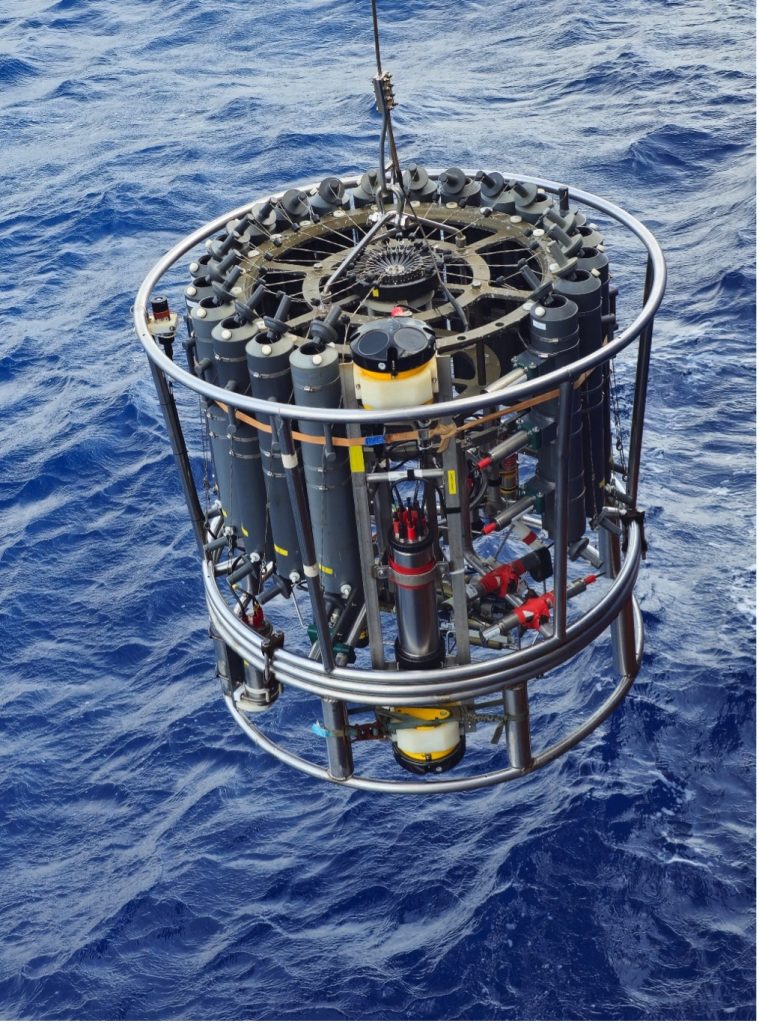
For the past four weeks, the CTD rosette (named after the three core variables it measures: conductivity, temperature, and depth) has been one of the busiest instruments on board. Day and night, it disappeared beneath the waves and returned with information about the entire water column.
Now the final station has been completed and the CTD rosette has been stored away for the last time. It feels like the right moment to reflect on a tool that has accompanied generations of oceanographers -and on a ship that has done the same.
Introduced in the 1970s, Conductivity-Temperature-Depth (CTD) systems revolutionized ocean observation by providing continuous measurements throughout the water column. When METEOR III entered service in 1986, the CTD was already the workhorse of physical oceanography. In the 1990s, it gained a trusted companion: the Lowered Acoustic Doppler Current Profiler (LADCP), capable of measuring ocean currents from the surface to the seafloor.

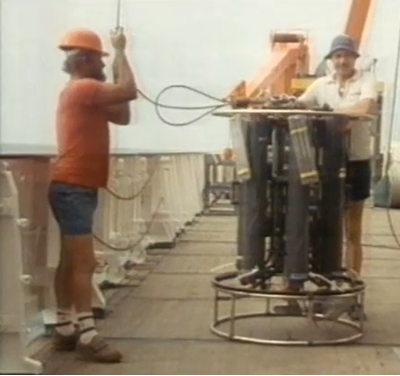
Aboard METEOR, the CTD rosette now also carries a suite of additional sensors measuring oxygen, chlorophyll, turbidity, photosynthetically active radiation, nitrate, and even particles and plankton through an Underwater Vision Profiler. At the same time, its Niskin bottles collect seawater samples for analyses of oxygen, nutrients, salinity, and other properties, providing a detailed picture of the water column.
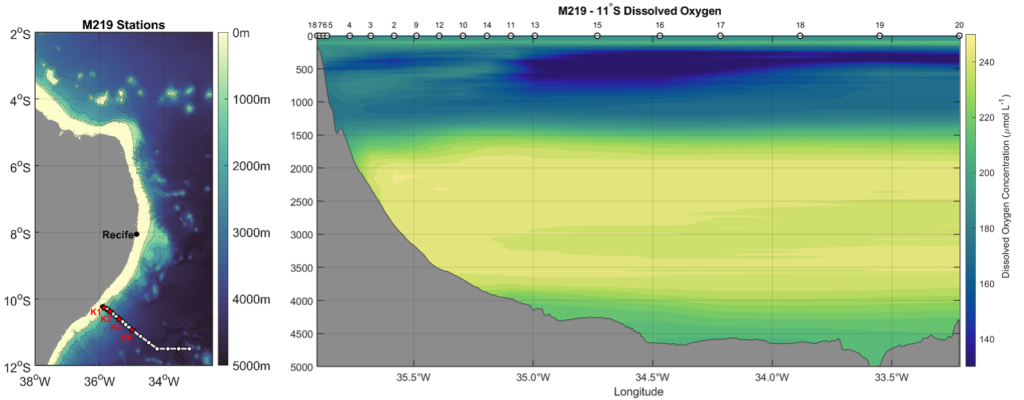
During M219, this classic CTD/LADCP system helped us reveal some of the hidden “highways” of the tropical Atlantic. Along the 11°S section off Brazil, a key location for monitoring the Atlantic Meridional Overturning Circulation, CTD measurements identified distinct water masses through their temperature, salinity, and oxygen signatures. At the same time, the LADCPs captured the currents carrying them: the warm, northward-flowing North Brazil Undercurrent in the upper ocean and the colder, southward-flowing Deep Western Boundary Current nearly two kilometers below.

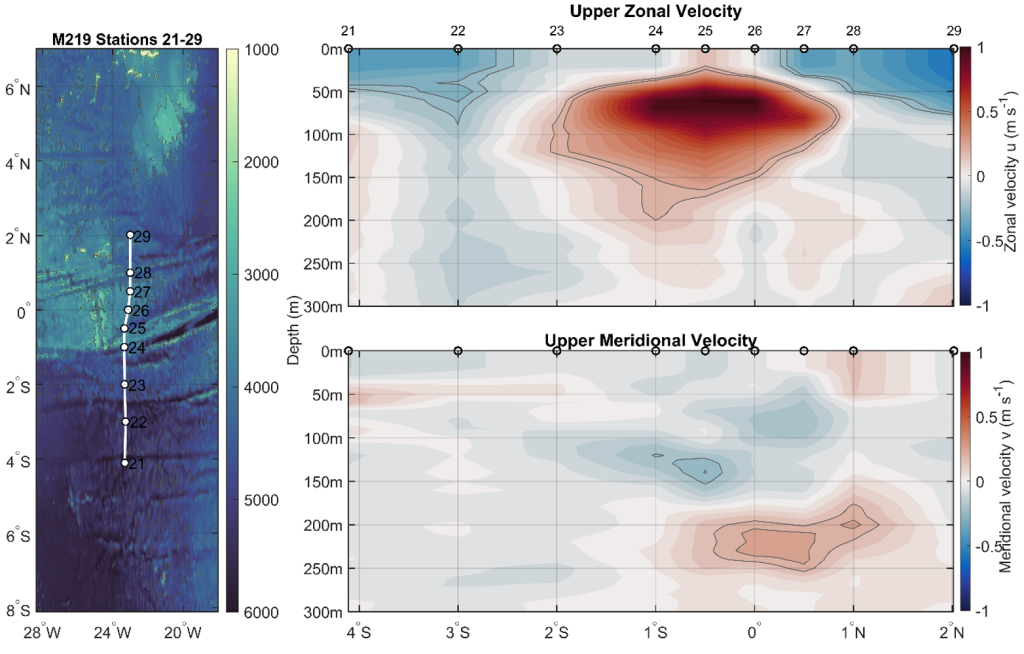
Further north, along 23°W, we crossed the equator and encountered one of the strongest subsurface currents in the world ocean: the Equatorial Undercurrent. Hidden just beneath the surface, this powerful eastward-flowing jet transports enormous amounts of water, heat, oxygen, nutrients, and carbon across the Atlantic: roughly one hundred times the discharge of the Amazon River!

While these observations allow us to investigate water masses, currents, and the circulation of the tropical Atlantic, they also carried an additional meaning for many on board.
For four decades, CTD rosettes have been lowered from the deck of METEOR III in every ocean of the world, helping scientists understand complex ocean processes, monitor changes, and train generations of oceanographers. During more than 11,940 days at sea, thousands of stations have been completed from her deck. Countless students, technicians, crew members, and scientists have contributed to these observations, and many have built their careers around the data collected aboard this vessel.
To take part in the final cruise -and the final CTD cast- of METEOR III was a privilege. Over the course of this voyage, it became impossible not to notice the connection many people have with this vessel. For some, METEOR has been a second home for years. Colleagues became lifelong friends, sometimes even family, and countless memories were made during deployments, watches, and transits at sea. The research vessel, the discoveries, and even the familiar CTD rosette hold a special place in many hearts.
As we pack the last equipment and the laboratories become emptier, it is difficult not to wonder what comes next. METEOR IV will soon continue the tradition, equipped with new capabilities and ready to tackle the scientific questions of the coming decades. New technologies will undoubtedly expand how we observe the ocean, yet some traditions are likely to endure.

https://www.oceanblogs.org/m219/2026/06/27/no-cruise-without-a-ctd/