

Freddie Daley is a research associate with the Centre for Global Political Economy at the University of Sussex. Charlie Lawrie is a postdoctoral associate at the University of Sussex.
In December 2025, Indonesia quietly abandoned plans to close the Cirebon-1 coal power plant. This was no ordinary power plant. Cirebon-1 was supposed to be the centre-piece of a $21.4 billion (£16.5bn) international deal backed by the US, UK, Japan and the EU to help Indonesia end coal use.
Indonesia’s so-called Just Energy Transition Partnership, or JETP, was launched at a G20 summit in Bali in 2022. Similar deals have been struck with South Africa, Vietnam and Senegal. They are widely regarded as the most ambitious attempt at getting international climate finance to end coal use in populous, coal-dependent middle-income countries.
The UK government once touted the JETPs as “a template on how to support just transition around the world”. This refers to efforts to ensure that the phase-out of fossil fuels and phase-in of low-carbon technologies is fair, inclusive and reflects the demands of workers and affected communities.
But if this approach cannot retire a single plant in Indonesia, the world’s fourth largest coal consumer, there is reason to question whether the model itself works. Our research suggests these partnerships are better understood as a cautionary tale.
Investors needed
The idea underpinning the JETPs is elegant in theory: use public money from rich countries to attract private investment for renewable energy projects and closing down coal plants.
Grants from governments and low-cost loans supposedly reduce the risk enough to bring in billions more from banks and asset managers. The public money “unlocks” the private money, and together they fund an energy transition that benefits the public through cleaner air, reliable energy and reduced climate risk. Win, win.
But across all four JETP countries, the private money has yet to materialise at the scale envisioned. In Indonesia, as of early 2025, only around $1.1 billion of public money had been disbursed. But the country’s plan for decarbonising electricity estimates it needs $97 billion in investment by 2030 – a cavernous gap.
-
Santa Marta process can confront trade protection for fossil fuels, experts say
Academics at the first fossil fuel phase-out summit urged governments to recognise investor protection treaties as a barrier to the energy transition -
COP31 must persuade countries to make fossil fuel transition plans
As the Iran war disrupts oil and gas supplies, the UN climate summit should tackle fossil fuel dependency, energy affordability and energy access – national roadmaps are a good start


More troubling still is the lack of consolidated financial reporting for the JETP funds. Fifty separate funding packages within the Indonesian JETP, all with their own financial instruments and accounting frameworks, make it all but impossible to track how much money has been spent.
As international climate law expert Lukas Bogner has argued, this kind of finance creates complex bureaucratic layers that recipient countries must navigate.
Why investors haven’t shut coal plants
Decommissioning a coal plant is not like building a new one. It means buying out existing contracts, compensating investors for lost future profits, and renegotiating complex legal agreements.
Even then, the electricity the plant provided still needs to be replaced. This requires further investment in generation systems that may not yet exist. Investors have little appetite for any of this, and the costs fall primarily on the state.
In fact, the supposed unlocking of private investment with public money raises a perennial tendency: private capital moves where returns are highest and risks lowest.
Investors in London and New York, for example, demand high returns from middle-income economies like Indonesia, yet baulk at complex regulatory environments, state-owned electricity companies, powerful coal interests and mounting sovereign debt burdens. Public money can make some projects more attractive, but will not remove the supposed political and economic risks investors see in countries like Indonesia.

The JETP also means loading Indonesia with more debt. Of the $21.4 billion now pledged, only 2.6% comes in the form of interest-free grants. Most JETP finance would arrive as commercially-priced loans which Indonesia must eventually repay.
In other words, Indonesia is being asked to borrow more to decommission coal assets that currently generate government revenue and employment. At the same time, it will have to purchase renewable electricity from the privatised companies that would replace them.
In the words of one of our interviewees, the Indonesian state is expected to “pay twice” – once to close the old system, and again to buy power from the new one. Trade unions in Indonesia have been blunt about what this means in practice. Under the JETP model, they warn electricity will no longer be treated as a public good, but as a commodity that ordinary Indonesians will pay more for.
Why rich countries are “reluctant” on additional JETP coal-to-clean deals
The JETP model can also weaken the same state institutions needed to manage the energy transition. Countries that have managed rapid clean-energy booms, from China to Vietnam, have done so through strong state-owned enterprises, clear industrial strategies and the ability to direct investment and discipline business.
The JETPs, by contrast, are designed around a diminished role for the state and a central role for private capital. This happens through regulatory reform, the creation of new private markets, or through investor-friendly technologies.
In the case of Indonesia, this “de-risking” agenda explains the pressure to break up the national electricity company and sell off its assets – a prospect fiercely resisted by trade unions, civil society and even wealthy groups who profit from the existing system.
A broken model?
International climate finance remains important. Rich countries must still fund energy transitions in the Global South. But the Indonesian JETP suggests that relying on private investors to deliver coal phase-outs may be the wrong model.
Alternatives do exist, from proposals for much larger grant-based financing to the Bridgetown Initiative proposed by Barbados’s prime minister, Mia Mottley, which would use International Monetary Fund resources to support climate investment. More radical proposals call for publicly-owned, worker-led transitions. But so far, these ideas have made little progress.
Our research suggests just transitions are more likely when governments receive direct grants that help them retain the capacity to shape their own energy systems, and to support domestic industries through green industrialisation.
The failure to decommission Cirebon-1 matters beyond Indonesia. It suggests the world’s flagship model for financing the end of fossil fuels isn’t working. And the longer it takes to admit that, the harder the transition becomes – for Indonesia, and for everyone.
This article is republished from The Conversation under a Creative Commons license. Read the original article.
The post Indonesia’s failing Just Energy Transition Partnership is a cautionary tale appeared first on Climate Home News.
Indonesia’s failing Just Energy Transition Partnership is a cautionary tale

Next week, diplomats from around the world will descend on Yerevan, Armenia, to negotiate a series of decisions under the UN Convention on Biological Diversity (CBD).
Between 19 and 30 October, 196 parties will gather to hammer out the precise wording of the dozens of legal texts that make up the decisions under the Conference of the Parties (COP) to the CBD.
This year’s summit is particularly significant, as it marks the halfway point between the agreement of the Kunming-Montreal Global Biodiversity Framework and the deadline for achieving its targets.
The CBD has found that countries are currently not on track to meet 22 out of the framework’s 23 targets.
During the fortnight, delegates will also be negotiating decisions relating to the two supplemental protocols to the CBD: the Cartagena Protocol, which covers biosafety; and the Nagoya Protocol, which covers access and benefit-sharing for the use of genetic resources.
(The Cartagena and Nagoya Protocols, which are each governed by a “meeting of the parties”, or “MOP”, have fewer parties than the CBD as a whole, with 173 and 141, respectively.)
Carbon Brief is tracking the progress of countries towards consensus on dozens of negotiating texts using the interactive table below.
The tracker includes texts from the COP, as well as the MOPs for the Cartagena and Nagoya protocols. It also includes draft decisions from the most recent subsidiary body meetings, as these form the starting point for the negotiations in Yerevan.
The CBD has three subsidiary bodies: the subsidiary body on scientific, technical and technological advice (SBSTTA), the subsidiary body on implementation (SBI) and the subsidiary body on article 8(j) and other provisions (SB8J).
SB8J focuses on issues related to the Indigenous peoples and local communities. It was established at COP16 in Cali, Colombia, in 2024.
The first two columns of the interactive tracker list the topic of each agenda item and the relevant body, with subsequent columns including dates, page counts and links to the original documents.
The table is searchable and can be sorted using the arrows in the header.
Areas of disagreement in UN draft texts are denoted by square brackets. Counting the brackets in a particular iteration of a text therefore gives a sense of how far parties are from reaching consensus.
The bracket column is colour-coded, with dark green indicating a low number of brackets and red indicating a high number of brackets remaining.
Texts can also present parties with choices using “options” or alternatives (“alt”), which are counted together in the sixth column of the table.
The key discussions in Yerevan will centre around two agenda items in particular. The first is the global review, which will assess progress towards the GBF and make recommendations for accelerating action.
The second is finance, which can be separated into two parts: resource mobilisation and the financial mechanism. On resource mobilisation, biodiverse global south countries are likely to push for an increased amount of international finance for conservation.
Disagreement over the creation of the financial mechanism led to the suspension of COP16 in Cali in October 2024, as parties failed to find agreement on the mobilisation of finance before the end of the summit.
Global south countries want the establishment of a separate financial mechanism under the control of the CBD; global north countries largely prefer to maintain the existing mechanism, which sits under the Global Environment Facility.
At the resumed session of COP16 in Rome in early 2025, countries agreed on a roadmap that would lead to the establishment of a permanent mechanism.
related
Analysis: Lula presidency saved at least 20,000km2 of Brazilian Amazon since 2022
Why land-use emissions have fallen by a third this century – in six charts

Analysis: 84% of nations miss deadline to identify ‘nature-harming’ subsidies by 2025
UK withdraws millions in funding from world’s second-largest rainforest in Congo
The post Interactive: Tracking negotiating texts at the COP17 biodiversity summit appeared first on Carbon Brief.
Interactive: Tracking negotiating texts at the COP17 biodiversity summit
A beacon of love
On an outer island of Fiji, two thousand nautical miles from Sydney, is a shining light of hope and resilience for our troubled world.
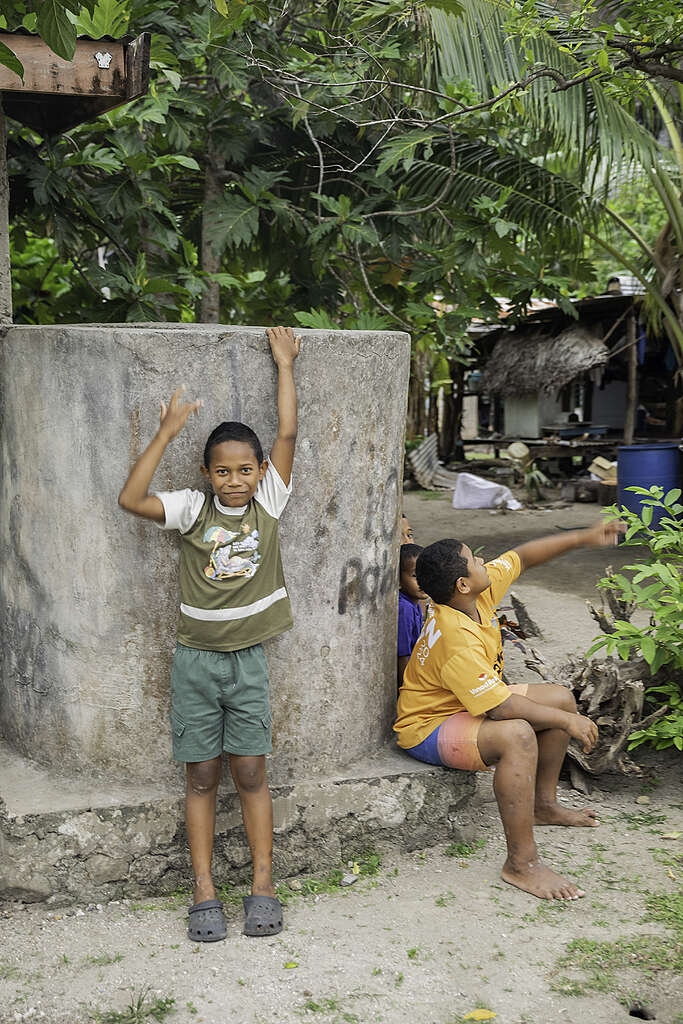
The island of Kioa is home to a Tuvaluan community who migrated from their atoll of Vaitupu in the late 1940s. It is a land of warm hearts, big smiles, and deep cultural roots; a place where the sound of a conch still summons the island together, where islanders paddle out to fish in carved outrigger canoes, and healthy happy children walk barefoot to school.
Here, culture is life. Kioans live sustainably through their traditional knowledge and practices. The island is alive with song, dance and the rhythms of a life tied to the tides, the winds, and the seasons.
Facing the future
Greenpeace has been lucky to have a relationship with Kioa for a number of years now, and we are continually learning from this remarkable community.
Last week, as part of our Voyaging Oceania project, we returned to the island. Our purpose was twofold —- to carry messages from the island to leaders gathering in Nadi this week for the Pacific Pre-COP, and to support the Kioa community in their efforts to improve water security for the island.
Unlike Tuvalu itself, with its eight atolls, Kioa is a mountainous, forested and richly fertile island. It will remain habitable far into the future. Kioans did not initially migrate from Vaitupu due to climate change, but the move was prophetic. They now have a lifeboat.
However, even Kioa faces challenges on our rapidly warming planet, in particular when it comes to water. Climate change is shifting once reliable rainfall patterns. On top of this, the island is already feeling the effect of this year’s intensifying El Niño event, which for Fiji means reduced rainfall and prolonged dry spells.
Right now, fresh water has to be carefully rationed, and is only available for a few hours a day. During last week’s visit aboard our campaigning ship Oceania, Greenpeace was privileged to work with the Kioa community on a new solar-powered water distribution project for the island.
Designed and led by the island, the project involves using a solar pump to move water from a reliable source to a storage tank and then using gravity to distribute the water around the village.
It was a lesson in how local knowledge and ingenuity can be the backbone of today’s climate solutions. To build a dam around the source, the local community knew the exact spot where they could gather gravel at low tide to mix with the cement. They took only what was needed, knowing that all resources must be carefully conserved. Kioa has no roads and no machinery, and it was an all-of-island effort to carry the materials up to the project site, including many heavy bags of sand and rock.
Such projects truly bring to life the vision of a resilient, locally-led, fossil fuel free Pacific.