

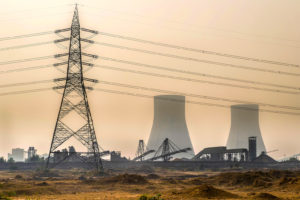
The number of new coal-fired power plants built around the world hit a “10-year high” in 2025, even as the global coal fleet generated less electricity, amid a “widening disconnect” in the sector.
That is according to the latest annual report from Global Energy Monitor (GEM), which finds that the world added nearly 100 gigawatts (GW) of new coal-power capacity in 2025, the equivalent of roughly 100 large coal plants.
It adds that 95% of the new coal plants were built in India and China.
Yet GEM says that the amount of electricity generated with coal fell by 0.6% in 2025 – with sharp drops in both China and India – as the fuel was displaced by record wind and solar output, among other factors.
The report notes that there have been previous dips in output from coal power and there could still be ups – as well as downs – in the near term.
For example, nearly 70% of the coal-fired units scheduled to retire globally in 2025 did not do so, due to postponements triggered by the 2022 energy crisis and policy shifts in the US.
However, GEM says that the underlying dynamics for coal power have now fundamentally shifted, as the cost of renewables has fallen and low usage hits coal profitability.
China and India dominate growth
In 2025, coal-capacity growth hit a 10-year high, with 97 gigawatts (GW) of new power plants being added, according to GEM.
(Capacity refers to the potential maximum power output, as measured in GW, whereas generation refers to power actually generated by the assets over a period of time, measured in gigawatt hours, GWh.)
This is the highest level since 2015 when 107GW began operating, as shown in the chart below. This makes 2025 the second-highest level of additions on record.
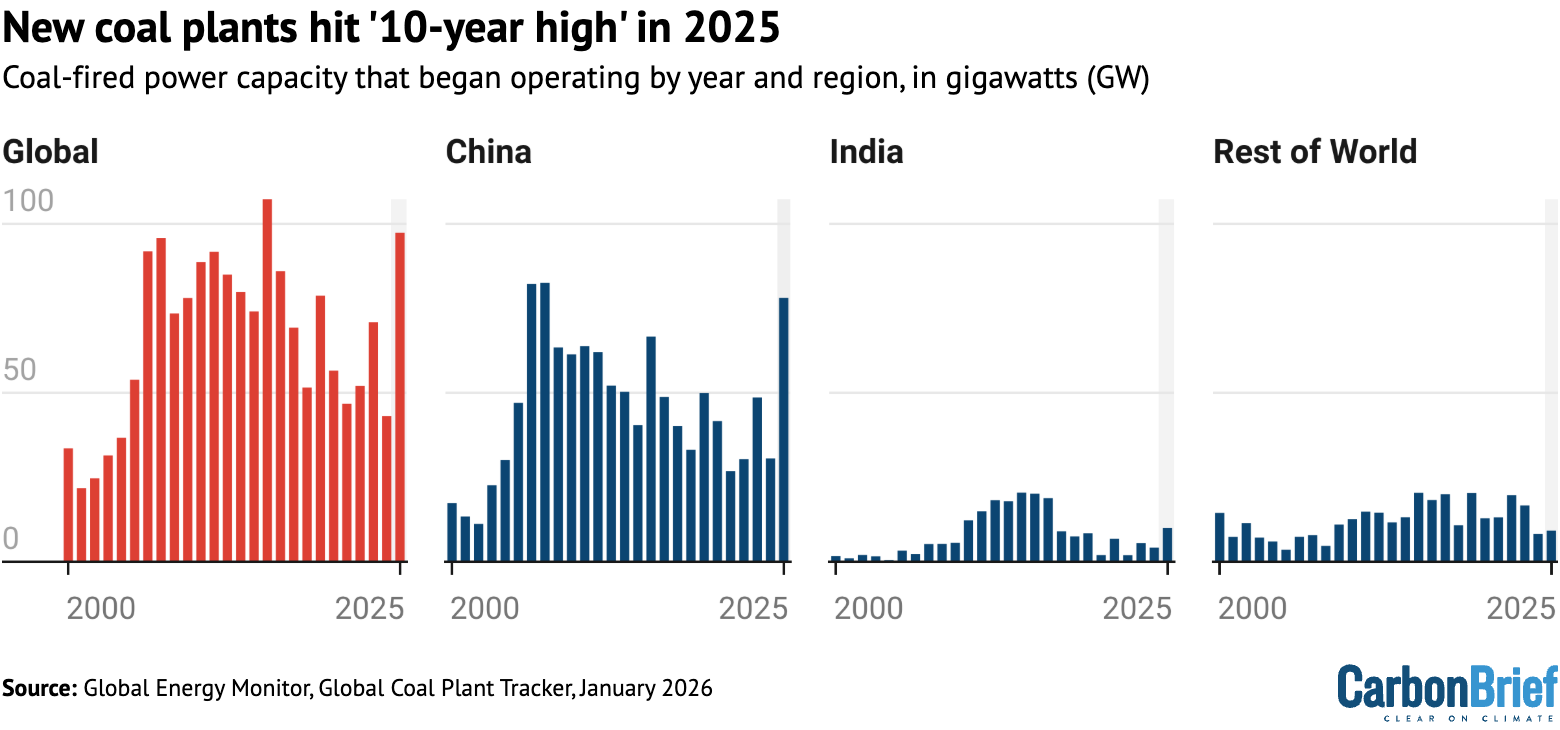
The majority of this growth came from China and India, which added 78GW and 10GW, respectively, against 9GW from all other countries.
Yet GEM points out that, even as coal capacity in China grew by 6%, the output from coal-fired power plants actually fell 1.2%. This means that each power plant would have been running less often, eroding its profitability. Similarly, capacity in India grew by 3.8%, while generation fell by 2.9%.
China and India had accounted for 87% of new coal-power capacity that came into operation in the first half of 2025. The shift up to 95% in the year as a whole highlights how increasingly just those two countries dominate the sector, GEM says.
Christine Shearer, project manager of GEM’s global coal plant tracker, said in a statement:
“In 2025, the world built more coal and used it less. Development has grown more concentrated, too – 95% of coal plant construction is now in China and India, and even they are building solar and wind fast enough to displace it.”
Both China and India saw solar and wind meet most or all of the growth in electricity demand last year.
Analysis for Carbon Brief last year showed that, in the first six months of 2025 alone, a record 212GW of solar was added in China, helping to make it the nation’s single-largest source of clean-power generation, for example.
However, the country continues to propose new coal plants. In 2025, a record 162GW of capacity was newly proposed for development or reactivated, according to GEM. This brought the overall capacity under development in the country to more than 500GW.
China’s 15th “five-year plan”, covering 2026-2030, had pledged to “promote the peaking” of coal use, while a more recent pair of policies introduced stricter controls on local governments’ coal use.
For its part, in India some 28GW of new coal capacity was newly proposed or reactivated last year, bringing the total under development to 107.3GW and under-construction capacity to 23.5GW.
The Indian government is planning to complete 85GW of new coal capacity in the next seven years, even as clean-energy expansion reaches levels that could cover all of the growth in electricity demand.
Outside of China and India, GEM says that just 32 countries have new coal plants under construction or under development, down from 38 in 2024.
Countries that have dropped plans for new coal in 2025 include South Korea, Brazil and Honduras, it says. GEM notes that the latter two mean that Latin America is now free from any new coal-power proposals.
This means that both electricity generation from coal and the construction of new coal-fired power plants are increasingly concentrated in just a few countries, as the chart below shows.
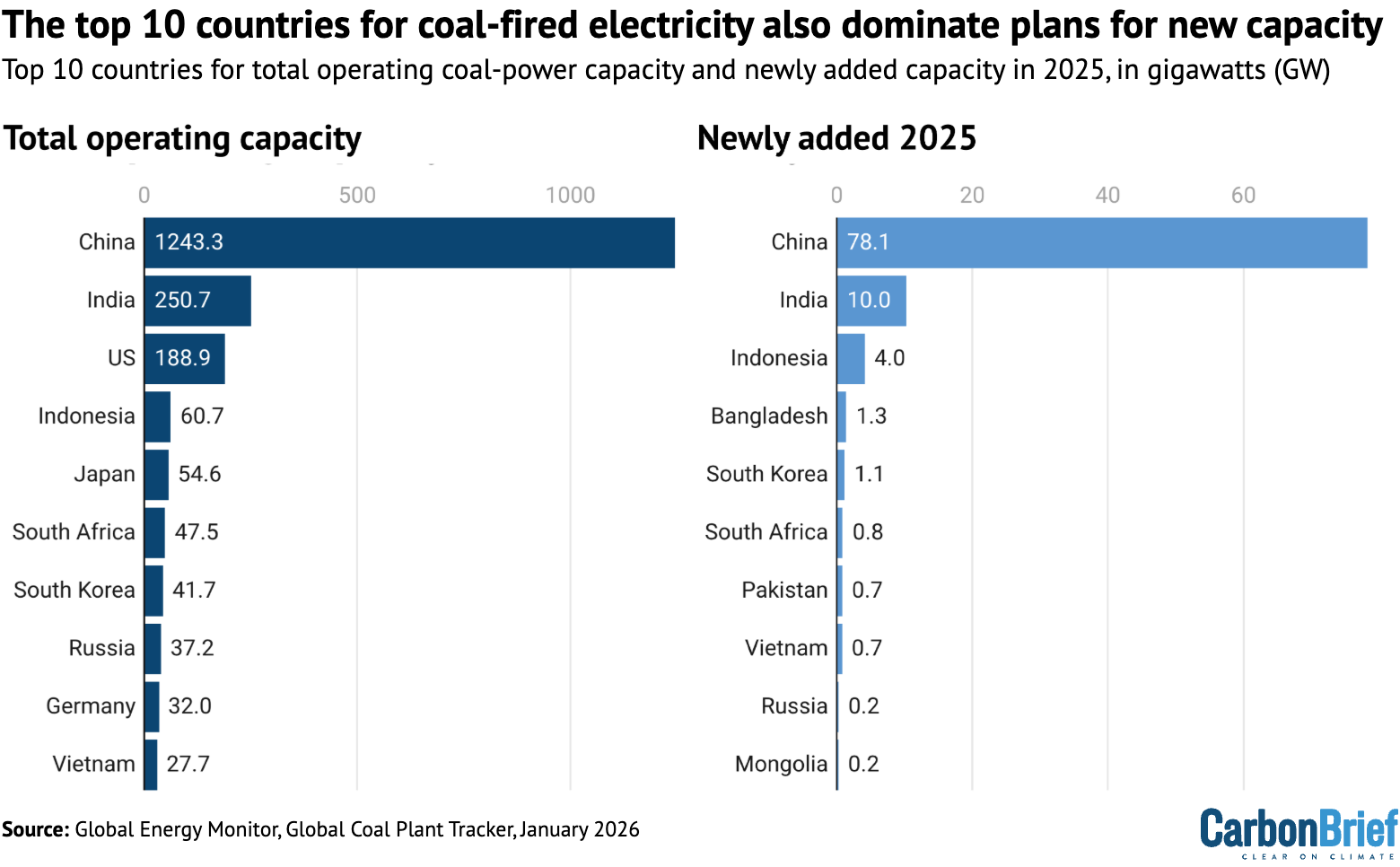
Indonesia’s coal fleet grew by 7% in 2025 to 61GW, with a quarter of the new capacity tied to nickel and aluminium processing, according to GEM.
Turkey – which is gearing up to host the COP31 international climate summit in November – has just one coal-plant proposal remaining, down from 70 in 2015.
The amount of new coal capacity that started to operate in south-east Asia fell for the third year in a row in 2025, according to GEM.
Countries in south Asia that rely on imported energy are increasingly looking to other technologies to protect themselves from fossil-fuel shocks, such as Pakistan, which is rapidly deploying solar, states the GEM report.
In Africa, plans for new coal capacity are concentrated in Zimbabwe and Zambia, the report shows, with the two countries accounting for two-thirds of planned development in the region.
‘Persistence of policies’
While new coal plants are still being built and even more are under development, GEM notes that the global electricity system is undergoing rapid changes.
Crucially, the growth of cheap renewable energy means that new coal plants do not automatically translate into higher electricity generation from coal.
Without rising output from coal power, building new plants simply results in the coal fleet running less often, further eroding its economics relative to wind and solar power.
Indeed, GEM notes that electricity generation from coal fell globally in 2025. Moreover, a recent report by thinktank Ember found that renewable energy overtook coal in 2025 to become the world’s largest source of electricity.
GEM notes that coal generation may fluctuate in the near term, in particular due to potential increases in demand driven by higher gas prices.
It adds that gas price shocks, such as the one triggered by the Iran war, can cause temporary reversals in the longer-term shift away from coal.
According to Carbon Brief analysis, at least eight countries announced plans to either increase their coal use or review plans to transition away from coal in the first month of the Iran war. However, a much-discussed “return to coal” is expected to be limited.
GEM’s report highlights that global fossil-fuel shocks can have an impact on the phase out of coal capacity over several years.
In the EU, for example, 69% of planned retirements did not take place in 2025, due to postponements that began in the 2022-23 energy crisis triggered by the Russian invasion of Ukraine, according to the report. Countries across the bloc chose to retain their coal capacity amid gas supply disruptions and concerns about energy security.
Yet coal-fired power generation in the bloc is now more than 40% below 2022 levels. Again, this highlights that coal capacity does not necessarily translate into electricity generation from coal, with its associated CO2 emissions.
Overall, GEM notes that “repeated exposure to fossil-fuel price volatility is as likely to accelerate the shift toward clean energy as it is to delay it”.
GEM’s Shearer says in a statement:
“The central challenge heading into 2026 is not the availability of alternatives, but the persistence of policies that treat coal as necessary even as power systems move increasingly beyond it.”
In the US, 59% of planned retirements in 2025 did not happen, according to GEM. This was due to government intervention to keep ageing coal plants online.
Five coal-power plants have been told to remain online through federal “emergency” orders, for example, even as the coal fleet continues to face declining competitiveness.
Keeping these plants online has cost hundreds of millions of dollars and helped drive an annual increase in the average US household electricity prices of 7%, according to GEM.
Despite such measures, Trump has overseen a larger fall in coal-fired power capacity than any other US president, according to Carbon Brief analysis.
Meanwhile, according to new figures from the US Energy Information Administration, solar and wind both set new records for energy production in 2025.
Despite challenges with policy and wider fossil-fuel impacts, the underlying dynamic has shifted, says GEM, as “clean energy becomes more competitive and widely deployed” around the world.
It adds that this raises the prospect of “a more sustained decoupling between coal-capacity growth and generation, particularly if clean-energy deployment continues at current rates”.

The post New coal plants hit ‘10-year’ global high in 2025 – but power output still fell appeared first on Carbon Brief.
New coal plants hit ‘10-year’ global high in 2025 – but power output still fell

Climate Change
After a week of plenty of activity and drama for Greenpeace at sea, I felt like writing to you on a much quieter theme…
Do you have a favourite book, poem or story about the ocean?
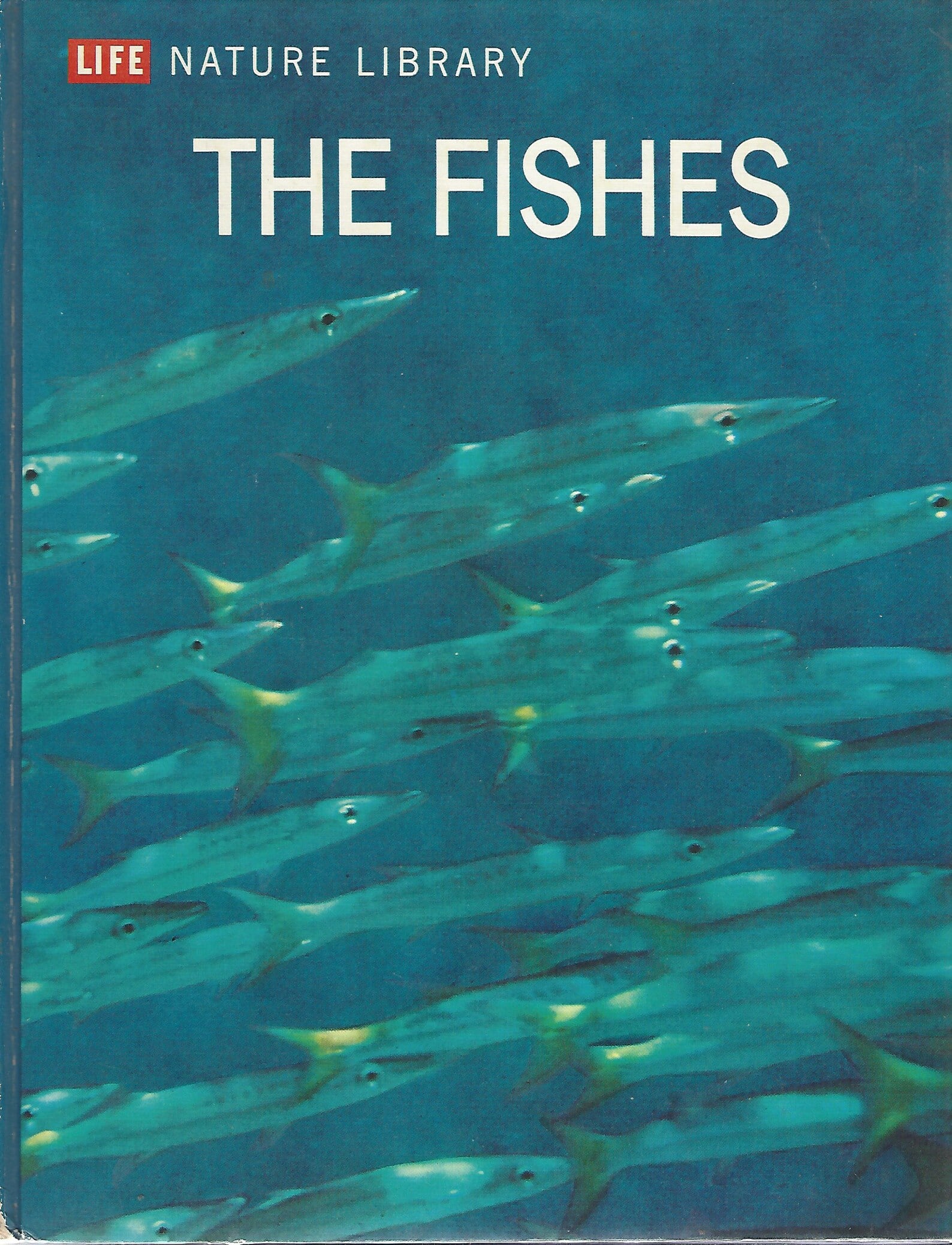
When I was very small, it was the TimeLife book of The Fishes, by F. D. Ommanney, which I remember endlessly poring over, my child’s mind gripped, in total fascination. The cover illustration showed a shoal of barracuda, mid-water and heading upwards, lit up as an iridescent blue by a column of sunlight. Oddly, it is only the cover and the illustrations of the deep sea creatures which I now remember—but I loved that book, as the weakened spine, blunted pages and dog-eared corners attested.
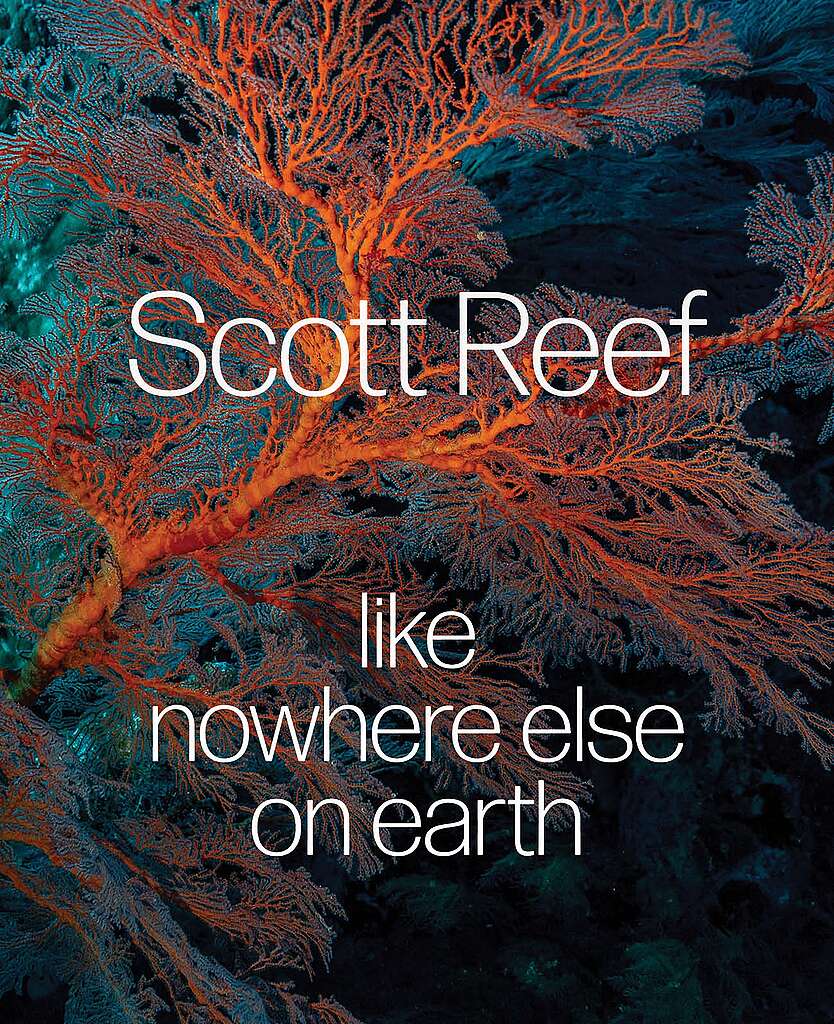
The Fishes has been on my mind recently, because I’ve been working with some dear friends on our own illustrated oceans book, to be published by Upswell Publishing. The book is called Scott Reef: Like Nowhere Else on Earth, and I want to share with you a bit of the story behind its creation.
Scott Reef is absolutely magnificent: Australia’s largest freestanding oceanic reef, brimming with life, including rare and threatened species such as a genetically distinct population of green sea turtles, pygmy blue whales and the wonderfully elegant dusky sea snake. But Scott Reef isn’t near our capital cities; it is way off the north-west coast of WA. And it is threatened with devastation by Woodside, which wants to drill up to 57 toxic wells at the Reef for its vast, dirty Browse gas project.
One of the main challenges in the fight to save Scott Reef from being turned into an industrialised gas zone by Woodside is bringing this incredible location to life for people who haven’t actually experienced it first hand. Because despite its ecological significance and dazzling beauty, ‘Scott Reef’ is also—at least not yet—exactly a household name.
To help get over this barrier, Greenpeace has enabled a number of photographers to travel to Scott Reef by boat (including the Rainbow Warrior) to document its astonishing diversity of colour and life. We then brought these images together in a remarkable photobook, produced by our talented in-house team, which we’ve been putting into the hands of as many leaders as possible—including the MPs whose decisions can determine the Reef’s future.
Back in June this year, I was sharing a copy of our in-house book at a business gathering in Perth when someone pulled me aside. Had we thought about publishing the book commercially? Apart from anything else, he wanted to buy a copy himself! He had a point. We were proud of what we’d created, but a commercially published version could reach a much wider audience and have even greater campaign impact. I immediately turned to my dear friend, Terri-ann White, who runs Upswell Publishing in WA, for advice.
Terri-ann has a huge heart and terrific vision. So many wonderful things in WA owe their existence to her doings, and, true to form, she was immediately encouraging and enthusiastic. “But,” she said, “it would add a whole new dimension if we had some words to accompany the incredible pictures.”
Fair enough, I thought. I could ask a few authors.
“And when would you like it published?” she asked.
“Ideally November,” I answered sheepishly.
Now, in publishing terms, nobody goes from idea to finished work, beautifully produced by a commercial publisher, in just four months. It. Just. Doesn’t. Happen. A book of this scale would ordinarily take nine months, I was told. But Terri-ann was undeterred. “If you can get a rapid turnaround on the writing, I will give it a shot.”
Over the following few days, I sent out 24 emails to prospective writers. To my joy and surprise 23 of them responded almost immediately with an enthusiastic yes!
Terri-ann was somewhat alarmed and perplexed when I told her the good news… we’d discussed a few authors, not more than twenty! “Impossible,” she texted. “Editing is important and you are talking about thousands of words!” But I also know Terri-ann. She does the impossible. And so, here we are… Terri-ann is going to hit that improbable deadline. Scott Reef: Like Nowhere Else on Earth will be on shelves in November.
The contributors are a wonderfully diverse bunch, united by their enthusiasm for Scott Reef — and their extraordinary speed!
It’s a brilliant mix. The book brings together national icons like Peter Garrett, Tim Winton, Mick Dodson, Janet Holmes à Court and Fiona Stanley; the intellectual heft of professors Frank Bongiorno, Jessica Meeuwig, Rick Steiner and Samantha Hepburn; the poetic vision of Prema Arasu, Berndt Sellheim and Saadiah Freeman; the field expertise and passionate first hand witnessing of Imogen Zethoven, Tooni Mahto, Ben Fitzpatrick, Geoff Bice, Olaf Meynecke, Paul Gamblin, Sarah Gittoes and Hayley Baillie; and the determination of emerging activist voices Jackson Reid and Emma Sangalli.
Their elegant words wrap themselves around the sheer wonder of the underwater world, brought to life by the work of the photographers — of whom one, Wendy Mitchell, has also contributed a wonderful essay.
Terri-ann showed me the full physical proofs this week and they are breathtaking. This book contains some of my absolute favourite images of wildlife beneath the waves -– and believe me, after almost 20 years at Greenpeace, I’ve been privileged enough to see some remarkable shots! The essays bring a whole new depth and richness to the story of Scott Reef.
If I am being honest, and maybe a bit sentimental, I hope that a four or five-year-old child somewhere in Australia will spend part of their summer holidays turning the pages of this book, wide-eyed with curiosity and awe at the beauty and strangeness of the creatures that call our oceans home.
Our shared commitment is to make sure that, as those children grow up, the wonders of Scott Reef will exist not just in the pages of the book, but out there in the wild waters off north-western Australia—alive, thriving, and every bit as extraordinary as they are today; a living wonder beneath the waves.
Pre-orders of Scott Reef: Like Nowhere Else on Earth are available here.


Q & A
Sometimes you get asked a question so often that you decide to produce a report to answer it!
We know there is strong public opposition to voter opposition to gas drilling at Scott Reef and fracking in the Kimberley in Western Australia. But I am frequently asked whether, even if people don’t want it, more gas drilling is a necessary evil to sustain WA’s prosperity?
The short answer is an unequivocal ‘No’. The longer answer is our new report, From Gas to Green: Building Western Australia’s Future State, which makes the comprehensive case that Asia’s gas market is declining — while WA has an enormous untapped opportunity to become a global leader in green industries and exports, helping drive the region’s shift away from fossil fuels. The faster that WA embarks on a decisive shift away from gas—and that includes no fracking in the Kimberley, or drilling at Scott Reef — so much the better for the state’s people, ecology and economy.
For the first time, new-energy vehicles (NEVs) made up 67% of new car sales in China in September, according to the latest data from the China Passenger Car Association (CPCA).
The figures show that NEVs, which include battery electric cars and plug-in hybrids, captured a record share of sales, even though fewer were sold than last year.
This is because sales of combustion-engine cars are falling steeply, a trend that the CPCA has attributed to rising petrol prices following the start of the Hormuz crisis.
Indeed, sales of fuel-only cars were down 31% year-on-year in the first nine months of 2026, with plug-in hybrid sales down 26% – whereas battery EV sales were only down 4%.
One analyst tells Carbon Brief that China’s rapidly growing EV fleet has offset demand for 143m barrels of oil since the start of the Hormuz crisis.
Another says that the crisis is “reinforcing China’s electrification of road transport”.
Meanwhile, amid slowing domestic sales, Chinese carmakers’ exports of NEVs more than doubled [in 2026 to date / in September] from a year earlier.
NEV record
A record two out of every three cars sold in September in China were NEVs, according to CPCA data, as shown in the figure below.
(NEVs predominantly include battery electric vehicles – BEVs – and plug-in hybrids – PHEVs. BEVs only run on electricity, whereas PHEVs also have a combustion engine.)