

Article Contents

From a striking sand installation in Kenya, to tens of thousands of people protesting against the Altri/Greenfiber mega-cellulose plant project in Spain, here are some of our favourite recent images from Greenpeace work around the world.
 Kenya
© Greenpeace / Alfred Abuka Alu
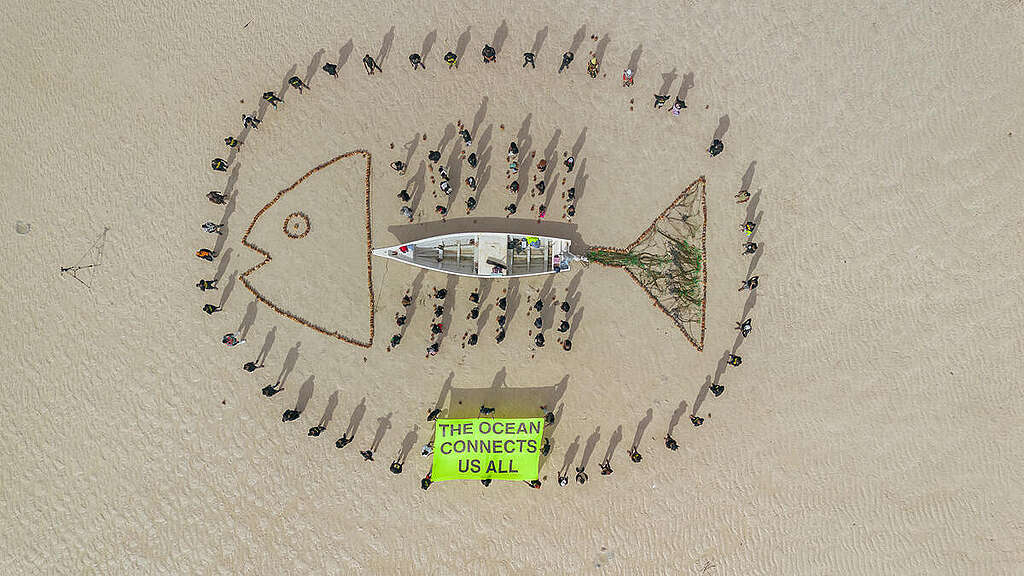
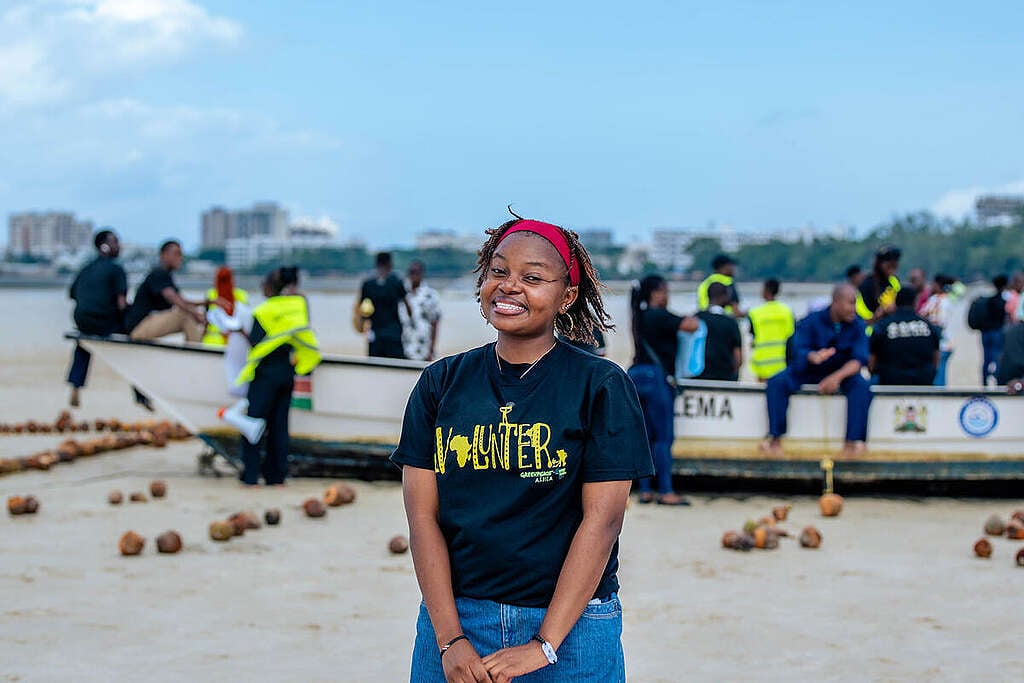
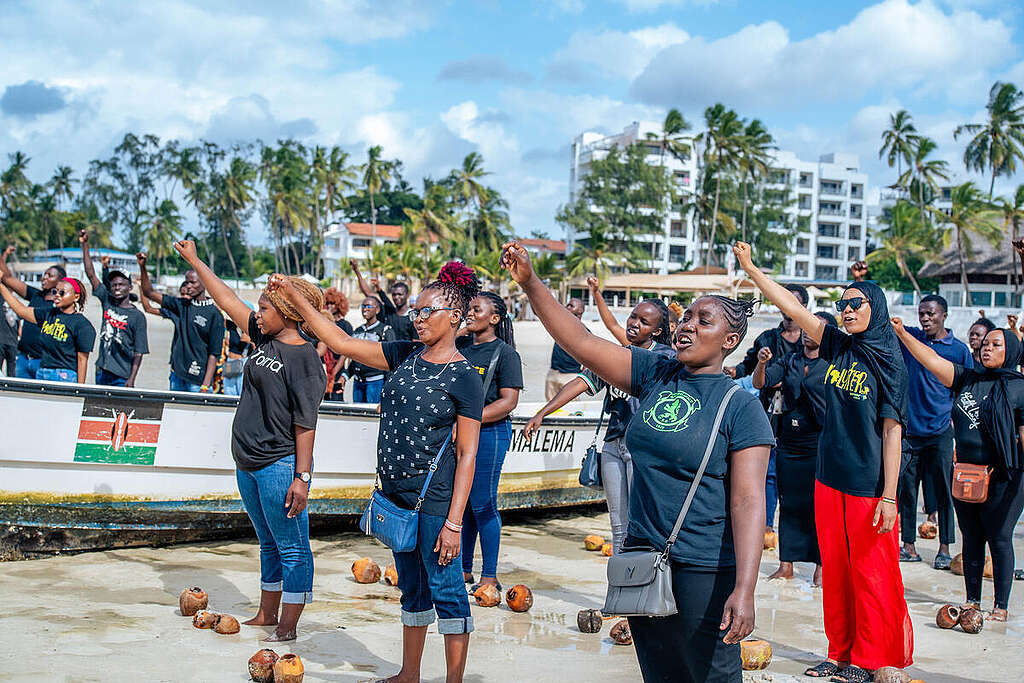
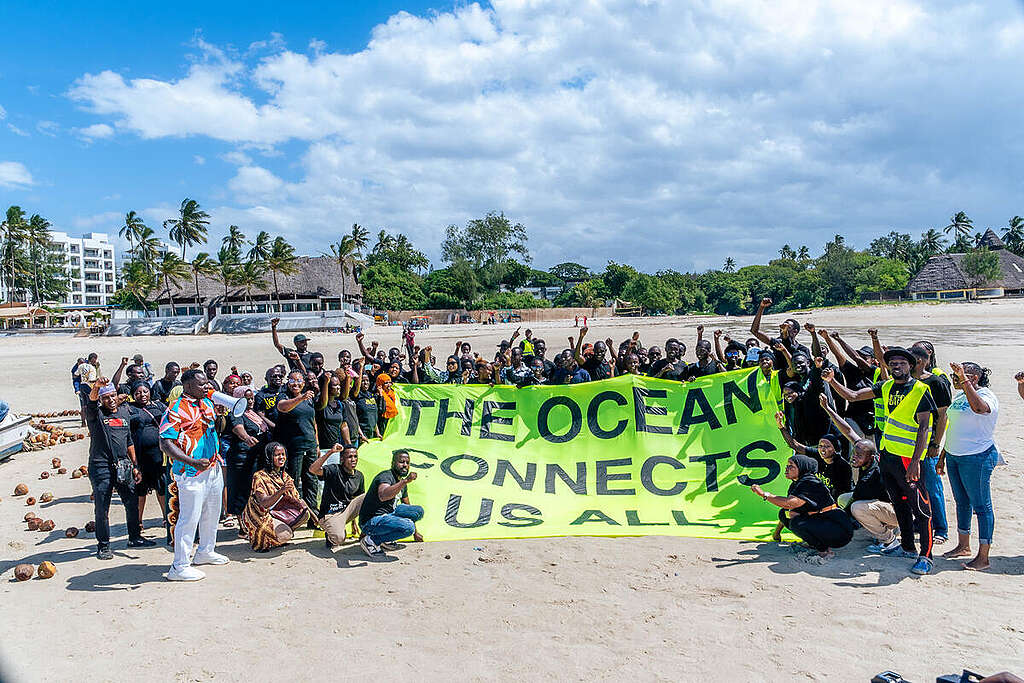
Volunteers and community members gathered at Pirates Beach/ Jomo Kenyatta Beach in Mombasa around a sand installation carrying the message “The Ocean Connects Us All” to highlight the interconnected challenges facing coastal communities across Africa and the need for ocean protection.
© Greenpeace / Alfred Abuka Alu
© Greenpeace / Alfred Abuka Alu
© Greenpeace / Alfred Abuka Alu
 Mexico

In the context of the World Cup, Greenpeace Mexico activists staged a peaceful protest at Terminal 2 of Mexico City International Airport (AICM) to remind people that the climate crisis is already changing the conditions in which we live, work, and play. With the messages “The game has extra time, the planet doesn’t” and “If the climate changes, the game changes,” the organisation drew attention to the increasingly evident impacts of climate change and the need to act urgently to prevent its effects from continuing to worsen.
Protecting marine and terrestrial ecosystems such as the Maya Forest, as well as a sustainable and just energy transition—one that no longer relies on oil and says no to fracking—are the kinds of decisive changes we need in the current government’s climate policy to truly help combat and curb the impacts of climate change. With the giant balloon—placed in the central rotunda of the airport terminal—as a backdrop, and under the gaze of domestic and international travellers, Greenpeace Mexico activists positioned themselves beneath the balloon, mimicking flames that represent the extreme heat threatening both the game and the planet.
 Germany
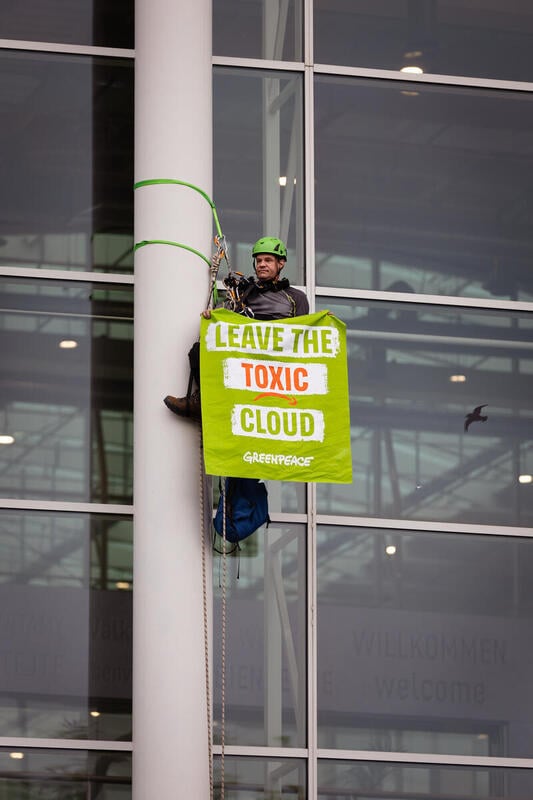
© Maria Feck / Greenpeace
Greenpeace activists protest against Amazon cloud provider AWS’s unscrupulous business dealings with controversial companies at the AWS Summit held at the Hamburg exhibition halls. The cloud provider is promoting its business, which it conducts without keeping exclusion lists.

© Maria Feck / Greenpeace
A sculpture of a globe controlled by servers is erected in front of the trade fair building, on which installed screens display scenes of human rights violations and environmental destruction that could be caused in a similar manner by business partners of “Amazon Cloud Services.”
 Belgium
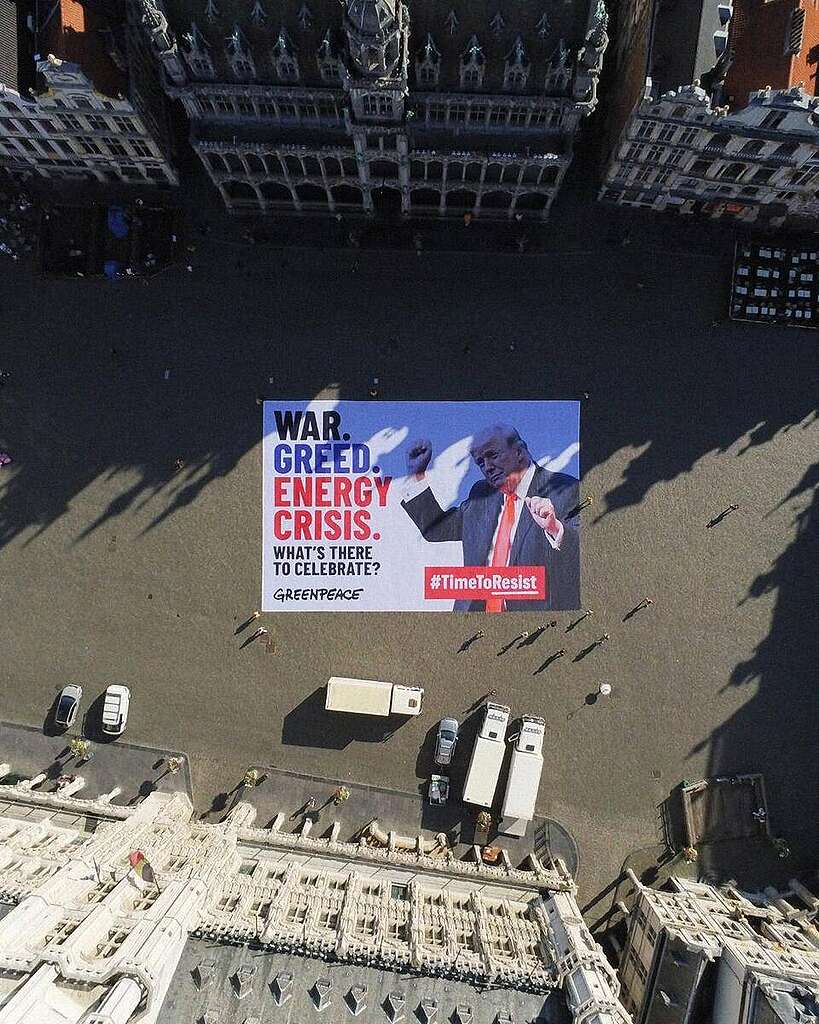
© Greenpeace
Greenpeace Belgium activists unroll a massive banner in Brussels’s historic Grand Place square, condemning the use of the celebrations of the United States’s 250th anniversary to promote Trump’s political and corporate agenda.
Germany
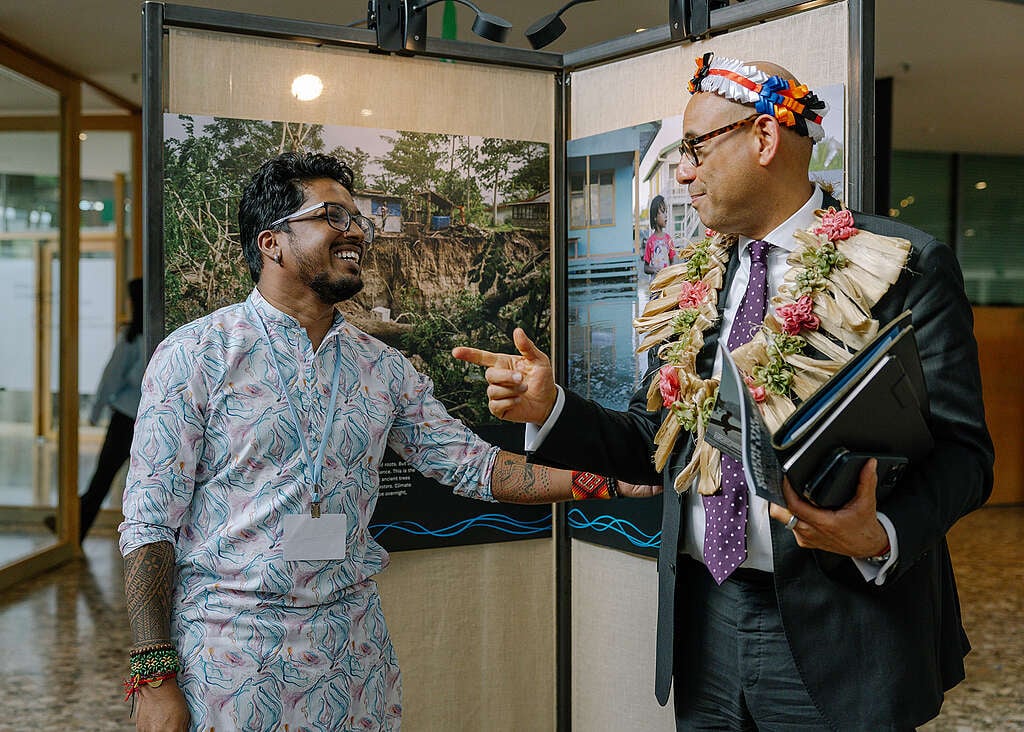
Simon Steill, Executive Secretary of the United Nations Framework Convention on Climate Change (UNFCCC), visits ‘The Wayfinder’s Roadmap’ photo exhibition at Bonn SB64 Climate Change Conference. The Greenpeace Australia Pacific exhibition highlights Pacific communities navigating the greatest global challenge of our time: climate change and the end of the fossil fuel age. The team gave Mr Steill a copy of their new report launched at Bonn, ‘Where the Ocean Leads Us’.
 Spain
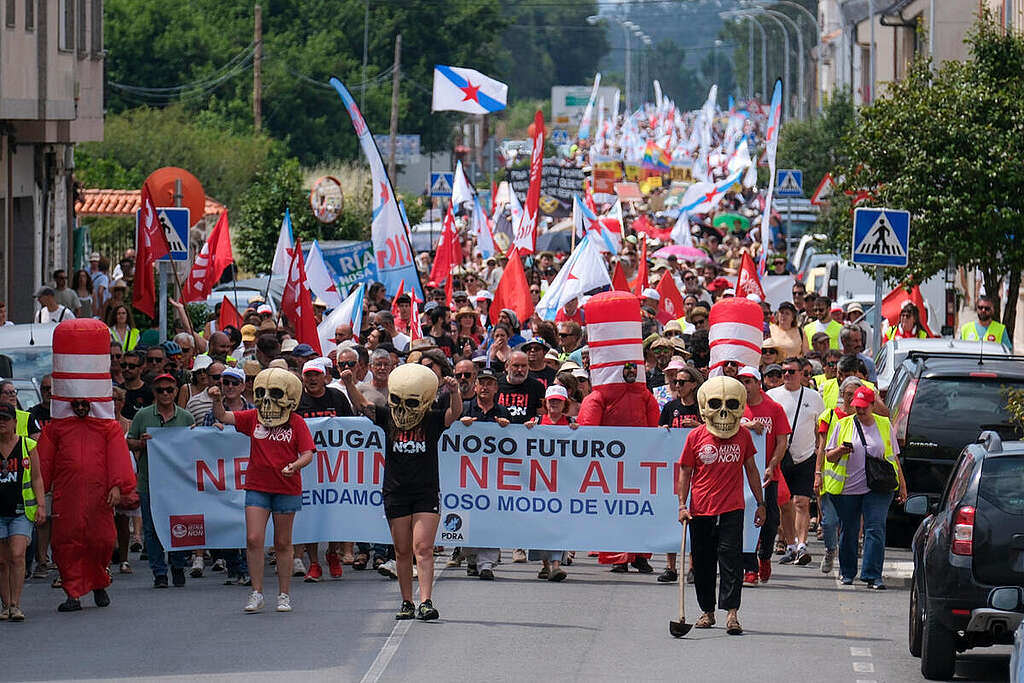
© Pedro Armestre / Greenpeace
Tens of thousands of people took part in A Illa de Arousa in a massive demonstration against the Altri/Greenfiber mega-cellulose plant project in Palas de Rei (A Ulloa, Galicia) and the reopening of the Touro-O Pino mine under the slogan “In defense of the Ulla River and the Arousa estuary. Let’s stop Altri and the Touro-O Pino mine.” Both projects would have a massive environmental impact on the Ulla River basin, which flows into the Arousa estuary—the most productive yet also the most environmentally degraded in Galicia.
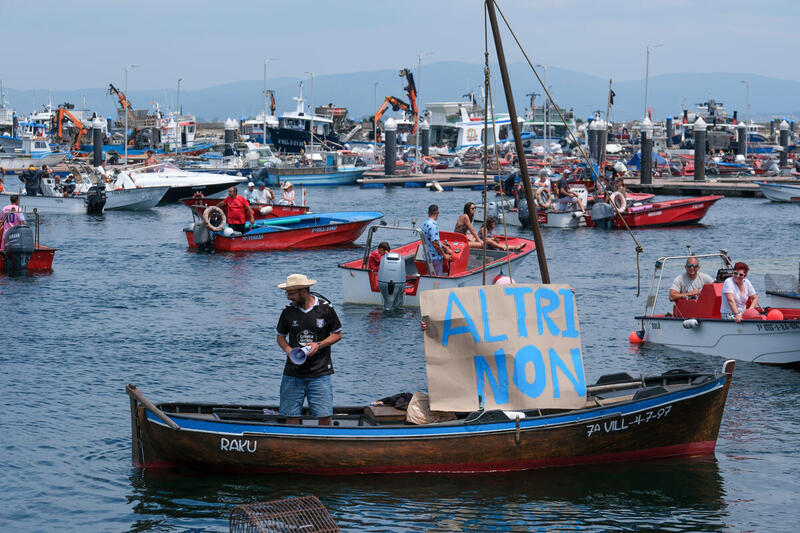
© Pedro Armestre / Greenpeace
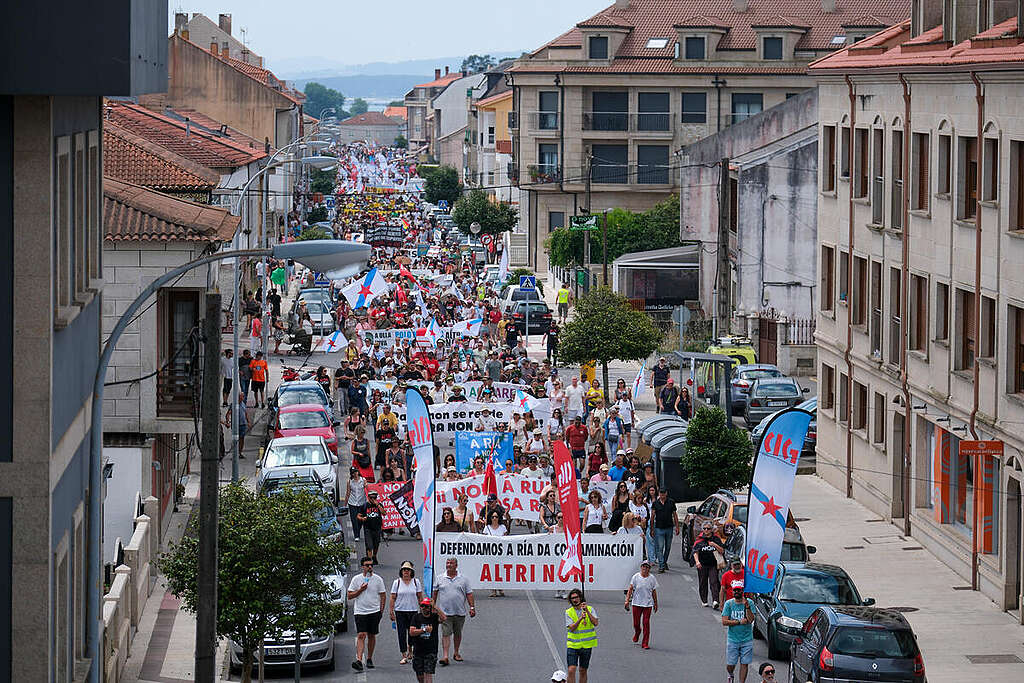
© Pedro Armestre / Greenpeace
Greenpeace has been a pioneer of photo activism for more than 50 years, and remains committed to bearing witness and exposing environmental injustice through the images we capture.
To see more Greenpeace photos and videos, visit our Media Library.
https://www.greenpeace.org.au/learn/greenpeace-pictures-of-the-month/
Continue Reading
An older teaching about land acknowledgement
As I have come to understand the spirit and intention of land acknowledgement, I often return to fond memories of my grandmother and her words of wisdom. She taught that the health of the places we call home comes first, because the wellbeing of the people depends on it.
In her teaching, land acknowledgement began with the land. Long before it became a paragraph read at the start of a meeting, it was a way of recognizing a homeland: its waters, its species, its seasons, and the spirit that revealed whether the place was well.
Her teaching echoes a practice found across many Indigenous Nations. Haudenosaunee gatherings, for example, have long opened with the Ohén:ton Karihwatéhkwen, the Thanksgiving Address, often translated as “the words that come before all else.” The speaker greets and gives thanks to the people, the earth, the waters, the plants, the animals, the winds, the sun, the moon and the stars. Only after everything that sustains life has been acknowledged does the gathering turn to its own business.
That order changes what an acknowledgement is for. Its purpose was to share the story of a place with neighbours and to draw them into the work of tending it. People entered the story second, as the ones responsible for what had just been named.
Understood this way, an acknowledgement does more than open a meeting. It asks us to reconsider where we stand, and what we owe the ground beneath us.
Nations among nations
In her teaching, people are one nation among many. The salmon are a nation. So are the cedars, the bison, the medicine plants, and the pollinators. Each belongs to a place, carries its own responsibilities, and offers gifts no other nation can give.
This idea of kinship runs through many Indigenous philosophies. The phrase “all my relations,” heard in ceremonies and gatherings across Turtle Island, is a reminder that family extends beyond people to the animals, plants, waters and lands that make life possible. Some Indigenous languages carry the same understanding in their grammar, speaking of many plants, animals and natural forces as living beings rather than objects.
Sovereignty, understood through this relationship, is a kind of standing more than a form of control. Each nation belongs fully to its place and carries its share of that place’s life. No nation thrives alone, and none thrives by taking over the whole.
The land is also the source of instruction. Over generations, people watched how a river valley or a stretch of prairie kept itself well: who arrived when, who fed whom, and how much could be taken before the giving stopped. In my grandmother’s telling, those observations became instructions, and those instructions helped shape law and protocol. They guided when to harvest, where to camp, how to enter a neighbour’s territory, and what was owed in return.
Indigenous legal scholars today often describe this as law that comes from the land itself, learned by watching how living systems sustain one another. A plainer name for it is knowing how to live somewhere.
The host and the guest
One of the clearest teachings in this understanding of the world is the relationship between host and guest. My grandmother invited us to recognize that relationship in the lives of plants and animals.
A host prepares the place before anyone arrives. A beaver family dams a stream, and the pond becomes a home for fish, frogs, birds and plants. A fallen tree becomes a nurse log, feeding the next generation of seedlings as it returns to the soil.
A host offers first. A flowering plant sets out nectar. A berry bush ripens fruit. These provisions come in their own season, not whenever a visitor happens to want them.
A host also makes its presence known. Birdsong, scent and the marks left along a trail tell newcomers that a place is already inhabited. The visitor does not arrive in an empty world.
The guest has responsibilities too. A guest attends to the season and to what the place can offer. A guest does not assume that everything within reach is theirs to take. A guest leaves something that helps sustain the relationship.
A bee takes nectar and carries pollen. Read through this teaching, that exchange offers an image of visiting well: receiving a gift while helping the host continue its life.
Many Indigenous harvesting protocols carry the same ethic into daily practice: ask before taking, take only what is needed, offer thanks, and leave enough for others and for the plant or animal to recover.
None of this suggests that every relationship in nature is peaceful or generous. These are ways of seeing responsibilities that people can learn to carry.
Everyone is both
No being is only a host or only a guest.
A tree makes room for other life while depending on soil, water, sunlight, fungi, and relationships beyond itself. People, too, may welcome others into their homes while remaining dependent on the larger homeland that sustains them.
The distinction between host and guest is therefore about roles, not ranks. Everyone receives. Everyone has something to give.
The question is whether the exchange sustains the place.
A visitor who takes without restraint leaves less for those who come next. A host who neglects the place has less to offer. Both have responsibilities, and neither can fulfil them alone.
This is the heart of reciprocity, a principle found across Indigenous philosophies: relationships stay healthy when gifts move in both directions. The Haudenosaunee teaching of the seventh generation extends that exchange across time, asking that decisions made today leave the place well for those not yet born.
Mutual benefit begins here, with the recognition that different beings carry different gifts and obligations.
What people carry forward
My grandmother’s teaching connects these relationships to the ways people meet their neighbours.
The host prepares a place, offers food and rest, and explains where the visitor has arrived. The guest makes themselves known, explains why they have come, listens to the terms of the visit, and brings something in return. The gift may be material. It may also be labour, knowledge, news, or a commitment to help.
Nations around the Great Lakes carried this ethic into treaty. The Dish with One Spoon, an agreement among the Haudenosaunee, Anishinaabe and allied Nations, describes shared hunting grounds as a single dish. Everyone eats from it with one spoon, takes only what they need, leaves enough for others, and keeps the dish clean. The Two Row Wampum, between the Haudenosaunee and European newcomers, shows two vessels travelling side by side on the same river, each keeping its own ways and neither steering the other.
In this understanding, acknowledgement is more than naming the people associated with a territory. It is learning enough about a homeland to behave responsibly within it.
Whose home is this? What sustains it? What laws and agreements guide our presence? What can we receive, and what must we return?
These questions make acknowledgement a relationship rather than a recital.
They also make it diplomatic. A guest who recognizes the host’s homeland recognizes that they have entered a place with its own relationships and responsibilities. A host who welcomes the guest makes room for an encounter governed by those relationships.
Neither arrives without standing. Neither arrives without obligations.
Beginning with place
I write from the shores of the Bay of Quinte. Here, the teaching asks me to begin with the water, the shoreline, and the life they sustain. Before I describe myself, I must attend to where I am.
That does not make people or history less important. It places them within the homeland that gives them meaning. The people, their laws, their agreements, and their responsibilities all belong to the place.
In a time of longer fire seasons, troubled waters, and uncertainty about what the next season will bring, this teaching asks something difficult and useful of us: pay attention before you speak.
An acknowledgement cannot tell the story of a place if the speaker has stopped noticing it.
The land came first. Beginning there again means learning to name what sustains us, and accepting that what sustains us also asks something of us.
By Rye Karonhiowanen Barberstock
Photo by Andrik Langfield on Unsplash
The post The Land Came First appeared first on Indigenous Climate Hub.
Carbon dioxide (CO2) emissions from fossil fuels and cement are projected to fall by around 0.4% in 2026 to 38.2bn tonnes of CO2 (GtCO2), according to new figures from the Global Carbon Project.
This guest post is by:
- Dr Zeke Hausfather, Carbon Brief’s climate science contributor
- Prof Pierre Friedlingstein, chair of mathematical modelling of climate systems at the University of Exeter and part of the Global Carbon Project team.
Carbon dioxide (CO2) emissions from fossil fuels and cement are projected to fall by around 0.4% in 2026 to 38.2bn tonnes of CO2 (GtCO2), according to new figures from the Global Carbon Project.
The 21st edition of the annual “global carbon budget” report, published today, says that this small decline is largely due to a 1.9% drop in emissions from oil and the energy shock triggered by the Iran conflict and the closure of the strait of Hormuz.
Emissions from coal continue to increase slightly.
The Global Carbon Project’s projections for fossil fuel and cement CO2 emissions in 2026 are preliminary, with a range that spans a fall of -1.5% to a rise of +0.6%.
This means a small increase in emissions can not be ruled out.
Emissions from land-use change, such as deforestation, are projected to rise in 2026.
This is primarily driven by peat fires and forest degradation in south-east Asia and is linked to the development of a strong El Niño event this year.
As a result, total CO2 emissions from fossil fuels and land use are projected to reach a record high of 43.3GtCO2 in 2026 – marginally above 42.8GtCO2 in 2025.
Research published alongside the report by the same team in Nature Climate Change finds that the growth in solar, wind and electric vehicles (EVs) now offsets around two-thirds of the emissions that would otherwise come from rising energy demand.
However, the deployment of these technologies is not yet enough to push global emissions into a sustained decline, according to the study.
The 2026 global carbon budget report also estimates that:
- Fossil emissions are projected to fall in China (-0.9%), the US (-1.3%) and the EU (-1.5%) in 2026, but rise by 4.4% in India.
- Oil emissions are projected to fall in every major region, with the largest drop in China (-4.6%).
- Land-use emissions averaged 4.9GtCO2 per year over 2016-25, around 21% lower than the decade before.
- Total CO2 emissions (fossil and land-use) grew by an average 0.3% per year over the past decade (2016-25), compared with 1.7% per year over the decade before.
- The remaining carbon budget to limit warming to 1.5C is 150GtCO2, or less than four years of current emissions.
- The land sink in 2025 was the highest on record, rebounding after being weakened during the 2023-24 El Niño. The current El Niño is expected to weaken the land sink in 2027.
- The concentration of CO2 in the atmosphere is set to reach 427.7 parts per million (ppm) in 2026, 54% above pre-industrial levels.
(For more on previous editions of the Global Carbon Project’s annual report, see Carbon Brief’s coverage in 2025, 2024, 2023 and 2022.)
Total emissions edge up as land-use emissions rise
Total global CO2 emissions, which combines fossil fuels and land-use change, are projected to reach a record high of 43.3GtCO2 in 2026, up from 42.8GtCO2 in 2025.
The increase in 2026 comes entirely from a projected rise in land-use emissions, which are more challenging to estimate than fossil emissions.
(The global carbon budget groups emissions from fossil fuels and cement production as “fossil emissions”. Carbon Brief follows this convention throughout this piece.)
If land-use emissions had stayed at 2025 levels, total emissions would have fallen slightly in 2