

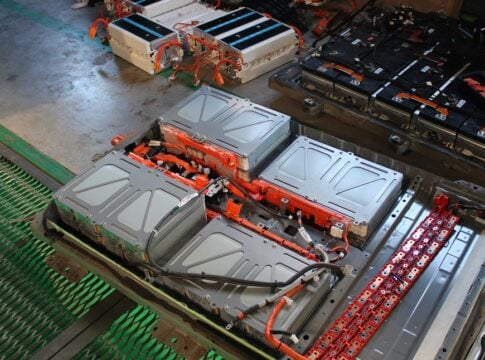
American EV maker Rivian and battery recycling leader Redwood Materials are showing how retired EV batteries can do more than power cars. Their new partnership at Rivian’s Illinois manufacturing plant uses second-life batteries as stationary energy storage, creating a model that could support factories, strengthen the grid, and lower electricity costs.
The project starts with more than 100 used Rivian battery packs. Together, they will deliver 10 megawatt-hours of dispatchable energy at Rivian’s Normal, Illinois facility. That stored energy will help the plant reduce electricity use during peak-demand periods, cut costs, and ease stress on the power system.
The numbers behind the opportunity are much larger. The press release reveals that by 2030, the U.S. is expected to need more than 600 gigawatt-hours of energy storage to support rising electricity demand, stabilize peak loads, and power expanding digital infrastructure. Simply put, it is equivalent to the total energy output of the Hoover Dam running continuously for two months.
Rivian Founder and CEO RJ Scaringe said,
“EVs represent a massive, distributed and highly competitive energy resource. As energy needs grow, our grid needs to be flexible, secure, and affordable. Our partnership with Redwood enables us to utilize our vehicle’s batteries beyond the life of a vehicle and contribute to grid health and American competitiveness.”
Second-Life Batteries Move Beyond Recycling
The Rivian-Redwood system gives retired EV batteries a second job before recycling. Redwood will integrate the battery packs into a stationary storage system using its Redwood Pack Manager software. The technology allows batteries with different levels of degradation and chemistries to work together safely.
This is important because EV batteries often remain healthy long after vehicles retire. Many can still serve for years as stationary storage assets. This creates a powerful circular economy model. Instead of going straight to recycling, batteries can generate added value while supporting energy needs.

The supply potential is significant. Redwood already receives more than 20 GWh of batteries each year, equal to roughly 250,000 EVs. The company says that by 2030, end-of-life batteries could supply more than 50% of the entire energy storage market.
And this could make second-life batteries a major domestic energy resource.
JB Straubel, Redwood Materials Founder and CEO, also commented on this development. He said,
“Electricity demand is accelerating faster than the grid can expand, posing a constraint on industrial growth. At the same time, the massive amount of domestic battery assets already in the U.S. market represents a strategic energy resource. Our partnership with Rivian shows how EV battery packs can be turned into dispatchable energy resources, bringing new capacity online quickly, supporting critical manufacturing, and reducing strain on the grid without waiting years for new infrastructure. This is a scalable model for how we add meaningful energy capacity in the near term.”
Data Centers Drive Storage Demand
The timing is critical because electricity demand is accelerating.
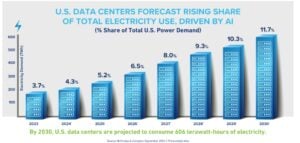
Artificial intelligence, cloud computing, and hyperscale data centers are pushing power demand sharply higher. Research from the Belfer Center cited,
The Lawrence Berkeley National Laboratory predicts that data center demand will grow from 176 terawatt hours (TWh) in 2023 (or, about 4.4% of total U.S. electricity consumption) to between 325-580 TWh (6.7-12.0%) by 2028.
Secondly, according to the Battery Council International, data center demand is expected to quadruple by 2030, again driven by AI and cloud computing. This surge is one reason stationary battery systems are becoming essential.
Battery Energy Storage Systems, or BESS, help store electricity and release it when demand spikes. They support peak shaving, frequency regulation, microgrids, and backup power.
Uninterruptible Power Supply (UPS) systems play a different role. They provide immediate short-term power support for critical systems such as data centers, telecom networks, and emergency infrastructure, where even brief outages can cause major disruption.
Together, UPS and BESS are becoming critical to keeping digital infrastructure running.
Market Size
Speaking about market size, the global commercial and industrial battery energy storage market is forecast to reach $21 billion in value by 2036, driven by AI-fueled data center construction, according to research from Globe Newswire.
This is where the Rivian-Redwood model becomes useful. It connects second-life batteries to one of the fastest-growing needs in the energy system. The modular structure of repurposed battery systems may also allow faster deployment than traditional infrastructure, which can take years to build.
Circular Economy Meets Energy Security
The project also supports energy security. Using domestic battery assets for storage can reduce dependence on imported energy storage systems. It may also help defer billions of dollars in grid infrastructure upgrades. This is vital when the U.S. is looking for ways to expand electricity capacity faster.
Second-life batteries can also help during high-stress events. During heat waves or peak demand events, stored energy can be discharged instantly to reduce strain on the grid and avoid buying higher-cost electricity.
It creates economic and reliability benefits at the same time.
The partnership also shows how batteries are evolving from transportation assets into broader infrastructure assets. And this shift can have wide implications for manufacturing, utilities, defense facilities, and digital infrastructure.
Market Competition and Technology
Redwood faces competition from established players in the energy storage market. Tesla has been running Megapack as a first-life business, while Redwood is building a parallel market in second-life batteries.
The Redwood Pack Manager technology acts as specialized software that enables battery packs with different degradation levels and chemistries to work together safely. This capability is crucial for second-life applications where batteries have varying performance characteristics.
Second-life batteries are gaining traction in industrial applications. Battery costs have fallen to historic lows, making these projects increasingly viable economically.
A Blueprint for the Next Phase of Clean Energy
Rivian and Redwood’s 10 MWh deployment represents a practical solution to two major challenges: managing retired EV batteries and meeting surging industrial energy demand. The project demonstrates how automakers can extract additional value from their battery investments while supporting grid stability.
As AI-driven electricity demand continues climbing and EV adoption accelerates, second-life battery projects could become standard practice across the automotive industry. The success of this Illinois pilot may influence how other manufacturers approach end-of-life battery management, creating a new revenue stream while supporting America’s clean energy transition
This project suggests one answer is to connect those two problems. Old EV batteries can become new energy infrastructure.
The post Rivian (RIVN) and Redwood Deploy 10 MWh Second-Life Battery Storage at Illinois Factory appeared first on Carbon Credits.

The post Promoting Improved Cooking Practices in Nigeria appeared first on Terrapass.
For most companies, the largest figure in the carbon inventory is not the office, the vehicle fleet, or the electricity bill. It sits upstream, in the goods and materials a business buys to make and sell its products. These purchased inputs form the bulk of a company’s Scope 3 emissions, which routinely exceeds everything the business controls directly, and can add up to 90% of their global footprint.




-
Climate Change1 year ago
Guest post: Why China is still building new coal – and when it might stop
-

 Greenhouse Gases2 years ago
嘉宾来稿:满足中国增长的用电需求 光伏加储能“比新建煤电更实惠”
-
Greenhouse Gases1 year ago
Guest post: Why China is still building new coal – and when it might stop
-

 Climate Change2 years ago
嘉宾来稿:满足中国增长的用电需求 光伏加储能“比新建煤电更实惠”
-

 Renewable Energy12 months ago
Sending Progressive Philanthropist George Soros to Prison?
-
Climate Change2 years ago
Bill Discounting Climate Change in Florida’s Energy Policy Awaits DeSantis’ Approval
-
Greenhouse Gases1 year ago
嘉宾来稿:探究火山喷发如何影响气候预测
-

 Climate Change2 years ago
Analysis: China’s CO2 falls 1% in Q2 2024 in first quarterly drop since Covid-19