

Moving towards sustainable sourcing, Nestlé has recently announced groundbreaking initiatives aimed at curbing cocoa supply emissions. Already a global leader in food and beverage, its commitment to the environment has grabbed a significant spotlight.
Nestlé has unveiled its transformative projects spanning five years in collaboration with suppliers Cargill and Export Trading Group’s (ETG) Beyond Beans. These initiatives involve advancements in agroforestry practices and a shift towards sustainable farming of cocoa.
Let’s deep dive into the details of Nestlé’s ambitious efforts to revolutionize the cocoa industry towards emission reductions.
Fostering Partnership with Cargill and ETG | Beyond Beans for Sustainable Projects
Nestlé’s partnership with its suppliers Cargill and ETG | Beyond Beans aligns with its objective to achieve net zero by 2050. They will primarily target carbon reduction and removal with Nestle’s cocoa supply chain.
The key objectives of the projects are:
Cocoa & Forest Initiative (CFI)
It envisions planting over 2 million shade trees, managed by 20,000 farmers in Ghana and Côte d’Ivoire. These projects are projected to cut down over 500,000 MTs of carbon dioxide over twenty years.
The shade trees mitigate exposure to sunlight and preserve moisture for the cocoa crops in dry seasons. They optimize water resources and boost biodiversity on farms. Most importantly, they are highly efficient in absorbing CO2 from the atmosphere.
Under CFI, Nestlé also plans to cut cocoa supply emissions by encouraging farmers to shift towards regenerative agriculture. The core focus would be to support reforestation in degraded cocoa farming lands.
To support this program, Darrell High, global cocoa manager at Nestlé has said:
“We’re working to address our emissions all the way to the farms we source from. Long-lasting forest protection can only happen when collaborating with fully committed suppliers, just like Cargill and ETG | Beyond Beans. We also depend on the participation of local communities, who have an impact on the forests and can help find land-use solutions that are best suited for the local reality.”
Involving Locals and Community Engagement Activities
Community engagement and social inclusions of the locals come under Nestlé’s Income Accelerator Program. It’s specifically designed to support cocoa-farming families. The projects would ensure that farmers receive their due rewards and incentives for the labor they put into planting and nurturing the cocoa crops.
Ursule Gatta, Cargill’s sustainability partnership officer in Côte d’IvoireOur said,
“Our ambition is to scale up the project to cover 18 cooperatives over five years, aligned with the Nestlé Income Accelerator program.”
Cargill and ETG | Beyond Bean projects strive to engage the local communities whose agricultural lands have not been cultivated for a long time. These two firms will take over those lands for reforestation and redevelopment purposes.
They aim to plant tree nurseries for cocoa seed cultivation. Apart from financial aid, the companies will offer technical assistance and consultations to the farmers to carry out sustainable agricultural practices.
Both the supplier chains play crucial roles in facilitating the implementation of Nestlé’s Income Accelerator Program within these projects.
Unlocking Global Reforestation Program (GRP) to Mitigate Cocoa Emissions by 2030
As mentioned on Nestlé’s official website, it has set an ambitious reforestation goal aka the Global Reforestation Program (GRP). The company pledges to grow 200 million trees by 2030 in and around farms where it sources its key ingredients.
Nestle’s primary focus will be on deforested land. They will also work to establish conservation and restoration as standard practices across their supply chains.
Why Nestlé’s GRP is crucial for climate change? Well, reforestation and restoration of degraded landscapes actively aid in long-term carbon removal and storage. These efforts are part of Natural Climate Solutions (NCS), essential for combating climate change.
Therefore, Nestlé with its land-use footprint must urgently invest in conservation and restoration to reach the 1.5°C target set by the International Panel on Climate Change (IPCC) in the COP21 Paris agreement.
The company’s Net Zero Roadmap incorporates carbon removals, primarily from sourcing ingredients. They believe that natural climate remedies in their supply chain can potentially eliminate GHGs from the atmosphere. This is expected to further boost their decarbonization goal of achieving 2.0 million tCO2e removals by 2030.
The chart examines Nestlé’s sustainability performance in 2021

source: www.nestle.com/sustainability
The main points highlighted in this chart are:
-
By 2025, reduce absolute emissions by 20%
from 2018 levels -
By 2030, reduce absolute emissions by 50% from 2018 levels
Simultaneously, it is also important to track the viability of the projects to enjoy long-term benefits. One such way is monitoring the number of trees planted and the volume of CO2 removed.
As per reports, Nestlé anticipates installing high-resolution satellite imaging technology to ensure the smooth running of its cocoa supply emission control strategy. With this tool, they can track the sustainability of the cultivated trees and evaluate the overall outcome of the reforestation projects.
One can foresee that Nestlé aims to revolutionize the cocoa industry’s approach to mitigating emissions with innovative strategies and partnerships. They are investing at the landscape level to achieve both environmental and socio-economic benefits.
The post Nestlé Unveils New Initiatives to Cut Cocoa Supply Emissions appeared first on Carbon Credits.

This concludes my three-part post. Part I, “Beginning,” began with the Three Mile Island accident and covered the decline of nuclear dread, the advent of fabulously reliable reactor operation, and nuclear power’s climate-hero status; it’s available here. Part II, “Centerpiece,” covered the failure of carbon tax advocacy, the closure of Indian Point, and the dissolution of my dream that renewable energy could do it all; it’s available here. This part takes antinuclear activism to task for turning a blind eye to the far more lethal harms from unrestrained automobility, and then turns to the need to redefine “least-cost” decision rules guiding electricity investment. — C.K.
7. A More-Brutal Bête Noire
On a different, but as I’ll show, related topic: I had known for some time that deaths from being struck by a motorist were shockingly common in the U.S., with 300 a year in New York City alone. I had made that fact a central element in defending bicycling against the moral panic over ― of all things ― New York’s industrious bicycle couriers during the pre-digital 1980s. And as a bicycle commuter I had long jousted with drivers. But the death of oncologist Dr. Jie Zhang in 1994 forced me to consider driver-caused traffic violence as an assault on both public health and the moral order.

The horrific death in 1994 of physician and expectant mother Jie Zhang called into question antinuclear dogma that prioritized hypothetical reactor accidents over lethal dangers like unrestrained automobility.
A speeding driver hit and killed Dr. Jie outside Memorial Sloan Kettering Cancer Center on Manhattan’s East Side. She was nine months pregnant. As she lay dying, her colleagues at the hospital delivered her son, who survived. The newspaper ran a photo of the newborn in his father’s arms. My wife and our week-old son were safe at home. My good fortune was hard to bear.
What were the hazards of nuclear power, next to those of motorized traffic? There was and is no agreed-upon damage ratio between the two technologies. But in my eyes, the anti-nukers’ derogatory depictions of U.S. nuclear regulators seemed better suited to officials in charge of “auto safety.” In 2009, for example, after a spate of deaths in SUV rollovers, the National Highway Traffic Safety Administration required that roofs on new vehicles be able to support three times their already swollen weight. That rule led to wider windshield-obstructing structural posts , badly expanding SUV drivers’ blind spots. The result, according to a recent New York Times report, was a tidal wave of crashes that killed hundreds of pedestrians and cyclists and injured thousands more.
As a young attorney in the 1960s, Ralph Nader rocketed to fame by documenting how regulatory capture made cars excessively dangerous. His subsequent pivot to opposing nuclear power initially made sense but, over time, inadvertently left American pedestrians, cyclists, and occupants of smaller vehicles vulnerable not just to “vehicle bloat” but driver distractions and the “windshield perspective” of police, prosecutors and juries.
All the while, anti-nuclear activists keep pounding their drum, willfully ignoring U.S. reactors’ splendid post-seventies safety record (see Sections 1 & 2). With few domestic miscues to flog, they leaned instead into the faraway disasters at Chernobyl (1986) and Fukushima (2011). Those disasters were real enough, but they differed from the U.S. situation not just in location but also in root cause. Soviet and Japanese officials had downplayed reactor risks, while the U.S. nuclear enterprise had built a culture dedicated to containing them.
Even reactor radioactivity, like reactor accidents, is becoming another non-barking dog. We are half-a-century into the age of large-scale deployment of nuclear power, and not a single large-scale study has emerged that credibly pins increased morbidity and/or mortality on nuclear power plant operation. Moreover, the old Rubik’s Cube problem of nuclear waste disposal is yielding to engineered solutions. The hangup was never technical. It was political.
8. By All Means, Decarbonize
For half-a-century, nuclear power and renewable energy have circled each other like wary prizefighters.
The two weren’t simply antithetical, they were incompatible — logistically as well as culturally. One couldn’t be for both; you had to pick a side. That was the gospel of physicist Amory Lovins, whose revolutionary 1976 article in Foreign Affairs magazine, “Energy Strategy: The Road Not Taken,” upended energy policy debates and galvanized the antinuclear power movement.[12]
In Lovins’ influential framing, nukes epitomized “hard” energy — lumbering and brittle. Renewables — wind and solar — were “soft” — home-grown and “right-sized.” (This was before the relentless push for engineering efficiencies turned wind turbines into colossi and blanketed entire fields with solar panels.)
Fifty years on, the climate crisis has entered the ring and demanded that the rivals partner up. The choice now is carbon-burning vs. carbon-free. Further, the perilous timeline of the crisis has toppled another dictum, also traceable to Lovins: that the transition from fossil fuels must proceed under a “least-cost-first” hierarchy that turns to costlier energy sources only after first exhausting all of the less-expensive ones.
Once, that logic was persuasive. In a leisurely, decades-long transition, why not have the lowest-cost energy lead the way? Wherever a home solar array or a Great Plains wind farm could turn a profit, the thousand busy ants of capitalism could be trusted to deploy them. The climate-warping curve would bend, steadily, painlessly, bringing a more flexible and benign energy system into the bargain.
That was the idea. The reality is falling far short, as revealed by the stubborn persistence of U.S. carbon emissions.[13] The manifold causes have been touched on here; they include everything from traditional NIMBYism to viral versions built on conspiracy-mongering, along with supersized pickups, “sport utes” and the absence of robust carbon emissions pricing. The shale revolution and two Trump presidencies did their part as well, keeping fossil fuels cheap (until No. 47 made war on Iran), which added to the stock of carbon in the atmosphere and America’s stock of carbon-consuming cities and towns, farms and roadways.
In World Cup parlance, we’ve entered stoppage time. A new rule applies: nuclear power ― or any other fossil-fuel antidote ― need not pencil out as cheaper than solar or wind to merit a part in decarbonizing U.S. grids. Instead, we should pursue any energy source or energy-saving measure that displaces fossil fuel use at lesser cost than the harm caused by burning those fuels in the first place.
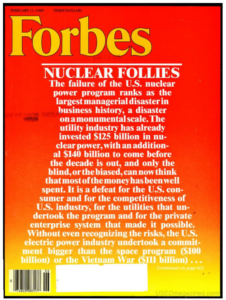
Feb. 11, 1985 cover.
Think of it like the hikers’ joke about the bear: I don’t need to outrun the bear, I just need to outrun you. In the same way, new nuclear plants don’t need to be cheaper per kilowatt-hour than solar or wind. Their electricity just needs to cost less than the added climate damage that would result from burning the fossil fuels that would otherwise fill the gap. And on that test, new nuclear power plants appear likely to succeed.
Let’s break that down.
What will new U.S. reactors cost to build?
This year I applied my statistical skills and power plant knowledge to the 49 most recently built U.S. reactors. Forty-seven of them limped to completion in the dozen years following Three Mile Island. At the time, their swollen costs so ravaged U.S. electric utilities that Forbes magazine termed the U.S. nuclear power program “the largest managerial disaster in business history.”
Nevertheless, my analysis of that cost data points to a path forward. I found that even if future reactor costs track past costs, a program that builds two or more reactors at each site and uses standardized designs will allow new plants to be built for an average cost of $8,200 per kilowatt of capacity, in 2025 dollars. At that price, building and running new reactors is almost certainly a lower-cost proposition than facing the ecological and human damage from burning equivalent fossil fuels.[14]
If anything, my figure is on the pessimistic side, since it bakes in the kind of shifting regulatory requirements that drove up costs so much in the post-TMI period. Even so, it comes to just half of what it cost to build the final two reactors — Georgia Power new Vogtle 3 and 4 units ― a project that nuclear power critics dredge up at every opportunity as proof that any new U.S. nuclear plant is doomed to be uneconomical.
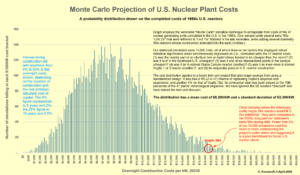
An alternative visualization of this chart appears as Fig. 9 in “Beyond Vogtle.”
Just as important, the odds of future extreme overruns appear low. Using a probabilistic model, I found that the likelihood that a new twin-unit plant, built to a standardized design, will end up costing as much as Vogtle is slim ― the same odds, around 1.7%, as correctly calling six coin flips in a row.[15]
Will the long time to build new reactors undo their climate benefit?
Past nuclear plants seemed to take forever to finish. The 47 reactors whose costs I analyzed averaged nearly 12 years from initiation to completion ― a 50 percent worsening from their 1970s counterparts. Much of that added time traces back to Three Mile Island, which triggered design changes, equipment upgrades, and staffing shifts across the entire U.S. nuclear sector, each adding delays. Slowing demand for power also led some utilities to stretch out construction schedules on their own.
To nuclear power’s critics, these setbacks come with the territory. But reactors aren’t the only major infrastructure projects facing long timelines. Delays in building wind farms, transmission lines, and other accoutrements of renewable energy have prompted plenty of national hand-wringing too. Even balcony solar ― the latest face of decarbonization ― will need time to scale up. Electrical codes and fire regulations must be rewritten, and then the real challenge begins: installing roughly 25 million of these devices (at 220W each) to match the climate benefit of a single 1,000-megawatt reactor.
There’s also a déjà vu tinge to the complaint that nuclear power is too slow to help with the climate crisis. That argument easily predates Vogtle 3 and 4 ― the massive Georgia project that tested residents’ patience and wallets, but is now helping decarbonize Atlanta and hundreds of other cities. The goal isn’t to repeat Vogtle’s egregiously high cost, which doesn’t yet clear the bar set by the social cost of carbon. It’s to treat the climate fight as an ongoing effort to reduce harm by whatever effective means are available.
Balcony solar and giant nukes aren’t rivals ― they’re partners. Building Vogtle didn’t stop Georgians from putting solar panels on their roofs in 2015, and if balcony solar really is the money-saving no-brainer its supporters claim, there’s no reason it shouldn’t help rate-burdened Georgia families in 2027, too. “All hands on deck” is a cliché, but it fits here. The world has no time to wait ― it needs to decarbonize by every means available. Including nuclear power.
[12] Lovins’ Foreign Affairs article is available here. I recounted its momentous impact on energy policy and public discourse for The Electricity Journal in 10 Blows That Stopped Nuclear Power (Jan/Feb 1991).
[13] U.S. CO2 emissions circa averaged only 1 to 2 percent annual reductions over the period 2010-2025, a rate many times slower than needed to meaningfully address the climate crisis.
[14] See Komanoff & Boucher, “Beyond Vogtle,” op. cit., pp. 41-44.
[15] The chance of correctly calling six coin-tosses in a row is one-half raised to the sixth power, which is 1 in 64, or 1.56%, which more or less matches the 1.7% chance that a new nuclear plant will cost as much as or more than Vogtle 3 and 4. See Komanoff & Boucher, op. cit., Fig. 9.
What auditors actually test, where projects actually fail, and the contract clauses that protect you before signature.
The meeting happens about fourteen months after the contract was signed. Your assurance provider has reached the nature-based investment line in your Scope 3 file, and the partner across the table has exactly two questions. How do you know the reductions happened? And how do you know they would not have happened anyway?
The first question is MRV: measurement, reporting, and verification. The second is additionality. Between them, they decide whether your nature-based investment counts, in your inventory, in your disclosure, and in front of your board. Everything else in the project documentation is supporting material for these two answers.
This article walks through what each question actually tests, where projects most commonly fail, what digital MRV has changed (and what it has not), and the contract clauses that protect you. The goal is to give you the diligence framework before you sign, because after the credit issues is the wrong time to discover the answers were weak.
What MRV actually verifies
MRV is the machinery that turns a field intervention into a defensible number. Measurement covers the data: biomass surveys, soil sampling, remote sensing, activity records from participating farms. Reporting covers the translation of that data into claimed reductions under a recognised methodology. Verification covers the independent check: an accredited third party tests the reporting against the methodology and the evidence.
The methodologies live in registries. Verra’s Verified Carbon Standard and the Gold Standard are the two largest for nature-based projects, and each publishes the methodology documents, monitoring requirements, and verification protocols that a project must follow. The ICVCM Assessment Framework now sits above the registries, assessing whole methodologies against the Core Carbon Principles and granting the CCP label to those that pass.
For a buyer, the practical questions are concrete. What is the monitoring frequency, and is it specified in the project design document or left vague? Who is the verifier, how were they selected, and how often do they rotate? What raw data do you, the buyer, get access to, and in what format? A project that answers these in writing is a different procurement than one that answers them in a sales call.
What additionality actually proves
Additionality asks whether the intervention caused the reduction, or whether the reduction would have happened anyway. The test is a counterfactual: what would this landscape, this farm, this forest have done without the project’s money?
Three forms matter in practice. Financial additionality asks whether the project needed the carbon revenue to proceed. Regulatory additionality asks whether the activity was already required by law. Common-practice additionality asks whether the activity is already standard in the region, in which case paying for it buys you nothing the world was not getting for free.
The reason additionality dominates audit conversations is recent history. Research published in 2023, including the Science paper examined at length in our piece on conventional offsets and boardroom credibility, found that a large share of REDD+ credits failed the counterfactual test because baselines were inflated. The market response was a wave of methodology revisions at Verra and the arrival of independent ratings agencies whose entire business is re-testing additionality claims. The Carbon Credit Quality Initiative publishes transparent scoring of methodologies on exactly this dimension, and it is free to consult before you sign anything.
Where projects most commonly fail the test
Five failure modes account for most of the wreckage.
- Inflated baselines. The counterfactual assumes more deforestation, more degradation, or lower yields than the evidence supports. The claimed reduction is the gap between reality and the baseline, so an inflated baseline manufactures reductions from nothing.
- Unaccounted leakage. The project protects one forest and the logging moves to the next valley. The methodology is supposed to net this out; weak projects estimate it optimistically.
- Thin permanence protection. Nature-based carbon can reverse: fire, pest, drought, or a change of landowner. Buffer pools and insurance mechanisms exist for this, but their adequacy varies enormously between projects.
- Attribution and double counting. In supply chain settings, the same reduction can be claimed by the supplier, the buyer, and a credit purchaser unless contracts prevent it. Our Insetting vs Offsetting piece covers the inventory rules; the point here is that the auditor will ask who else is counting this tonne.
- Stale monitoring. Data collected at validation and never refreshed. The IPCC AR6 Working Group III land-sector chapter documents how quickly carbon stocks respond to disturbance; a three-year-old measurement is a historical artifact, not a current claim.
What digital MRV changes, and what it does not
Digital MRV is the genuine improvement in the field. Satellite remote sensing, including the free archives at NASA Earthdata, allows biomass and land-cover change to be monitored continuously rather than at multi-year verification intervals. Soil carbon models calibrated with physical sampling reduce the cost of agricultural measurement. The practical effect is more frequent data at lower cost, which compresses the window in which a problem can hide.
What digital MRV does not change is judgment. Baselines are still human decisions about counterfactuals. Additionality is still an argument, not a measurement. Research groups such as the Oxford Smith School have been clear on this point: better sensors improve the M in MRV, but the integrity questions live in the assumptions, and assumptions need governance, not gadgets.
For a buyer, the test is simple. Ask the provider what is measured by instrument, what is estimated by model, and what is assumed by methodology. A provider who can answer that question crisply understands their own evidence chain. A provider who cannot is selling you their confidence rather than their data.
What to require in your contract
The diligence above converts into five contract clauses.
- Monitoring cadence and buyer data access, specified by dataset and frequency.
- Verifier independence, named accreditation, and rotation terms.
- Baseline revision triggers, so the counterfactual updates when the methodology or the evidence changes.
- Reversal liability and buffer adequacy, with the mechanism named and sized.
- Documentation handover in audit-ready form, so the evidence file your assurance provider needs already exists.
None of these clauses is exotic. All of them are absent from weak contracts, and their absence is the most reliable early signal that the MRV and additionality answers will be weak too.
If you are evaluating a nature-based investment and want the MRV and additionality stress-tested before signature rather than after, the carbon and sustainability experts at Carbon Credit Capital can run that review against any project on your shortlist, and design nature-based supply chain investments where the evidence chain is built audit-first. Schedule a consultation.
Sources and further reading
- ICVCM: Core Carbon Principles Assessment Framework
- Verra: Verified Carbon Standard
- Gold Standard for the Global Goals
- Carbon Credit Quality Initiative: Methodology quality scores
- University of Oxford Smith School: Sustainable finance research
- IPCC AR6 Working Group III, Chapter 7: AFOLU
- NASA Earthdata satellite remote sensing archive
EU Directive: Empowering Consumers for the Green Transition (ECGT)
The EU Directive, Empowering Consumers for the Green Transition (ECGT), takes effect on September 27, 2026.(1) The goal of ECGT is to protect consumers by ensuring that environmental claims are fair, understandable, and reliable. This regulation does create a new compliance requirement for businesses, but it also provides sustainability and marketing teams with important guidance that helps create consistency in sustainability communications.
Key takeaways
- ECGT takes effect September 27, 2026, and prohibits claims that a product or service has a neutral, reduced, or positive environmental impact based on offsetting alone.
- Named example phrases the regulation prohibits include climate neutral, CO2 neutral certified, carbon positive, climate net zero, climate compensated, reduced climate impact, and limited CO2 footprint.
- ECGT does not want to deter investment in carbon credits. It wants companies to communicate the real benefits of the projects they support instead.
- SBTi’s guidance recommends framing carbon credits as taking responsibility for ongoing emissions, not as making a product or company neutral.
- Voluntary carbon projects deliver real climate progress: reducing super-pollutants, protecting and restoring ecosystems, and supporting communities.
Regarding carbon credits specifically, voluntary carbon projects deliver important climate progress and environmental benefits that provide many talking points for companies. They reduce climate super-pollutants by removing industrial emissions like methane, N2O, HFCs and others. They protect and restore valuable ecosystems and carbon sinks like forests, mangroves and grasslands. They help communities by reducing local pollution, creating employment opportunities, improving access to healthcare, and more.
The Science Based Targets Initiative (SBTi), a global leader in business climate action, concludes that alongside aggressive decarbonization, we should also use high quality carbon credits to take responsibility for our ongoing emissions. SBTi recognizes that carbon credits are important “to help limit temperature overshoot, mitigate transition risks, and support climate solutions.”(2)
ECGT language on carbon offsetting says that they do not want to deter investment in carbon credits. They just want companies to focus on communicating the benefits of the projects they support and avoid claims beyond the scope of carbon credits, which is good for everyone, companies and consumers alike.
The regulation reinforces that carbon credits do not change the sustainability of your products, so carbon credit buyers should not suggest that their products are more sustainable because of carbon credits. Instead, companies need to promote their climate contributions as a way to compensate or take responsibility for their carbon emissions by supporting projects that do great things like reducing global carbon emissions, reducing pollution, preventing deforestation, restoring forests, and more.
ECGT language related to carbon offsetting
The regulation is particularly focused on prohibiting claims, based on offsetting greenhouse gas emissions, that a product or service has a neutral, reduced, or positive impact on the environment in terms of greenhouse gas emissions. These claims are prohibited in all circumstances because they mislead consumers into believing the claim relates to the product itself, or to how it was made and supplied, or into thinking that using the product carries no environmental impact at all.
Named examples of prohibited claims include:
- climate neutral
- CO2 neutral certified
- carbon positive
- climate net zero
- climate compensated
- reduced climate impact
- limited CO2 footprint
These claims are only allowed when they rest on a product’s actual lifecycle impact, not on offsetting emissions outside that product’s value chain, since the two are not equivalent. This prohibition does not stop companies from advertising their investments in environmental initiatives, including carbon credit projects, as long as they present that information in a way that is not misleading and that meets the other requirements of Union law.(1)
SBTi also provides guidance on climate contribution language in its Corporate Net Zero Standard Version 2.0 Draft for Second Public Consultation, November 2025. While the SBTi language is fairly technical, it has a good framework for crafting a climate contribution message.
SBTi Language for Carbon Credits(3)
- Take responsibility for ongoing emissions by delivering mitigation impact contributions
- Carbon credits certify the mitigation outcomes of projects that reduce, avoid, or remove carbon emissions
- Activities that reduce emissions from emission sources not located within the company’s value chain
- Activities that conserve, protect, and enhance natural carbon sinks
- Activities that capture and store carbon in storage pools
SBTi’s draft standard also walks through sample claim language for this kind of contribution. In general, the samples move from a simple percentage statement, to naming a specific verified tonnage tied to that percentage, to a fuller statement that breaks the tonnage into reductions versus removals. Across all three, the framing stays consistent: a company took responsibility for a defined share of its ongoing emissions over a set period, by funding a specific, verified amount of mitigation, achieved through emission reductions or removals.(3)
FAQ: ECGT and Carbon Credit Claims
When does the ECGT directive take effect?
The rules apply across the EU from September 27, 2026, after member states transposed the directive into national law by March 27, 2026.
Does ECGT ban carbon offsetting?
No. It bans specific marketing claims that a product or service is environmentally neutral, reduced impact, or positive based on offsetting. Advertising investment in carbon credit projects themselves is still allowed if it is not misleading.
What phrases does ECGT specifically prohibit?
Named examples include climate neutral, CO2 neutral certified, carbon positive, climate net zero, climate compensated, reduced climate impact, and limited CO2 footprint, when those claims are based on offsetting rather than a product’s actual lifecycle impact.
How should a company describe its carbon credit purchases instead?
SBTi’s guidance recommends stating the specific verified tonnage of emissions reductions or removals funded and describing that as taking responsibility for a defined share of ongoing emissions, rather than claiming the company or product is neutral.
Does this rule apply to company level sustainability claims too?
ECGT is focused on claims about specific products and services in consumer marketing. Broader company level sustainability communication is a separate matter still governed by other existing rules.
While ECGT does add a new compliance burden for businesses, it helps create consistency in sustainability messaging that is important to building confidence in voluntary carbon projects and scaling the industry to help us achieve progress on global carbon emissions.
Disclaimer: Terrapass does not provide legal or regulatory advice. Any interpretation of regulation must be approved by your legal representative.
References:
(1) https://eur-lex.europa.eu/eli/dir/2024/825/oj
(2) https://files.sciencebasedtargets.org/production/files/Corporate-Net-Zero-Standard-version-2.pdf
(3) https://files.sciencebasedtargets.org/production/files/CNZS-V2-Second-Consultation-Draft.pdf
The post The EU’s New Green Claims Rules and Carbon Credits appeared first on Terrapass.


-

 Greenhouse Gases2 years ago
嘉宾来稿:满足中国增长的用电需求 光伏加储能“比新建煤电更实惠”
-
Climate Change1 year ago
Guest post: Why China is still building new coal – and when it might stop
-
Greenhouse Gases1 year ago
Guest post: Why China is still building new coal – and when it might stop
-

 Climate Change2 years ago
嘉宾来稿:满足中国增长的用电需求 光伏加储能“比新建煤电更实惠”
-

 Renewable Energy11 months ago
Sending Progressive Philanthropist George Soros to Prison?
-
Climate Change2 years ago
Bill Discounting Climate Change in Florida’s Energy Policy Awaits DeSantis’ Approval
-
Greenhouse Gases1 year ago
嘉宾来稿:探究火山喷发如何影响气候预测
-

 Carbon Footprint2 years ago
US SEC’s Climate Disclosure Rules Spur Renewed Interest in Carbon Credits