

If you’re looking to go on an adventure in the great outdoors, the variety of landscapes in the Pacific Northwest — from temperate rainforest and brilliant geological formations to expansive sand dunes and stunning river-carved canyons — are awe-inspiring for even the seasoned traveler.
Hoh Rainforest, Olympic National Park, Washington State

Named for the Hoh River that runs from Mount Olympus to the Pacific Coast, the Hoh Rainforest is one of the largest temperate rainforests in the United States. This magical ecosystem is one of the wettest places in the country, with an annual average rainfall of 140 inches per year. All that rain creates a dense canopy of deciduous and coniferous trees, and the forest floor is blanketed with ferns, fungi and mosses.
A gigantic rainforest once stretched from southeastern Alaska all the way to central California along the Pacific Coast — the Hoh Rainforest is what remains of that ancient forest.
Located around an hour drive from the city of Forks, Washington, and a two-hour drive or so from Port Angeles, the Hoh Rainforest is in the western portion of Olympic National Park. To get there take Highway 101 to Upper Hoh Road.
The old-growth forest has a year-round campground with 72 sites along the Hoh River. Reservations can be made six months in advance at recreation.gov.
Stop in at the Hoh Rain Forest Visitor Center — closed from January through early March — for tips on making the most of your visit.
From the visitor center there are two loop trails: the 0.8-mile Hall of Mosses Trail — which features old-growth forest, including a maple tree grove and club moss springing from the forest floor — and the 1.2-mile Spruce Nature Trail, which leads you along the Hoh River and Taft Creek through new- and old-growth forest.
The main hiking trail in the Hoh Rainforest is the out-and-back Hoh River Trail. You can take this trail as far as you feel comfortable, up to its endpoint 18.5 miles in. Along the way the trail takes you past multiple campsites, the farthest of which is Glacier Meadows at 17.3 miles in. The trail ends with a view of Mt. Olympus at Blue Glacier moraine.
“I love the Hoh Rainforest! The Hoh River trail parallels the Hoh River and is relatively easy. At the end of August, the river is low enough that you can wade across it near Tom Creek,” adventurer Sarah Strock told EcoWatch.
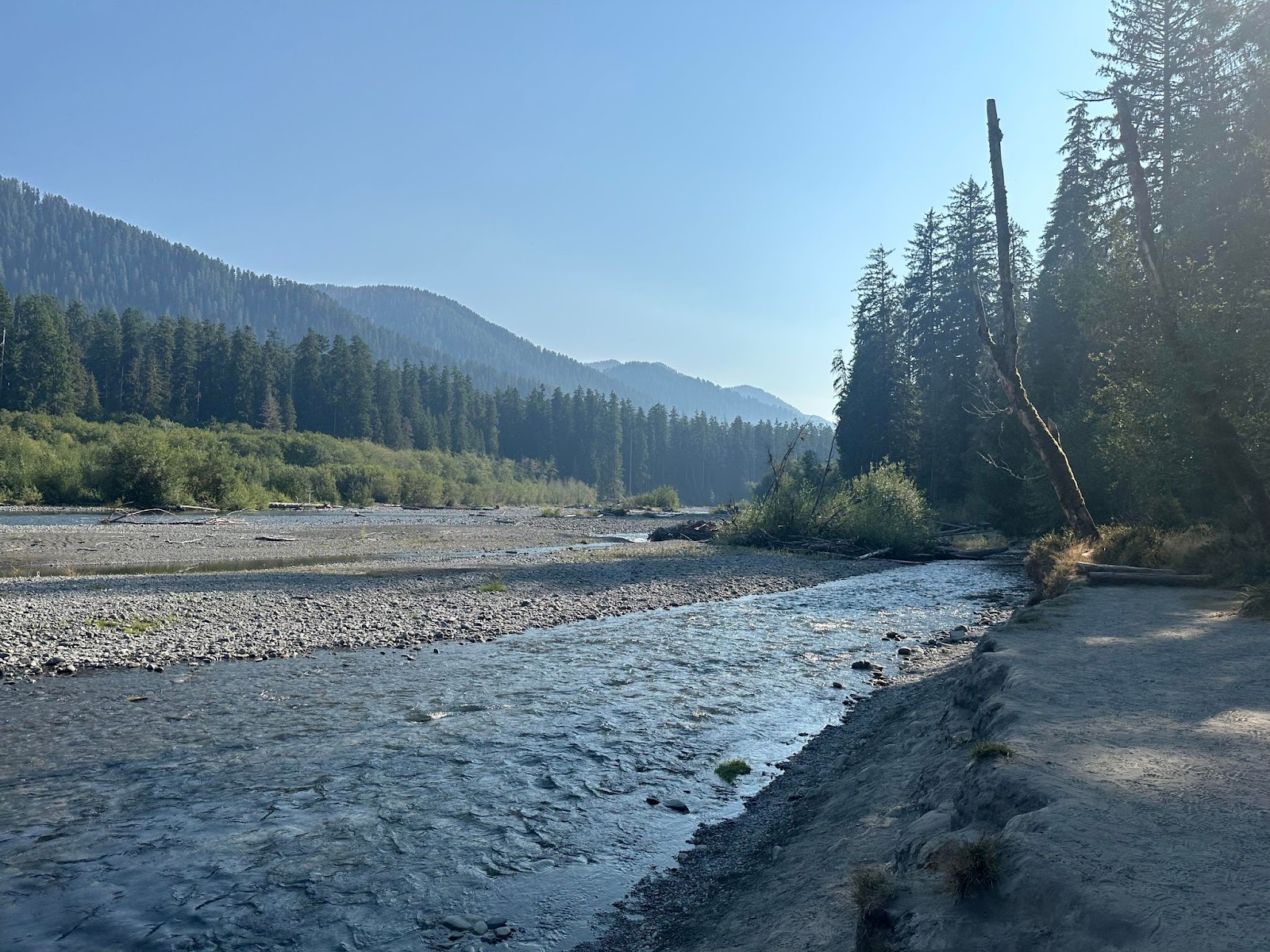
The Hoh Rainforest. Sarah Strock
Just past the ranger station on the Hoh River Trail is the Hoh Lake Trail, which goes up to Bogachiel Peak between the Sol Duc Valley and the rainforest. Turn-around day hikes in this area include Mineral Creek Falls 2.7 miles in; First River access 0.9 miles in; Cedar Grove four miles in; and Five-Mile Island, which is five miles one way.
More information on hiking and permits for the Hoh River Trail and Olympic National Park can be found on the Wilderness Backpacking Reservations page. Pets are not permitted on Hoh Rainforest trails.
With the Hoh’s plentiful rainfall comes a rich ecosystem of flora and fauna. Average summer temperatures stay in the pleasant mid-70 degrees Fahrenheit, and the dense forest canopy and thick undergrowth provide ample shade for the rainforest’s many species.
Mammals like black bears, Roosevelt elk and river otters are common. Mountain lions and bobcats can be harder to spot, but at night you may hear or feel them roaming about their mystical home. Making their way along the forest floor are snails, banana slugs, salamanders, snakes and rodents. Songs, screeches and hoots from barred owls, American robins and Canada grey jay can frequently be heard, along with sightings of these majestic creatures. The endangered northern spotted owl also graces the old-growth trees of the forest.
Among the mammoth trees you will spot in the Hoh Rainforest are red cedar, sitka spruce, douglas fir and big leaf maple. As you explore the rainforest, you will see many fallen trees. When one of these giants topples, it allows sunlight onto the floor of the forest and provides nutrients for many new plants, animals and fungi.
There is truly no place like the ancient, hushed wonderland of the Hoh Rainforest — living evidence of the height of our planet’s balance and beauty.
Painted Hills, Central Oregon

The red and gold Painted Hills of Central Oregon sit like colorful camel humps in the foreground of the Cascade Mountain Range. The soft, rolling hills were formed 32 to 35 million years ago by sedimented clay and cooled and oxidized ash from the nearby mountains.
“If you drive north past the Painted Hills, the road will become thin and rutted. It passes through the John Day river canyon, with views normally available only to the ranchers and farmers who line its banks. It comes out on the crest of the Ochoco Mountains near Antelope, in a location where you can watch the sun set behind the Cascades – spanning from Rainier to South Sister,” lifelong Oregon resident Zach Spier told EcoWatch.
The climate east and west of the Cascades is vastly different. The western part of Oregon is temperate and rainy, while in the east lies the dry and cooler high desert.
To the east of the mountains is the John Day Fossil Beds National Monument. The monument is made up of three units — including the Painted Hills — each from one to two hours apart by car. The formation of the varying strata of the fossil beds began approximately 100 million years ago; it continues to this day.
Located about 10 miles from the town of Mitchell, the Painted Hills are located within the John Day River Basin. The ash that gives the hills some of their layers blew east from the mountains, and combined with shale and clay deposits to give the hills their colorful stripes.
“The reddish and yellowish layers consist of laterites, soils rich in iron and aluminum that were created in tropical climates with a distinct wet and dry season. Red soils come from a more tropical period, while the yellows are from a drier and cooler time. Dark black dots and streaks in the hills are stains from manganese nodules, likely the work of plants that fixed the mineral or from salts that became concentrated as pools of water rich in the mineral dried up,” the Geology In website explains.
There are five hiking trails in the Painted Hills unit, each with its own parking area along Bear Creek Road. They include the 0.5-mile Painted Hills Overlook Trail, the 1.6-mile Carroll Rim Trail, the 0.25-mile Painted Cove Trail, the 0.25-mile Red Scar Knoll Trail and the 0.25-mile Leaf Hill Trail.
Learn more about the region’s geological history at the Thomas Condon Visitor Center, located in the Sheep Rock unit of the John Day Fossil Beds National Monument. The visitor center has a paleontology lab, fossil gallery and displays with information on the more than 40-million-year-old fossil record of the area. The center also offers a short film, Layers of Life: Stories of Ancient Oregon.
Oregon Dunes National Recreation Area

While exploring the Pacific Northwest, the rugged and dynamic Oregon Coast is a place you won’t want to miss! Among its wonders is the Oregon Dunes National Recreation Area — one of the most extensive temperate coastal sand dunes on Earth. Looking out upon the expanse of undulating golden sand, you might feel as though you’ve traveled to the Sahara Desert.
Part of the Siuslaw National Forest, the 31,500-acre Oregon Dunes were designated as a National Recreation Area in 1972. The sand in the dunes comes from sedimentary rock, uplifted and blown over from the Oregon Coast Mountain Range 12 million years ago. The rock moved downstream in rivers, eroding into sand. The shoreline as it stands now stabilized 6,000 years ago, but wind and water shape the dunes into various formations that change throughout the year.
The unique ecosystem of ocean, forest and dunes is home to many animal and plant species, including the western snowy plover — tiny shore birds who lay their eggs on the open sand; black-tailed deer — a subspecies of mule deer who sometimes graze on foredune grasses near the beach; bald eagles, raptors and golden eagles, who can be seen soaring above the dunes in the warm summer months; bobcats who roam the dunes at night, hunting birds and small mammals living in small stands of trees; the rare Humboldt marten, who usually lives in old-growth forests along the coast, but ecosystem changes have caused to take up residence in sand dune forests; sand verbena — a sweet-smelling succulent with bright yellow and pink flowers; tiny coastal strawberries that ripen into a rare and delicious treat in late June; and European beachgrass — an invasive species introduced in the early 1900s to keep the dunes from overtaking railroads, roads and ports, but which now covers more than half the landscape and threatens all of it.
There are several trails to guide you through the varied landscapes of the Oregon Dunes. One of them is the Tahkenitch Dunes Trail near Gardiner, Oregon. This six-mile loop takes about two-and-a-half hours, offers opportunities for birdwatching and does not allow dogs.
“The Tahkenitch Dunes trail is a quiet respite, taking hikers in a loop through multiple ecosystems, including areas in the process of becoming forested,” Spier told EcoWatch.
A shorter hike that you can take with your canine best pal is the 1.4-mile Tahkenitch Creek Trail, which is also a loop that takes about half an hour to complete.
Another possibility is the Oregon Dunes Loop Trail — a four-mile, moderately challenging hike near Westlake, Oregon. It takes about an hour and 17 minutes and does not allow dogs.
If you’re looking to gain some elevation and see a body of water other than the magnificent Pacific Ocean, the Threemile Lake Trail might be for you. This out-and-back hike is a total of 6.1 miles and takes you 997 feet above sea level to Threemile Lake. Starting out near Gardiner, the moderately challenging route takes about two hours and 47 minutes and is best tackled from March through October.
The distinctive colors, textures, animals and plants of the wind-blown Oregon Sand Dunes pretty much guarantee that whatever you choose to do while visiting this one-of-a-kind landscape, your experience will be unforgettable.
Columbia River Gorge National Scenic Area, Border of Washington and Oregon

A trip to the Pacific Northwest would not be complete without a visit to the Columbia River Gorge. The gorge is an 80-mile-long, meandering spectacle of ridges, overlooks, cliffs and waterfalls. At 1,243 miles long, the Columbia River is the biggest river in the Pacific Northwest and forms the border of Oregon and Washington.
“I have ridden my motorcycle many times through the Columbia River Gorge area on both sides of the river, Highway 84 in Oregon or 14 in Washington, and both offer spectacular views going both directions of the marvelous geology and wondrous architecture of Mother Nature,” Harley rider and nature enthusiast Patrick Roat told EcoWatch.
The country’s largest national scenic area was formed approximately 18,000 years ago when an ice dam broke and Lake Missoula flooded the region on its way to the sea, forming gorges in its path.
Long before pioneers settled the gorge, the Klickitat Tribe thrived on the river’s plentiful salmon from both the Klickitat and Columbia Rivers.
The Columbia Gorge boasts the most waterfalls in the U.S., including the famous Multnomah Falls, Oregon’s tallest waterfall at 620 feet.
Hiking and camping are both popular pastimes here, as are picking your own fresh fruit at local orchards, enjoying fresh produce from nearby farms and visiting regional wineries.
Hundreds of wildlife species grace the Columbia Basin Watershed, including beavers, bobcats, black bears, the Pacific tree frog, yellow-bellied marmots, chipmunks, the western tanager, the greater roadrunner, the California ground squirrel, steelhead, walleye and small and largemouth bass.
One of the many trails you can follow through this glorious landscape is the 2.3-mile Oneonta Gorge Trail that leads you through a canyon past waterfalls and scenic views. The best time to hike this trail may be in late summer, as the canyon is at risk for flash floods in the spring. Also, stay clear of log jams.
Other hikes include the 13.1-mile out and back Eagle Creek Trail — 25.8 total miles — to Wahtum Lake; the six-mile Munra Point Trail with an elevation gain of 2,300 feet and spectacular views; and the 12-mile Tunnel Falls hike that will take you past multiple waterfalls.
Head to the Bridge of the Gods trailhead to join the Pacific Crest Trail, Section G of which leads to Timberline Lodge.
Another fun option is the Hood River Fruit Loop, a 35-mile drive through the Hood River Valley, where you will be greeted by fruit stands, u-pick farms and wineries. Depending on the season, you may find cherries, berries, lavender, apricots, flowers, pumpkins or wine and beer tastings.
“I absolutely love it in the summertime, it’s like a mini Grand Canyon in places, and it feels sort of hidden because it’s not on major highways per se like I-90 or I-5,” Roat said.
For those who love to be out on the water, the gorge provides opportunities for boating, canoeing, windsurfing and swimming, as well as kayak tours.
The Columbia River Gorge has something for everyone — each season offers new ways to appreciate this testament to the untamed splendor of the Pacific Northwest.
“The canyons, spires, cliffs, and river basin all afford breathtaking views and leave you with a sense of reverence about the area that will draw you back for more,” Roat added.
The post 4 Natural Wonders of the Pacific Northwest appeared first on EcoWatch.
https://www.ecowatch.com/natural-wonders-pacific-northwest-ecowatch.html

The first Earth Day was celebrated on April 22, 1970 — 56 years ago — and, goodness, how the world has changed since then. We’ve come a long way since the days of burning our trash and pumping our gas guzzlers with leaded gasoline. In honor of those 56 years, here are 56 important changes and milestones since the first Earth Day.
Legislation
The U.S. government has led much of the environmental charge, starting with the implementation of the EPA (1) in July 1970. Later that year, the Clean Air Act (2) targeted air pollutants, followed by the Clean Water Act (3) in 1972 and the Endangered Species Act (4) in 1973.
Some lesser-known national laws included the Safe Water Drinking Act (5) in 1974, the Resource Conservation and Recovery Act (6) in 1976, the Toxic Substances Control Act (7) in 1976, the National Energy Act (8) in 1978, and the Medical Waste Tracking Act (9) in 1988.
In some cases, states have led the charge. Oregon passed the first bottle bill (10) in 1971, Minnesota’s Clean Indoor Air Act (11) was the first law to restrict smoking in public places (1975), and Massachusetts required low-flush toilets (12) for construction and remodeling in 1988.
Green Innovations: The Early Years
In order to comply with all the laws from the 1970s, we needed new technology to ensure consumers could adhere to the new standards. Consider:
- The “Crying Indian” PSA debuts in 1971 (13)
- Dichlorodiphenyltrichloroethane (DDT) gets banned in 1972 (14)
- The energy-efficient compact fluorescent light bulb launches in 1973 (15)
- Cars begin displaying fuel economy labels in the mid-1970s (16)
- In 1975, all cars are manufactured with catalytic converters to limit exhaust emissions (17)
- Chlorofluorocarbons are banned from aerosol cans starting in 1978 (18)
- The first curbside recycling program begins in New Jersey in 1980 (19)
- In 1986, McDonald’s switches from foam to paper food containers (20)
- Mercury is removed from latex paint in 1990, providing a viable alternative to banned lead paint (21)
- Earth911 launches the first U.S. recycling directory in 1991 (22)
- Energy Star certification debuts in 1992 for appliances and electronics (23)
- The U.S. Green Building Council begins in 1993 (24)
The Political Movement
The Green Party (25) launched in 1984, which was just the beginning of green issues entering the mainstream. One Percent for the Planet (26) was founded in 2002 to challenge businesses to donate to environmental causes, and the ISO 14001 standard (27) established environmental management. Companies are now facing pressure to allow employee telecommuting (28).
Things really developed after the release of Al Gore’s An Inconvenient Truth (29) in 2006. NBC debuted Green Week (30) in 2007. Carbon offsets (31) alleviated corporate green guilt. Bisphenol A (32) made us all question plastic purchases. Hybrid vehicles (33) generated tax credits and gas savings. Plastic bag bans gave rise to a reusable bag (34) craze. Fracking (35) and the Dakota Access Pipeline (36) were two of the most hotly contested news stories of the decade, at least until the 2016 election.
Green Tech: The Next Wave

In the past 10 years, emerging green tech has made eco-friendly a way of life, including:
- LED light bulbs (37)
- Portable solar panels on backpacks and watches (38)
- Plant-based plastics (39)
- Motion sensor lighting (40)
- Faucets with automatic shut-off (41)
- Low volatile organic compound (VOC) paint (42)
- Recycled plastic clothing (43)
- Ride-sharing mobile applications (44)
- Natural cleaning products (45)
- Biodiesel engine vehicles (46)
- Food waste composting (47)
- Portable air purifiers (48)
- Europe’s Green Deal introduced global recyclables shipping regulations to reduce pollution in low-income nations (49)
- Corporate borrowers headed toward $500 billion in bond financings for the renewables transition (50)
- President Biden rejoins the Paris Climate Accord on his first day in office. (51)
The Latest Five: 2022–2026
The pace of innovation has not slowed. Five more milestones have reshaped the environmental landscape since that 51st Earth Day:
- The Inflation Reduction Act (52), signed into law in August 2022, became the largest climate investment in U.S. history, directing roughly $370 billion toward clean energy tax credits, EV incentives, methane reduction, and domestic clean manufacturing. Analysts projected it will drive more than $4 trillion in cumulative capital investment over a decade and put the U.S. on track for a 40% emissions reduction by 2030. Sadly, many of its key provisions have been defunded or eliminated by the Trump Administration.
- The Kunming-Montreal Global Biodiversity Framework (53), adopted by 188 governments in December 2022, set the most ambitious biodiversity protection commitment in history. Its headline “30×30” target calls for conserving 30% of the planet’s land, freshwater, and ocean areas by 2030, a goal that would require doubling current protected land coverage and quadrupling marine protections.
- America’s first commercial direct air capture plant (54), opened by Heirloom Carbon Technologies in Tracy, California in November 2023, marked the arrival of atmospheric carbon removal at commercial scale on U.S. soil. The plant uses limestone to absorb CO₂ directly from the air, with the captured carbon injected into concrete for permanent storage. In May 2024, Climeworks activated the world’s largest direct air capture facility, the Mammoth plant in Iceland, with a design capacity to remove 36,000 tons of CO₂ per year.
- Solid-state batteries (55), a next-generation alternative to conventional lithium-ion technology, moved from laboratory promise toward commercial reality between 2022 and 2026. Unlike liquid-electrolyte batteries, solid-state versions are less flammable, achieve higher energy density, and degrade more slowly. In early 2025, Mercedes-Benz began road-testing a prototype EV powered by a lithium-metal solid-state cell that extended driving range 25% over comparable liquid-battery models. Multiple automakers and cell manufacturers now target commercial production between 2027 and 2030.
- Perovskite and tandem solar cells (56), a new photovoltaic technology that pairs conventional silicon with thin perovskite layers, pushed solar efficiency into territory once considered theoretical. By 2024, tandem cells in laboratory settings exceeded 34% efficiency — well above the roughly 22% ceiling of standard silicon panels only a few years ago. manufacturers in Asia and Europe began scaling pilot production lines. Because perovskite cells can be printed on flexible substrates, they open the door to solar surfaces on buildings, vehicles, and everyday objects that conventional panels cannot reach.
The past 56 years have been huge when it comes to saving the environment. Expect more to come, including a resurgent EV industry, nuclear fusion, regenerative agriculture, restorative forestry, and more, as costs and the cool factor improve.
Editor’s Note: Originally published on April 18, 2018, this article was most recently updated in April 2026.
The post 56 Environmental Innovations in the 56 Years Since Earth Day Began appeared first on Earth911.
https://earth911.com/eco-tech/eco-friendly-innovations/
This week’s quotation is from Franklin D. Roosevelt, 32nd president of the United States: “A nation that destroys its soils destroys itself. Forests are the lungs of our land, purifying the air and giving fresh strength to our people.”
Earth911 inspiration posters: Post them and share your desire to help people think of the planet first, every day. Click the poster to get a larger image.

The post Earth911 Inspiration: Forests Are the Lungs of Our Land appeared first on Earth911.
https://earth911.com/inspire/earth911-inspiration-forests-are-lungs-of-land/
One gallon of water. That’s roughly how much a well-run aquaponics system uses to grow a kilogram of leafy greens. Compare that to the 30 or more gallons required by conventional soil farming, according to a 2024 comparative greenhouse study, and the benefits are inescapable.
That efficiency is why aquaponics — raising fish and growing plants in a closed-loop system — has moved from backyard novelty to subject of serious agricultural research. A 2025 review in Sustainable Environment Research documents how integrating AI, IoT sensors, and automation into aquaponics can significantly enhance system efficiency, increase food production, reduce operational costs, and minimize waste. For home gardeners in 2026, the barrier to entry has never been lower. All-in-one kits start under $100, water quality testing has become more accurate and affordable, and the science behind getting both fish and plants to thrive is well-established.
Nitrification is at the heart of every aquaponics system. Fish produce ammonia-rich waste. Beneficial bacteria convert that ammonia first into nitrite, then into nitrate — a form plants can absorb directly. The plants filter the water. The cleaned water returns to the fish. Once the system cycles, the main inputs are fish food and occasional water top-offs.
This article contains affiliate links. If you purchase an item through one of these links, we receive a small commission that helps fund our Recycling Directory.
1. Invest in Reliable Equipment
-
The core hardware list hasn’t changed much — but what’s available at each price point has improved considerably.
Aquarium or tank. A 100-gallon tank remains the recommended starting point for a serious home system. It gives you flexibility in fish species, plant density, and system stability. Acrylic tanks are lighter and optically clearer; glass tanks are heavier but scratch-resistant. Expect to pay $300–$600 for a quality 100-gallon tank. Search current options on Amazon.
If you’re new to aquaponics, the AquaSprouts Garden Kit is a well-reviewed all-in-one beginner system that fits a standard 10-gallon aquarium. It includes a grow bed, submersible pump, mechanical timer, and light bar mounting system, and costs $75–$90. The aquarium itself is sold separately.
Canister filter. For a 100-gallon aquaponics tank, target 500–600 gallons per hour (GPH) of water turnover, well above what the tank volume alone would suggest, because the fish load demands high filtration. The Fluval FX2 (~$269 on Amazon) is consistently top-rated for tanks up to 100 gallons, featuring 4-stage filtration, Smart Pump technology that auto-adjusts flow, and a built-in water change system. A solid budget alternative is the Penn-Plax Cascade 1000 (~$199 on Amazon), which handles up to 100 gallons, recirculating the water more than twice an hour.
Air pump. Dissolved oxygen is critical for fish health and for the beneficial bacteria driving nitrification. A quality air pump — or a canister filter with an integrated spray bar — will keep oxygen levels stable. A 2025 review in Reviews in Aquaculture found that micro-nano bubble (MNB) aeration increased butterhead lettuce yield by 35% compared to conventional diffusers, and raised nitrate concentration in the water. MNB systems are commercially available but not yet mainstream for home setups, so a conventional air pump remains the practical choice for most beginners.
Grow lights (optional, system-dependent). Indoor systems need supplemental lighting. Full-spectrum LED grow lights have dropped substantially in price and energy draw. Look for LED bars with daylight-spectrum output (5000–6500K) sized to your grow bed. Search LED grow lights on Amazon.
Water heater (optional). Tilapia require 70–85°F. If your space runs cooler, a submersible aquarium heater is essential. Search aquarium heaters on Amazon.
2. Choose Your Setup
Three system types work at home scale. The choice depends on available space, target crops, and tolerance for complexity.
Media bed are recommended for beginners. Plants grow in a bed of inert media, such as expanded clay pebbles, gravel, or lava rock, positioned above or beside the fish tank. A pump floods the bed periodically, then drains back. The media supports roots and houses beneficial bacteria. Research from Texas A&M confirmed media beds are the most forgiving system for beginners and support the widest range of crops, including fruiting vegetables like tomatoes and cucumbers. The Oklahoma Cooperative Extension Service provides detailed DIY build plans.
A 2025 study found that carbonized rice husks and cocopeat as grow media can yield five times more crop than traditional expanded clay aggregate (LECA), though they decompose over time and require more frequent replacement.
Nutrient film technique (NFT). A thin stream of water flows continuously through PVC tubes past plant roots dangling inside. Excellent for herbs, lettuce, and small greens in tight or vertical spaces; the tubes can be wall-mounted. Vertical aquaponics setups can increase productivity per unit area by up to 160% compared to horizontal systems, based on research with strawberries and basil. NFT kits are available on Amazon for both DIY and complete systems.
Raft (deep water culture). Plants float on foam rafts with roots submerged directly in nutrient-rich water drawn from the fish tank. They produce a higher yield than NFT for leafy greens, but requires more robust filtration because solids aren’t removed by a media bed. More common in semi-commercial operations than small home setups. Check options on Amazon.
A growing range of IoT sensors let you track pH, dissolved oxygen, ammonia, and temperature continuously from your phone. WiFi pH/EC meters designed for hydroponic and aquaponic systems are now in the $60–$120 range. For beginners, manual weekly testing is fine. For anyone running a system unattended or scaling up, continuous monitoring significantly reduces the risk of a water quality crash.
3. Add the Fish
An aquaponics system will support many species of fish. Several of the most popular options are:
- Tilapia: The most common aquaponics fish for good reason. Tilapia tolerate temperature swings, pH variation, and elevated ammonia better than most species. They grow quickly (typical harvest: 6–8 months), are inexpensive to stock, and provide a dual harvest of vegetables and protein. Best for warm indoor or greenhouse systems (70–85°F).
- Koi: Popular ornamental choice. Koi tolerate poor water quality and are hardy once established, but they’re susceptible to a range of pathogens and aren’t typically harvested for food. Well-suited to media bed systems where water quality is easier to maintain.
- Bluegill, perch, and catfish. Solid edible alternatives to tilapia in cooler climates where tilapia’s warmth requirements are a challenge. Texas A&M’s fish species selection guide covers temperature ranges, feed conversion ratios, and disease susceptibility for home-scale species in detail.
These are great options, but you can also consider carp, perch, largemouth bass, bluegills, guppies, and more. Purchase fish from a reputable aquaculture supplier or local fish hatchery when possible — disease-carrying fish is one of the fastest ways to crash a new system. Pet store fish are not certified disease-free.
4. Add the Plants
Like fish, the options are endless when deciding which vegetables to grow in your aquaponics system. Some popular options include broccoli, celery, cucumbers, and basil.
But because different plants require different conditions, you’ll want to select plants that will thrive in your setup. As Go Green Aquaponics explains, it is important to consider the following:
- System: What type of aquaponics system you will use – plants with no root structure do well in a raft setup, while root vegetables do well in a media bed.
- The optimal temperature and pH level for your fish and your plants – the closer the match, the more successful you’ll be.
- Environment: the amount of light, temperature and – if you’re setting up your system outside – rain the plants will get.
- How much space you have for plants versus how much space the plants need to grow.
- Plant-to-fish ratio: The more fish you plan on having, the more plants you need to absorb the nutrients.
5. Maintain Your System
Keeping healthy plants and fish will require regular maintenance. Some tips include:
-
Feed your fish two to three times daily in small amounts. Overfeeding is the most common cause of ammonia spikes in home systems. Uneaten food decomposes rapidly and overwhelms the beneficial bacteria that keep the system in balance.
Test pH weekly. Target range is 6.4–7.4, with most systems running best around 6.8–7.0. The API Freshwater Master Test Kit (~$35 on Amazon) tests pH, ammonia, nitrite, and nitrate in one kit — the standard recommendation for aquaponics monitoring. For more serious systems, the LaMotte Aquaponics Water Test Kit (~$85 on Amazon) covers nine parameters including dissolved oxygen and carbon dioxide, and comes with a rugged carrying case. To raise pH naturally, dissolve a tablespoon of food-grade potassium carbonate (potash) in a bucket of system water, add it slowly to the tank, and retest after 24 hours before adding more.
Test ammonia and nitrate weekly or biweekly. Ammonia should be below 2 ppm; nitrates should stay under 160 ppm. Elevated ammonia: feed less, increase aeration, or reduce fish density. High nitrates: add more plants or remove some fish.
Mind the cycling period. A new system takes 4–6 weeks to fully cycle and for the bacterial colony to establish and nitrogen conversion to stabilize. Don’t increase fish load or plant density during this period. Ammonia and nitrite readings near zero consistently is your green light.
The following video from Rob Bob’s Aquaponics provides guidance on how to check the pH, ammonia levels, and nitrate levels.
Get Some Fish In Your Garden
Aquaponics is an easy and environmentally conscious way to grow produce and raise fish at the same time. It can be used to grow all your favorite leafy greens, and there are endless varieties of fish that will adapt well to this system. Just keep up with regular maintenance and aquaponics will prove to be a viable and sustainable new way to garden.
The science of aquaponics is advancing quickly. Three developments from recent peer-reviewed literature are worth knowing about, even if most aren’t yet practical for home systems:
Algae co-cultivation. Reviews in Aquaculture reports that introducing macroalgae such as Spirogyra spp. can nearly double plant yields compared to traditional aquaponic systems. Co-cultivating microalgae (Chlorella) with plants in raft systems also controls ammonia at twice the efficacy of non-algal systems. This is emerging research — not yet mainstream for home growers — but a promising direction for anyone looking to push yields further.
Decoupled system design. Research from the Journal of the World Aquaculture Society (2024) documents that decoupled systems, which separate the aquaculture unit from the hydroponic unit, allow optimized conditions in each component, resulting in better nutrient utilization and increased productivity compared to coupled designs. Decoupled systems allow independent pH management for fish and plants, which is otherwise a constant compromise in standard coupled setups. Commercially available decoupled systems are beginning to become available; for DIY builders, it’s a worthwhile design consideration when scaling up.
AI and IoT integration. A 2025 Sustainable Environment Research review emphasizes that monitoring strategies using artificial intelligence, the Internet of Things, and renewable energy can significantly enhance aquaponic system efficiency. For home growers, this means the WiFi monitoring systems mentioned in Step 2 are part of a broader wave of automation coming to small-scale aquaponics. The good news: prices will continue to drop.
Editor’s Note: This article was originally published on March 17, 2021, and updated in April 2026. Feature image of outdoor aquaponics system courtesy of Vasch~nlwiki, CC BY-SA 4.0, via Wikimedia Commons
About the Author
David Thomas is founder and editor-in-chief of Everything Fishkeeping, a fishkeeping and aquascaping magazine. He has been keeping fish since he was a child and has kept over 12 different setups. His favorite is his freshwater tank with Tetras and Loaches.
The post How To Grow Vegetables With Aquaponics appeared first on Earth911.
https://earth911.com/home-garden/grow-vegetables-with-aquaponics/


-
Climate Change8 months ago
Guest post: Why China is still building new coal – and when it might stop
-
Greenhouse Gases8 months ago
Guest post: Why China is still building new coal – and when it might stop
-

 Greenhouse Gases2 years ago
嘉宾来稿:满足中国增长的用电需求 光伏加储能“比新建煤电更实惠”
-
Climate Change2 years ago
Bill Discounting Climate Change in Florida’s Energy Policy Awaits DeSantis’ Approval
-

 Climate Change2 years ago
嘉宾来稿:满足中国增长的用电需求 光伏加储能“比新建煤电更实惠”
-
Climate Change Videos2 years ago
The toxic gas flares fuelling Nigeria’s climate change – BBC News
-

 Renewable Energy6 months ago
Sending Progressive Philanthropist George Soros to Prison?
-

 Carbon Footprint2 years ago
US SEC’s Climate Disclosure Rules Spur Renewed Interest in Carbon Credits