

Last Updated on August 19, 2025
Reusing your items is one of the best things you can do for the environment. As well as simply using what you have!
Before buying new, I’ll borrow from a loved one first. If that doesn’t work, getting it secondhand is second best. And, as a last resort, I’ll buy it new – but support small businesses where applicable.
Some of the links in this post are affiliate links; for more information please see my disclosure policy.
There’s already so many items on this planet – and our resources aren’t infinite. Did you know every single piece of plastic ever made still exists today? Considering most items are made from plastic nowadays, we should make the effort to buy less and choose well.
If you’re looking for a list of items that you can reuse over and over again, here’s what I love to use.
This post is divided into sections to make it easier to navigate, so feel free to jump around where you need to. I also tried to link to small businesses whenever possible in place of Amazon.
kitchen
The kitchen is one of the most wasteful rooms of the home. And I spend a good chunk of time in it whipping up scrappy recipes (check them out in my new book, 101 Tips For a Zero Waste Kitchen)!
1. reusable water bottle
Almost everyone has a reusable water bottle nowadays, which is great! But I’ve noticed that sometimes people feel pressured to buy these to be trendy (ahem, Stanley cups anyone?).
Now those very Stanley cups are littering thrift stores. My best advice? Stick to what you have.
And if you are in need of a new reusable water bottle, I’ve had my Klean Kanteen for 6 years and couldn’t be happier with it!
2. tumbler
If you love hitting up cafes for tea or coffee, consider bringing a reusable tumbler with you! I’ve even been known to bring a coffee mug from home in the past if I plan to stay for a bit.
Of course, double check the cafe doesn’t offer their own mugs if you order it to stay. Many small, local cafes will!
3. french press
I cannot say enough about my French press – yes, it can make coffee. But it also can make loose leaf tea! And we love a versatile, reusable product that eliminates the need for single-use K-cups or plastic tea bags.
4. stasher bags
To replace plastic ziplock bags, I recommend silicone bags that seal shut. Stasher bags are a good option to consider. You can use them in the microwave, freezer, or even the oven.
5. metal lunch box
A metal lunch box totally beats wrapping a sandwich in plastic wrap or aluminum foil. They even have tiered ones which are great when you want to pack more than one thing but don’t want the foods touching. You can wash and reuse it for years to come.
6. snapware
Glass snapware is perfect for storing leftovers, cut produce, and transporting homemade goodies! You don’t have to worry about plastic leaching into your food either. And it can be frozen too, if need be.
7. silicone baking mat
I love lining my pans with a silicone baking mat – I use it in place of parchment paper or tin foil and it works like a charm. Just clean and repeat! Use some baking soda and a wooden scrubber to get off burnt-on grime.
8. silicone covers
Silicone bowl covers work great at covering bowls with leftovers instead of using plastic wrap. I don’t prefer beeswax wraps (though that is another option).
9. long handled wood dish brush
Instead of a sponge, which can get grody very fast, consider switching to a long handle wooden dish brush! Not only will it make cleaning easier, it helps reduce plastic waste.
And, you only have to change out the top part of it periodically – which can be composted. I like to use it in tandem with a dish soap block, but refillable liquid soap is a great option too.
10. rechargeable candle lighter
Instead of single-use matches, try switching to a reusable candle lighter. You can recharge it, so it can be reused indefinitely! Saves you money in the long run. Pair it with some sustainable, non-toxic candles!
11. cloth napkins
I’m never purchasing single-use napkins again. Reusable cloth napkins save SO much money, and when you’re done, just chuck them in the washing machine! There are so many cute ones you can invest in with a multitude of patterns to fit any vibe.

cleaning
There’s a lot of waste that comes with cleaning (paper towels, wipes, harsh chemicals etc.). But there doesn’t have to be!
12. reusable cloth towels
Instead of paper towels, try using reusable cloth towels to clean messes. This can be rags (from old t-shirts or sheets) or microfiber cloths.
Just chuck them into the laundry bin when you’re done. And yes – you can use these to clean toilets too! Make sure to keep a color coded system going.
13. swedish dish cloths
Swedish dish cloths are great for cleaning countertops – and they’re reusable for a long time. Think of them like a reusable paper towel. Just add water, some soap, and you can use them to clean surfaces. Or soak up spills.
They can even be washed (just air dry them). When they reach the end of their life, just cut them up and add them to your compost!
14. reusable swiffer pads
If you still have a swiffer pad, don’t toss it. Just get reusable swiffer pads! When yours starts to look grimy, toss it in the wash. No waste needed! If you’re good at sewing, you can probably even make your own.
15. washable duster
I have a plastic-free feather duster I purchased secondhand made from ostrich feathers and a wooden handle. It gets the job done and I don’t need to waste any disposable wipes or paper towels.
16. refillable cleaning products
Instead of buying a new bottle of cleaner every month, why not reuse the same container and just refill it? Many sustainable cleaning companies offer refills that reduce so much plastic waste.
Blueland is a good example of this – nab their spray bottles once, then refill it using their condensed, water-activated refills. Here are some more sustainable cleaning options. And I also love DIY cleaning products too – as long as it’s not laundry detergent!
bathroom and personal care
The bathroom is an area where a lot of waste gets generated. It’s probably the second most wasteful room in the home after the kitchen.
Makeup, skincare, and haircare products can also be extremely wasteful. Especially if you like to keep up with trends, or get those ‘restock’ videos on your feed.
FYI – those videos aren’t normal and are usually beauty influencers who receive tons of PR (no average person could go through THAT much product, even in one year’s time).
17. reusable cotton rounds
Instead of disposable cotton rounds, I made my own reusable cotton rounds from scrap fabric! I had a flannel shirt that shrunk and didn’t want to toss it – so I upcycled it instead. I can reuse these cotton rounds over and over, which I love. I use them to remove makeup or apply toner to my skin.
18. bidet attachment
I don’t use toilet paper wrapped in plastic (I’ve switched to Who Gives a Crap), but I barely even need TP because of my bidet! It’s easy to install a bidet on your toilet (yes, they even have ones for renters).
Tushy is one option, but there are many bidet brands out there worth checking out. Bidets can be used to clean more than just number two – they’re great for post-sex and workouts, and that time of the month (ladies, just lean forward a little bit). They’ll keep you clean in so many ways!
19. refillable soap
Instead of using hand soap you dispose of after it empties, consider switching to a container you can refill. Head to a local refillery (if you have one), or buy from a brand that offers refillable hand soap options.
The same applies to shampoo, conditioner, and body wash soap too! There are several brands that make refillable products you can use in the bathroom. Plaine Products, Public Goods, and Blueland are just a few options to consider. You can also use bar soap.
20. handkerchiefs
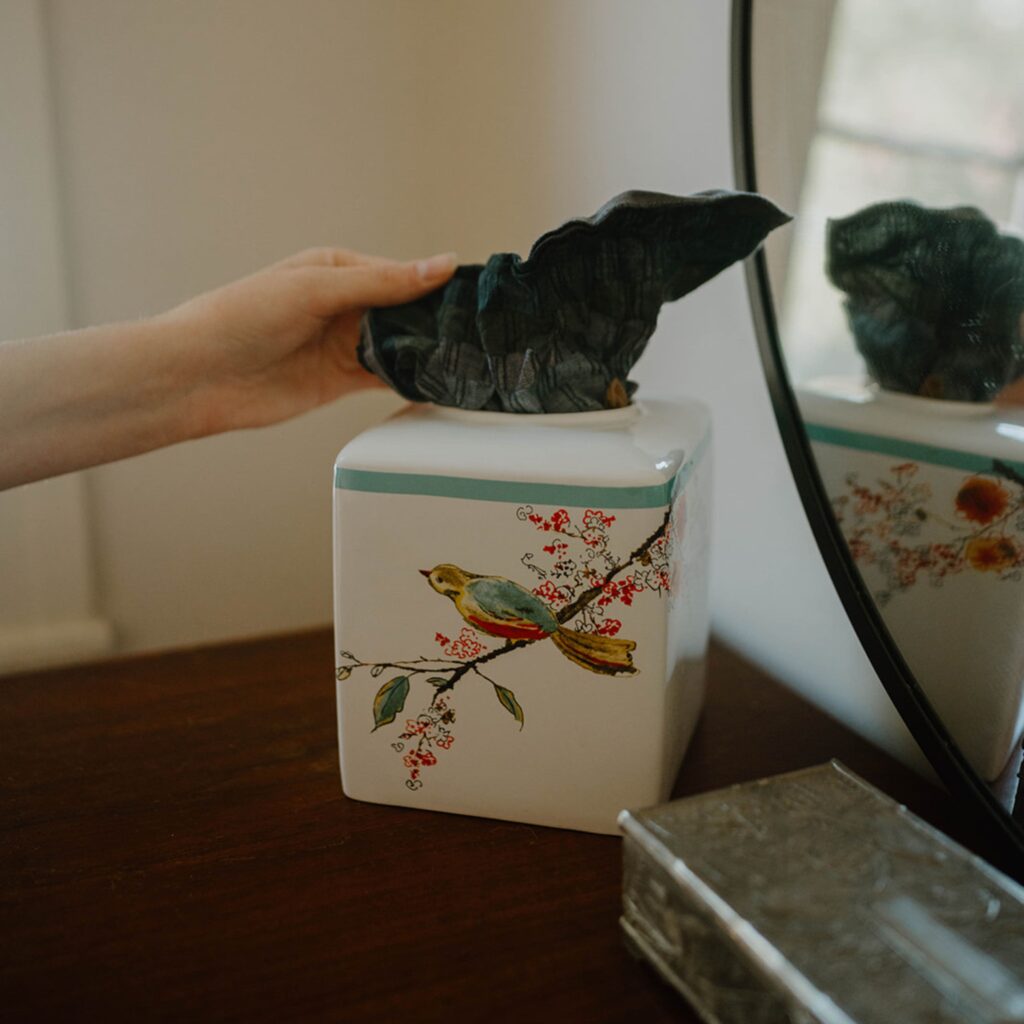
I’ve stopped using tissues and switched over to handkerchiefs instead, which can be washed after use. I fold them in an accordion pattern so when you pull one, it’ll automatically pull the next one out.
I store them in an old porcelain cover box. Many of them are from my grandmother and great grandmother, which is a lovely way of keeping them with me.
21. reusable period products
In the U.S. alone, around 12 billion pads and 7 billion tampons are thrown out every year. Switching to reusable period underwear is a great way to reduce period waste.
I co-founded a period underwear company (Kayaness) with my best friend, Shelby, so I’m a little biased!
But period underwear are wonderful for those irritated by period pads and tampons and want to feel like they’re wearing nothing. Use the discount code kay10 for $10 off your first order!
But reusable pads and menstrual cups are also options for those who prefer extra coverage. Menstrual cups may take some trial and error to find the right fit – but once you do, it will keep for hours!
22. safety razor
Disposable razors don’t work well and rack up in cash. But when you buy a safety razor, it’s not something you’ll have to replace for years (if ever).
All you’ll need to do is replace the razor blades – but those can be recycled. And honestly, I bought a pack of refills back in 2017 that I’m still using – it will probably last me for several more years, seeing as they don’t have to be replaced frequently.
23. glass nail file
Most nail files are flimsy and break after a few uses. However, I absolutely love my reusable glass nail file because I can just wash it clean when I’m done and reuse it without worrying it will break!
24. refillable makeup products
There are so many amazing eco makeup brands making a conscious effort to package their products thoughtfully. I am a huge fan of Kjaer Weis and Zao because they are refillable and made using natural ingredients.

parties and events
Parties can create a large amount of waste, from the food to the decor. But with a little planning, you can prevent this (and still have fun!).
25. reusable plates and cups
Having a stash of plates you keep just for parties is a great idea. Hitting up a thrift shop will deliver affordable results. At the end of the night, ask your friends for help to load up the dishwasher!
For drinks, obviously you can just use glass cups if it’s a dinner party. But if you know guests will be wandering around and may be drinking alcohol, investing in stainless steel pint cups might be for the best. Another option is asking friends to bring their own reusable tumblers!
26. reusable silicone baking cups
If you’re planning on baking for a gathering, especially muffins or cupcakes, consider investing in reusable silicone baking cups! They will save you money, plus you can just wash them for next time (they’re freezer and dishwasher safe too – a plus!).
27. fabric gift wrap
I love wrapping gifts with furoshiki wrap (aka cloth/fabric). You can thrift pretty scarves, sheets and handkerchiefs you use as wraps but make a second gift!
But you can also upcycle gift bags and tissue paper, reusing them over and over again. Reusing packaging paper to wrap your gifts is also charming (keep it plastic-free by tying it together using twine).

office and stationary
28. refillable fountain pen
If you work an office job, you probably go through a lot of pens. But switching to a refillable fountain pen will save you money in the long run! I draw the ink from an ink well.
And if you’re worried you might lose it – when you know an item is valuable, you’re going to treat it a lot better. Plus there are lots of carrying cases you can nab for it on the go.
29. wooden highlighters
Are you constantly highlighting things in college textbooks or in books? Consider switching to wooden highlighters. They don’t bleed through the paper and are completely plastic-free. And yes, reusable, to the last point! They won’t dry out on you either.
30. rechargeable batteries
Switching to rechargeable batteries is such a great way to reduce e-waste, but also saves money in the long run. You won’t constantly be tossing out batteries and can just put them on a charging dock when their juice runs low.
What do you think of these reusable products? Which is your favorite, or what would you add to this list? Let me know in the comments!
The post 30 Things I Reuse Instead of Buying New appeared first on Going Zero Waste.

Last winter, we kept our house at 60 degrees and our electric bill was STILL $280. I’ve been interested in solar for a long time, but on the long list of house projects (especially when you’re restoring a 200 year old house on the historic registry) some are more pressing than others.
But with a few of those major projects wrapping up, and a daunting bill before me, I figured now was the time for a quick google search on solar panels, and let me tell you….. It can be very overwhelming.
Figuring out the rules (cough, cough, historic society), incentives or rebates if applicable, how much it would cost, how much we could save, etc. felt a little like a part-time job. But, one website made it really easy to compare things, and I am happy to be partnering with Aurora Solar to share that site with you.
Because I think you should be able to easily run the numbers on your house without a lot of hassle!

This post is sponsored by Aurora Solar, but all thoughts and opinions are my own.
If you’ve ever gotten a solar quote, there’s a good chance that Aurora Solar was involved. Aurora was founded in 2013 after its co-founders spent seven months trying to design a solar energy system using a patchwork of different tools.
Afterall, designing a solar system shouldn’t be harder than actually installing one. So they built software specifically for solar professionals. Today, more than 7,000 solar organizations use Aurora, and more than 20 million solar projects have been designed using the platform. They are also the largest solar software provider in the world. Their software is used by roughly 80% of the top 75 residential solar companies in the U.S.
All of this tech has been primarily used by professional installers to map your roof and then create a proposal, but now Aurora is offering this tech to us to help compare quotes.
So instead of having to call a bunch of different installers, I could use the Aurora Solar Marketplace to understand my solar potential, compare estimates, understand my possible savings, look into battery storage and other home electrification incentives, and map out different financing options.
1. know how much electricity the system will actually produce
Before you even get into the price, make sure you understand what you’re actually being quoted.
Two solar systems can have very different prices because they may not be the same size or produce the same amount of electricity. A cheaper system might simply have fewer panels and offset less of your electric bill.
With Aurora, you can compare solar estimates and see the system size, energy production, and how much electricity the system should offset.
You can also upload your utility bill to get a solar estimate based more closely on your actual energy usage, to make the quote accurate for you instead of a ‘generic household’.
2. understand the solar payback period
Aurora calculates things like payback period and lifetime savings, which makes it much easier to understand the long-term finances.
The solar payback period is basically how long it takes for your estimated savings to make up for what you spent on the system, and this is the number that surprised me most!
One estimate had a payback period of around 7 years, and another was closer to 11 years! Over 25 years, two of the estimates I looked at had almost a $13,000 difference in projected savings.
Of course, these are still projections as electricity rates can change (HELLO 2026) but when you’re trying to compare two options for the same house, knowing that one is projected to pay for itself four years sooner is pretty useful information.
3. look beyond the monthly payment
Depending on the installer, you may be looking at a cash purchase, solar loan, lease, or power purchase agreement.
But thankfully with Aurora you can compare the different financing options side-by-side which makes it a lot easier to see the trade-offs. One option may have a lower upfront cost, another may have a lower monthly payment, and another may give you better long-term savings.
4. find out which solar incentives actually apply to you
The minute you start Googling solar, you can find federal incentives, state incentives, utility programs, rebates, net metering, and a whole bunch of information that may or may not even apply to where you live.
And some of the articles ranking at the top of Google are several years old! (RIP to the federal incentives canceled at the end of 2025.) But, Aurora can account for solar incentives when calculating the cost and savings of a system, including state, local, and utility-specific programs.
I would still double check any incentive or tax benefit you’re planning to use before signing a contract, especially because programs and eligibility can change, but having all the relevant information in the same place makes the research process much less overwhelming.
5. research the installer, equipment, and warranties
Aurora lets you compare solar installers based on things like reviews, reputation, pricing, and financing options, which I think is just as important as the actual quote.
I’d also look closely at what equipment is included. What panels are they using? What kind of inverter? How long are the equipment warranties? Is there also a workmanship warranty from the installer? Who handles repairs if something goes wrong five or ten years from now?
And, I know I’ve said it a million times, but it’s nice to see it side-by-side without having to fill out a bunch of forms and be hounded on the phone just to get an idea of what solar may look like.
The post How to Compare Solar Quotes: What to Look For Before You Choose appeared first on Going Zero Waste.
How to Compare Solar Quotes: What to Look For Before You Choose
Green Living
Sustainability In Your Ear: XPRIZE’s David Babson on Why Climate Grand Challenges Need Buyers, Too
Buyers contracted nearly 30 million tons of durable carbon removal in 2025, more than triple the 2024 total, according to CDR.fyi data reported by Heatmap. About 90% of those purchases came from a single company, Microsoft, and suppliers delivered only about 450,000 tons during the year. That is a sliver of the six to 10 billion tons of removal a year that climate scenarios suggest the world will need by 2050. The technology to pull carbon out of the air works, but the customers needed to scale it remain scarce.
Our guest today, David Babson, is executive vice president of the Energy, Climate, and Nature domain at the XPRIZE Foundation. He calls the slow progress a market failure, because the technology is progressing faster than it is being adopted. Babson previously led MIT’s Climate Grand Challenges initiative and was a program director at the U.S. Department of Energy’s ARPA-E. His portfolio includes XPRIZE Carbon Removal, which drew 1,334 teams and whose participants have raised more than $3.3 billion. In April 2025, Mati Carbon won its $50 million grand prize for spreading crushed basalt on smallholder farms in India, where the rock locks away carbon dioxide. “If people could make money taking carbon out of the air and putting it underground, as opposed to only being able to make money taking it from underground and putting it in the air, we would be in a better place,” Babson says. Mati is weathering the slump in part because its rock dust also improves soil health and crop yields, giving farmers a reason to participate that doesn’t depend on carbon credit prices.

XPRIZE’s answer is to change what winners receive. Babson describes “mixed purses” that pair a cash award with a guaranteed buyer through an advance market commitment, a power purchase agreement, or an offtake contract. In one thought experiment, a carbon removal prize would come with a separate $1 billion fund raised from credit buyers, which qualified teams could draw on as they deliver verified tons. XPRIZE is applying the same thinking to a planned series of fusion energy prizes, pairing technical milestones with market mechanisms to build the supply chain that commercial fusion will require. The same gap between invention and adoption shows up in other XPRIZE competitions. On September 23, XPRIZE Wildfire awarded about $4.55 million from its $11 million purse, with defense contractor Anduril Industries taking first place in autonomous fire response along with a $1 million Lockheed Martin bonus. Babson expects costs to fall as fire agencies adopt the tools and as startups license individual components into cheaper platforms, though underfunded agencies will need a way to buy the first systems. He also notes that the competition left fuel management and ground-based autonomy for future prizes. Earlier this year, program director Andrea Santy told us that field testing had moved ahead of drone regulations. In biodiversity, Limelight Rainforest won $5 million for surveying 100 hectares of tropical forest in under 24 hours and identifying more than 250 species. Biodiversity still lacks a price, but Babson argues that once ecosystems can be measured, slow-walking policy becomes “a dereliction of what they should be doing.”
We also discuss the tension inside XPRIZE’s vision of “equitable abundance,” including a $101 million Healthspan prize that could add years of consumption to longer lives. Babson argues that abundant, cheap clean energy would let society move beyond efficiency as its organizing principle, powering uses such as indoor vertical farms that could return millions of acres of farmland to nature. You can follow XPRIZE’s new competitions and get involved in its prize ideation workshops at xprize.org.
- Subscribe to Sustainability In Your Ear on iTunes
- Follow Sustainability In Your Ear on Spreaker, iHeartRadio, or YouTube
Interview Transcript
Mitch Ratcliffe 00:36
Hello. Good morning, good afternoon, or good evening, wherever you are on this beautiful planet of ours. Welcome to Sustainability In Your Ear. This is the podcast conversation about accelerating the transition to a sustainable, carbon-neutral society, and I’m your host, Mitch Ratcliffe. Thanks for joining the conversation today.
Let’s talk about the power and the uses of grand challenge programs to kickstart low-carbon industries and respond to the changing environment. Over the past several years, we’ve talked on the show with leaders of grand challenge programs designed to accelerate progress on humanity’s most difficult challenges, from pulling carbon out of the atmosphere to fighting rapidly growing wildfire threats in cities and rural communities. Many of these competitions have been launched by XPRIZE, whose leaders have shared on the show the stories of these competitions as they launched and unfolded.
Today is a chance to take stock, to look back and think about how climate markets, technology, and politics are changing fast, and how that makes this a good moment to ask the question: Are these programs designed to accelerate progress actually delivering that progress?
Our guest today designs XPRIZE’s climate bets. David Babson is executive vice president of the Energy, Climate, and Nature domain at the XPRIZE Foundation. Before XPRIZE, he was the executive director of MIT’s Climate Grand Challenges initiative and a program director at the U.S. Energy Department’s ARPA-E energy technology research agency.
His portfolio includes the largest incentive in prize history. In 2025, Mati Carbon received a $50 million grand prize for their enhanced rock weathering solution for capturing and drawing down carbon, and XPRIZE now reports that companies participating in its programs have raised $3.3 billion. That carbon removal win arrived just as the removal market hit serious turbulence, and as XPRIZE’s wildfire competition wrapped up with its top prize still unclaimed.
So we’re going to discuss what grand challenges can really accomplish, which winners continue to build and which stall, and what the reasons are, as well as the tensions inside a portfolio that funds both climate solutions and longer human lifespans. We’ll get to the conversation right after this brief commercial break. Stay tuned.
[COMMERCIAL BREAK]
Welcome back to Sustainability In Your Ear, and welcome, David Babson, to Sustainability In Your Ear. How are you doing today?
David Babson 03:10
I’m doing well.
Mitch Ratcliffe 03:11
I’m glad to have you here. You’ve run research portfolios at ARPA-E and MIT. What can a prize purse accomplish that a well-funded grant program can’t, or are they complementary?
David Babson 03:22
They’re absolutely complementary. The way that I think about it is that the value of these different mechanisms for promoting innovation is at different parts of the innovation supply chain, if you will. A prize is not a substitute for the very necessary investments that places like governments make into basic, applied, and advanced research. In fact, those types of investments are really valuable for establishing the innovation ecosystems and the technical capacities to eventually win prizes.
Where the prize is very valuable is somewhat downstream: translating technologies, ideas, and innovations that are coming out of academia and labs to market for scale. It challenges the innovators to imagine those technical capacities as solutions to global challenges, and then the visibility that the prize brings to those translations of technologies de-risks funding to flow to those innovators so they can imagine their uses in practice.
So I actually see them as very complementary, particularly when it comes to solutions in the energy and climate space that require rapid