

At the end of the first year in which global average temperatures are almost certain to top the key threshold of 1.5C above pre-industrial times, scientists have sounded the alarm about the extremes of climate and weather we’re already experiencing – and are warning things could get even more serious.
At the same time, they say it’s not too late both to limit the damage by phasing out planet-heating fossil fuels and doing more to protect communities from the dangers of worsening heatwaves, droughts, floods and storms.
After Cyclone Chido, France accused of neglecting climate threat to “fragile” Mayotte
In a report outlining their findings for 2024, researchers collaborating with the World Weather Attribution (WWA) and Climate Central projects said climate change had intensified 26 of the 29 weather events they studied during the year.
Those disasters killed at least 3,700 people and displaced millions – but are only a small sample of what was experienced on the frontlines of a warming world. They included severe floods in eastern Spain, hurricanes in the US, drought in South America’s Amazon rainforest, and flooding across West and Central Africa.
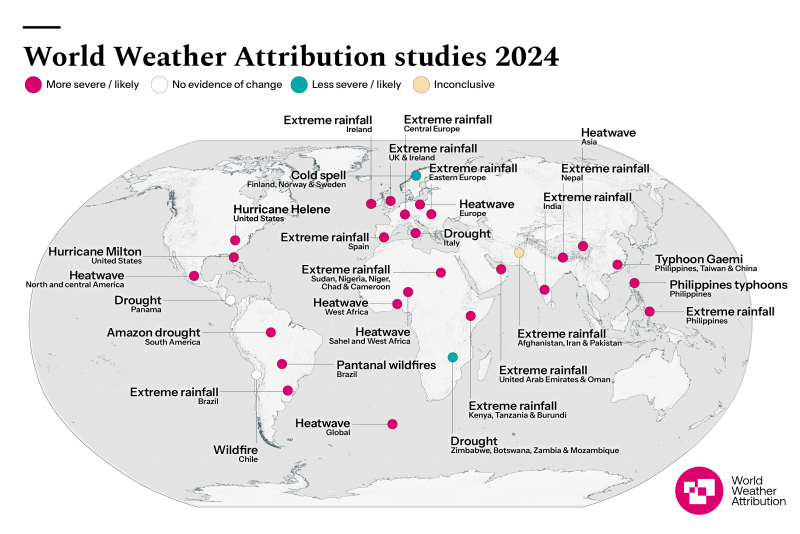
Source: “When Risks Become Reality: Extreme Weather in 2024” report from World Weather Attribution & Climate Central
The scientists also found that people around the world experienced, on average, 41 extra days of dangerous heat in 2024 due to human-caused warming.
Friederike Otto, WWA’s lead and a senior lecturer in climate science at Imperial College London, said the “unrelenting suffering” could be alleviated if we stop burning coal, oil and gas, use renewable energy to power our economies instead, and adapt to climate impacts.
“The top resolution for 2025 must be transitioning away from fossil fuels, which will make the world a safer and more stable place,” she said in a statement.
Here are some key facts and figures from the report:
Heat: Too hot to handle
2024 is set to be the hottest year on record – again. The first six months saw record-breaking temperatures, extending a streak started in 2023 to 13 months. The world’s hottest day in history was recorded on July 22, while a day earlier more than 5 billion people were exposed to high temperatures made at least two times more likely due to climate change.
However, the scientists note that surpassing global warming of 1.5C for a one-year period, as expected for 2024, does not mean the Paris Agreement’s aim of limiting it to that level has failed, because that would require several years with temperatures above 1.5C. “However, it is a warning that we are getting dangerously close,” the report said.
The El Niño climate phenomenon, caused by warmer temperatures in the Pacific Ocean, added some heat in the first half of this year, but rising emissions were the main culprit for so many record-shattering temperatures, it added.
The countries with the highest number of risky heat days were largely small island developing states (SIDS), accounting for 18 out of the top 20. Their residents – also threatened by rising sea levels and powerful storms – experienced more than 130 additional days of dangerous heat in 2024. SIDS, many of them highly indebted, pushed for more financial support for vulnerable countries at COP29 and were disappointed with the outcome.
Flooding: Be warned
The high heat levels of 2024 also translated into record-breaking downpours, as warmer air holds more moisture and hotter seas cause increased evaporation. As a result, devastating floods hit many places worldwide, from Dubai to Kathmandu and Brazil’s Rio Grande do Sul.
The scientists said their work this year highlighted how early warning – and acting on it – often makes the difference between life and death.
In September, for example, four days of record rainfall brought by Storm Boris flooded regions of Central Europe, but people were evacuated days in advance, reservoirs were drained and flood defences built up, meaning that less than 30 people lost their lives.

Source: “When Risks Become Reality: Extreme Weather in 2024” report from World Weather Attribution & Climate Central
Meanwhile, floods in Sudan, Nigeria, Niger, Cameroon and Chad were the deadliest event studied by WWA in 2024, with at least 2,000 people killed and millions displaced. The group found that if warming reaches 2C, which could happen as soon as the 2040s or 2050s, those regions could experience similar periods of heavy rainfall every year.
“Our studies continue to show the need to enhance preparedness for extreme weather to reduce loss of life and damages,” said Julie Arrighi, director of programmes at the Red Cross Red Crescent Climate Centre. “In 2025, it’s crucial that every country accelerate efforts to adapt to climate change.”
Storms: Blown away
Scientists said that as the world and its oceans warm, a bigger share of the most powerful tropical cyclones are reaching category 3 or above (5 being the highest), with faster maximum wind speeds, heavier rainfall and much greater destructive potential.
Other shifts in tropical cyclones include storms strengthening faster, migrating towards the poles and moving more slowly over land, often leading to more severe impacts.
This year the typhoon-prone Philippines was hit by six consecutive storms in just a few weeks from mid-October to mid-November – including three classed as “super typhoons” – affecting 13 million people and killing more than 160. The likelihood of three or more major typhoons making landfall in the Philippines in a given year has increased by about 25% due to human-induced climate change, WWA said.

Source: “When Risks Become Reality: Extreme Weather in 2024” report from World Weather Attribution & Climate Central
Also this year, Hurricane Helene killed more than 230 people after extreme rainfall affected communities in the southern Appalachians, making it the deadliest hurricane to strike the mainland United States since Katrina in 2005.
Drought and wildfires: Drier – and more flammable
Rising temperatures make droughts worse by increasing water loss from soils through evaporation and plant transpiration.
In 2024, the Italian islands of Sicily and Sardinia suffered severe droughts that led to water rationing and huge losses of wheat crops. They were made 50% more likely by climate change, WWA’s study found.
As Earth dries out, countries fail to reach drought agreement
Persistent heat also intensified the devastating drought in the Amazon River Basin this year, provoking concerns about tree dieback in the world’s largest rainforest, which could release large amounts of carbon dioxide into the atmosphere, further accelerating global warming.
Regina Rodrigues, professor of physical oceanography and climate at Brazil’s Federal University of Santa Catarina, said worsening droughts might push the Amazon forest irreversibly into a drier state, reducing its moisture flow and ability to absorb and store carbon, as well as its biodiversity.
“All these critical processes are essential not only locally and regionally but also globally in order to maintain life as we know it. We are already witnessing some of these devastating consequences,” she warned.

Source: “When Risks Become Reality: Extreme Weather in 2024” report from World Weather Attribution & Climate Central
One study published in Nature by an international team this year warned that parts of the Amazon may have already passed a safe boundary, and as much as half of the rainforest could hit this tipping point by 2050 unless deforestation – which harms the forest’s ability to hold water – is halted.
Hot and dry conditions also mean that if fires ignite in forests, the chances of the blazes spreading are much higher and they are far harder to control.
2024 was an extremely active year for wildfires, particularly in the Americas – from Chile and Brazil’s drought-hit Pantanal wetland to western Canada and the United States.
The report said smoke from the fires in North America impacted air quality across the region and as far away as Europe, with recent research suggesting the number of people dying due to inhaling smoke from wildfires is rising due to global heating.
(Reporting by Megan Rowling; editing by Mariel Lozada)
The post 2024: A year of extreme heat and growing climate danger appeared first on Climate Home News.

Climate Change
After a Slow Start on Climate, Zohran Mamdani Faces Scrutiny Over Parks Budget and Environmental Promises
Climate-conscious New Yorkers hope the mayor hasn’t forgotten them.
During his New York City mayoral campaign, Zohran Mamdani courted votes from environmentalists. He promised to expand green spaces in public schools and equip them with renewable energy, to meet the demands of the city’s building electrification laws and to increase investments in city parks.
That would be American ratepayers—i.e., you.
From our collaborating partner Living on Earth, public radio’s environmental news magazine, an interview by Jenni Doering with Katharine Kollins, the president of Southeastern Wind Coalition.
Who Loses in the Trump Administration’s $1 Billion ‘Deal’ to Abandon Offshore Wind?
County officials have said they will eventually close the incinerator, located in a predominantly Black community. Advocates want a concrete plan.
Minneapolis activists are escalating a decades-long fight by going on a hunger strike to demand that local officials shut down a polluting trash incinerator.
Minneapolis Activists Launch Hunger Strike to Protest Polluting Trash Incinerator

After a Slow Start on Climate, Zohran Mamdani Faces Scrutiny Over Parks Budget and Environmental Promises
Who Loses in the Trump Administration’s $1 Billion ‘Deal’ to Abandon Offshore Wind?
Minneapolis Activists Launch Hunger Strike to Protest Polluting Trash Incinerator
-
Climate Change8 months ago
Guest post: Why China is still building new coal – and when it might stop
-
Greenhouse Gases8 months ago
Guest post: Why China is still building new coal – and when it might stop
-

 Greenhouse Gases2 years ago
嘉宾来稿:满足中国增长的用电需求 光伏加储能“比新建煤电更实惠”
-
Climate Change2 years ago
Bill Discounting Climate Change in Florida’s Energy Policy Awaits DeSantis’ Approval
-

 Climate Change2 years ago
嘉宾来稿:满足中国增长的用电需求 光伏加储能“比新建煤电更实惠”
-
Climate Change Videos2 years ago
The toxic gas flares fuelling Nigeria’s climate change – BBC News
-

 Renewable Energy6 months ago
Sending Progressive Philanthropist George Soros to Prison?
-

 Carbon Footprint2 years ago
US SEC’s Climate Disclosure Rules Spur Renewed Interest in Carbon Credits