



- What timeline options were delegates debating?
- How did the timeline discussions unfold?
- What were the main points of disagreement?
- Why is the IPCC in a ‘serious funding crisis’?
- How have scientists reacted?
- What other issues remain unresolved?
- How are the IPCC AR7 reports progressing?
- How might the IPCC use AI and enhance gender inclusivity?

The president of the next UN climate summit, Cop28, has told government negotiators they must agree how to set up a new loss and damage fund before leaving the Egyptian city of Aswan.
The United Arab Emirates’ Sultan Al Jaber addressed the 24 members of the transitional committee by video link on Friday morning, the last official day of talks.
At Cop27 in Sharm el-Sheikh, governments tasked the committee with working out what a new loss and damage fund for climate victims should look like and present their proposals to Cop28 in November.
The fund is supposed to channel money to people who have suffered loss and damage caused by climate change. This could mean rebuilding homes after a hurricane or supporting farmers displaced by recurrent drought. Failure to reach consensus risks delaying support to those in need.
But developing countries were incensed by a proposal to host the fund at the World Bank, painting it as a US power grab. And rich-poor divides persisted on how to define the “vulnerable” groups eligible for funds and who gets to control spending.
Al Jaber accused the negotiators of dragging their feet and told them not to leave this task to ministers. “I expect you to deliver,” he said. “If I don’t see real and tangible results, that will not be acceptable.”
The committee was supposed to have three meetings this year but added a fourth to try and resolve deep splits between developed and developing countries.
As open negotiations resumed on Friday afternoon, that extra meeting was expected to run into extra time. Al Jaber said the Egyptian hosts could facilitate “extra hours or even an extra day in Aswan”.
Deal with the devil
Pedro Luis Pedroso Cuesta is a Cuban diplomat and chair of the G77+China bloc, which represents all the developing countries.
Speaking from Aswan, he told reporters on Thursday: “At this late hour, a small group of nations responsible for the most significant proportion of the stock of greenhouse gases have tried to bargain potential support for a Fund on one side with eligibility and administrative arrangements.”

Pedro Luis Pedroso Cuesta represents 136 developing countries (Photo credit: UN Geneva)
Referring to the 16th century tale of Dr. Faustus, who sold his soul to the devil, he said: “Accepting this Faustian bargain now would break the Cop when we need the greatest internationalism and solidarity to solve climate and other global challenges”
He told reporters that he did not want to single out any country but “since you’re asking, we have been confronted with an elephant in the room – and that elephant is the US”. He said they came to the talks with a “fixed idea” that the World Bank should host the fund.
World Bank controversy
Developing nations have argued that the World bank is too slow, inefficient, unaccountable and lacks the organisational culture to tackle climate change.
World Bank officials addressed negotiators questions in a closed-door meeting in Aswan on Tuesday but Cuesta was not impressed.
He said that consultations with the Washington-DC based bank had “displayed clearly” that it was “not fit for purpose in relation to what we’re looking for” and the fund should be set up as part of the United Nations instead.
China’s Belt and Road gets ‘green’ reboot and spending boost
He pointed out that the World Bank only added tackling climate change to its mission last week and said this showed they lacked the “operational culture” of climate action.
With the World Bank as host, he said, the fund would not be legally or operationally independent from the bank.
“We know the history”
The bank was set up by the US and its allies after the second world war and the US is still its biggest shareholder and chooses who leads it. “We know the history. We know the politics. We know the manipulation,” said Cuesta.
He added that, under the bank, the fund also wouldn’t be accountable to all governments through the Cop climate talks and the United Nations Framework Convention on Climate Change.
Developed countries have argued that setting up a new independent fund would take longer than having the World Bank host it. But Cuesta said it would be “naive” to believe that speed is rich nations’ real motivation.
The talks’ co-chairs released a draft text on Friday morning. Climate Home has seen it and it includes four options.
The fund could be hosted by the World Bank, with or without conditions. It could be an independent institution or there could be an open process to select the fund host.
Who benefits?
The second main division is over which countries are prioritised for funding. Developed countries want the funds to be allocated “based on vulnerability”.
There is no clear definition of vulnerability and Cuesta said this criteria would impede the fund’s ability to respond to recent climate-related floods in middle-income countries like Pakistan and Libya.
Developing countries fear that in practice “vulnerability” criteria mean funds will be restricted to just the world’s least developed countries (LDCs) and small islands developing states (Sids).
The 46 LDCS are mostly in Africa and parts of Asia. Major nations like China, India, Brazil, Nigeria and South Africa are neither LDCs or Sids.

A map of the world’s least developed countries, as defined by the UN. The map does not include Sids. (Photo credit: Unctad)
Further splits include developing nations wanting a target of $100 billion of funding a year by 2030 to be included and developed countries wanting to earmark budgets for slow onset events, recovery and reconstruction and small countries.
Negotiators have almost agreed one thorny issue though. The US had pushed for the fund’s board to include seats for nations that paid into the fund, sparking accusations that they were trying to rig the board in rich nations’ favour.
Friday morning’s draft said there would be 12 board members from developed countries and 14 from developing ones. There could also be non-voting members representing indigenous peoples and climate-induced migrants, although negotiators have yet to agree that.
The post World Bank controversy sends loss and damage talks into overtime appeared first on Climate Home News.
World Bank controversy sends loss and damage talks into overtime
Continue Reading
Three countries have been named by the Paris Agreement’s compliance committee for failing to submit a nationally determined contribution (NDC) and repeatedly snubbing offers of help with their climate plans.
After months of internal debate over whether to identify serial non-responders, the Paris Agreement’s Implementation and Compliance Committee (PAICC) named the three countries which have failed to engage with it over their NDCs on Friday.
It named Democratic Republic of Congo, Senegal and North Korea in a footnote of its annual report, adding that it decided to name them “with a view to facilitating engagement”, adding that representatives of the three nations had been invited to its meeting in early 2027 “with the purpose of identifying any challenges and constraints”.
“The Committee noted the importance of Parties engaging with the Committee in a timely manner, while noting that some delays may be due to the national capabilities and circumstances of the Parties”, the report said.
-
Under US pressure, World Bank says it will back gas “where appropriate”
The US wants the World Bank to expand its gas support while climate campaigners are pushing for it to end – its head spoke this week of limited backing for the fossil fuel -
IPCC scientists vow to press on with climate reports despite political deadlock
After governments again failed to agree a timeline, nearly 120 IPCC authors pledged to complete their assessment on time and with full scientific rigour -
Paris Agreement committee snubbed over missing NDC climate plans
Many governments have still not submitted a nationally determined contribution to the UN, breaching a key requirement of the Paris Agreement
In July, PAICC said 12 countries had ignored its repeated attempts to discuss why they had not published an NDC as required every five years under the 2015 Paris accord.
Members of the committee had been divided over whether to name them, but at a September meeting decided to do so in their annual report to the annual climate COP summit.
By the time the report was published on Friday, only Congo, Senegal and North Korea “had not communicated an NDC or submitted a [Biennial Transparency Report] and had not yet responded to any of the Committee’s notifications, despite several reminders issued by the Committee in this regard”.
Rainforest and renewable energy ambitions
The silence from Congo and Senegal is notable because the former is home to much of the Congo Basin rainforest while the latter has sought billions of dollars in climate finance to support its renewable energy ambitions.
After Brazil, Congo has more rainforest than any country in the world. This forest, and the country’s peatlands, absorb huge amounts of greenhouse gas but are fast being lost to expanding farmland, charcoal production, logging and mining.
Senegal signed a Just Energy Transition Partnership with Canada and wealthy European nations in 2023, to help it meet its renewable energy targets under the-then government of Macky Sall. It was chair of the Least Developed Countries group between January 2022 and December 2023.

Tejas Rao, who is researching the PAICC as part of a doctoral thesis at Cambridge University, said the governments of the three countries should engage with the committee.
“Engagement costs these governments very little and the committee has shown it will listen,” he said.
“Silence leaves the committee with no basis to help, and it leaves the [governments] exposed to the narrative that they are simply disengaged,” he told Climate Home News.
Paris Agreement requirement
The 2015 Paris Agreement requires all parties to publish an NDC every five years outlining their emissions reduction targets, with each plan meant to be more ambitious than the country’s last NDC.
The latest set – the third round of plans, with new targets for 2035 – was due in February 2025. While most countries missed this deadline, all but around 30 – mostly small emitters but including Egypt, Vietnam and Argentina – have now submitted them.
Over the year, the PAICC – which is made up of government climate officials from developed and developing countries – has been communicating with governments that have not submitted NDCs and trying to overcome barriers to them doing so.
Some nations have cited exceptional circumstances as the reason for not submitting an NDC, a process that requires a significant amount of work in tracking emissions and consulting on how to curb them across the economy. For example, a letter from a Sudanese official to the PAICC, seen by Climate Home News, said that the country’s civil war had led to the suspension of its NDC preparation.
-
IPCC scientists vow to press on with climate reports despite political deadlock
After governments again failed to agree a timeline, nearly 120 IPCC authors pledged to complete their assessment on time and with full scientific rigour -
Under US pressure, World Bank says it will back gas “where appropriate”
The US wants the World Bank to expand its gas support while climate campaigners are pushing for it to end – its head spoke this week of limited backing for the fossil fuel -
Who shapes climate science? The equity question facing the IPCC
Early completion of the next global climate science assessment reports risks excluding research from the Global South, which is key to ensuring the findings are fair
The US and Iran are not signed up to the Paris Agreement and so do not have active NDCs, nor does Taiwan, which is not a UN member state.
Rao said that because the PAICC is “facilitative and non-punitive”, naming the countries “is meant to open a door, not close one – the invited consultation is the point”.
“In recent months, governments that explained their constraints, whether capacity, finance or domestic process, have been met with follow-up and support rather than sanction, and the number of silent governments has fallen sharply,” Rao said.
The post Paris Agreement committee names three countries snubbing it over NDCs appeared first on Climate Home News.
Paris Agreement committee names three countries snubbing it over NDCs
Countries have failed – for the sixth time running – to agree on the timeline for publishing the Intergovernmental Panel on Climate Change’s (IPCC) next set of influential reports.
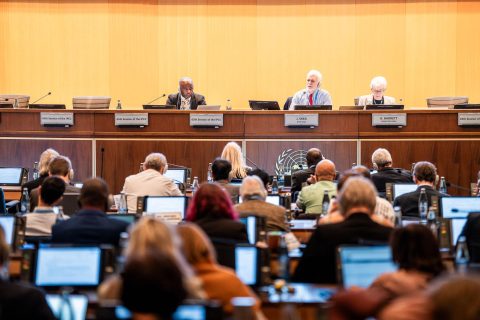
The IPCC’s 65th session (IPCC-65) was seen by many to be the final opportunity for countries to agree on a schedule where its seventh assessment report (AR7) would be published in time for the UN’s second “global stocktake” of climate action.
Before last week’s meeting in Addis Ababa, Ethiopia, IPCC chair Prof Sir Jim Skea had warned that releasing the reports in time for the stocktake in 2028 would depend on a timelines being agreed by the end of 2026.
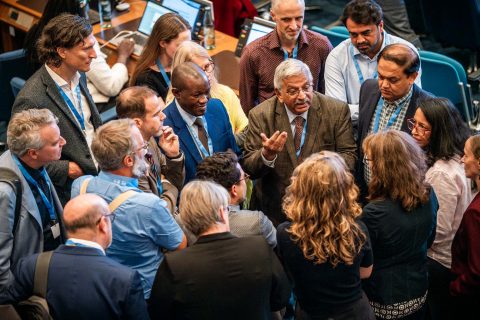
But the week-long meeting descended into fraught disagreements between governments, resulting in Skea “suspending” the talks on Friday evening with no decision made.
Countries were also unable to agree on the IPCC’s budget for the rest of the AR7 cycle, leaving the body with a “serious funding crisis”.
The IPCC has pledged to reconvene the meeting at the “earliest opportunity”; however, it has not yet given an indication of when this will be.
In his concluding remarks, Skea described the Addis Ababa summit as a “profound disappointment” and “among the most difficult IPCC meetings”, according to reporting from the Earth Negotiations Bulletin (ENB).
Some countries have reacted with dismay to the breakdown of negotiations, warning that a failure to have the IPCC’s latest assessments on climate adaptation and mitigation ready for the UN stocktaking exercise would undermine global climate action.
A climate envoy from a Pacific island state said i