

Ana Yang is Director of the Environment and Society Centre at Chatham House.
In recent months, Brazil has been portrayed by the media, activists and other commentators as either angel or devil.
On the one hand, the country that houses 60% of the Amazon rainforest and an enormous wealth of biodiversity is touted as a climate champion, progressive host of the next UN climate talks, the potential saviour of multilateralism.
On the other, the fifth-largest and seventh-most populous country in the world is demonised as hypocritical for pursuing oil exploration and production, investing in agriculture as a key export industry, and – most recently – building a new road on the outskirts of the northeastern city of Belem, which will host the COP30 UN climate summit in November.
As a Brazilian working and living in London, this is a deeply familiar and frustrating story of a developing nation that cannot be trusted to act in its own interests on climate change, nor in those of the world. It is a story that holds low- and middle-income countries to different standards from rich ones, and denies them the same rights and routes to development.
Oil production supports development
Recent criticism of Brazil’s decision to join the oil producers club, OPEC+, and of President Lula’s support for a new oil project typify this gleeful tendency to attack pragmatic leadership and deny political complexity. Such criticism is not only condescending, but counterproductive and short-sighted.
By joining OPEC+ Brazil – with only 4% of global oil production and less than 2% of global trade oil – gets to be part of the club of countries that dictates oil prices. Crude oil is Brazil’s main export commodity, with China its main customer. Joining OPEC+ is a geopolitical move by a middle power designed to support commercial interests and trade diversification.
The Amazon rainforest emerges as the new global oil frontier
Of course, rapid decarbonisation is imperative if the world is to limit global warming to 1.5 degrees Celsius above pre-industrial levels, as per the Paris Agreement. But just as other countries scramble to balance climate goals against other policy objectives, including the opportunities of investment in fossil fuels, or provision of infrastructure, so too should Brazil be able to determine its own path to net zero.
Brazil, a country at the forefront of the climate crisis, whose wealth is concentrated in its abundant natural resources, knows full well the importance of a managed fossil-fuel phase-out. The climate transition and decarbonisation is owned at the highest political level. The country already generates over 90% of its electricity from renewable sources, and has per capita emissions well below the global average.
But President Lula was also elected on a promise of addressing the deep inequality, poverty, hunger and other challenges affecting the Brazilian population. Oil production and exploration contribute to the national coffers and help pay for the national health service, anti-poverty initiatives, and climate adaptation actions.
If we genuinely want to support and encourage progress, we cannot expect Brazil to forgo its biggest commodity overnight. Instead we need an approach which acknowledges that policy-making is a game of balancing competing demands.
No one-size-fits-all path to decarbonisation
Indeed, the truth is that, with three quarters of its emissions coming from deforestation and agriculture, Brazil’s decarbonisation challenge lies less in oil production and more in land use. To effect an equitable and low-carbon transition, the country will need to move away from a deforestation-based agriculture production model, cut methane from cattle herds and reduce reliance on fertiliser.
Its farmers – from large to micro producers – will need to shift to integrated land management approaches that enable the protection of nature. And the country will need to continue to expand renewable energy capabilities while ensuring benefits are shared with local communities, and invested in climate adaptation.
“Not silver bullets”: COP30 CEO downplays impact of yearly climate summits
As for the international community, supporting Brazil as COP30 host means being inclusive rather than prescriptive. It means engaging the COP30 Presidency on areas of mutual interest and bringing the private sector along. It means offering solutions for climate and nature finance, focusing on the link with inequality, and aligning net-zero target dates with Lula’s own plans. It also means rich countries keeping their promises on climate finance.
There are so many expectations around Brazil’s presidency of COP30, some unrealistic. But there are clear opportunities to make progress on climate finance, on emissions reduction targets and on nature. With the right sort of engagement from the international community and the private sector, Brazil will be able to start delivering on its climate promises, setting an example for others to follow.
At its best, COP30 could kick off a decade of action, where the economic opportunities of the energy transition are turned into reality, and the polarised narrative of growth vs. climate action is consigned to history.
To realise this potential, Brazil needs constructive partners who understand that decarbonisation is not a one-size-fits all policy. In a context of heightened geopolitical instability and competing fiscal pressures, collaboration between coalitions of the willing, characterised by mutual respect, must be at the heart of climate action in 2025 and beyond.
The post Why accusations of Brazilian hypocrisy on climate are ill-judged appeared first on Climate Home News.
Why accusations of Brazilian hypocrisy on climate are ill-judged

The conference is one of the largest aimed at preparing for hurricane season, which begins June 1. A task force report on potential reforms to the agency also remains on hold.
ORLANDO, Fla.—A major conference to help communities prepare for hurricane season kicked off Monday without the agency that coordinates federal disaster response.
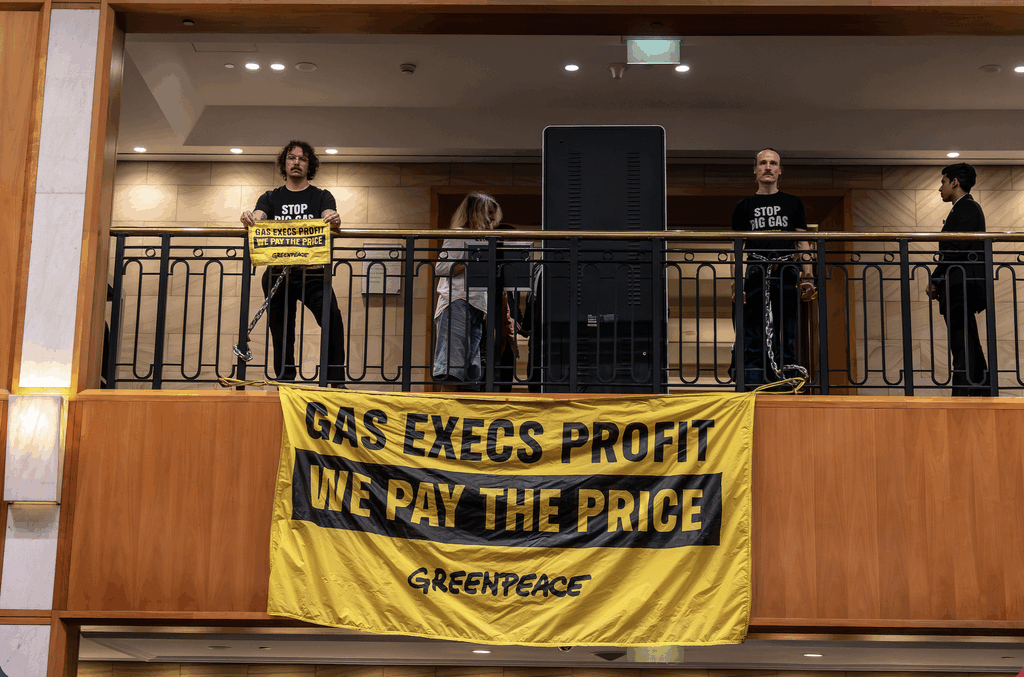
Right now, Greenpeace activists are standing up to Big Gas at a major gas conference in Sydney.
Inside the Sheraton Grand Hotel, executives from fossil fuel companies have gathered alongside lobbyists, investors and political allies to plan the future of gas in Australia – and how to maximise their profits.
So Greenpeace has stepped in to call it out. Activists have dropped a banner inside the venue with a clear message: Gas Execs Profit. We Pay The Price.
We need your help to spread the message that we won’t stand by and let this happen.
What’s really going on
Gas corporations are making billions in windfall profits from global conflicts – from Ukraine to Iran – while Australians pay the price with higher energy bills and climate damage.
And they want more.
More drilling. More exports. More profit.
Why Greenpeace took action today
This conference is where it all comes together. Behind closed doors, gas executives, lobbyists, investors and political allies are meeting to push for more gas expansion, no doubt using global instability as their justification.
That’s why Greenpeace couldn’t let this gathering go uninterrupted.
Big Gas is counting on people not paying attention. Let’s prove them wrong.
Share the video to call out Big Gas.
What needs to happen now
Gas is expensive. It’s volatile. And it ties our energy system to global instability.
But there is a better way. Renewable energy is already cheaper, more reliable, and made right here in Australia. It’s the fastest path to lower bills, real energy security and a safer climate.
To get there, we need to:
- properly tax the gas industry and its exports
- stop expanding gas
- and speed up the transition to homegrown renewable energy.
Share this video far and wide to show just how much support there is to tax Big Gas properly and speed up the transition to renewable energy.
This is just the beginning
This action is part of a growing movement to stand up to Big Gas and challenge the power it holds over our government and society. The Federal Government has a role to play – starting by taxing gas corporations properly and then accelerating the transition to homegrown renewable energy.
Together, we can show just how much support there is for change and make it impossible for decision-makers to ignore.
What you can do
- Follow along on our social channels.
- Share the video far and wide to show how much support there is.
- Sign the petition to tell Albo to stand up to Big Gas – because if we can, he can.
BREAKING: Greenpeace activists disrupt major gas conference in Sydney
SYDNEY, Tuesday 31 March 2026 — Two Greenpeace Australia Pacific activists have been arrested following a peaceful protest at the Australian Domestic Gas Outlook conference in Sydney, where they dropped a banner that said — “Gas Execs Profit. We Pay The Price” and held banners saying “Tax Gas Profits”.
Photos and B Roll video of the protest and arrests are available here
Live updates on Greenpeace Instagram
The two activists were arrested by police around 9:00am AEDT and taken to Day Street Police Station. Information on this morning’s gas conference disruption can be found here.
Solaye Snider, Campaigner at Greenpeace Australia Pacific, said: “Greenpeace activists have taken a strong stand today against profit hungry gas corporations and lobbyists, who see horrific global wars as an opportunity to price gouge and profiteer, while everyday people pay the price.
“Australians have had enough of gas corporations like Santos and ConocoPhillips ripping us off, leaving us with nothing but empty pockets and climate damage. The gas industry is aggressively lobbying against being fairly taxed and pushing to drill for more gas. Change requires showing up and speaking out, and that’s what these activists have done today.
“Greenpeace Australia Pacific stands by our activists, and stands with all communities who are peacefully fighting for a safe and clean energy future. The right to peaceful protest is a fundamental pillar of a healthy democracy and a basic right of all Australians.”
-ENDS-
Media contacts:
Lucy Keller: +61 491 135 308 or lkeller@greenpeace.org or Kate O’Callaghan: +61 406 231 892 or kate.ocallaghan@greenpeace.org
Greenpeace activists arrested after disrupting major gas conference in Sydney



-
Greenhouse Gases8 months ago
Guest post: Why China is still building new coal – and when it might stop
-
Climate Change8 months ago
Guest post: Why China is still building new coal – and when it might stop
-

 Greenhouse Gases2 years ago
嘉宾来稿:满足中国增长的用电需求 光伏加储能“比新建煤电更实惠”
-
Climate Change2 years ago
Bill Discounting Climate Change in Florida’s Energy Policy Awaits DeSantis’ Approval
-

 Climate Change2 years ago
嘉宾来稿:满足中国增长的用电需求 光伏加储能“比新建煤电更实惠”
-
Climate Change Videos2 years ago
The toxic gas flares fuelling Nigeria’s climate change – BBC News
-

 Renewable Energy5 months ago
Sending Progressive Philanthropist George Soros to Prison?
-

 Carbon Footprint2 years ago
US SEC’s Climate Disclosure Rules Spur Renewed Interest in Carbon Credits