

As oil companies pull out of Argentina’s oil heartland in the Patagonian province of Chubut, workers and communities are struggling to secure their future, with little say in the decisions being made about it.
“The impacted are fragmented, the exploiters organised,” said José Glinski, a member of parliament from the province.
In Comodoro Rivadavia, where Argentina’s oil industry began in 1907, those words carry particular weight. For nearly 120 years, oil has shaped the city’s economy and that of Chubut province, which helped power Argentina for decades. Now the companies that built their fortunes there are shifting their investments elsewhere, threatening an economy that has depended on oil for generations.
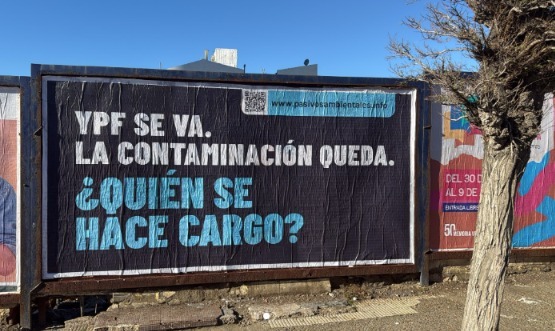
Argentina’s national oil company, YPF, whose roots lie in Comodoro Rivadavia, is selling off its mature oilfields in the region to concentrate investment in the shale oil and gas reserves of Vaca Muerta, further north. According to Glinski, around 10,000 direct jobs have gone in Chubut, and unemployment has climbed from 2% to 10% in a single year.
“And this while all remaining companies have kept extremely high levels of profit,” he said.
COP31 Briefing: What to expect from the Antalya climate summit?
Glinski blames government policy as much as the companies. “Companies are choosing to leave and the government lets them do so, while weakening tax and environmental regulations, leaving the city without the necessary income to organise the transition.”
Nobody has yet worked out who will clean up the old fields and more than 6,000 wells, look after the workers who remain, or pay for whatever comes next.
Comodoro Rivadavia is not alone. From Mejillones and Tocopilla in Chile to La Guajira in Colombia and Appalachia in the United States, from Scotland to Mpumalanga in South Africa and East Kalimantan in Indonesia, places built around fossil fuels for generations face some version of the same problem. As investment moves elsewhere, plans to protect workers, support communities and repair damaged land often lag far behind, if they exist at all.
Building an economy beyond fossil fuels
In Comodoro, as locals call the city, the community has not been passively waiting for oil to run out.
“We have looked into multiple alternatives for the territory, including building on geothermal capacity, an agricultural programme that could reinforce food security and focus on cultures that are not too water dependent, and exploring also aquaculture built on local species,” explained Ruben Zárate, who heads Comodoro Conocimiento, a public agency created by the municipality to develop economic opportunities. “The only alternative is economic diversification.”
But having ideas is one thing. Finding the money and securing the political support to put them into practice is another. In many countries, decisions that shape a region’s economy are made in the capital or in company boardrooms, and local authorities have little say, and few resources, when a major employer pulls out.
Glinski points to deals struck at the national level that leave communities without a meaningful say in decisions affecting their future.
“Some of the barriers relate to the absence of regulation of private actors which have negotiated conditions at the national level that prevent provinces or territories from capturing benefits that could be useful to fund the transition,” he said. “Comodoro had no voice in these deals.”
One example is Argentina’s Large Investment Incentive Regime, known as RIGI, which offers substantial tax benefits and regulatory guarantees to major investors. Argentina’s Fundación Ambiente y Recursos Naturales (FARN) has warned that this regime could also give large projects preferential access to water and energy at the expense of local communities and businesses, making it harder for regions to diversify their economies.
At root, it’s a question of power: who controls the money and the decisions, and whether the people who kept these industries running for generations have any control over what comes next.
“Comodoro, like most territories that developed around fossil fuels, is heavily dependent. Everyone knew the oil business would end, but none planned for it,” said Antonella Risso, a climate expert and community member. “Comodoro deserves a bright future. Its people have the capacity to chart a future for its next hundred years – a real Just Transition”.
What COP31 could do
Last year in Belém, governments agreed to develop a Just Transition Mechanism. At COP31 in Antalya they will negotiate how it should work, and civil society is pushing for a strong Belém-Antalya Mechanism (BAM) that can help channel resources for action on the ground.
Camila Mercure, a climate policy officer with FARN and a coordinator of CAN’s Just Transition working group, said, “For a city like Comodoro Rivadavia, the BAM could mean support to develop diversification plans, assess viable alternatives, and access public, grant-based finance to put them into practice.”
“Workers and communities must have a meaningful role in shaping these plans, building on local knowledge and priorities. The aim should be to create decent livelihoods beyond fossil fuels and avoid alternatives that reproduce the same economic dependence, inequalities and environmental harm,” she said.
Why COP31 needs to start talking about just transition finance
The BAM could also put regions in touch with each other. Officials in Patagonia, northern Chile, Mpumalanga or East Kalimantan are wrestling with many of the same questions, and sharing what has worked would spare them from starting from scratch.
Then there are the companies. Fossil fuel producers should not be able to walk away from their workers, their environmental obligations and the towns that depended on them. The BAM could help regions share experiences and develop ways to hold companies accountable, ensuring they plan ahead and pay their fair share of the transition costs.
In Comodoro Rivadavia, the transition has already begun, without the community’s consent and with little support. COP31 is a chance to help places like it plan ahead, before the last company leaves rather than after.
The post When the oil companies leave, who pays? appeared first on Climate Home News.
https://www.climatechangenews.com/2026/11/05/when-the-oil-companies-leave-who-pays/

SYDNEY, Friday 27 November 2026 — In response to the Federal Government today announcing public consultation on a proposed bilateral agreement for approval of native forest logging with the Tasmanian Government, the following statement can be attributed to Adele Chasson, Nature Policy Lead at Greenpeace Australia Pacific:
“The Tasmanian Government has a proven track-record of reckless disregard for the state’s precious native forests, and for decades have given the logging industry the green light to tear through critical habitat of threatened species like swift parrots and Tasmanian devils, threaten water sources, damage cultural heritage and deplete carbon stores.
“The Federal Government has the extraordinary opportunity to implement our new national nature laws to finally protect the incredible Tasmanian wilderness, but that would be undermined by allowing native logging to continue unchecked. The Tasmanian government cannot be trusted to do it themselves.
“The Federal Government must address deep-rooted problems with the Tasmanian system governing forestry, particularly its governance failures and mismanagement of species habitat, and step up protection for forests as it looks to bring forestry under the new nature laws.
“Native forest logging is a national shame and it must end across Australia. Governments need to get on with the urgent job of protecting Australia’s extraordinary forests and wildlife for good.”
-ENDS-
Tas govt ‘cannot be trusted’ in new proposed native forest logging sign-off
Climate Change
“Absurd” environmental green light for Australia’s most polluting AI data centre proposal shows urgent need for moratorium
SYDNEY, Friday 27 November 2026 — In response to an Anthropic-backed $32 billion AI data centre proposal in Queensland being given the environmental green light by the National EPA, Greenpeace Australia Pacific has renewed calls for an urgent moratorium on AI data centre approvals and construction.
The Zerra-DC Western Downs Digital Park proposal in Queensland has been ranked as the most polluting data centre proposal in the country by the Climate Council. The AI data centre would have a maximum power demand of 3.24 gigawatts (GW) and Zerra-DC has not ruled out building dedicated on-site gas generation for power.
Joe Rafalowicz, Head of Climate and Energy at Greenpeace Australia Pacific said: “For the most polluting AI data centre proposal in the country to be given the environmental green light shows the desperate need for a moratorium on the construction of these monstrosities until appropriate safeguards are put in place.
“It is frankly absurd that this proposal has been waved through when this data centre alone would use more energy than six million homes. That energy has to come from somewhere, and because the Federal Government has given a free pass to Queensland to use coal and gas to power data centres, it will increase the cost of electricity for everyone else and the pollution it creates will turbocharge climate disasters like floods and extreme heat.
“Australia desperately needs national legislation to manage the frenzied build-out of AI data centres, and until then we need a moratorium on new approvals. Right now it is a free-for-all with these resource-hungry mega data centres locking in access to water, power and land with minimal safeguards and input from local communities.
“As the Federal Government prepares to introduce new legislation for the regulation of AI data centres in the new year, they need to remember they serve the Australian people, not Big Tech. They must introduce a strong national framework that at a minimum forces AI data centres to build their own renewable energy, excludes projects which impact water resources, and makes operators genuinely consult with local communities.
“Australians should not be forced to absorb the economic, environmental and social costs of data centre expansion.”
-ENDS-
Media contact
Lucy Keller on +61 491 135 308 or lucy.keller@greenpeace.org
Dan Ioschpe is the Climate High-Level Champion for COP30.
A year ago at COP30 in Belém, we said this would be the decade of implementation for climate action. Simply put, implementation is the fastest way to promote sustainable socio-economic development. But implementation is not about words. It is about action, on the ground, at speed and scale.
COP31 in Antalya demonstrated why the implementation of the Paris Agreement must extend well beyond the two weeks of a climate conference. Despite political divisions, businesses, investors, governments, cities and communities came with results and remained committed to scaling climate action, showing that the real economy does not wait.
That is why continuity matters. In Belém, the Global Climate Action Agenda was given a new structure, with six thematic axes, and Plans to Accelerate Solutions (PAS). Because that structure carries work from one COP to the next, progress can compound. And progress is now something we can measure.
This year’s Yearbook of Global Climate Action shows that 87% of PAS reported progress, while 38% of the 40 with quantitative targets are on track or ahead of their goals. It highlights where the gaps remain.
Grids stretching halfway around the world
The strongest signal from Antalya came from electrification. The Electrification Delivery Package brings together more than 200 actions from over 180 organisations, involving over 150 countries plus the European Union – together over two-thirds of global GDP – and more than 260 businesses with over $4 trillion in annual revenue.
The results are already visible on the ground. Members of the Utilities for Net Zero Alliance built more than 21,000 kilometres of grid in 2025, up from 14,000 km the year before – enough to stretch halfway around the world. From grids, storage and renewable power to energy access, the foundations of a modern, interconnected system are coming together at speed and scale.
-
Australia and South Korea’s clean energy deal could boost low-carbon trade
The deal aims to connect Australia’s renewable resources with Korean industries’ clean energy demand, potentially transforming a relationship built on coal and gas -
After COP31, our chance to save climate diplomacy lies in global shipping
If COP31’s high ambition countries can show the same resolve at London shipping talks, a climate breakthrough is possible next week

The Global Climate Action Agenda is helping connect these investments and shift from individual solutions to economy-wide transformation. Electrification is simply the fastest way to foster sustainable socioeconomic development – efficiently, affordably, and securely.
On transport, 13 zero-emission freight corridors are now in development across six continents, covering more than 29,000 km of roads. That is already ahead of the Global Green Road Corridors Initiative’s goal of ten corridors by 2026.
Sustainable aviation fuel starts to take off
Progress is also visible on sustainable aviation fuel (SAF), a solution approaching a positive tipping point. One in three new sustainable industry investment decisions this year was for SAF, a sign of how quickly the market is developing, including through an Action Agenda plan to decarbonise aviation.
Projects that have reached final investment decision represent around 7 million tonnes of SAF a year, or 3% of today’s jet fuel use. But the wider pipeline stands at 31 million tonnes – around 11% of the existing market. Once sustainable solutions capture 5-10% of an established market, growth can become self-reinforcing as costs fall, supply chains mature and investors gain confidence. Across heavy industry more broadly, 36 deep decarbonisation projects reached final investment decision this year – a record.

On nature, the Tropical Forest Forever Facility has reached $8.3 billion in commitments towards its $10-billion initial target, and the Global Fund for Coral Reefs announced $30 million in new reef financing across 22 developing countries.
With the launch of the Rio Synergies Group for Action, implementation will be at the centre of the three Rio Conventions on climate, biodiversity and land, and 17 governments are now backing the Intergovernmental Land Tenure Commitment to strengthen the rights of Indigenous Peoples and local communities.
On food and agriculture, solutions range from methane-reducing practices reaching more than 5,000 smallholders to food recovery initiatives now reaching 40.5 million people, cutting food waste and emissions at the same time. Some 66 million hectares are now under regenerative landscape projects.
Accelerator to support two solutions per year
Antalya also laid the groundwork for progress. Mandated by the Mutirão Decision in Belém, the Global Implementation Accelerator established its governance and operational framework at COP31. Each year, two solutions – one on mitigation and one on adaptation – will be selected for coordinated support, informed by independent expert assessment and mobilising the capabilities of a dedicated partner network.
The Accelerator builds on the Action Agenda, bringing governments, businesses, finance and technical expertise together to accelerate solutions with the potential to reach positive tipping points.
None of this happened by accident. It was possible because a structure is in place that allows progress to compound – connecting political guidelines with investments, infrastructure and sustainable socio-economic development.
This is the Global Climate Action Agenda at work: a multi-year engine for the implementation of the Paris Agreement, guided by a shared vision towards 2030. And I am optimistic about what comes next.
In Belém, we collectively revamped its structure and strengthened its foundations. In Antalya, we demonstrated the value of continuity. The opportunity now is to deepen its reach across regions, strengthening implementation on the ground with speed and scale.
From Antalya to Addis Ababa and beyond, the work continues 365 days a year, 24 hours a day.
The post Despite political divisions, COP31 showed the real economy does not wait appeared first on Climate Home News.
https://www.climatechangenews.com/2026/11/26/despite-political-divisions-cop31-showed-the-real-economy-does-not-wait/

Tas govt ‘cannot be trusted’ in new proposed native forest logging sign-off
“Absurd” environmental green light for Australia’s most polluting AI data centre proposal shows urgent need for moratorium
Despite political divisions, COP31 showed the real economy does not wait

-
Climate Change1 year ago
Guest post: Why China is still building new coal – and when it might stop
-
Greenhouse Gases1 year ago
Guest post: Why China is still building new coal – and when it might stop
-

 Renewable Energy1 year ago
Sending Progressive Philanthropist George Soros to Prison?
-
Greenhouse Gases1 year ago
嘉宾来稿:探究火山喷发如何影响气候预测
-

 Climate Change2 years ago
Analysis: China’s CO2 falls 1% in Q2 2024 in first quarterly drop since Covid-19
-

 Climate Change1 year ago
嘉宾来稿:探究火山喷发如何影响气候预测
-

 Renewable Energy5 months ago
Send a Bible to a Starving Child