Connect with us

Published

on

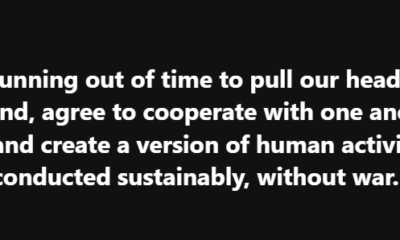
The meme here is powerful, but there is no evidence that such a moment will actually arrive.

Of course, it’s possible that humankind will find itself on the precipice of some sort of collapse, perhaps, via environmental decay, and there will be a massive movement uniting all the peoples of Earth.

Uncountable works of science fiction have been based on this premise.  Could happen.

What Matters Most

Renewable Energy

No One Has a Crystal Ball

Published

on

There is much speculation floating around as to what lies ahead for the United States after Trump leaves office, through whatever means.

In particular, our traditional trading partners, e.g. Canada are hard at work replacing us, given that our leader is a criminal sociopath.

But what if the next U.S. president is a sane human being?  Will they remain gone, or will they come back?  At what rate?

No one knows, but most of us figure that the sooner we remove Trump, the sooner normalcy returns.

No One Has a Crystal Ball

Continue Reading

Renewable Energy

WindEurope Demands Action, Siemens Gamesa Closes In on Break-Even

Published

on

Weather Guard Lightning Tech

WindEurope Demands Action, Siemens Gamesa Closes In on Break-Even

Allen covers WindEurope Madrid, the ten-point Call to Action, Vestas CEO Andersen’s mission impossible warning, Siemens Gamesa’s narrowing losses, and CNC Onsite’s deals in Asia.

Sign up now for Uptime Tech News, our weekly newsletter on all things wind technology. This episode is sponsored by Weather Guard Lightning Tech. Learn more about Weather Guard’s StrikeTape Wind Turbine LPS retrofit. Follow the show on YouTubeLinkedin and visit Weather Guard on the web. And subscribe to Rosemary’s “Engineering with Rosie” YouTube channel here. Have a question we can answer on the show? Email us!

Good Monday, everyone.

This past week… some big things happened in Madrid.

Fifteen thousand wind energy people from every corner of the world walked into the same room.

They came to talk. They came to listen. They came to ask for help.

And they came to warn.

The WindEurope Annual Event opened on Tuesday, the twenty-first of April, with six hundred twenty exhibitors and four hundred speakers across three days.

Spain’s Prime Minister Pedro Sanchez gave the opening address.

Fourteen national ministers stood on the stages, alongside European Commission Executive Vice President Teresa Ribera and European Commissioner for Energy Dan Jorgensen.

And the message coming out of Madrid… was a single piece of paper.

They called it the Madrid Call to Action.

Ten points. Ten things European governments need to do… right now.

Fast-track permitting, and treat wind as overriding public interest. Award at least eighty percent of wind auction bids… no more artificial scarcity. Repower aging wind farms and triple their output with fewer turbines. Multiply EU grid funding by five. Zero VAT on heat pumps and electric vehicles. And permanently cut taxes on electricity… because homegrown power should be the cheapest power.

The framing was simple.

From crisis… to confidence… in a decade.

But while the speeches were polite… the panels were not.

On Thursday afternoon, Vestas chief executive Henrik Andersen took the microphone, and he did not mince words.

Andersen called it mission impossible.

He told politicians to stop submitting wish lists for new auctions. He pointed at Denmark’s recent failed offshore auction… an auction that no developer would even bid on. And he pointed at countries trying to build a three-dimensional CSRD into the next tender.

Then he delivered the line that quieted the room.

If we don’t get this under control… we’ll be sitting here in five years… begging to keep the lights on.

Now… while the warnings were echoing through Madrid… something quieter was happening on a balance sheet in Munich.

Siemens Energy released preliminary second-quarter results on Wednesday, and then raised their full-year outlook.

Group orders for the quarter came in at seventeen point seven billion euros… up almost thirty percent year on year.

Net income for the full year is now expected to be around four billion euros, with Grid Technologies orders alone up forty-one percent.

And the wind unit… Siemens Gamesa… their losses narrowed to forty-four million euros.

A year ago, that number was two hundred forty-nine million.

Still in the red. Still operating at a margin of negative one point seven percent. But the trend is clear.

The Spanish wind unit is closing in on break-even.

After years of crisis… after billions of euros in impairments… Siemens Gamesa is healing.

Now back to Madrid.

Because last Thursday, WindEurope published a different kind of paper.

Not about money. Not about megawatts. About sabotage.

Across Europe’s seas, energy infrastructure has become a target. Cables, substations, offshore platforms… spread across thousands of square kilometers of open ocean… difficult to protect.

WindEurope Chief Executive Tinne Van Der Straeten said it plainly.

The physical security of Europe’s wind turbines must be treated as an integral part of energy security… not as an afterthought.

The policy paper calls for civilian protection, not military. Risk-based and proportionate, with clear cost allocation between government and industry.

Wind farms now generate twenty percent of Europe’s electricity, and the North Sea countries have pledged three hundred gigawatts of offshore wind by twenty fifty.

That is a lot of critical infrastructure… sitting in the open ocean.

But here is where Madrid got uncomfortable.

Vestas’ senior vice president stood on a panel Wednesday afternoon and offered a reality check.

The EU has set a goal of twenty-two gigawatts of new wind installation every year through twenty thirty.

What is the reality?

The EU installed fifteen gigawatts in twenty twenty-five. Sixteen the year before.

There is a gap… between political will, goals, and promises… and the reality we see in the market.

The Madrid Call to Action wants to close that gap.

The paper exists. The politicians have been told. Now… we wait.

And while the speeches were happening in Madrid… a small Danish company was quietly opening doors in Asia.

CNC Onsite… a wind sector subsupplier… signed two deals this month.

One with Dutch firm WE4CE for Thai customer Cewa Plus, a deal that opens twelve Asian countries.

The technology? A specialized machine that drills out the steel bushings holding a wind turbine blade to the hub, so they can be replaced without scrapping the blade.

Repair on site. Save the blade. Extend its life.

The second deal… a CNC milling machine sold into Japan for offshore monopile and foundation work.

CEO Soren Kellenberger says the combined opportunity could deliver up to fifty million Danish kroner in revenue… roughly six point seven million euros.

Not big numbers. Not yet.

But while everyone in Madrid was talking about politicians… CNC Onsite was signing contracts in Bangkok and Tokyo.

The number of wind turbines reaching the age where their blades need replacing… Kellenberger calls it… huge.

So let us step back.

In Madrid, fifteen thousand people gathered. A ten-point plan was published. A CEO warned of mission impossible. A trade association said the offshore turbines need physical protection from sabotage.

In Munich, a balance sheet showed the wind business is healing… slowly, quietly, quarter by quarter.

And in Bangkok, a Danish technician was teaching a Thai partner how to drill out a steel bushing.

Six stories. One week.

The wind industry showed up… asked for what it needed… and put the numbers on the table.

The financial proof is starting to come. The political follow-through… we wait.

And that is the state of the wind industry for the 27th of April… 2026.

Join us for the Uptime Wind Energy Podcast tomorrow.

WindEurope Demands Action, Siemens Gamesa Closes In on Break-Even

Continue Reading

Renewable Energy

Questioning Science

Published

on

Once one understands that science is not a body of truths, but our best method of finding truth, one realizes that there is no reason to “question” it.

For a moment, think of the most rapidly evolving arenas within the totality of the domains of science.  Let’s take epidemiology and climate change.

My mother went to her grave believing that Dr. Anthony Fauci should be indicted for crimes associated with the medical advice he gave re: COVID-19.  Her sole source of news was Fox News, and, from listening to what they had to say on the subject, she’d tell me, “He’s constantly changing his mind!” as if this were evidence of incompetence, or, more dastardly, corruption.  Was he in cahoots with the communists hellbent on destroying American capitalism? If not, he must have been making himself a billionaire by selling his own remedies.

Here, we’re talking about an extremely senior medical professional who had served successfully under five presidents, working on a brand-new pandemic that very little was known about.  We’re also talking about a “news” source known for its support of conspiracy theories that support the ultra-right-wing.

In cases like these, science is constantly “changing its mind,” as new studies come in that blow apart older data, and better represent the current understanding of the problem at hand.

The situation is the same with climate science. Newer models associated with the warming of our atmosphere and oceans are constantly replacing those of previous decades.  Is that evidence that scientists are corrupt, or that we are always learning more about an extremely complex set of information?

Questioning Science

Continue Reading

Trending

Copyright © 2022 BreakingClimateChange.com