

The “schlauchkern” is a type of coring method that we have been using a lot on M195. In essence, it is a test core to get a view of the sediments to see if we want to collect the material. The process begins with geophysical imaging of the sediments below the meeting point of the lowermost water column and the uppermost sediment layer. Once we have decided that the area looks promising for our studies, we collect a gravity core in a plastic bag liner, allowing us to preview the mud. The gravity core is a long steel pipe with weights on the top that drives into the sediment, thereby collecting sediment layer by sediment layer. The sediment layers enter a liner bag within the steel tube, which is then pulled up to, and laid out on, the deck of the ship, cut in half to expose the sediments. This “sneak peek” allows the scientists on board to see whether their interpretation of the imaging was correct, and the sediments are suitable for the various scientific studies that are planned. The schlauchkern is then returned to the sea (without the bag!). Because a schlauchkern does not need to be labelled and collected for later study at the end of examination, the schlauchkern approach is quick method of checking the sediments. If an interesting sedimentary sequence is recovered via a schlauchkern, we go ahead and place either a gravity core or a box core. Once a decision is made, the CYRTACI team starts the fun game of placing bids on the actual length of the final core.
Written by Melissa Berke (University of Notre Dame, USA). It is Melissa’s second voyage on the German research vessel METEOR, and while she does not (yet) speak German, she does have a favourite word: der “Schlauchkern”.
WAS IST EIN SCHLAUCHKERN?
Der “Schlauchkern” ist eine Art von Kernbohrung, die wir auf M195 häufig anwenden. Im Wesentlichen handelt es sich dabei um einen Probekern, mit dem wir einen ersten Einblick in die Sedimente am Meeresboden erhalten wollen, um zu sehen, ob wir weiteres Material von der gleichen Stelle gewinnen wollen. Der Arbeitsablauf rund um einen Schlauchkern beginnt mit der geophysikalischen Prospektion der Sedimente am Meeresboden. Hat sich eine erfolgversprechende Lokation identifizieren lassen, nehmen wir einen Schwerelotkern in einem Plastikschlauch, der uns einen ersten Einblick in die Sedimente ermöglicht. Der Schwerelotkern ist ein langes, Rohr mit einem Bleigewicht am Kopf, welches durch sein Eigengewicht in das Sediment getrieben wird. Die im Plastikschlauch gesammelten Sedimente werden zusammen mit dem Rohr an Bord zurückgeholt. Dort wird der Schlauch in zwei Hälften aufgeschnitten und sein Inhalt auf dem Schiffsdeck ausgelegt. Auf diese Weise können die Wissenschaftler an Bord schnell feststellen, ob ihre geophysikalische Interpretation des Untergrundes richtig war und ob sich die Sedimentabfolge für die geplanten Untersuchungen eignet. Der Schlauchkern wird nach der Inspektion ohne Beschriftung und Beprobung wieder ins Meer zurückgeworfen (ohne Plastikschlauch!). Wenn ein Schlauchkern ergibt, dass eine interessante Sedimentabfolge am Meeresboden vorhanden ist, setzen wir als nächstes entweder ein Schwerelot oder ein Kastenlot ein. Sobald diese Entscheidung getroffen ist, macht sich das CYRTACI-Team einen Spaß daraus, Wetten auf die tatsächliche Länge des endgültigen Kerns abzugeben.
Geschrieben von Melissa Berke (University of Notre Dame, USA). Melissa ist zum zweiten Mal auf der METEOR unterwegs und obwohl sie (noch) kein Deutsch spricht, hat sie ein doch ein deutsches Lieblingswort: “Schlauchkern”.
ΤΙ ΕΙΝΑΙ ΕΝΑ “SCHLAUCHKERN“;
Το “Schlauchkern” είναι ένα είδος πυρηνοληψίας που χρησιμοποιείται συχνά στην αποστολή M195. Ουσιαστικά πρόκειται για ένα δοκιμαστικό πυρήνα, με τον οποίο προσπαθούμε να πάρουμε μια πρώτη εικόνα των ιζημάτων για να δούμε εάν τελικά θα συλλέξουμε το υλικό. Η διαδικασία ξεκινά με μια γεωφυσική απεικόνιση των ιζημάτων κάτω από το σημείο όπου η θάλασσα συναντάει την ανώτερη στρώση του βυθού. Μόλις αποφασίσουμε ότι μια περιοχή δείχνει υποσχόμενη για τη μελέτη μας, συλλέγουμε έναν πυρήνα βαρύτητας με ένα περίβλημα μιας χοντρής, πλαστικής διαφάνειας, που μας επιτρέπει να εξετάσουμε γρήγορα το ίζημα. Ο πυρήνας βαρύτητας είναι ένας μακρύς, ατσάλινος σωλήνας με βάρη στην κορυφή του, που βυθίζεται στο ίζημα, συλλέγοντάς το στρώση-στρώση. Οι στρώσεις του ιζήματος εισέρχονται στο εσωτερικό της διαφάνειας μέσα στον ατσάλινο σωλήνα τον οποίο ανεβάζουμε στο κατάστρωμα. Στη συνέχεια η διαφάνεια εξάγεται και απλώνεται στο κατάστρωμα του πλοίου, όπου κόβεται σε δυο μισά αποκαλύπτοντας την αλληλουχία των ιζημάτων. Αυτή η γρήγορη ματιά επιτρέπει στους επιστήμονες στο πλοίο να επιβεβαιώσουν αν η ερμηνεία των γεωφυσικών απεικονίσεων ήταν σωστή και αν τα ιζήματα είναι κατάλληλα για τις σχεδιαζόμενες επιστημονικές μελέτες. Το περιεχόμενο αυτής της δοκιμαστικής πυρηνοληψίας (Schlauchkern), επιστρέφεται στη θάλασσα (χωρίς φυσικά την πλαστική διαφάνεια). Καθώς αυτή η δοκιμαστική πυρηνοληψία δε χρειάζεται να συλλεχθεί και να αριθμηθεί για μελλοντική μελέτη στο τέλος της εξέτασής της, η χρήση του Schlacuhkern προτιμάται ως μια γρήγορη μέθοδος πρώιμης εξέτασης των ιζημάτων. Εάν εντοπιστεί έτσι μια ενδιαφέρουσα στρωματογραφική ακολουθία, συνεχίζουμε είτε με έναν μεγαλύτερο πυρήνα βαρύτητας (gravity core) είτε με έναν κιβωτιόσχημο πυρήνα (Kasten Core). Μόλις ληφθεί η απόφαση, η ομάδα του CYRTACI ξεκινάει ένα παιχνίδι όπου στοιχηματίζουμε για το πόσο θα είναι το τελικό μήκος του κανονικού πυρήνα.
Κείμενο: Melissa Burke (Πανεπιστήμιο Notre Dame, HΠΑ). Πρόκειται για το δεύτερο ταξίδι της Melissa με το γερμανικό ερευνητικό πλοίο METEOR, και αν και δε μιλάει (ακόμα) Γερμανικά, η αγαπημένη της λέξη είναι “der Schlauchkern”.

“Kernwetten”, die die M195-Wissenschaftler nach der Entnahme eines Schlauchkerns und vor dem Einsatz des Kasten- oder Schwerelots abgegeben werden.
Credit: Eberhard Waldhör / OceanBlogs


Sobald der Schlauchkern geborgen ist, wird er an Deck gemessen und aufgeschnitten, damit Wissenschaftler Notizen die Zusammensetzung und Farbe des geborgenen Materials beurteilen können.
Στοιχήματα της επιστημονικής ομάδας μετά την δοκιμαστική πυρηνοληψία (Schlauchkern) και πριν ανασυρθεί ο πυρήνας βαρύτητας ή ο κιβωτιόσχημος στο κατάστρωμα. Μόλις ανασυρθεί ο δοκιμαστικός πυρήνας (Schlauchkern), κόβεται στα δυο από τους επιστήμονες για να μετρηθεί το μήκος του και να γίνουν κάποιες σημειώσειςσε σχέση με το χρώμα και το είδος του υλικού που ανακτήθηκε.
Credit: Derya Gürer / Maike Glos / OceanBlogs


After a slight delay of the Maria S. Merian caused by late-arriving containers our research cruise MSM142 finally got underway. By last Tuesday (24.03.2026), the full scientific team had arrived in Nuuk, the capital of Greenland, and the ship reached port on Wednesday (25.03.2026) morning. That same day, scientists and technicians moved on board and immediately began preparations, assembling and testing our instruments. Although the mornings on Wednesday and Thursday were grey and overcast, the afternoons cleared up beautifully. This gave us valuable time to organize equipment on deck and store empty boxes back into the containers before departure.
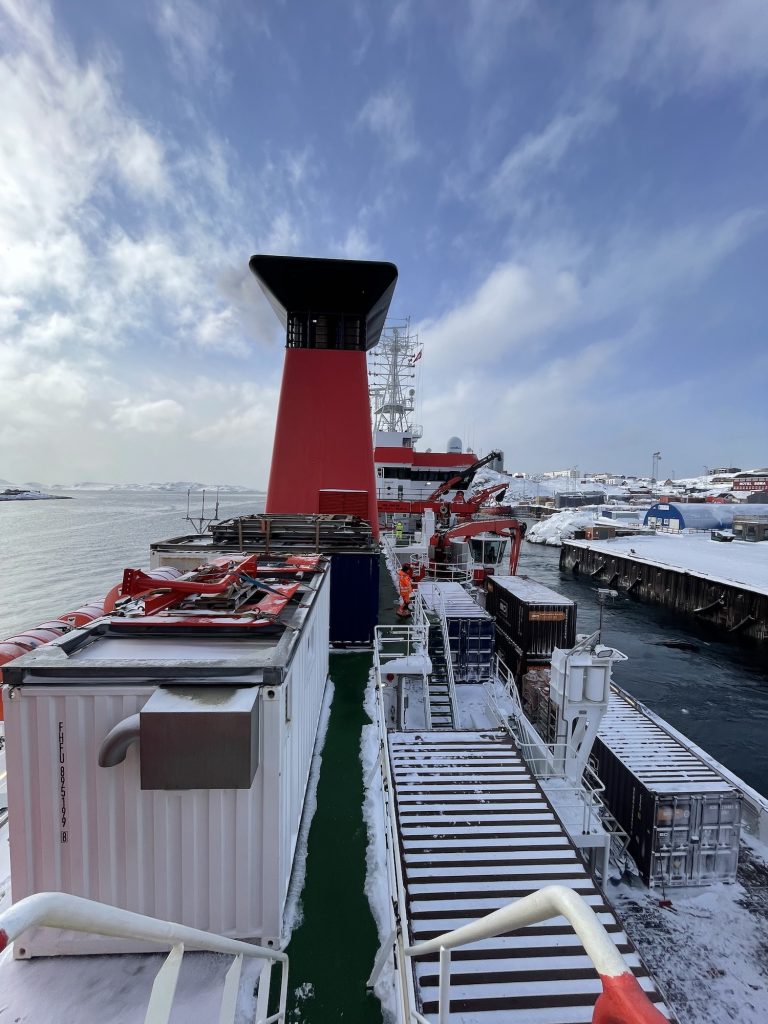
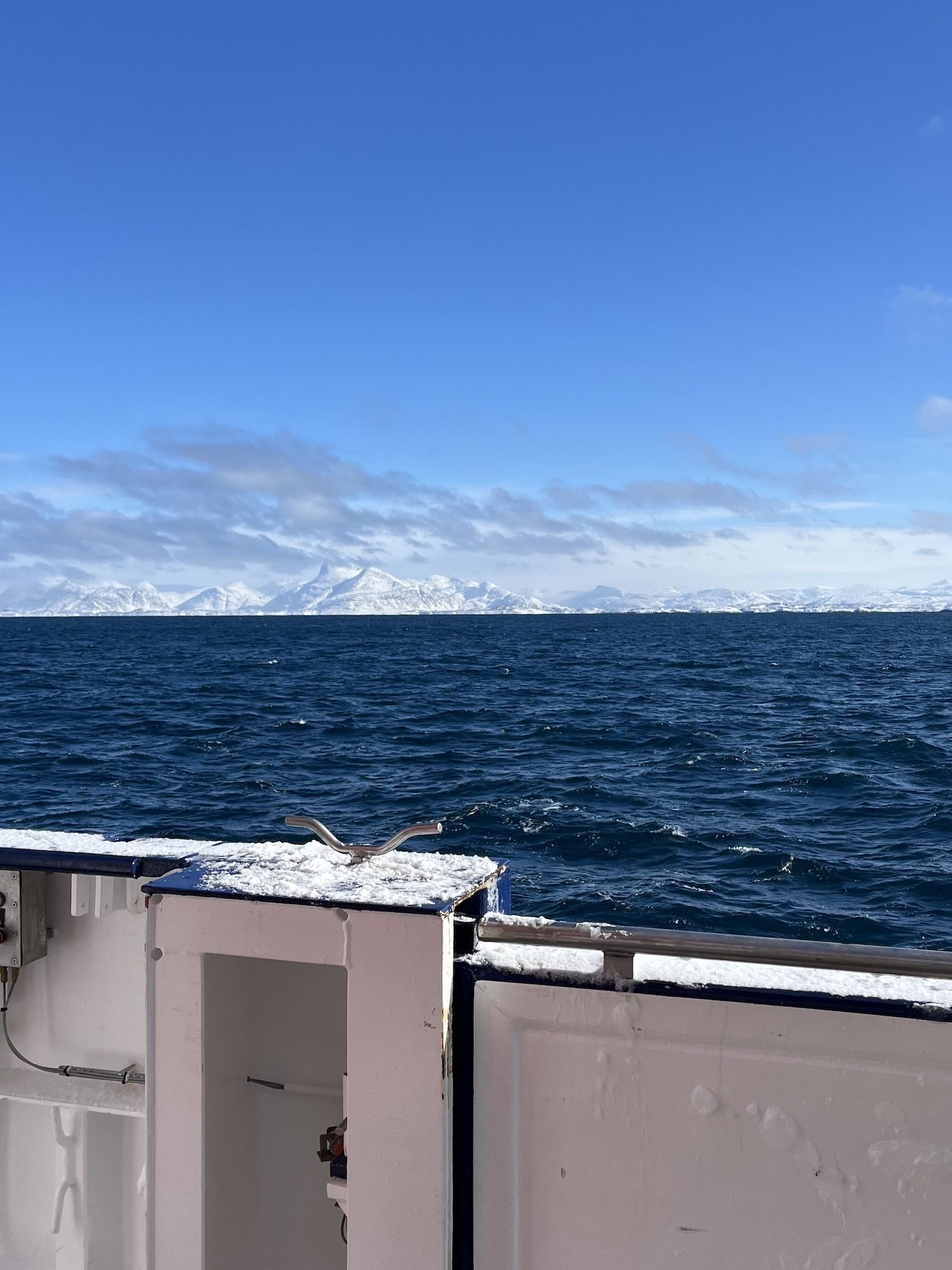
Given the forecast of harsh conditions outside the fjord, we carried out the mandatory safety drill while still in harbour. This included practicing emergency procedures and boarding the lifeboat. After completing border control, we were finally ready to leave Nuuk. We set sail on March 27th, heading into the Labrador Sea to begin our mission. Even before starting scientific operations, we tested the setup for deploying our gliders without releasing them during the transit out of the fjord. Once we reached open waters, we were met by high waves the following morning. For some on board, this was their first experience under such rough sea conditions. Seasickness quickly became a challenge for a few, while scientific work had to be temporarily postponed due to the strong winds and sea conditions. Together with the crew, we discussed how best to adapt our measurement plans to the given weather conditions. On March 29th, we were finally able to begin our scientific program with the first CTD deployment. A CTD is an instrument used to measure conductivity, temperature, and depth, which are key parameters for understanding ocean structure.
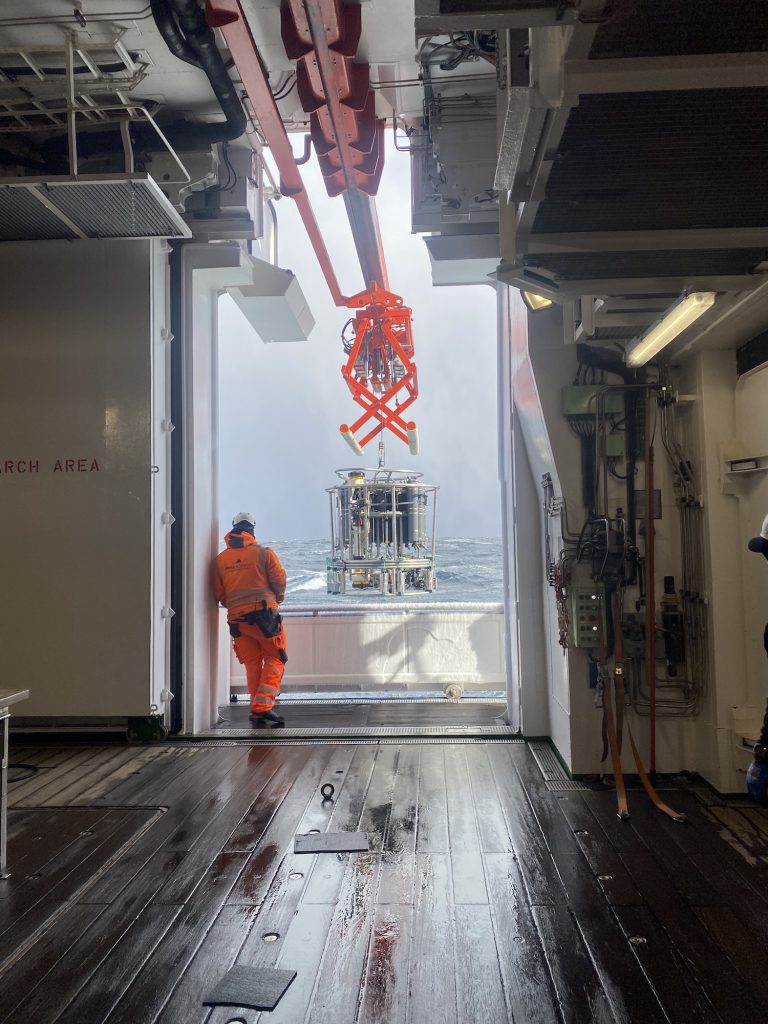
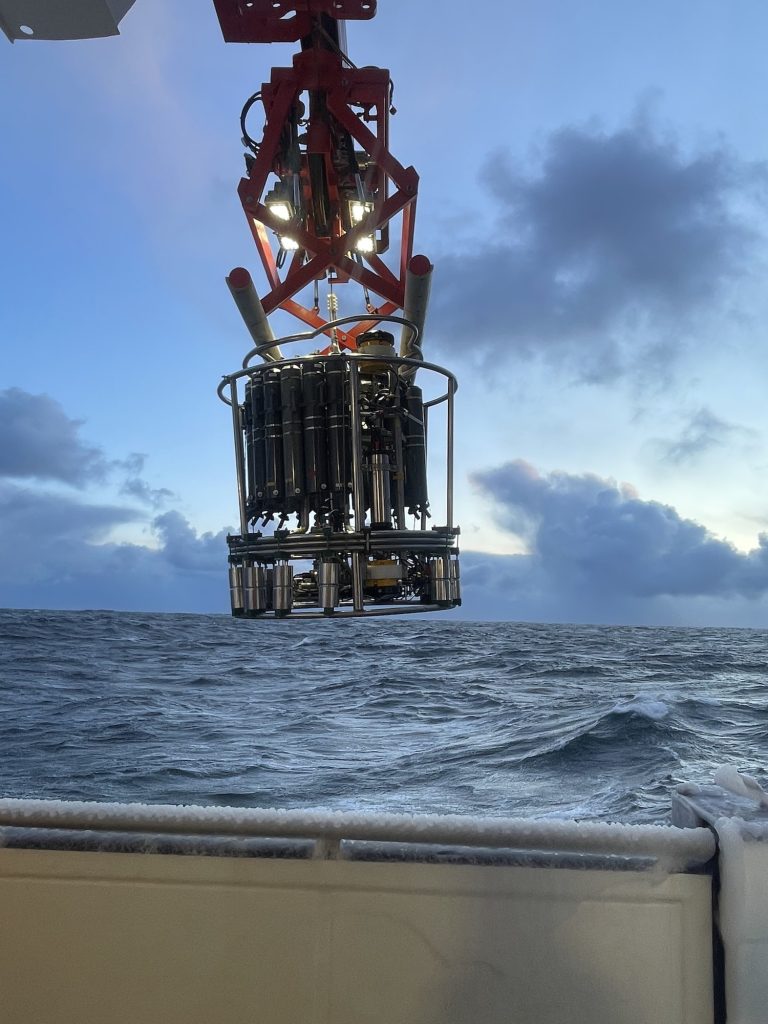
During the following night, we continued with additional CTD stations and successfully recovered two moorings: DSOW 3 and DSOW 4, located south of Greenland. These moorings carry instruments at various depths that measure velocity, temperature, and salinity. DSOW 4 was redeployed on the same day, while DSOW 3 followed the next day. In addition, the bottles attached to the CTD’s rosette can be used to collect water samples from any desired depth. These samples can be used, for example, to determine the oxygen content, nutrient levels, and organic matter.
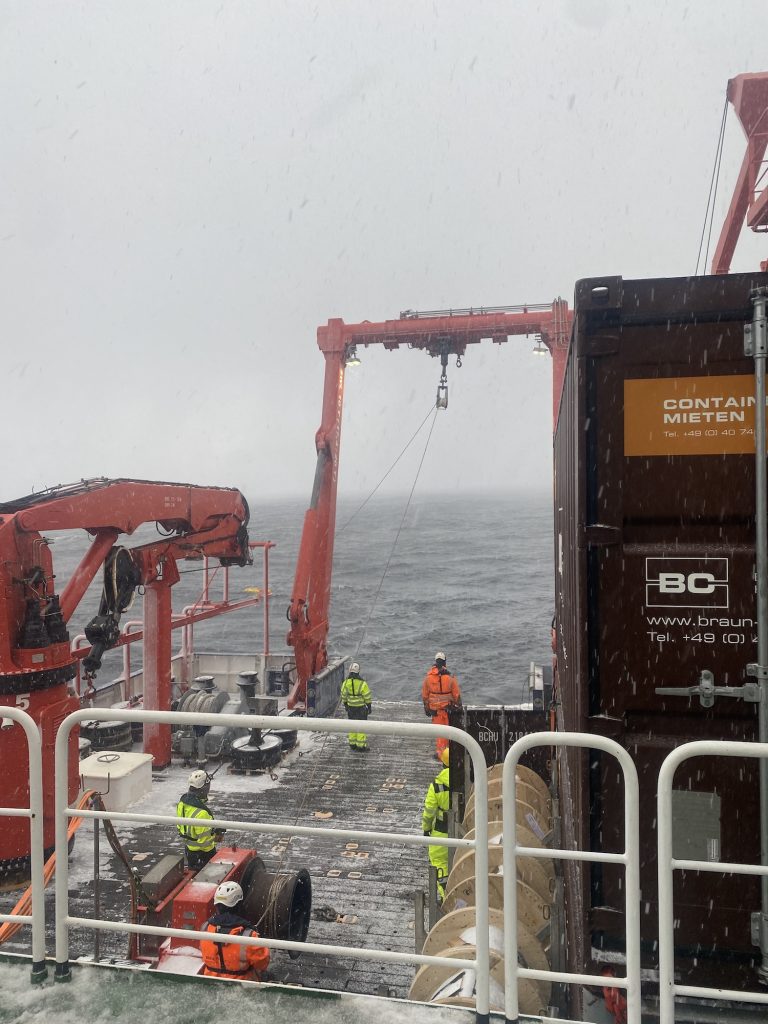
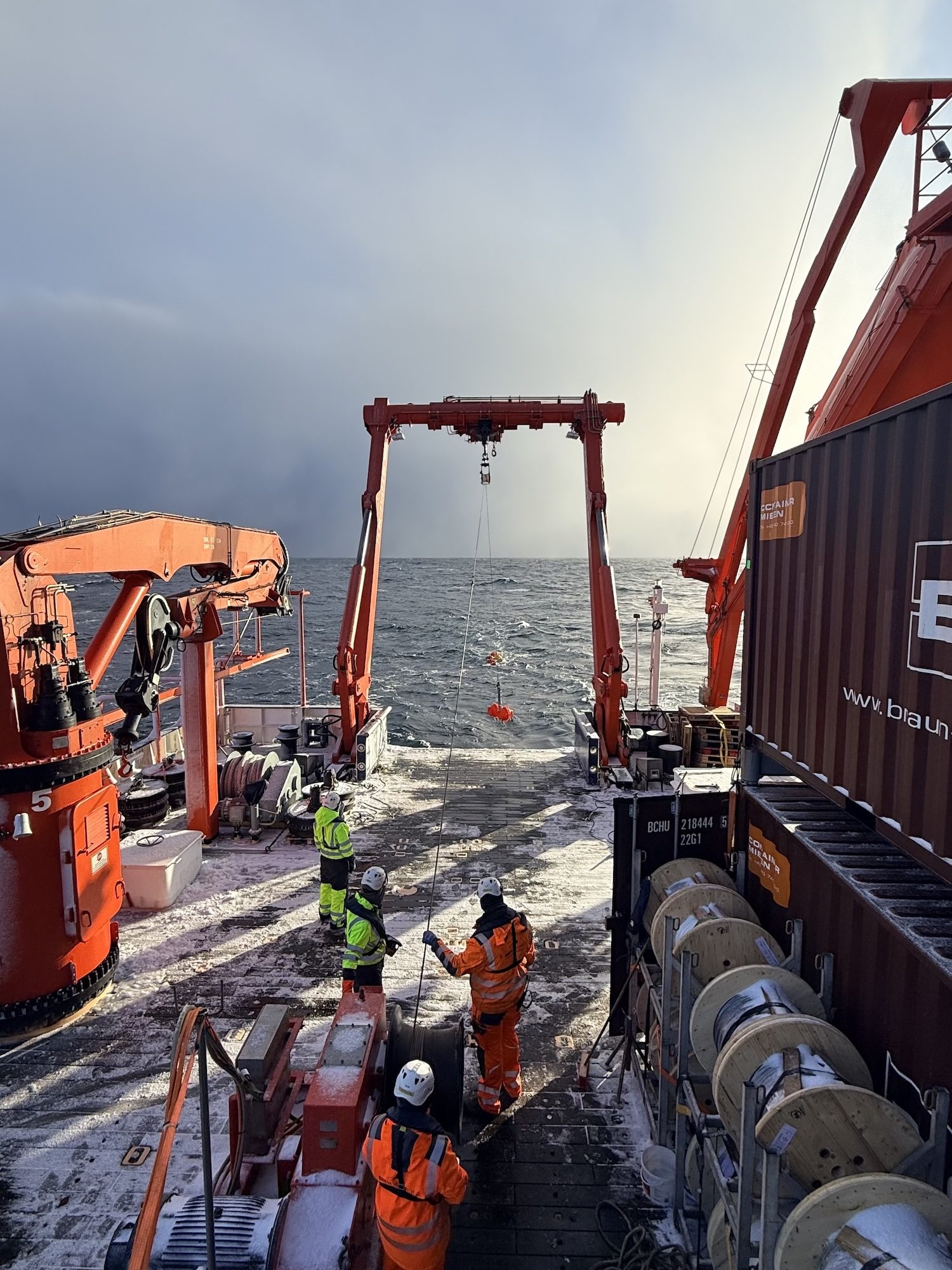
Both are part of the OSNAP array, a network of moorings spanning the subpolar North Atlantic. On these moorings are a few instruments, for example microcats which measure temperature, pressure and salinity.
We then conducted around 25 CTD stations spaced approximately 3 nautical miles apart across an Irminger ring identified from satellite data. This high-resolution sampling was necessary to capture the structure of an Irminger Ring, which had a radius of about 12 km wide.
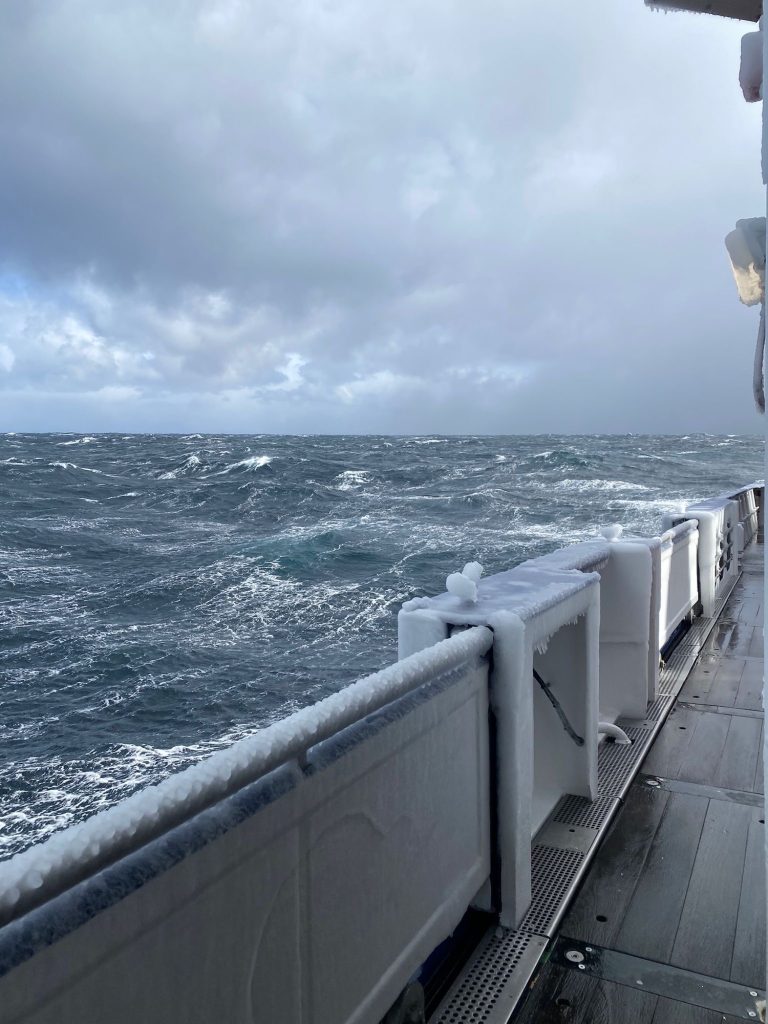
The days leading up to April 2nd were marked by very rough weather conditions. Life on board became both challenging and, at times, unintentionally entertaining sliding chairs were not uncommon. During the night from April 1st to April 2nd, winds reached 11 Beaufort with gusts up to 65 knots, forcing us to pause our measurements. Fortunately, conditions improved by morning, allowing us to resume our work. As well as with the help of the crew we had to adapt to the harsh weather conditions to continue our scientific work. On the 3rd of April, we were able to deploy a few gliders and one float. An ocean glider is an autonomous underwater Vehicle, which you can steer remotely and send to different locations, while it is measuring oceanographic key parameters.
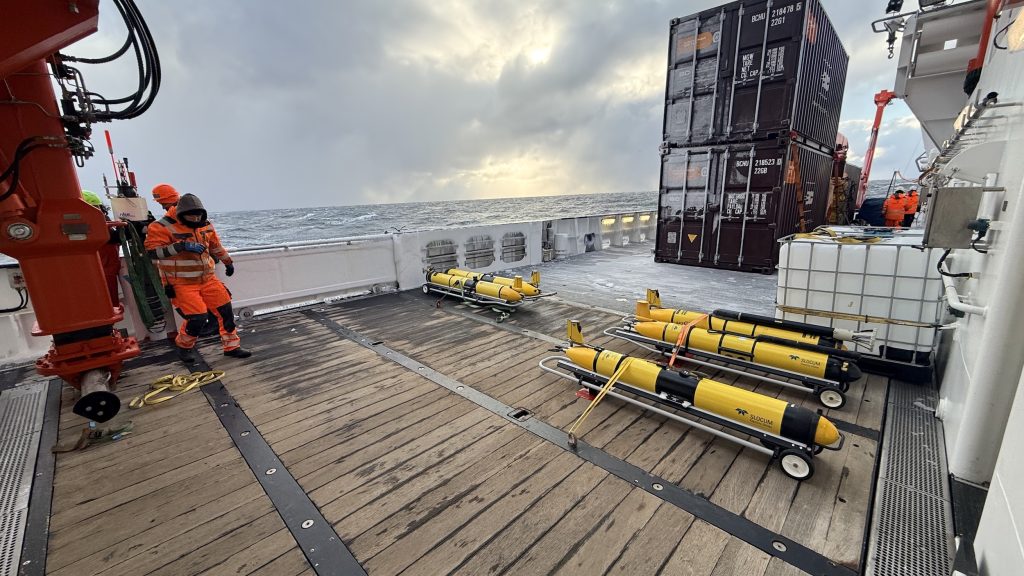
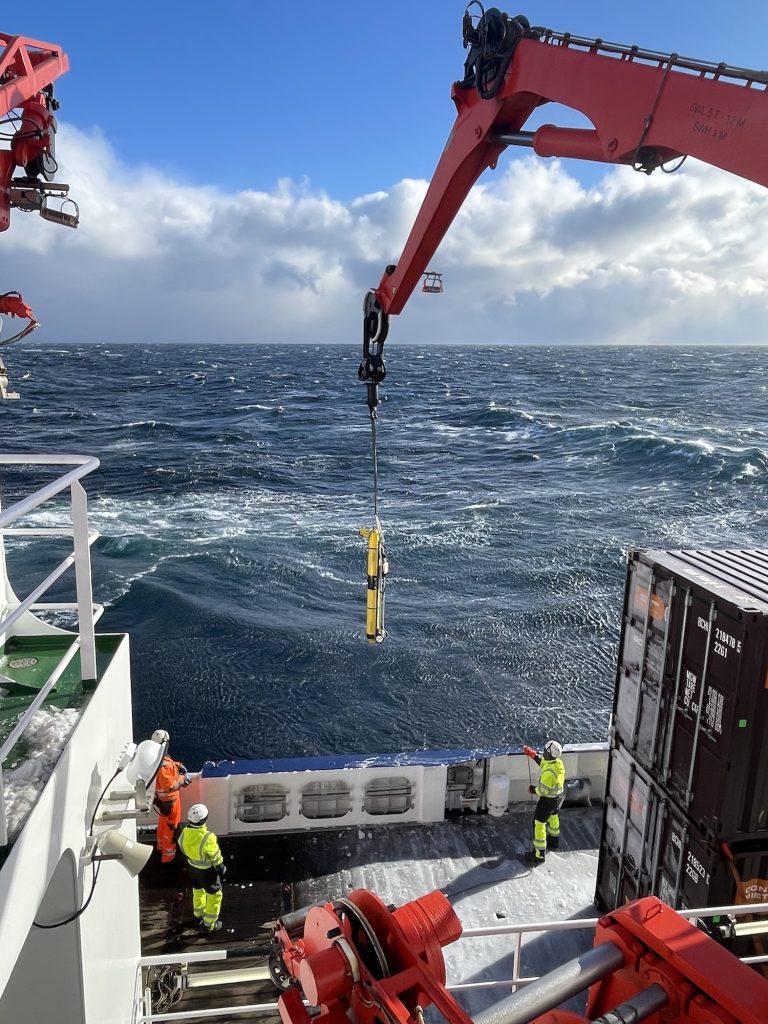
This research cruise focuses on understanding small-scale processes in the ocean and their connection to the spring bloom, an essential phase in marine ecosystem in subpolar regions. Despite the challenging start, we have already gathered valuable data and look forward to the weeks ahead in the Labrador Sea.
Despite their dramatic name, false killer whales aren’t an orca species. These animals are dolphins—members of the same extended family as the iconic “killer whale” (Orcinus orca). Compared to their namesake counterparts, these marine mammals are far less well-known than our ocean’s iconic orcas.
Let’s dive in and take a closer look at false killer whales—one of the ocean’s most social, yet lesser-known dolphin species.
Appearance and anatomy
False killer whales (Pseudorca crassidens) are among the largest members of the dolphin family (Delphinidae). Adults can grow up to 20 feet long and weigh between 1,500 and 3,000 pounds, though some individuals have been recorded weighing even more. For comparison, that’s roughly double the size of a bottlenose dolphin—and slightly larger than a typical sedan.
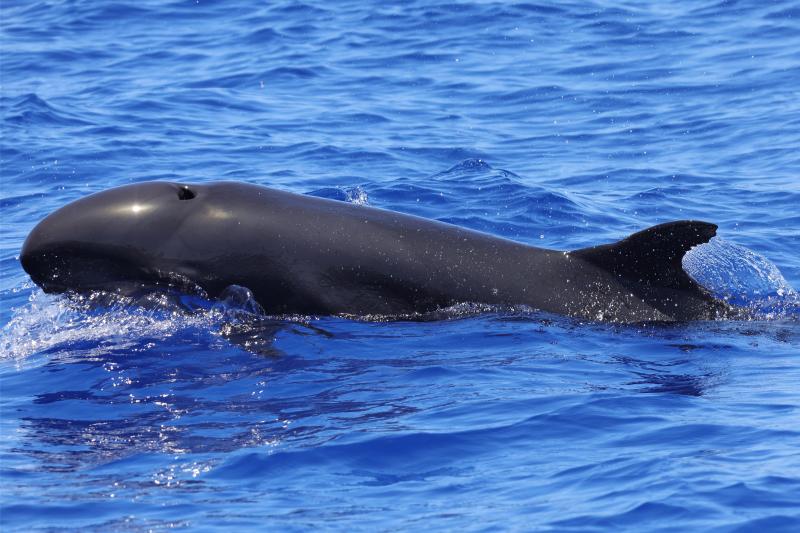
These animals are incredibly powerful swimmers with long, torpedo-shaped bodies that help them move efficiently through the open ocean in search of prey. Their skull structure is what earned them their name, as their head shape closely resembles that of orcas. With broad, rounded heads, muscular jaws and large cone-shaped teeth, early scientists were fascinated by the similarities between these two marine mammal species.
Although their heads may look somewhat like those of orcas, there are several ways to distinguish false killer whales from their larger namesake counterparts.
One of the most noticeable differences has to do with their coloration. While orcas are known for their iconic black-and-white pattern with paler underbellies, alternatively, false killer whales are typically a uniform dark gray to black in color—almost as if a small orca decided to roll around in the dirt. If you’ve ever seen the animated Disney classic 101 Dalmatians, the difference is a bit like when the puppies roll in soot to disguise themselves as labradors instead of showing their usual black-and-white spots.
Their teeth also present a differentiator. The scientific name Pseudorca crassidens translates almost literally to “thick-toothed false orca,” a nod to their sturdy, cone-shaped teeth that help these animals capture prey. Orcas tend to have more robust, bulbous heads, while false killer whales appear slightly narrower and more streamlined.
Behavior and diet
False killer whales are both highly efficient hunters and deeply social animals. It’s not unusual to see them hunting together both in small pods and larger groups as they pursue prey like fish and squid.
Scientists have even observed false killer whales sharing food with each other, a behavior that is very unusual for marine mammals. While some dolphin and whale species work together to pursue prey, they rarely actively share food. The sharing of food among false killer whales spotlights the strong social bonds within their pods. Researchers believe these tight-knit social connections help false killer whales thrive in offshore environments where they’re always on the move.
Maintaining these close bonds and coordinating successful hunts requires constant effective communication, and this is where false killer whales excel. Like other dolphins, they produce a variety of sounds like whistles and clicks to stay connected with their pod and locate prey using echolocation. In the deep offshore waters where they live, sound often becomes more important than sight, since sound travels much farther underwater than light.
Where they live
False killer whales are highly migratory and travel long distances throughout tropical and subtropical waters around the world. They prefer deeper waters far offshore, and this pelagic lifestyle can make them more difficult for scientists to study than many coastal dolphin species.
However, there are a few places where researchers have been able to learn more about them—including the waters surrounding the Hawaiian Islands.
Scientists have identified three distinct groups of false killer whales in and around Hawaii, but one well-studied group stays close to the main Hawaiian Islands year-round. Unfortunately, researchers estimate that only about 140 individuals remained in 2022, with populations expected to decline without action to protect them. This is exactly why this group is listed as endangered under the U.S. Endangered Species Act and is considered one of the most vulnerable marine mammal populations in U.S. waters.
Never Miss An Update
Sign up for Ocean Conservancy text messages today.
Current threats to survival
False killer whales are currently listed as Near Threatened on the IUCN Red List. From climate change-induced ocean acidification and harmful algal blooms to marine debris and fishing bycatch, false killer whales face the same mounting pressures that are impacting marine ecosystems around the world. As their prey becomes scarce due to increasing threats, populations of top predators like these decline, serving as a powerful signal that the ocean’s overall health is in critical need of protection.
Here at Ocean Conservancy, we’re working daily to confront these threats head-on and protect the ecosystems and wildlife we all cherish so dearly. But we can’t do it without you. Support from ocean lovers is what powers our work to protect our ocean, and right now, our planet needs all the help it can get. Visit Ocean Conservancy’s Action Center today and join our movement to create a better future for our ocean, forever and for everyone.
The post All About False Killer Whales appeared first on Ocean Conservancy.
https://oceanconservancy.org/blog/2026/03/31/false-killer-whales/
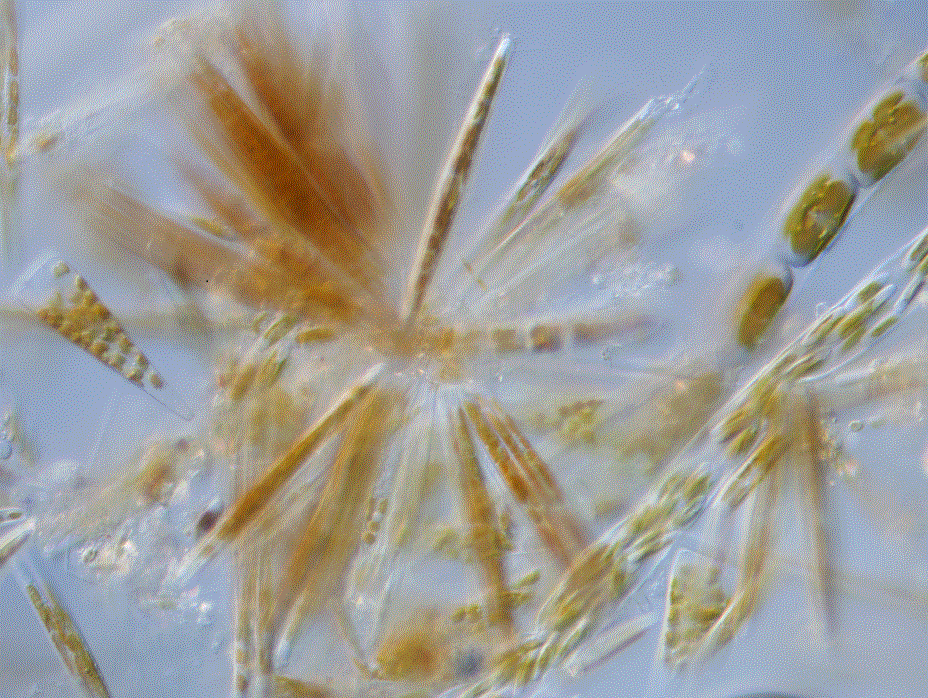
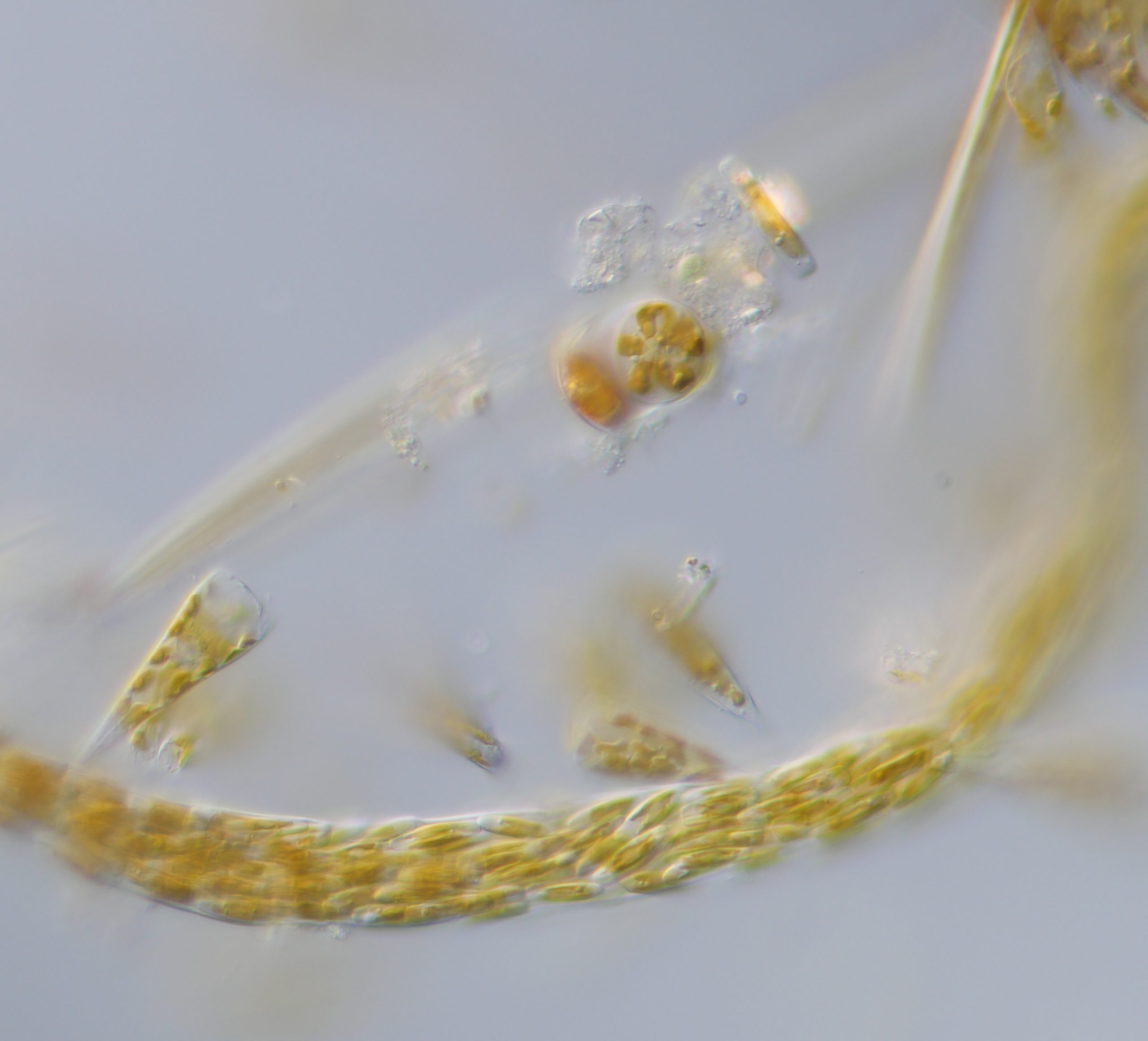
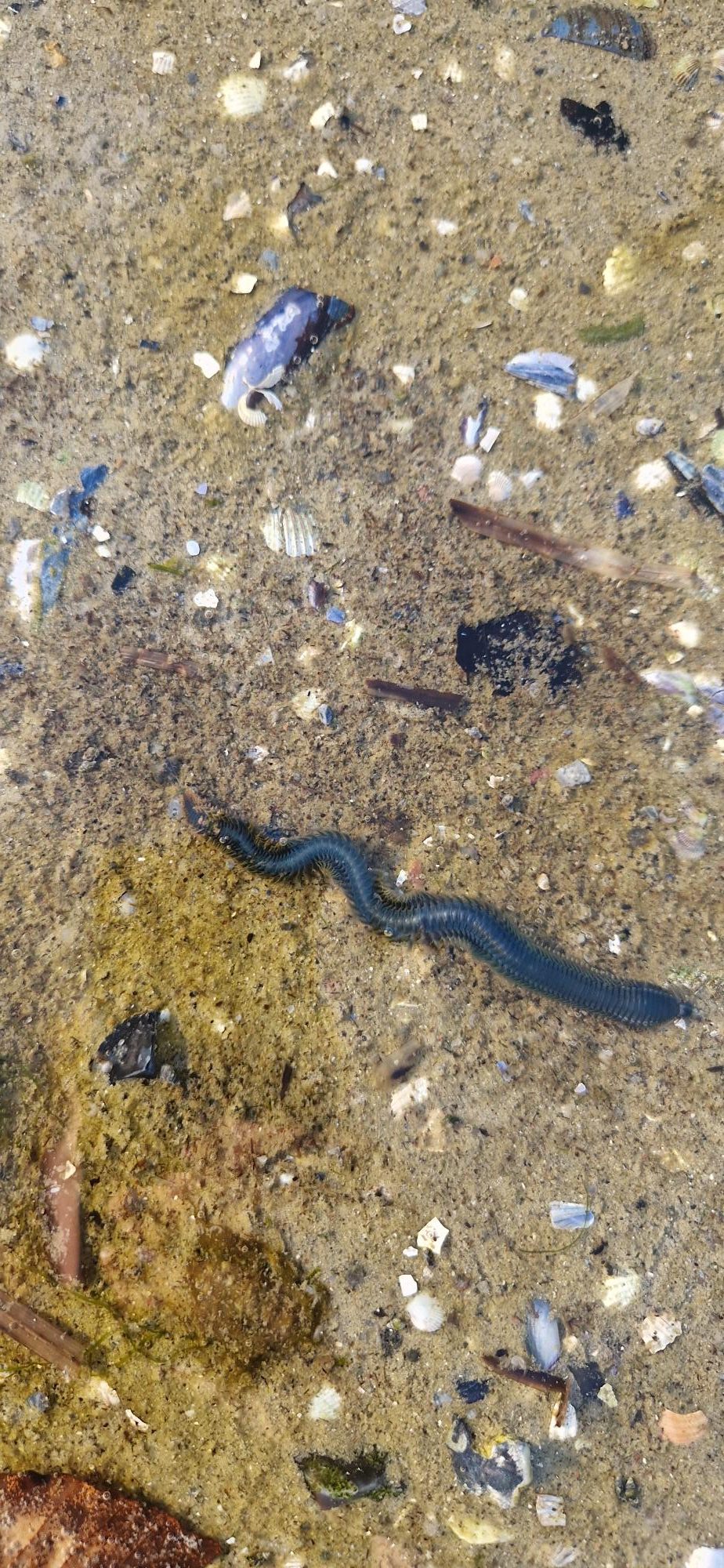
A lot has happened in the meantime: I became an Associate Professor at the University of Southern Denmark, we all lived through the Corona period, then slowly adjusted to the post‑pandemic stability, only to find ourselves again in turbulent political times. I am now affiliated with the Marine Research Center in Kerteminde, a beautiful coastal town on the island of Fyn. My plan is to share small updates on my research and activities every now and then. So let’s start with yesterday’s sampling trip for benthic phytoplankton, carried out by my colleague, Prof. Kazumasa Oguri. The sampling will help prepare for the first‑semester bachelor students who will join his small but fascinating project. This project is all about the benthic diatoms that form dense, photosynthetic communities on tidal‑flat sediments. Their daytime oxygen production enriches the sediment surface and allows oxygen to penetrate deeper, supporting diverse organisms that rely on aerobic respiration. The project will explore how oxygen distribution and oxygen production/consumption in sediments change under different light conditions (day, night, sunrise/sunset). The team will incubate benthic diatom communities in jars and measure oxygen profiles using an oxygen imaging system under controlled light regimes.
Yesterday, we visited several potential sampling sites where students can carry out their fieldwork. I encourage all PIs in our group to define at least one small project related to Kerteminde Fjord, where our laboratories are located. Over time, I hope we can build a more integrated dataset describing the marine and coastal ecosystems of the area.
Another activity currently in preparation is a project on marine invasive species in Kerteminde, which will feed into a course I will run in July and a master’s thesis project. More will come later.
Let’s hope for a more continuous blog from here on, keeping track of our activities, with or without jellyfish!


-
Climate Change8 months ago
Guest post: Why China is still building new coal – and when it might stop
-
Greenhouse Gases8 months ago
Guest post: Why China is still building new coal – and when it might stop
-

 Greenhouse Gases2 years ago
嘉宾来稿:满足中国增长的用电需求 光伏加储能“比新建煤电更实惠”
-
Climate Change2 years ago
Bill Discounting Climate Change in Florida’s Energy Policy Awaits DeSantis’ Approval
-

 Climate Change2 years ago
嘉宾来稿:满足中国增长的用电需求 光伏加储能“比新建煤电更实惠”
-
Climate Change Videos2 years ago
The toxic gas flares fuelling Nigeria’s climate change – BBC News
-

 Renewable Energy6 months ago
Sending Progressive Philanthropist George Soros to Prison?
-

 Carbon Footprint2 years ago
US SEC’s Climate Disclosure Rules Spur Renewed Interest in Carbon Credits