

Warming driven by deforestation caused an extra 28,000 heat-related deaths per year across Africa, South America and Asia over 2001-20, new research finds.
The study, published in Nature Climate Change, is the first to look at human health impacts of warming caused specifically by tropical deforestation, as opposed to the burning of fossil fuels, its lead author tells Carbon Brief.
The authors find that deforestation alone drove, on average, 0.45C of warming in the tropics over 2001-20, accounting for 64% of the total warming in regions with tropical forest loss.
They also find that tropical deforestation over 2001-20 exposed 345 million people to “local warming”, in addition to the warming they were already facing due to global warming.
Six out of every 100,000 people living in deforested areas died as a result of deforestation-induced warming during this time, they warn.
This number is higher in south-east Asia, with Vietnam setting a record of, on average, 29 deaths per 100,000 people.
A researcher who was not involved with the study tells Carbon Brief that the “sobering” paper “reframes tropical deforestation as not only a carbon emissions and ecological issue, but also a critical public health concern”.
Tropical deforestation
Tropical forests, mainly distributed across South America, Africa and Asia, account for 45% of global forest cover.
These regions are well-known for their high biodiversity and the crucial ecosystem services that they provide, such as carbon storage.
However, tropical forest loss is on the rise.
A record 6.7m hectares of previously intact tropical forest was lost last year, mainly due to fires and land clearing for agriculture. As the planet warms, worsening heat and drought extremes are also causing trees to become less resilient to change, resulting in forest degradation.
The new study uses data from the Global Land Analysis and Discovery laboratory at the University of Maryland to assess how tropical forest cover has changed year on year. The authors find that over 2001-20, a total of 1.6m square kilometres (160m hectares) of tropical forest was lost globally. This is shown on the map below, where blue indicates high forest loss and yellow indicates low loss.
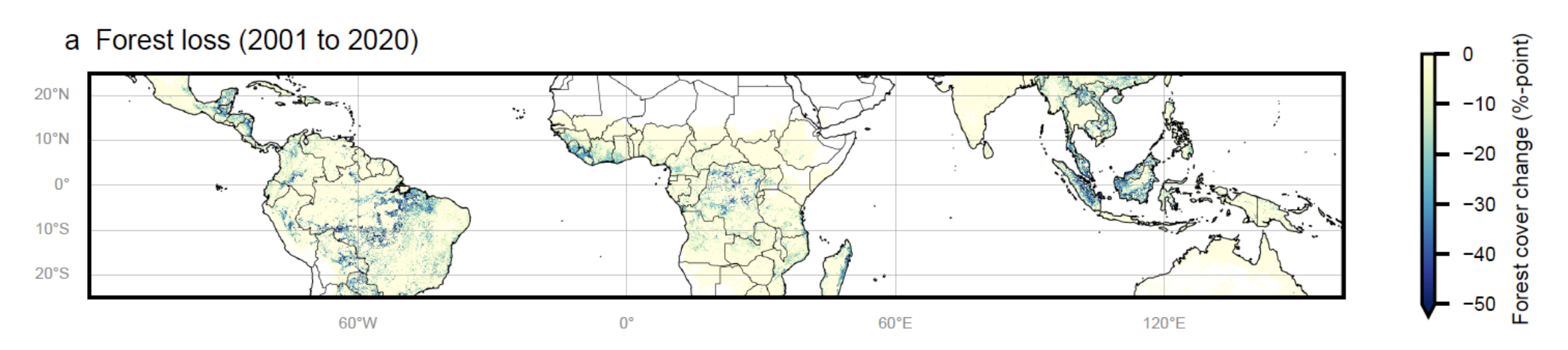
The authors find the largest forest loss was in central and South America, but also highlight “extensive” loss in south-east Asia and tropical Africa.
Forest warming
Tropical deforestation has a wide range of negative consequences, including decreasing biodiversity, releasing carbon into the atmosphere and threatening the safety of Indigenous communities.
Loss of tree cover can also affect local temperatures by influencing the water cycle.
Water is constantly moving from the surface of the land into the atmosphere through a process called evapotranspiration. Plants play a crucial part in this process by moving water from the soil up through their roots and into their leaves, where it evaporates, cooling the air above. When trees are cut down, this cooling effect is reduced.
The authors use data of land surface temperatures from the NASA MODIS satellite to map warming in tropical regions over 2001-20. These results are shown in the map below, where red indicates warming and blue indicates cooling.

The authors find that between 2001-03 and 2018-20, surface temperatures increased by 0.34C in tropical central and South America, 0.1C in tropical Africa and 0.72C in south-east Asia. They add that “areas of forest loss coincide with areas of strong positive change in temperature across many regions of the tropics”.
By comparing their deforestation and surface warming maps, the authors find that deforested regions of the tropics saw an average of 0.7C warming over 2001-20, while areas that “maintained forest cover” saw an increase of only 0.2C.
By comparing the change in temperature in deforested regions with that in neighbouring locations without forest loss, they find that deforestation alone caused 0.45C of warming in the tropics over 2001-20 – accounting for 64% of total warming experienced over those regions.
Heat exposure
High temperatures can be deadly.
During periods of extreme heat, people can suffer from heat stroke and exhaustion – and even die. Those with underlying health conditions are at higher risk of fatal complications.
The authors use data from Oak Ridge National Laboratory’s LandScan to map where people live in the tropics. They estimate that 425 million people live in regions that were exposed to tropical deforestation over 2001-20, and just over three-quarters of them were exposed to warming as a result of the loss of forest cover.
Finally, the authors estimated “heat-related excess mortality” due to nearby tropical deforestation.
Using data from the 2019 Global Burden of Disease study, they determine the number of “non-accidental” deaths in each deforested tropical area. This excludes deaths from “external” causes, such as accidents and suicides, but includes “internal” causes, such as disease.
The researchers then used previously published “temperature-mortality” relationships for different countries. These relationships show the link between temperature and excess mortality rate, indicating the percentage increase in mortality for every degree of warming.
These relationships vary between countries, as people in hotter regions are generally better adapted to extreme heat.
By combining the data on local warming due to deforestation, temperature-mortality relationships and the non-accidental mortality data, the authors calculated how many non-accidental deaths would have been expected in deforested regions if they had not warmed due to the loss of forest cover.
By comparing the real and counterfactual mortality rates, the authors were able to calculate the total mortality burden due to tropical deforestation-induced warming.
Overall, the authors find that tropical deforestation drove an additional 28,300 deaths every year over 2001-20, accounting for 39% of the total heat-related mortality from global climate change and deforestation combined over locations of forest loss.
The study finds that, on average, six out of every 100,000 people living in deforested areas died as a result of deforestation-induced warming. However, these numbers vary by country.
The chart below shows the average annual deaths due to deforestation-induced heat per 100,000 people living in areas of forest loss.

Dr Carly Reddington is a research fellow at the University of Leeds and lead author of the study. She tells Carbon Brief that it is the “first study to look at human health impacts of tropical deforestation-induced warming”.
Dr Nicholas Wolff, a climate change scientist at the Nature Conservancy who was not involved with the study, tells Carbon Brief that the paper is “sobering”. He adds that it “reframes tropical deforestation as not only a carbon emissions and ecological issue, but also a critical public health concern”.
Data-scarce
The authors note that there are no country-specific heat vulnerability indices available for African countries. To develop their data for African countries, they used the average heat vulnerability index for South America.
Reddington tells Carbon Brief that Africa is the most “uncertain region” in the study and tells Carbon Brief that “more data is really crucial” to develop more accurate estimates.
Wolff tells Carbon Brief that extrapolating heat-mortality relationships “from data-rich regions to data-poor ones” is a “common practice in global-scale climate-health research”.
He praises the overall methodology as “innovative, transparent and scientifically sound, with appropriate caveats”.
Dr Luke Parsons, a climate modelling scientist at the Nature Conservancy, tells Carbon Brief that the conclusions are “robust”. However, he notes some “methodological issues” with the paper, such as the fact that all results are modelled, rather than measured.
He tells Carbon Brief that future work could assess “near-surface air temperature and humidity changes associated with deforestation, as well as study regional air temperature changes beyond deforested areas”.
While the new study focuses on warming within one square kilometre of forest loss, Reddington tells Carbon Brief that “deforestation is associated with warming up to 100km away”.
Furthermore, the study notes that the increase in deaths due to excess heat is likely to affect the most vulnerable members of society the most. It says:
“Vulnerable populations, particularly traditional and Indigenous communities, often live near deforested areas and face limited access to resources and infrastructure needed to cope with the combination of rising temperatures and environmental changes caused by deforestation and climate change.”
Wolff also stresses this disparity, adding that “many of these communities depend on forest clearing for agriculture, income and survival, and are forced to make difficult choices between short-term economic needs and long-term health and environmental stability”.
The authors also note that deforestation can drive a range of other interacting health problems, which were not considered in this study. For example, deforestation is linked to a rise in zoonotic diseases, such as malaria.
Dr Vikki Thompson, a climate scientist at the Royal Netherlands Meteorological Institute who was not involved in the study, says that the findings of the paper are “relevant to everyone”. She continues:
“We can reduce impacts of extreme heat by planting more trees and reducing deforestation everywhere, on both local and international scales.”

The post Warming due to tropical deforestation linked to 28,000 ‘excess’ deaths per year appeared first on Carbon Brief.
Warming due to tropical deforestation linked to 28,000 ‘excess’ deaths per year

Climate Change
Toxic Ocean Crisis in Papua New Guinea Sparks Mass Marine Die-Off and Public Health Emergency
Thousands of dead fish are washing ashore and people are falling ill too, as officials investigate possible sources of contamination.
It started in December, when dead fish began washing ashore New Ireland—a mountainous island in Papua New Guinea’s New Ireland Province, flanked by the Pacific Ocean and the Bismarck Sea.
Toxic Ocean Crisis in Papua New Guinea Sparks Mass Marine Die-Off and Public Health Emergency
Go behind the scenes with senior editor Corey Mitchell and reporter Bob Berwyn as they discuss critical measures of the planet’s health.
“Earth is being pushed beyond its limits while every key climate indicator is flashing red,” warned U.N. Secretary-General António Guterres after the release of the latest State of the Global Climate report from the World Meteorological Organization.
Climate Change
Summit Sold Its Midwest Pipeline as a Carbon Solution. Now, It’ll Be Used for Fossil Fuels.
The pivot reveals a company adapting to Trump’s “drill, baby, drill” agenda and looking to cash in on recently boosted tax incentives for enhanced oil recovery.
For four years, battles over private property rights have gridlocked state legislatures across the Midwest and stalled plans for a pipeline to transport liquified carbon dioxide from ethanol plants in the region.
Summit Sold Its Midwest Pipeline as a Carbon Solution. Now, It’ll Be Used for Fossil Fuels.



-
Climate Change8 months ago
Guest post: Why China is still building new coal – and when it might stop
-
Greenhouse Gases8 months ago
Guest post: Why China is still building new coal – and when it might stop
-

 Greenhouse Gases2 years ago
嘉宾来稿:满足中国增长的用电需求 光伏加储能“比新建煤电更实惠”
-
Climate Change2 years ago
Bill Discounting Climate Change in Florida’s Energy Policy Awaits DeSantis’ Approval
-

 Climate Change2 years ago
嘉宾来稿:满足中国增长的用电需求 光伏加储能“比新建煤电更实惠”
-
Climate Change Videos2 years ago
The toxic gas flares fuelling Nigeria’s climate change – BBC News
-

 Renewable Energy5 months ago
Sending Progressive Philanthropist George Soros to Prison?
-

 Carbon Footprint2 years ago
US SEC’s Climate Disclosure Rules Spur Renewed Interest in Carbon Credits