

A UN effort to keep the threatened 1.5C warming limit alive is exposing deep divisions over the future of fossil fuels, pitting climate-vulnerable nations seeking a faster move away from coal, oil and gas against major emerging economies and producers that oppose targeting particular energy sources.
As countries weigh in on the “Belém Mission to 1.5”, a new process launched at COP30 last year to address the global shortfall in climate ambition, submissions show that small island nations and least developed countries (LDCs) want the initiative to help speed up a shift away from fossil fuels. Their calls for a focus on emissions-cutting measures in the energy sector are supported by the EU and the UK.
But the “like-minded developing countries” (LMDC) bloc – which includes China, India – and Arab states led by Saudi Arabia have warned against singling out specific energy sources or using the mission to assess how individual countries are performing on emissions cuts. Instead, they want its scope narrowed to identifying primarily what rich countries should do to cut their own emissions and provide more climate cash to developing nations.
Keeping 1.5C “within reach”
The split hints at a fight to come at COP31 in November over what the work programme’s findings should say and how much weight they should carry in the summit’s outcome.
Governments launched the Belém Mission to 1.5 at last year’s UN climate summit in the Brazilian Amazon city, after the latest round of national climate plans left the world set to shoot past the Paris Agreement temperature goals. Full implementation of current pledges is expected to limit global warming to only around 2.3-2.5 C by 2100, according to the UN.
Comment: The case for making polluters pay has moved into the mainstream
The current and two preceding COP presidencies – Türkiye, Brazil and Azerbaijan – are gathering views from governments on how to raise the ambition of national climate plans (NDCs) and adaptation plans (NAPs).
The initiative will culminate in a report at COP31 outlining priority actions for keeping the 1.5C goal “within reach”. But the proposals submitted by individual governments and negotiating blocs representing nearly four-fifths of all countries point to wildly diverging visions of what the Belém Mission should achieve, especially on the transition away from fossil fuels.
Tracking COP28 commitments
The Marshall Islands has proposed an ambitious package of concrete actions that would enable deep emissions reductions, led by a global commitment to build no new oil, coal and gas infrastructure. Together with its fellow Pacific island of Vanuatu, it also calls for a formal process to monitor progress towards the COP28 energy commitments, map fossil fuel subsidies and help countries phase them out.
The EU also said in its submission that the Mission to 1.5C is “well placed” to provide updates on how countries’ national climate plans have incorporated the COP28 agreement, including the commitment to accelerate a transition from fossil fuels in energy systems.

Countries wanting to build on the COP28 Dubai agreement have struggled to find a dedicated space for those discussions in the face of opposition from fossil fuel producers and big emerging economies.
The COP28 outcomes in response to the first stocktake of global climate action represent “one package… and not a pick-and-choose menu”, the European Commission emphasised in a thinly veiled reference to comments made by the Saudi energy minister in 2024 that the Dubai deal was an “à la carte menu” allowing nations to choose their own priority.
Push to boost NDC ambition
The Alliance of Small Island States (AOSIS) also advocated in its submission for “high-level approaches” towards developed countries and other major emitters ahead of COP31 to spur them to produce updated NDCs with additional emissions-cutting measures.
Vanuatu called on the COP presidencies overseeing the Mission to 1.5C to “exhibit leadership” by taking steps at home to phase out fossil fuels and reduce their “inefficient” fossil fuel subsidies.
Azerbaijan and Türkiye continue to rely heavily on fossil fuels in their energy systems, while Azerbaijan and Brazil remain significant oil and gas producers with plans to expand output.
-
Energy transition policymaking must evolve to fit an age of rupture
Economic competitiveness, energy security and green industrialisation are driving real-world change – but will this damage our collective mission for a fair green shift? -
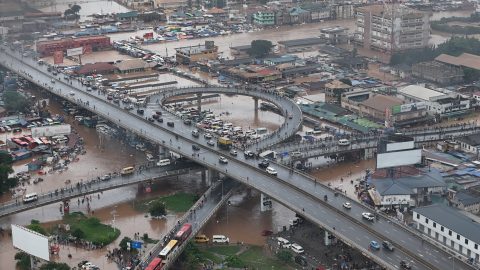
Flood deaths in West African cities raise fraught issue of slum evictions
Deadly floods expose poor urban planning, over-population and spread of informal settlements on disaster-prone land – a problem authorities are struggling to manage
In its submission, the LDC group of the world’s poorest nations says the failure to align global climate commitments with a pathway to keep warming under 1.5C is driven primarily by insufficient ambition from major emitters.
The Mission to 1.5C should focus its efforts on the “highest-impact” and “most feasible” solutions to curb emissions such as phasing out fossil fuels, it added.
Both the island nations and the LDCs, as well as the African group of nations, stress that significantly scaling up financial resources, and making it easier to access them, are necessary steps to enable the global energy transition.
Focus on “emissions”, not energy sources
Fossil fuel producers and several large developing economies, however, argue that the mission risks straying beyond its mandate if it singles out particular fuels or evaluates countries’ climate plans.
The Arab group, which is led by Saudi Arabia and includes the UAE, Qatar and Egypt, wrote that it should maintain a focus on “emissions management” rather than targeting specific sectors or energy sources.
Their submission says investments in fossil fuels “must increase” both to better manage the emissions associated with their production and to meet growing energy demand.
The LMDCs, a negotiating bloc that includes China and India, similarly argue that climate action should address emissions regardless of how they are produced, warning that energy sources should not be traded off against the need for growth. “Poverty eradication and sustainable development remain a key challenge for developing countries, which cannot be compromised in the name of 1.5°C,” the group’s submission says.
No “parallel” processes
For both Arab states and LMDCs, the mission’s primary goal should be to identify how rich countries that are historically responsible for the bulk of emissions can be required to further cut their greenhouse gases and channel more money to developing countries.
Both groups also caution against allowing the initiative to evolve into what they describe as a “parallel process” that could assess countries’ climate plans or create new expectations for what developing countries should do. Instead, they argue, it should simply produce a report identifying options for international cooperation.
The two sides disagree just as sharply on what should happen to the mission’s report once it lands. AOSIS and the LDC group explicitly want its findings carried forward into the COP31 outcome decision text and used to inform future negotiating rounds. The LMDC bloc, on the other hand, wants a guarantee that the report will not be used to support other processes.
The post UN bid to keep 1.5C alive exposes deepening divisions over fossil fuels appeared first on Climate Home News.
UN bid to keep 1.5C alive exposes deepening divisions over fossil fuels

The upcoming COP31 climate talks in Antalya, Turkey need to respond to the latest science on global warming, which is “really scary”, says UK climate minister Katie White.
In an interview with Carbon Brief setting out the UK’s priorities for the summit, White also responds to suggestions that the government is walking back its climate policies.
White says the “shocking” impact of extreme heat and wildfires this summer makes it clear that climate change “isn’t something far off; it’s something we’re living through”.
She adds that the UK will be working to “hold up the science”, including the Intergovernmental Panel on Climate Change (IPCC) reports that should be the “basis of discussions”.
The COP31 presidency push on electrification is “going to be key”, says White, who points to other priorities for the UK that include tackling methane emissions and reducing deforestation.
White says the recent approval of the Jackdaw gas field in the North Sea is “fully in line” with carbon budgets and that the UK continues to support the “transition away from fossil fuels”.
She adds that the Hormuz crisis has helped drive the “biggest uptake…we’ve ever seen” in the UK for solar, electric vehicles and heat pumps.
Finally, White defends the new approach set out in the budget by chancellor John Healey, including a greater focus on affordability, as a “natural evolution” of UK government policy.
Carbon Brief: Katie White, thank you very much for joining Carbon Brief today. Next week we’re going to be heading to COP31 climate talks in Antalya in Turkey.
We’ve seen this year the UN warning that a temporary overshoot of 1.5C degrees is now inevitable. We’ve had 50,000 excess heat deaths across Europe this summer. We’ve had extreme weather events hitting Nepal, deadly floods there. Heading into the talks, what would you say the UK’s priorities are?
Katie White: Thanks, Simon. Look, just to say, it’s great to be here. I’m a big fan of Carbon Brief and the work you’ve been doing. I think it’s incredibly important that there are people who are focused on the facts and have really excellent commentary. So just to say thank you, and it’s good to be here to discuss with you.
Look, this year has been a very significant year in terms of climate, particularly sat here in the UK. I think we have really felt the impacts of climate change for the first time. For you and me, who’ve been working on this for a long time [and] we talk about it. But even so – I don’t know how you felt – but I was even shocked by the implications of what that was for everyday life, for people actually sleeping at night. You know, in terms of parliament, I had colleagues who had to go pick up their children because their schools weren’t available, and you know, tragedies in terms of older people struggling in the heat.
Not to mention the wildfires that we had across the country. I went to visit one in Romford and I think just standing – literally in the ashes – and seeing people’s homes really close by. My colleague in Stourbridge, obviously, they had burnt-out houses – you know, devastating. And you think about it – and I talked with her about – the actual real-life implications of that.

Membership
Support award-winning climate journalism
Obviously, people think about it, but then the after-effects, and you know the challenges with insurance and the challenge with all these sky boxes, and all of the things that come – those smaller things, as well as the tragedies around your photos, and all of that being lost.
So I think it’s really opened, sadly, another door for us in terms of the climate-change journey. This isn’t something far off; it’s something we’re living through. I know that’s been the case for many countries for a long time, but it really felt like a shift here in the UK.
You’re right, the science, once again, is really scary. The overshoot report is incredibly concerning. Scientifically, obviously, they look for a longer period. But I think the main message – for me as a politician – is this is really worrying. And every year we have another call to action. How do we translate that call into actual delivery? And that’s the bit we need to make sure of, because you know, I think we have to be listening to the science, and the science is fundamental and key. And we might talk about the IPCC [Intergovernmental Panel on Climate Change] and all the elements of that. But also, for me, how do we translate that?
It’s not, as you all know, it’s not the big global stocktake COP [this year in Antalya]. So it’s not going to be that big event, where we have it every five years. But we still need to be making significant progress. So we really focus a lot on the science, on the “action agenda” and on those political decisions – that “cover decision” that the Australian presidency [of negotiations] has said that they’re going to pursue.
So in terms of the action agenda, which obviously the Turkish [presidency] has led on and [has] been really forthright about leading on this, I think electrification is going to be key. It’s something that shot up the agenda.
I think most of your audience will know what electrification is, but for anyone outside of the climate bubble [it is] around electrifying our homes, electrifying our transportation. And in the UK, we’ve done a good job of decarbonising our electricity system, but we need to be pulling down on that and increasing demand to make sure that we take full advantage of the clean electricity that we have, which would be good for bills, but also around reducing our emissions as well. So something around electrification, we’re expecting a lot of talk of that. [It is] something the Turks have been talking about a lot.
Methane is another area which we’ve been working on, but I expect there will be some progress in terms of methane. Forests, you’ll know that we’ve pledged an investment to the [Tropical Forest Forever] TFFF, so we will be hoping for some momentum around that forests agenda.