

After repeated delays, the Africa Energy Bank (AEB) was officially launched this week – tasked with financing oil and gas projects across the continent as global lenders retreat from such investments due to climate concerns.
Even as the world aims to transition away from fossil fuels, many African leaders have made clear they want to continue exploring and extracting the continent’s large oil and gas deposits – estimated at about 125 billion barrels of crude and more than 600 trillion cubic feet of gas – to fund economic development.
“The creation of the Africa Energy Bank reaffirms African governments’ determination to secure their own energy future,” said a statement announcing the institution’s launch at a meeting in Abuja, adding that the bank’s founders believed oil and gas remained vital to the continent’s energy systems.
The delays to the bank’s launch had raised questions about its momentum and whether it could mobilise investment to finance major African hydrocarbons initiatives in an era of energy transition.
The initial plan for the energy bank – a joint initiative of the African Petroleum Producers’ Organization (APPO) and the African Export-Import Bank (Afreximbank) – was to start operations in January 2025, but the bank’s opening was repeatedly pushed back.
Quest for investment
The bank said it had authorised capital of $5 billion but did not disclose how much of that had been subscribed or paid in by shareholders. It vowed to focus on projects that would help strengthen productive capacity, reduce reliance on imported fuels and promote trade in energy goods across the continent.
-
Made in Nigeria: The race to build an African solar industry from scratch
A solar power revolution is gathering pace in Africa and Nigeria wants a slice of the fast-growing industry, but competing with Chinese imports won’t be easy -
Why the global electrification agenda misses the point on Africa’s energy crisis
With hundreds of millions of Africans still lacking electricity access, global electrification goals must reflect the continent’s realities and deliver development alongside connections -
Uganda cites contentious IEA fossil fuel scenario backed by Trump administration
Critics of the African nation’s oil ambitions say referencing the International Energy Agency’s most pessimistic scenario for climate action is a risky policy

It estimates Africa’s energy investment needs at $200 billion, and energy analysts told Climate Home News the institution could struggle to mobilise enough resources to advance large-scale projects.
However, its backers said at the weekend launch that the bank would seek investment from governments, national oil companies, financial institutions and private investors across the continent to ensure that “Africa’s energy future is shaped by Africans”.
African-led approach to energy financing
Backers said the bank was needed because many traditional international lenders have curtailed financing for oil and gas projects, potentially hindering a more extended and gradual energy transition advocated by many African leaders as a way to ensure economic and social development.
Chantal Naidoo, executive director at Rabia – a South Africa-based just transition think-tank – said the creation of a bank to invest in fossil fuel projects reflected the complexities of switching to clean energy for African countries – noting the high cost of financing for clean energy projects.
Africa wants adaptation finance on COP31 agenda, raising risk of a fight
At the same time, Naidoo said, the continent is expected to transition within a global system in which the rules are not applied equally – citing recent support for continued oil and gas development by the British and Norwegian governments.
“A binary choice between fossil fuels and renewables does little to address these complexities,” Naidoo said.
“Momentum lies with renewables”
But many climate campaigners say the bank should prioritise renewable energy investment as Africa builds out much of its energy system for the first time, fueling growth in solar power.
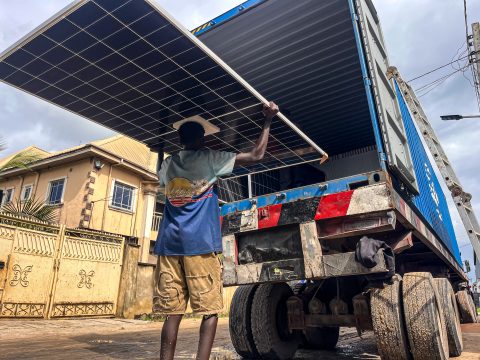
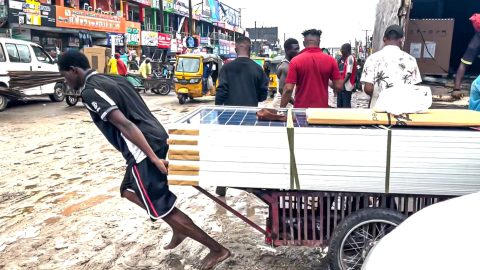
Data from energy think-tank Ember, published in August, projects that the continent will install a record 17 gigawatts (GW) of solar capacity in 2026 – equal to about 100,000 solar panels every day. This would mark the third consecutive year of record growth, following increases of 51% in 2025 and 25% in 2024.
African governments strengthen waste rules as solar and battery use surges
Joseph Ibrahim, Nigeria campaign director for Secure Energy Project, a global advocacy organisation working to accelerate the energy transition, said Africa receives only about 2% of global clean energy spending, leaving plenty of scope for more.
“A new African energy bank should build on that momentum, not pull scarce public money away from it,” Ibrahim said.
The post Africa launches long-delayed energy bank to finance fossil fuel projects appeared first on Climate Home News.
Africa launches long-delayed energy bank to finance fossil fuel projects

The upcoming COP31 climate talks in Antalya, Turkey need to respond to the latest science on global warming, which is “really scary”, says UK climate minister Katie White.
In an interview with Carbon Brief setting out the UK’s priorities for the summit, White also responds to suggestions that the government is walking back its climate policies.
White says the “shocking” impact of extreme heat and wildfires this summer makes it clear that climate change “isn’t something far off; it’s something we’re living through”.
She adds that the UK will be working to “hold up the science”, including the Intergovernmental Panel on Climate Change (IPCC) reports that should be the “basis of discussions”.
The COP31 presidency push on electrification is “going to be key”, says White, who points to other priorities for the UK that include tackling methane emissions and reducing deforestation.
White says the recent approval of the Jackdaw gas field in the North Sea is “fully in line” with carbon budgets and that the UK continues to support the “transition away from fossil fuels”.
She adds that the Hormuz crisis has helped drive the “biggest uptake…we’ve ever seen” in the UK for solar, electric vehicles and heat pumps.
Finally, White defends the new approach set out in the budget by chancellor John Healey, including a greater focus on affordability, as a “natural evolution” of UK government policy.
Carbon Brief: Katie White, thank you very much for joining Carbon Brief today. Next week we’re going to be heading to COP31 climate talks in Antalya in Turkey.
We’ve seen this year the UN warning that a temporary overshoot of 1.5C degrees is now inevitable. We’ve had 50,000 excess heat deaths across Europe this summer. We’ve had extreme weather events hitting Nepal, deadly floods there. Heading into the talks, what would you say the UK’s priorities are?
Katie White: Thanks, Simon. Look, just to say, it’s great to be here. I’m a big fan of Carbon Brief and the work you’ve been doing. I think it’s incredibly important that there are people who are focused on the facts and have really excellent commentary. So just to say thank you, and it’s good to be here to discuss with you.
Look, this year has been a very significant year in terms of climate, particularly sat here in the UK. I think we have really felt the impacts of climate change for the first time. For you and me, who’ve been working on this for a long time [and] we talk about it. But even so – I don’t know how you felt – but I was even shocked by the implications of what that was for everyday life, for people actually sleeping at night. You know, in terms of parliament, I had colleagues who had to go pick up their children because their schools weren’t available, and you know, tragedies in terms of older people struggling in the heat.
Not to mention the wildfires that we had across the country. I went to visit one in Romford and I think just standing – literally in the ashes – and seeing people’s homes really close by. My colleague in Stourbridge, obviously, they had burnt-out houses – you know, devastating. And you think about it – and I talked with her about – the actual real-life implications of that.

Membership
Support award-winning climate journalism
Obviously, people think about it, but then the after-effects, and you know the challenges with insurance and the challenge with all these sky boxes, and all of the things that come – those smaller things, as well as the tragedies around your photos, and all of that being lost.
So I think it’s really opened, sadly, another door for us in terms of the climate-change journey. This isn’t something far off; it’s something we’re living through. I know that’s been the case for many countries for a long time, but it really felt like a shift here in the UK.
You’re right, the science, once again, is really scary. The overshoot report is incredibly concerning. Scientifically, obviously, they look for a longer period. But I think the main message – for me as a politician – is this is really worrying. And every year we have another call to action. How do we translate that call into actual delivery? And that’s the bit we need to make sure of, because you know, I think we have to be listening to the science, and the science is fundamental and key. And we might talk about the IPCC [Intergovernmental Panel on Climate Change] and all the elements of that. But also, for me, how do we translate that?
It’s not, as you all know, it’s not the big global stocktake COP [this year in Antalya]. So it’s not going to be that big event, where we have it every five years. But we still need to be making significant progress. So we really focus a lot on the science, on the “action agenda” and on those political decisions – that “cover decision” that the Australian presidency [of negotiations] has said that they’re going to pursue.
So in terms of the action agenda, which obviously the Turkish [presidency] has led on and [has] been really forthright about leading on this, I think electrification is going to be key. It’s something that shot up the agenda.
I think most of your audience will know what electrification is, but for anyone outside of the climate bubble [it is] around electrifying our homes, electrifying our transportation. And in the UK, we’ve done a good job of decarbonising our electricity system, but we need to be pulling down on that and increasing demand to make sure that we take full advantage of the clean electricity that we have, which would be good for bills, but also around reducing our emissions as well. So something around electrification, we’re expecting a lot of talk of that. [It is] something the Turks have been talking about a lot.
Methane is another area which we’ve been working on, but I expect there will be some progress in terms of methane. Forests, you’ll know that we’ve pledged an investment to the [Tropical Forest Forever] TFFF, so we will be hoping for some momentum around that forests agenda.
So, I think, those are some of the really practical areas of action, as well as making sure we’re moving forward, holding up the UNFCCC [UN Framework Convention on Climate Change], holding up the science, so we can keep moving forward and making progress on any of those areas within the cover decision that the Australians will obviously steer us through.
CB: Great, thank you. You mentioned electrification. Obviously, that’s a target announced by the Turkish presidency earlier this year. They said they want to see the adoption of a global target for 35% of final energy to come from electricity by 2035.
At the moment, it’s a voluntary sign-on pledge, but presumably that’s something that could enter into the cover decision, as you mentioned. I guess I’m wondering: is the UK going to sign up to that, if it remains as a voluntary pledge? And would the UK like to see that in the cover decision, brought formally into the [COP31] outcome?
KW: Good questions. Look, so we’ll wait and see how we manage the next couple of weeks in terms of [that]. I think we have definitely, domestically, been looking at electrification and how we take advantage of the clean electricity that we have more effectively. Because of the Middle East crisis, broadly, we’ve seen interest in EVs, in solar panels and heat pumps, just shoot up this year, as people have got increasingly concerned about energy prices. And for those who are in a position, you know, a lot of them have taken advantage.
So we are seeing shifts in the market, and we’re looking at what role we can play to encourage and accelerate that. Whether it’s supporting the rollout of charging points for electric vehicles. You’ll probably know this, Simon, but there are more public charging points in the UK now than petrol pumps, which I think is an incredible fact – and most people don’t know. That’s not including those within driveways, of which nearly 70% of the UK has access to a driveway, so all of those people who might have their own home charging, there is more public.
We are making this infrastructure more easy, more accessible, so that people can make that shift. But we are [already] seeing the shift, you know, we’ve got two million EVs on the road. Super excitingly for the motor geeks, the second-hand [EV] car market is really starting to – excuse the pun – “motor”. Actually, that does mean a big shift in terms of accessibility.
So we’re seeing this happen within the UK. We’ll look at whether th