Connect with us

Published

on

U.S. DOE Restores Carbon Capture Hub Funding: Texas and Louisiana Projects Approved

On April 18th, Reuters reported that the U.S. direct air capture (DAC) sector received a major boost after the Department of Energy (DOE) decided to retain funding for two flagship carbon removal hubs originally backed under the Biden administration.

The move removes months of uncertainty and protects more than $1 billion in federal support for the South Texas DAC Hub and Louisiana’s Project Cypress. The decision also reinforces that carbon removal remains part of the United States’ long-term climate and industrial strategy, even as policy priorities evolve.

From Funding Risk to Revival: DOE Keeps Landmark Direct Air Capture Hubs Moving Forward

The Department of Energy had previously placed several clean energy awards under review, including major carbon capture, hydrogen, and industrial decarbonization projects. Among the most closely watched were the two large DAC hubs in Texas and Louisiana, both of which risked losing federal backing.

  • South Texas DAC Hub, developed with Occidental’s carbon management arm 1PointFive, holds a $500 million federal award.
  • Project Cypress in Louisiana received $550 million in support.

Although both projects were awarded significant funding, only an initial $50 million tranche had been disbursed so far, leaving most capital still pending deployment.

Once fully operational, both facilities are expected to remove more than 2 million metric tons of CO₂ annually from the atmosphere. That scale places them among the most ambitious carbon removal projects globally and positions the United States as a leader in early DAC commercialization.

Energy Secretary Chris Wright noted that the agency retained projects with credible delivery pathways following extensive review discussions with applicants. The DOE’s Hydrocarbons Geothermal and Energy Office will now help guide next steps, including fund disbursement and project execution.

U.S. Direct Air Capture Market Gains Policy and Investment Support

The funding confirmation strengthens confidence across the growing U.S. DAC ecosystem, which depends heavily on long-term policy signals and federal incentives.

The country already leads global carbon removal development, supported by programs such as the $3.5 billion DAC Hubs initiative and the Section 45Q tax credit, which can provide up to $180 per ton for permanent carbon storage under current structures.

In parallel, corporate demand for high-quality carbon removals continues to expand. Technology firms, airlines, and industrial players are signing long-term agreements to secure carbon removal supply, reflecting a shift from low-cost avoidance credits toward durable carbon storage solutions.
direct air capture
Source: Green Fuel Journal

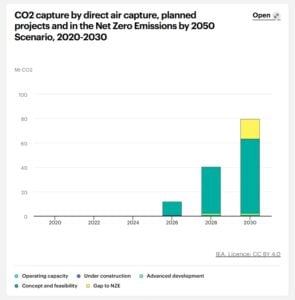
According to the International Energy Agency (IEA), more than 130 large-scale DAC facilities are now in development globally, with the United States holding a significant share of planned capacity. This pipeline highlights growing commercial interest even as the technology remains in its early deployment phase.

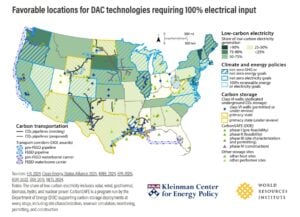
At the same time, regional DAC clusters are beginning to take shape. West Texas, for example, has emerged as a leading hub due to its combination of renewable energy access, subsurface storage potential, and industrial infrastructure. Projects like STRATOS, targeting 500,000 tons of annual CO₂ capture, illustrate how scaling could evolve through concentrated deployment.
direct air capture
Source: IEA

DAC Cost Challenges and Fuel Market Link Drive Long-Term Outlook

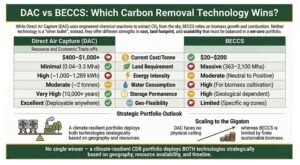
Despite strong policy backing, cost remains the most significant barrier for direct air capture expansion. Current estimates place DAC costs between $500 and $1,000 per ton of CO₂ removed, depending on technology type, energy sourcing, and storage logistics. While costs are expected to decline with scale and innovation, near-term economics remain challenging.

From Carbon Credits to SAF, DAC’s Business Case Is Getting Stronger

However, the value proposition is expanding beyond carbon credits. Captured CO₂ is increasingly viewed as a potential feedstock for synthetic fuels, including sustainable aviation fuel (SAF). This integration could improve project economics while also supporting fuel supply diversification.

Recent geopolitical tensions affecting global oil markets have added further urgency to alternative fuel development. In this context, DAC-linked synthetic fuel production could play a dual role by reducing emissions while supporting energy security.

Texas and Louisiana Lead the Transition

Texas and Louisiana are particularly well-positioned for this transition. Both states offer strong industrial infrastructure, access to geologic storage formations, and proximity to energy and chemical industries. Texas also benefits from expanding renewable energy capacity, which is important for powering energy-intensive DAC systems.
DAC US

Even so, scaling from today’s million-ton projects to gigaton-scale removal pathways will require sustained investment, policy support, and continued technological improvements. Some research suggests that large-scale DAC deployment may still require carbon prices or subsidies above $200 per ton for economic viability in the early phases.

Thus, the DOE’s decision to keep funding for the South Texas and Louisiana DAC hubs signals stability for a sector still shaping its commercial future. While cost and scale challenges remain, rising demand, broader policy support, and growing industrial interest suggest DAD is moving from experimental climate technology toward early-stage infrastructure development in the United States.

The post U.S. DOE Restores Carbon Capture Hub Funding: Texas and Louisiana Projects Approved appeared first on Carbon Credits.

Continue Reading

Carbon Footprint

Where should an SME start with a carbon action plan?

Published

on

More and more small and medium-sized businesses are hearing the same question from their larger customers: What is your carbon footprint? That question now travels down entire supply chains, and it arrives next to tender requirements, certification criteria, and rising customer expectations.

Continue Reading

Carbon Footprint

Insetting vs Offsetting: Which Actually Counts Toward Your Scope 3 Targets

Published

on

The accounting differences that decide whether your nature investment shows up in inventory, in BVCM, or nowhere at all.

The question reaches a procurement team about three weeks before the next sustainability committee meeting. Someone has read about insetting. Someone else has just signed off on an offset purchase. The CSO wants to know if the two are interchangeable. The answer is no, and the GHG Protocol Land Sector and Removals Standard is the reason why.

This article walks through what each term means at audit-grade specificity, what the standards actually say about how each gets counted, and how to decide which tool fits which target. The insetting vs offsetting question is one of the most-searched in corporate climate strategy, and one of the most poorly answered. By the end of this piece, you should be able to brief a committee on the difference without notes.

The two definitions, in plain English

Offsetting means buying carbon credits generated outside your value chain and retiring them against your residual emissions. The reduction happens somewhere else, financed by you, and the credit is the receipt.

Insetting means investing in emission reductions or removals inside your own value chain, typically with suppliers, where the reduction is directly linked to the products and services you buy. The reduction happens inside the boundary of your Scope 3 inventory, and the accounting treatment is fundamentally different.

The shorthand from the University of Oxford’s Nature-based Insetting Initiative is useful: insetting is what you do with the supply chain you have; offsetting is what you do with the supply chain you do not have.

What the GHG Protocol Land Sector Standard actually says

The GHG Protocol Land Sector and Removals Standard, finalised in 2024 after a multi-year pilot, sets the rules for how land-based emission reductions and removals enter corporate inventories. The Standard distinguishes between inventory accounting (Scope 1, 2, and 3) and project or intervention accounting (a separate methodology for crediting).

For insetting, the practical implication is that supplier-level interventions, when properly measured and attributed, can reduce your Scope 3 category 1 (purchased goods and services) emissions in your inventory. The reduction is not a credit retired against the inventory; it is a lower inventory number, period.

For offsetting, the credit is retired separately. It can be reported as a contribution toward a net-zero claim under the SBTi Beyond Value Chain Mitigation framework or as part of a VCMI Carbon Integrity claim, but it does not lower the inventory number.

A practical consequence: if your Science Based Target requires a 50% absolute reduction in Scope 3 emissions by 2030, insetting moves you toward the target. Offsetting does not. This single point of difference reshapes the procurement decision.

When insetting counts toward Scope 3 (and when it does not)

Insetting counts toward Scope 3 only when several conditions are met:

  • The intervention must occur with an entity in your value chain.
  • The emissions reduction or removal must be measured against a defensible baseline.
  • The reduction must be attributed to your share of that supplier’s output, not double-counted with other buyers.
  • It must follow the inventory accounting rules in the GHG Protocol Land Sector Standard, not the project accounting rules used to generate credits.

The most common failure mode is double counting. If your supplier sells the same reduction as a credit on the voluntary market and also reports it to you as a Scope 3 reduction, the math breaks. The Standard requires you to address this risk, typically by purchasing and retiring the supplier-issued credit as part of your inventory or by contractual provisions that prevent the supplier from selling the reduction twice.

When insetting does not count toward Scope 3: when the intervention sits with a supplier you do not buy from, when the baseline is not defensible, when the attribution is unclear, or when the documentation does not survive audit. Those cases default to Beyond Value Chain Mitigation, which is still useful but operates on a different ledger.

The procurement and supplier engagement question

Insetting is harder than offsetting. That is the unfashionable truth most buyers eventually confront. Offsetting is a transaction; insetting is a relationship.

To run an insetting program, you need supplier mapping precise enough to know which farms or facilities sit at which Scope 3 boundary. You need an engagement model that gets suppliers to participate, which usually requires multi-year commitments and shared economics. You need an MRV architecture that measures the right things and produces audit-ready documentation. And you need a contractual structure that prevents double counting and protects both sides.

The trade-off you receive in return is significant. Reductions count against your inventory rather than your residual. Supplier relationships deepen, which protects sourcing continuity. Yield and quality improvements often follow regenerative interventions, which reduces your input cost over time. And the regulatory file, under CSRD, CSDDD, EUDR, and the SBTi FLAG Guidance, is materially stronger.

Choosing the right tool for the right target

A practical decision rule. If your target is a science-based Scope 3 reduction and you operate in a FLAG sector or source FLAG commodities, insetting is the structurally correct tool. If your target is a net-zero claim that includes neutralising hard-to-abate residual emissions outside your value chain, BVCM via high-integrity offsets is the structurally correct tool. Most companies with material Scope 3 exposure need both, in different proportions, sequenced over time.

The sequencing matters. Insetting takes longer to stand up but produces a permanent reduction in the inventory. Offsetting can be transacted faster but does not change the inventory and now sits under tighter claim restrictions. Treat them as complementary tools with different jobs, not as substitutes. The Accountability Framework Initiative and the IUCN Global Standard for Nature-based Solutions both provide useful guardrails for the insetting side, with biodiversity, human rights, and benefit-sharing requirements that go beyond carbon math.

If you are mapping a Scope 3 reduction roadmap and need to scope which interventions count toward your inventory versus which sit in Beyond Value Chain Mitigation, the carbon and sustainability experts at Carbon Credit Capital can help you structure a nature-based supply chain investment program that fits your FLAG exposure, your target architecture, and your audit horizon. Schedule a consultation.

Continue Reading

Carbon Footprint

Net zero needs nature: a carbon credit guide

Published

on

Net zero is often described as a balancing act: cut what you can, account for the rest, and reach zero on the ledger. That framing is useful, but it leaves something out. It treats every tonne of carbon as interchangeable and every route to zero as equally sound, while the science tells a more specific story.

Continue Reading

Trending

Copyright © 2022 BreakingClimateChange.com

