


With Q2 2025 earnings released, all eyes are on Tesla’s margins, credit revenue, and regulatory risk. The electric vehicle (EV) pioneer remains a top global player in clean energy and EV manufacturing. However, shifting political winds and market dynamics could hurt its profits—especially its revenue from carbon credits, a long-time earnings booster. The EV giant’s credit sales this quarter drops to more than 50%.
With stiffer competition, changing demand for EVs, and the threat of U.S. climate policy rollbacks, Tesla’s path forward is less predictable than in past quarters. Let’s see how the company performs this quarter and what lies ahead.
Q2 2025 Earnings: Deliveries, Revenue, and Margins All Down
In its latest Q2 2025 report, Tesla posted revenue of $22.5 billion, a 12% drop from the same quarter last year. Net income came in at $1.17 billion, 16% down due to pricing pressure and weaker delivery numbers. Earnings per share (EPS) landed at $0.40, missing analyst expectations of $0.43.
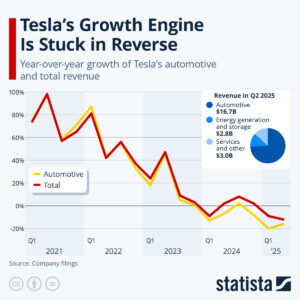
Tesla delivered 384,122 vehicles during the quarter, down from 466,140 in Q2 2024, a decline of nearly 14% year-over-year. Much of the dip came from reduced demand in North America and ongoing price competition in China.
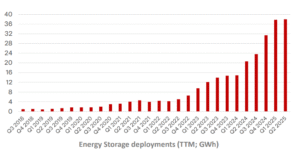
Moreover, Tesla’s energy generation and storage segment, which continues to grow in the past quarters, also fell. This segmet is led by strong sales of its Megapack and Powerwall units. These energy products generated more than $2.8 billion, down 7% year-over-year—an increasingly important line as vehicle profits tighten.
CEO Elon Musk noted in the earnings call that Tesla is pushing ahead with its Robotaxi launch, and reiterated plans for a more affordable EV model in 2026. He acknowledged that while macro and political factors remain uncertain, Tesla remains committed to innovation and global market expansion.
Competition Erodes Tesla’s Global Lead
Tesla’s long-standing EV dominance is being tested. In Q2 2025, Tesla delivered just under 385,000 vehicles globally. Meanwhile, China’s BYD sold over 606,000 battery electric vehicles, widening its lead and showing how quickly the competitive landscape is shifting.
Tesla’s market share in the U.S. has dropped from 75% in 2022 to about 43% in 2025. In Europe, Tesla now holds just 1.6% of the EV market.
Chinese automakers like Xiaomi, Nio, and Xpeng continue to grow quickly, offering lower-priced EVs with strong features. As affordability becomes more important to buyers, Tesla’s premium pricing may limit its growth. This is especially true if U.S. subsidies are scaled back or eliminated.
Unless Tesla launches a budget-friendly model soon, analysts believe it may lose more ground. Combined with falling credit revenue, this puts real pressure on its profit margins.
Tesla’s Carbon Credit Revenue Faces Political Risk
One of Tesla’s most profitable business lines has been the sale of regulatory credits to other automakers that fail to meet emissions targets. These carbon credits have nearly zero production costs and have historically delivered high-margin income.
In 2023, Tesla earned $1.79 billion from regulatory credits. That surged to $2.76 billion in 2024, accounting for almost two-thirds of Tesla’s profit in some quarters.
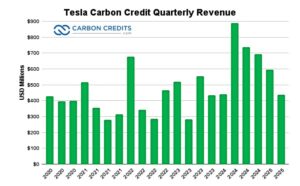
Notably, Q2 2025 carbon credits revenue fell by over 50% to 439 million, from 890 million in the same period last year. And the company’s quarterly credit sales show a decreasing trend since Q2 2024, as seen below.
Still, a major risk is emerging. The proposed “One Big Beautiful Bill” (OBBA) from Republican lawmakers aims to undo several of President Biden’s climate programs. It will eliminate EV tax credits, reverse EPA emissions standards, and weaken the Inflation Reduction Act (IRA). All of this could reduce the need for automakers to buy carbon credits—shrinking Tesla’s most lucrative income stream.
Estimates suggest Tesla’s credit revenue could fall to $595 million or less by 2026, and disappear completely by 2027. This would cut deeply into its margins and future earnings. Despite Elon Musk’s occasional support for deregulation, these changes would be a major setback for Tesla’s business model.
- SEE MORE: Why Tesla (TSLA) Stock Fell: Carbon Credit Crackdown, Musk’s Politics, and Canada’s Frozen Funds
Understanding the Carbon Credit System
Tesla benefits from emissions rules that reward automakers for producing zero-emission vehicles. Since it sells only EVs, Tesla accumulates more credits than it needs. It then sells the extras to competitors like Stellantis, GM, and Toyota, who still sell many gas-powered cars.
This has been an easy revenue stream. But if OBBA or similar legislation weakens clean air rules or emissions targets, the demand for these credits will shrink. That would leave Tesla more dependent on EV sales and energy storage—both of which face their own competitive and pricing challenges.
The Political Climate Adds More Uncertainty
Trump’s OBBA law reflects a broader effort by Republicans to reverse Biden’s climate agenda. With this new policy, many climate-focused programs will be rolled back. This includes EV subsidies, clean energy tax credits, and stricter emissions standards.
Tesla could face a drop in EV demand, especially in the U.S., if those incentives vanish. Ironically, Elon Musk has voiced support for deregulation, but the fallout from such policies could significantly hurt Tesla’s bottom line. Investors are concerned that political shifts could make Tesla’s future earnings far more volatile.
Tesla’s Stock and Strategic Outlook
Tesla’s stock (TSLA) has seen big swings this year. After climbing above $300 per share earlier in 2025, it fell to around $250 in July as delivery numbers declined and political risks grew.
Investors are watching key developments going forward:
- Will Tesla launch an affordable EV model to regain market share?
- Can its energy storage business grow fast enough to offset falling vehicle margins?
- How will regulatory changes affect its carbon credit income?
Upcoming launches like the RoboTaxi platform and Optimus AI robot are exciting but may take time to affect the bottom line. In the near term, Wall Street wants to see stable margins, smart cost controls, and consistent vehicle output.
Driving Forward: Can Tesla Adapt?
Tesla is still a powerful brand with loyal customers and strong technology. But its financial strength depends not only on vehicle sales, but also on favorable policies. Carbon credits and government incentives have played a big role in Tesla’s success.
With political uncertainty rising and competitors growing stronger, Tesla has to adapt fast. The company’s energy business and AI-driven platforms offer new growth paths, but execution and timing will be key.
As Trump’s OBBA bill turned into law, Tesla’s stock could remain volatile. But if the company navigates these challenges and continues to innovate, it may yet hold onto its leadership role in the clean energy transition.
- FURTHER READING: Tesla’s U.S. Robotaxi Launch: A New Catalyst for TSLA Stock Growth?
The post TSLA Stock Drops on Weak Q2 2025 Earnings: Tesla Faces Carbon Credit, Margin, and Political Risks appeared first on Carbon Credits.

Most businesses have a clear picture of what happens inside their own operations. They track energy consumption, manage waste, and monitor the emissions produced on-site. What they often cannot see is everything that happens before a product reaches their facility, and everything that happens after it leaves.

Carbon Footprint
Texas-Based EnergyX’s Project Lonestar™ Signals a Turning Point for U.S. Lithium Supply

Energy Exploration Technologies, Inc. (EnergyX), led by CEO Teague Egan, has moved the United States closer to building a reliable domestic lithium supply chain. The company recently commissioned its Project Lonestar™ lithium demonstration facility in Texas, marking a key milestone in scaling direct lithium extraction (DLE) technologies.
This development comes at a time when lithium demand is rising sharply due to electric vehicles and energy storage systems. At the same time, the U.S. remains heavily dependent on foreign processing, particularly from China.
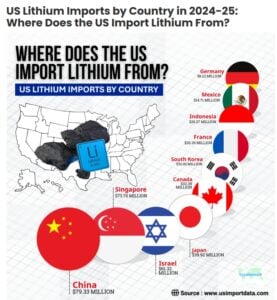
- According to the US import data and Lithium import data of the USA, the total value of US lithium imports reached $432.36 million in 2024, a 9% decline from the previous year.
- The total value of US lithium imports (cells & batteries) accounted for $205.29 million in the first 6 months of 2025.
Against this backdrop, EnergyX’s progress offers both technological validation and strategic value.
From Concept to Reality: How Project Lonestar™ Works
Project Lonestar™ is EnergyX’s first major lithium project in the United States and its second globally. The demonstration plant, located in the Smackover region spanning Texas and Arkansas, is now operational and uses industrial-grade systems rather than small pilot equipment.
- The facility produces around 250 metric tons per year of lithium carbonate equivalent (LCE).
While this output is modest compared to global supply, its importance lies in proving that EnergyX’s proprietary GET-Lit™ technology can efficiently extract lithium from brine. The plant processes locally sourced Smackover brine, a resource that has historically been underutilized despite its lithium potential.

Unlike traditional lithium production, which often relies on hard-rock mining or evaporation ponds, DLE technology directly extracts lithium from brine using advanced filtration and chemical processes. This reduces production time and may lower environmental impact.
- More importantly, the Lonestar™ plant can supply 5 to 25 tons of battery-grade lithium samples to customers.
This allows battery manufacturers to test and validate the material before committing to large-scale supply agreements.
Scaling Up: From Demonstration to Commercial Production
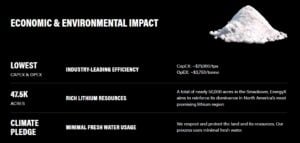
The demonstration plant is only the first phase of a much larger plan. EnergyX aims to scale Project Lonestar™ into a full commercial operation capable of producing 50,000 tonnes of LCE annually across two phases.
- The first phase alone targets 12,500 tonnes per year, which would already place it among the more significant lithium producers in the U.S.
- Significantly, the company has invested approximately $30 million in the demonstration facility, supported in part by a $5 million grant from the U.S. Department of Energy.
- For the full-scale project, EnergyX estimates total capital expenditure at around $1.05 billion.
Cost metrics suggest strong economic potential. The company estimates capital costs at roughly $21,000 per tonne of capacity and operating costs near $3,750 per tonne. If these figures hold at scale, the project could compete effectively with global lithium producers, particularly in a market where cost efficiency is becoming increasingly important.
Teague Egan, Founder & CEO of EnergyX, said,
“Bringing the biggest integrated DLE lithium demonstration plant online in the United States is a foundational milestone for EnergyX and for U.S. domestic lithium production in general. This facility not only validates the performance of our technology on an industrial scale under real-world conditions, but also establishes EnergyX as the lowest cost producer in the U.S. Ultimately this benefits all our customers who need large volumes of lithium for EV and ESS applications, as well as any lithium resource owners looking to implement best-in-class DLE technology whom we are happy to license to.”
Breaking the Bottleneck: Why U.S. Refining Matters
One of the biggest challenges facing the U.S. lithium sector is not resource availability but refining capacity. While lithium deposits exist across the country, most battery-grade lithium chemicals are processed overseas.
China dominates this segment, controlling roughly 70 to 75 percent of global lithium chemical conversion capacity. This concentration creates a structural dependency. Even when lithium is mined in the U.S. or allied countries, it is often shipped abroad for processing before returning as battery materials.
Project Lonestar™ directly addresses this gap. By integrating extraction and refining into a single domestic operation, EnergyX is working to build a complete “brine-to-battery” value chain within the United States. This approach could reduce reliance on foreign processing and improve supply chain resilience.
U.S. Senator Ted Cruz highlighted the project’s importance, noting that domestic lithium production supports both energy security and defense readiness, particularly for applications in advanced battery systems.
- CHECK: LIVE LITHIUM PRICES
The Current Landscape: Limited Supply, Big Ambitions

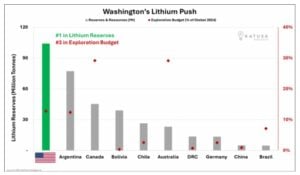
Investment is flowing into regions such as Nevada, North Carolina, and Arkansas. If even a portion of these reserves is converted into production, the U.S. could significantly reduce its reliance on imported lithium.
Active Resources and Future Potential
At present, U.S. lithium production remains relatively small. The only active large-scale operation is the Silver Peak Mine in Nevada, which produces between 5,000 and 10,000 tonnes of LCE annually, depending on market conditions.
However, several projects are in development that could significantly expand capacity. The Thacker Pass project, for example, is expected to produce around 40,000 tonnes per year in its first phase once operational later in the decade.
In addition, brine-based developments in the Smackover region aim to produce tens of thousands of tonnes annually, with long-term plans exceeding 100,000 tonnes across multiple sites.
These projects indicate a shift from a niche domestic industry to a more substantial production base. Still, timelines remain uncertain due to regulatory and financial challenges.
Demand Surge: Batteries Drive the Lithium Boom
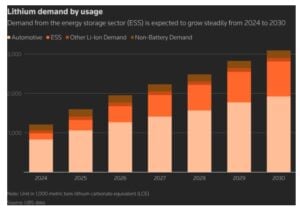
The urgency to expand lithium production is driven by rapid growth in battery demand. Electric vehicles, renewable energy storage, and grid modernization are all increasing lithium consumption.
According to S&P Global, U.S. lithium demand is expected to grow at an average rate of 40 percent annually between 2024 and 2029. Canada is projected to see even faster growth, albeit from a smaller base, with demand rising by around 74 percent per year over the same period.
Globally, battery capacity is forecast to approach 4 terawatt-hours by 2030. This expansion highlights lithium’s central role in the clean energy transition. Without sufficient supply, battery production—and by extension, EV adoption—could face constraints.
Why Progress Takes Time
Turning lithium reserves into operational mines and processing facilities is not straightforward. Projects often face long permitting timelines, environmental scrutiny, and legal challenges. Financing can also be difficult, especially in a volatile commodity market.
Local opposition can further complicate development, particularly in areas with high environmental concerns. These factors can delay projects by several years, slowing the pace of expansion.
To address these barriers, the U.S. government is increasing its involvement through funding, policy support, and efforts to streamline permitting. The Department of Energy’s backing of EnergyX reflects a broader strategy to accelerate domestic critical mineral development.
Conclusion: A Strategic Shift in Motion
Project Lonestar™ represents a meaningful step toward reshaping the U.S. lithium landscape. By proving the viability of direct lithium extraction at an industrial scale, EnergyX has laid the groundwork for larger, commercially viable operations.
The project also aligns with national priorities around energy security, supply chain resilience, and clean energy transition. While challenges remain, the combination of technological innovation, government support, and rising demand creates a strong foundation for growth.
As the world moves toward electrification, lithium will remain at the center of the transition. Projects like Lonestar™ show that the United States is beginning to close the gap between resource potential and real-world production—one facility at a time.
The post Texas-Based EnergyX’s Project Lonestar™ Signals a Turning Point for U.S. Lithium Supply appeared first on Carbon Credits.
Carbon Footprint
Canada Doles Out Almost C$29M for CCUS and Renewables as Clean Energy Market Surges

Canada has pledged nearly C$29 million ($21.6 million) to support carbon capture, utilization, and storage (CCUS) and renewable energy projects. The funding aims to back new technologies that reduce greenhouse gas emissions and make clean energy more competitive. This commitment was announced by the Canadian government in late March 2026 as part of ongoing efforts to meet climate goals.
The investment is small compared with Canada’s larger climate budget. But it signals continued federal support for emerging technologies and deployment of clean energy solutions. CCUS is one of several tools that nations are using to curb emissions while keeping energy supplies stable.
What Canada Is Funding? Inside the C$29M Clean Tech Bet
The C$29 million pledge covers a mix of CCUS and renewable energy efforts. It is intended for 12 projects that capture carbon dioxide (CO₂) from industrial emissions. It also supports systems that convert captured CO₂ into usable products or store it underground so it cannot enter the atmosphere.
The Honourable Tim Hodgson, Minister of Energy and Natural Resources, said:
“Canada is scaling up clean energy while strengthening our electricity grid and responsibly growing our conventional energy industry — because competitiveness means doing more than one thing at the same time. We are investing to provide reliable, affordable and clean power across the country that will propel our economic growth, protect affordability for Canadian families and make Canada a low-risk, low-cost, low-carbon energy superpower.”
Carbon capture refers to systems that trap CO₂ from power plants and factories before it is released. The captured gas can be stored deep underground or used in industrial processes, such as making building materials or fuels. Utilization means finding commercial uses for captured CO₂ so that it has economic as well as environmental value.
Renewable energy projects in Canada focus on expanding wind, solar, hydro, and other low‑carbon power sources. As of 2024, about 79 % of Canada’s electricity generation came from low‑carbon sources, with hydropower alone accounting for roughly 55 %. The rest comes from wind, solar, and nuclear energy.
Carbon Capture’s Strategic Role in Net Zero
Canada has a strong track record in CCUS deployment. Several large‑scale facilities already operate in the country, especially in Alberta and Saskatchewan.
For example, the Quest Carbon Capture and Storage Project in Alberta captures about one million tonnes of CO₂ per year and stores it deep underground.
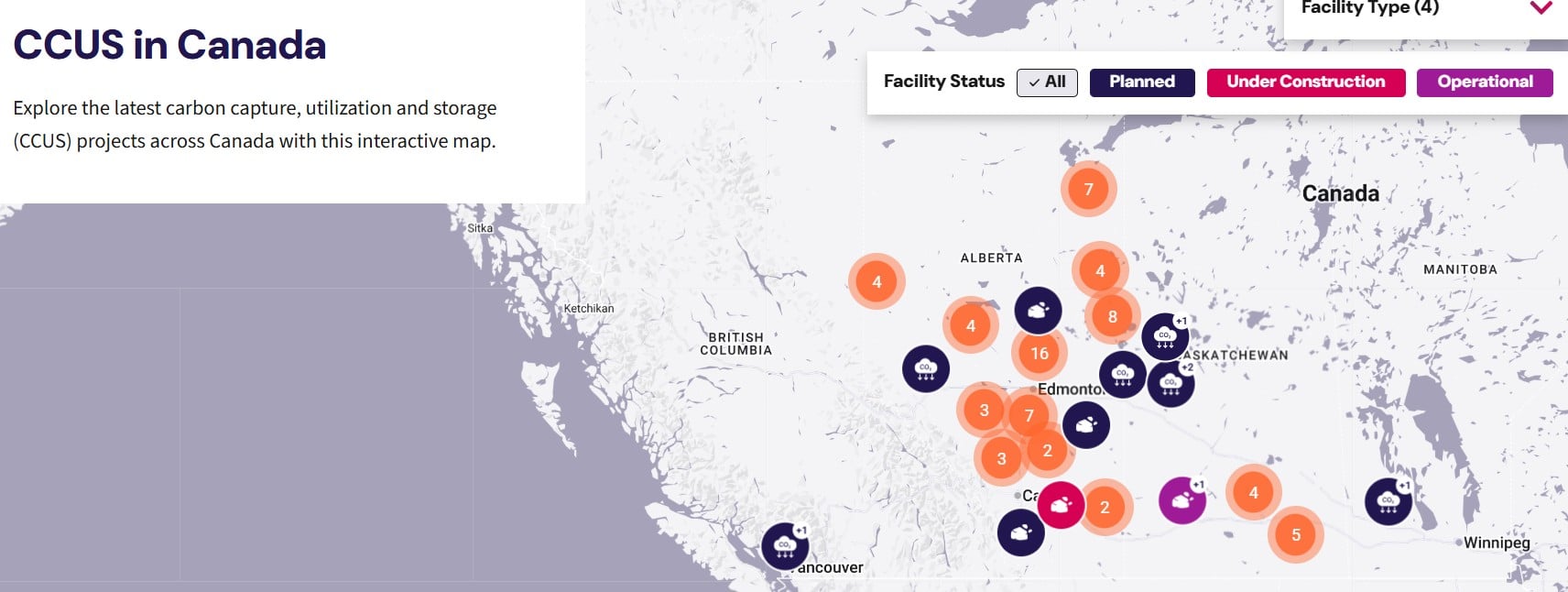
Canadian CCUS technology accounts for a notable share of planned global capacity. Canadian projects represent about 11.5 % of planned CCUS storage capacity worldwide.
Notably, Canada’s carbon capture capacity could increase from about 4.4 million tonnes of CO₂ per year to 16.3 million tonnes annually by 2030. However, much larger growth is still necessary to meet net-zero targets by 2050.
CCUS is considered critical for reducing emissions from hard‑to‑decarbonize sectors like heavy industry and oil and gas. It also plays an important role in achieving Canada’s long‑term climate targets, including net-zero emissions by 2050. In these scenarios, CCUS helps bridge gaps that electrification and renewables alone cannot fill.
Canada’s Energy Innovation Program (EIP) is designed to speed up the development of clean energy technologies while keeping the energy system reliable and affordable. It supports early-stage research and development in CCUS.
The program also funds renewable energy demonstration projects that test new ways to generate and integrate clean power, especially those with local benefits. In addition, EIP promotes innovation in electricity systems by supporting new approaches to smart grid regulation and capacity building.
A Power Mix Already Going Green
Renewable energy is another core part of Canada’s climate strategy. Over the last decade, installed renewable capacity has grown steadily. Between 2014 and 2024, Canada’s total renewable energy capacity increased from about 89,773 MW to 110,470 MW.
The federal government has supported renewable projects through multiple funding programs. Earlier initiatives included a $964‑million investment targeting wind, solar, storage, hydro, and other renewable technologies.
Canada has also set decarbonization targets tied to renewables. The country aims for net‑zero electricity by 2035, which supports a broader economy‑wide goal of net‑zero greenhouse gas emissions by 2050.
CCUS and Renewables on a Global Rise
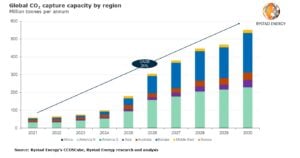
Investment in CCUS and renewable energy is rising globally. According to industry forecasts, the global clean energy market — including wind, solar, energy storage, and CCUS — is expected to continue strong growth through 2030 as countries push toward climate targets.
For CCUS specifically, analysts project that global installed capacity could grow fivefold by 2030 as more projects move from demonstration to full deployment. Canada is among several countries with mature CCUS infrastructure and planned expansions.
Renewables continue to be the fastest‑growing energy source globally. International agencies like the International Renewable Energy Agency (IRENA) project that renewable capacity will keep expanding rapidly through the end of the decade, driven by falling technology costs and climate commitments.
The Roadblocks to Scaling Clean Tech
While CCUS has potential, it also faces hurdles. Costs are high, and the technologies are still emerging at scale. Critics argue that CCUS has historically underperformed in some early projects, and that a significant amount of captured CO₂ is used in enhanced oil recovery rather than stored permanently.
Some stakeholders also warn that public funds for CCUS must be carefully targeted to avoid subsidizing continued fossil fuel use rather than meaningful emission cuts. Despite these concerns, many policymakers see CCUS as an essential component of climate strategy if Canada is to meet its 2030 and 2050 goals.
Renewable energy projects also face challenges, including grid integration, siting barriers, and supply chain constraints for equipment like turbines and solar panels. However, continued funding and clear policy signals tend to reduce these barriers over time as markets mature.
Cutting Emissions While Keeping Energy Stable
Canada’s C$29 million commitment fits into a broader pattern of public funding aimed at accelerating clean energy and decarbonization technologies. Larger federal efforts, such as the Net Zero Accelerator Initiative, provide billions of dollars over multiple years for clean tech, including CCUS deployment and industrial decarbonization.
The CCUS market is evolving from pilot projects to commercial opportunities. Meanwhile, renewable energy continues its growth as a mainstream power source. Together, these developments support Canada’s long‑term climate and economic goals.
As the global energy landscape changes, investments in both CCUS and renewables help reduce emissions, create jobs, and build resilience in a low‑carbon economy. Canada’s latest funding pledge reinforces its ongoing role in these key markets.
- READ MORE: Canada Approves First Uranium Mine in 20 Years as Tech Giants Eye Nuclear Fuel for AI Power
The post Canada Doles Out Almost C$29M for CCUS and Renewables as Clean Energy Market Surges appeared first on Carbon Credits.



-
Climate Change8 months ago
Guest post: Why China is still building new coal – and when it might stop
-
Greenhouse Gases8 months ago
Guest post: Why China is still building new coal – and when it might stop
-

 Greenhouse Gases2 years ago
嘉宾来稿:满足中国增长的用电需求 光伏加储能“比新建煤电更实惠”
-
Climate Change2 years ago
Bill Discounting Climate Change in Florida’s Energy Policy Awaits DeSantis’ Approval
-

 Climate Change2 years ago
嘉宾来稿:满足中国增长的用电需求 光伏加储能“比新建煤电更实惠”
-
Climate Change Videos2 years ago
The toxic gas flares fuelling Nigeria’s climate change – BBC News
-

 Renewable Energy5 months ago
Sending Progressive Philanthropist George Soros to Prison?
-

 Carbon Footprint2 years ago
US SEC’s Climate Disclosure Rules Spur Renewed Interest in Carbon Credits