In the midst of a record-breaking heatwave in Europe, the UK city of Exeter recently played host to the second international conference on “tipping points”.
The event was billed as a “call to action” to the “research community, policymakers and business to raise awareness and understanding of the importance of tipping points and to accelerate the required action”.
As human activity drives global temperatures to record highs, multiple parts of the Earth system are at risk of being pushed beyond thresholds that would see them shift irreversibly into a new state.
The conference also focused heavily on “positive tipping points”, where large-scale, self-propelling social change can reduce the impact of humans on the climate.
Hosted jointly by the Global Systems Institute at the University of Exeter, the Potsdam Institute for Climate Impact Research and the Max Planck Institute of Geoanthropology, the conference was the second event dedicated to global tipping points, following the first in 2022.
A statement issued by conference convenors – and endorsed by hundreds of delegates – warned that the window for preventing tipping points is “rapidly closing”.
It called for “immediate, unprecedented action from policymakers worldwide and especially from leaders” at the forthcoming COP30 climate talks in Brazil.
The meeting was part of a week-long Exeter Climate Forum, which also included a separate Climate Conference and a series of community and business-focused events.
In this article, Carbon Brief draws together some of the key talking points, new research and ideas that emerged from the four-day event.
Climate tipping points
As he opened the conference, Prof Tim Lenton – director of the University of Exeter’s Global Systems Institute and one of three convenors of the event – introduced tipping points and set out the direction of the upcoming four days of talks.
He explained that tipping points are caused by “amplifying feedbacks” in a system becoming “self propelling”. He said these systems are “very hard to reverse and it could be quite abrupt”.
Lenton warned that since the last tipping points conference in 2022, global temperatures have risen, bringing many Earth system tipping points closer.
However, he told the conference that not all tipping points are harmful, distinguishing between a “bad tipping point in the climate or a positive one in societies and technologies”.
Lenton told the conference that “there is a compelling case that we could accelerate out of trouble”, adding that we could “lift [many people] out of harm” by focusing on positive tipping points.
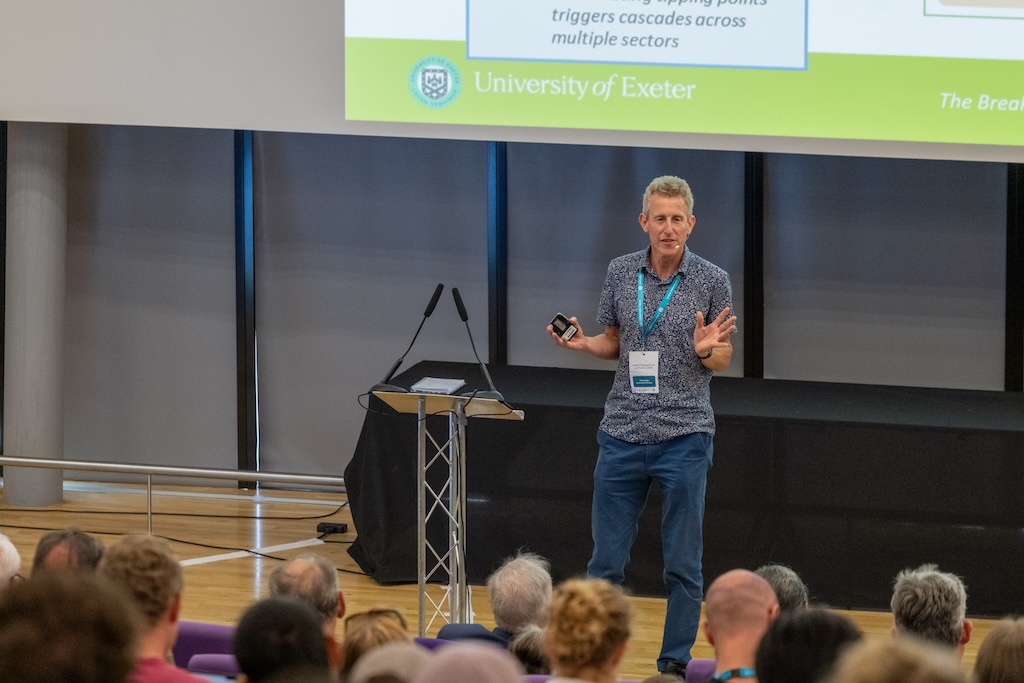
Prof Johan Rockström, director of the Potsdam Institute for Climate Impact Research (PIK) and joint convenor of the conference, talked about the importance of considering planetary boundaries in tipping-points research. This framework sets out nine interlinked thresholds that would ensure a “safe operating space for humanity”.
Rockström told the conference that using this “whole Earth approach” can highlight that thresholds for tipping points may be lower than when only considering climate change.
For example, he said the Amazon rainforest is at risk of crossing a tipping point that could trigger “dieback” at around 3-5C of global warming above pre-industrial levels. However, he said that “transgressing” other thresholds, such as deforestation and moisture levels, could cause the system to tip sooner.
Rockström also argued that Earth system risks have now reached the “global catastrophic” level – defined by the Global Challenges Foundation as an event or process that “would kill or seriously harm more than 10% of the human population”.
He said the collapse of the Greenland and West Antarctic ice sheets, the dieback of the Amazon rainforest and the shutdown of the Atlantic Meridional Overturning Circulation (AMOC) present the greatest risk, as they have a high severity of impact and probability of occurrence.
He closed by arguing that scientists need to better communicate the risks of tipping points to encourage more action.
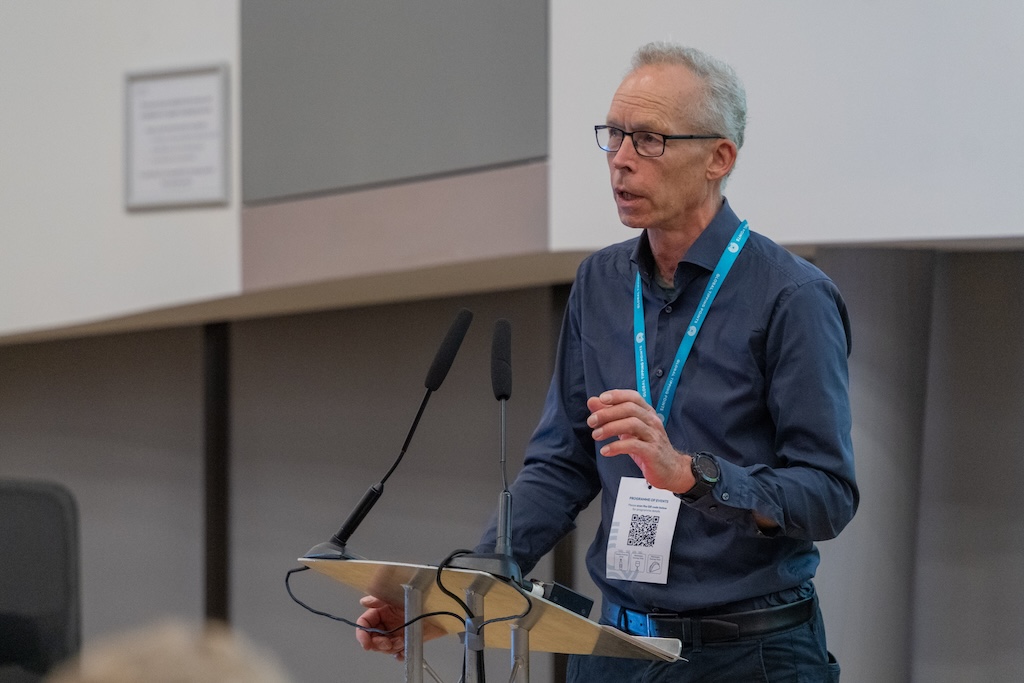
Prof Ricarda Winkelmann, the third convenor of the conference and professor of climate system analysis at PIK, discussed tipping of the Greenland and West Antarctic ice sheets, which together hold enough ice to raise global sea levels by 65 metres.
Winkelmann encouraged the delegates to consider timescales. She described tipping of the ice sheets as “slow-onset systems”, but highlighted that they can also “undergo quick and abrupt changes”.
To demonstrate this, she played a video of “calving” from the Ilulissat glacier in western Greenland. This was the largest calving ever caught on camera, which saw chunks of ice up to 1,000-metres thick break off the main ice sheet, she said.
Winkelmann described a “time clash” between the long-term changes in biophysical systems and short-term changes in socioeconomic systems. She concluded:
“The choices and actions implemented in this decade really have impacts now and also for the next 1,000 years.”
Also in the opening plenary session, Dr Carlos Nobre, a former Earth system scientist at the University of São Paulo, discussed tipping in the Amazon rainforest.
He said that decades of “high-level deforestation and degradation” across the Amazon have resulted in “much less water recycling”, as well as droughts and forest fires, that are creating a “tremendous health problem” for people.
Nobre noted that higher levels of deforestation push down the temperature threshold at which the rainforest could tip from lush rainforest to dry savannah.
He also discussed “nature-based solutions” and the importance of combining scientific knowledge with Indigenous knowledge and local communities.
Dr David Obura, the founding director of CORDIO East Africa and chair of the Intergovernmental Science-Policy Platform on Biodiversity and Ecosystem Services (IPBES), highlighted the importance of the IPBES framing, which emphasises the need to connect nature and people.
He flagged the state of the world’s coral reefs, telling delegates that, as of the end of last year, 44% of the 800 coral reef species studied by the International Union for Conservation of Nature (IUCN) are “threatened”.
Obura added that “ocean temperatures have shot up in the last few years”. However, he warned that looking at temperature alone is insufficient, arguing that there are other physical and socioeconomic factors that need to be understood.
In the panel discussion that followed, Nobre stressed the importance of the COP30 talks in Brazil this year “looking at solutions” to the changing climate. Obura said that humanity has “extracted wealth from nature into economic systems”, arguing that this money must “come back into nature”.
When asked why the risk of tipping points is not being discussed at the UN security council, Rockström flagged an “inability to handle timescales” and said that language around uncertainty allows politicians to “kick the can down the road”.
When asked about the media, Rockström said it is “unfortunate” that humanity is allowing a media landscape that “underplays risk” and allows only “soundbites” from scientists. He added that the “media has a huge responsibility” in the current framing of climate change.

However, Winkelmann said the media “can play an incredibly important role in moving things forward”.
Broader focus
While the central themes of the 2022 conference were the two main areas of climate tipping points and positive tipping points, the 2025 event took a broader focus that encompassed social systems and governance.
Prof Winkelmann told Carbon Brief that this reflected how the tipping points “community” is much larger now than it was three years ago:
“The community has grown a lot since [2022] and it especially also includes not just the scientific community, both on the biophysical side and the social side, but also a lot of people from policy, governance and business. So I think it is really brilliant to have this community here together, thinking about tipping dynamics and the impacts in this holistic approach.”
Lenton told Carbon Brief the conference was “bigger and more diverse” than the 2022 edition. This, he said, was likely due to “demand for knowledge of the subject”, alongside a wider range of “stakeholders, voices and actors” being engaged in discussions about tipping points.
While tipping points are well-defined in natural sciences, they are less so in the social sciences, Rockström told Carbon Brief:
“I would even argue that many social scientists – even some social scientists at this conference – are even uncomfortable in using the term social tipping point, or positive tipping point, and are much more academically grounded in defining ‘social transformations’, ‘social transitions’ or ‘social change’. I have a strong respect for that. It is really important to humbly recognise that the social sciences come at this with very different methods and theories.”
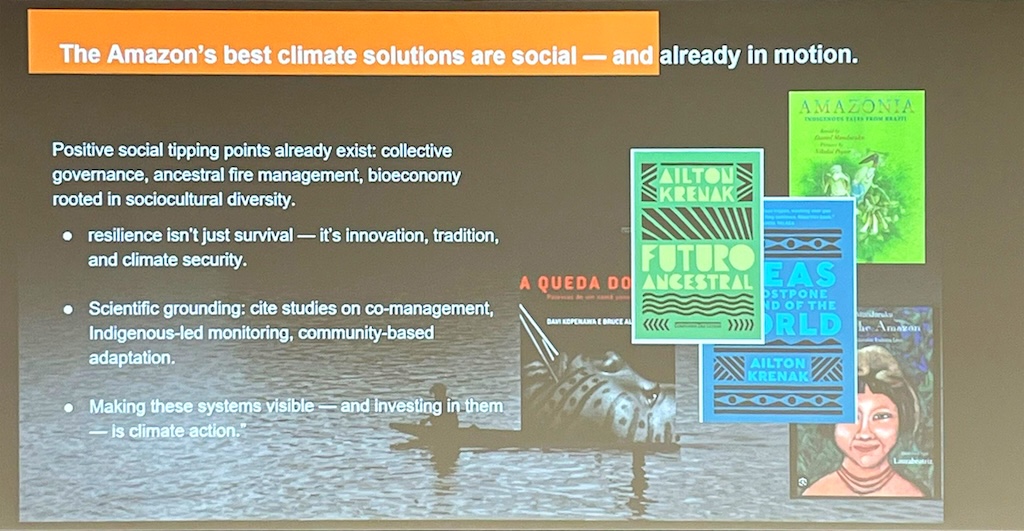
In a plenary session on social-ecological tipping points, Dr Patricia Pinho – deputy science director at the Amazon Environmental Research Institute (IPAM) – argued that “we can’t really model forest resilience if we ignore the people that are on the frontline”.
According to her presentation, “Indigenous and traditional communities are already experiencing and resisting socio-ecological tipping points”.

Global warming and land-use change have led to forest degradation in 36% of the region, Pinho said. Combined with increasing forest fires, heat and drought, communities are seeing impacts on “food security, health [and] loss of biodiversity”, she added:
“So what we are seeing is loss of identity, place, attachment. People are losing their relationship [with the Amazon] and livelihoods and culture.”
Another plenary considered the positive tipping points in “socio-technical systems”.
Among the talks, Simon Sharpe, former deputy director of the UK government’s COP26 unit and now managing director of the non-profit research group S-Curve Economics, outlined the progress towards positive tipping points in the sectors of power generation, road transport and steel production.
While the power-sector transition is “going quite well” and light road transport is already seeing electric vehicles (EVs) make up “20% of new car sales globally”, the steel transition is in its “very early stages”, Sharpe explained.
For the steel industry, the “tipping point that we have to cross is in terms of risk perception”, Sharpe said:
“You have to get to the point where industry feels that actually it’s no longer the ‘first-mover risk’ that is the biggest risk – it’s the ‘late-mover risk’ that’s the biggest risk.”
Sharpe argued that this was best achieved by a clean-steel subsidy, noting that “we’ve seen for the brief period where the US had its [Inflation Reduction Act] and was strongly subsidising clean industrial production”. He continued:
“That resulted in a big shift of industry lobbying in Japan and the EU, where all the steel companies suddenly said, ‘Oh, can we have clean-steel subsidies as well, please?’”
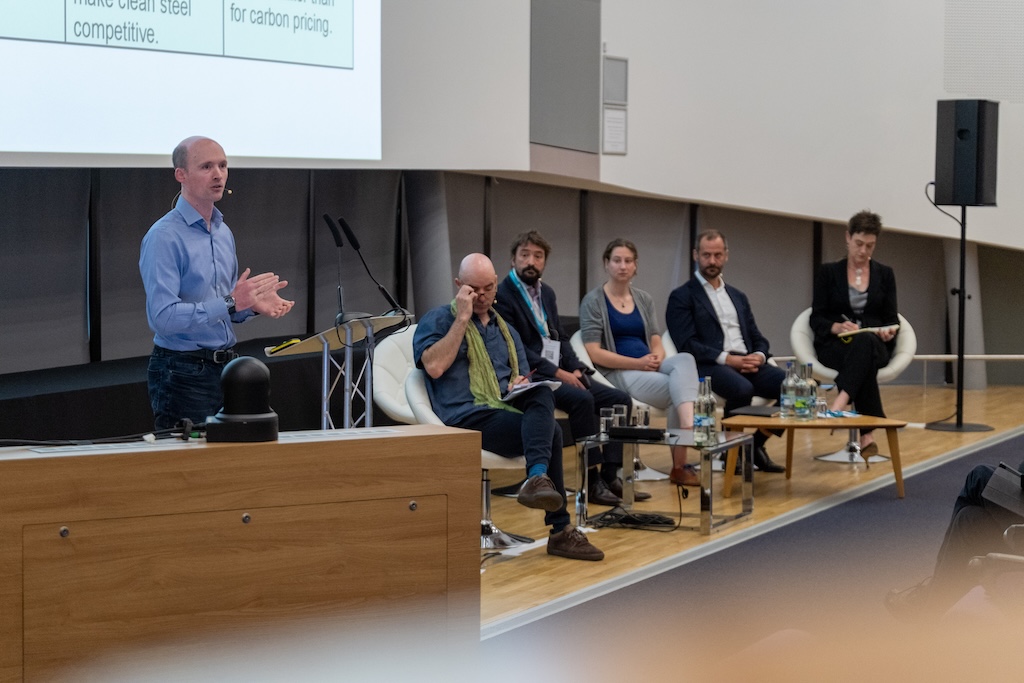
Focusing specifically on EVs, Dr Jean-Francois Mercure from the University of Exeter described his forthcoming study on the tipping point “that is unfolding now”.
This has been driven by a feedback loop between the falling cost of EVs and the rise in how many are being purchased, Mercure explained:
“The cost coming down helps people buy more electric vehicles; more electric vehicles [being bought] causes the cost to come down.”
While there is “exponential growth” in EV sales, Mercure showed how the sales market share in conventional cars has been “plunging” in “Germany, UK, France and especially China” since 2019:
“So we’re kind of saying, yes, the system has started to tip into this new electric vehicle regime.”
However, Mercure added, “it’s fragile” as it could be bogged down by policy reversals. He also noted that there are barriers, such as China’s dominance in producing batteries, which is “becoming problematic” and led to tariffs in the EU and US.
From the audience, Prof Joyeeta Gupta of the University of Amsterdam questioned whether EVs are seeing a “long-term” tipping point when the global south is considered:
“Electric cars are going up the global north, but the old petrol cars are going south. Basically, what you’re seeing is that when certain things improve in the global north, the older stuff just gets dumped on the global south.”
Governance
The conference also emphasised the importance of governance, with multiple breakout sessions and a plenary dedicated to the topic.
In one breakout session, author Herb Simmens explained that governance is a “system of rules, processes and practices by which public institutions are managed and controlled”, which aim to “establish how decisions are to be made, and then to ensure that those responsible for making them do so”.
He argued that setting out to limit tipping points should be considered policymaking, not governance. However, he said that strong global governance is needed in order to oversee the implementation of policies to stop global warming. He also added that local governance is needed in many instances – for example, to stop deforestation in the Amazon in order to prevent the rainforest from tipping.
Dr Manjana Milkoreit – a postdoctoral researcher at the University of Oslo – chaired a plenary session on governance. She told delegates that the 2023 tipping points report identifies “two major domains of governance involved” in managing global tipping points. These are “prevention” and “reorganisation”, she said.
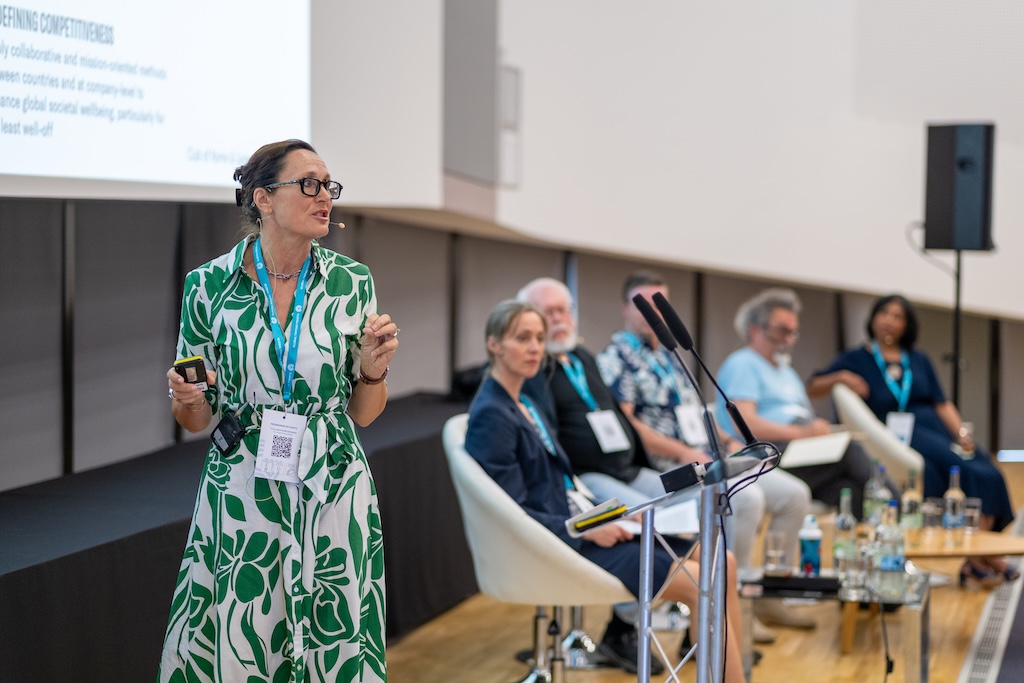
Sandrine Dixson-Decleve, co-president of the not-for-profit Club of Rome, stressed the importance of discussing how to “integrate planetary emergency at the top level into constitutional law”. She concluded:
“If we can’t get the governance to work right now, we have to think about other types of governance frameworks at the local level, community level, that start to create the feedback loop all the way back up to the international level.”
Durwood Zaelke, founder and president of the Institute for Governance & Sustainable Development, highlighted the success of the Montreal Protocol – an agreement signed in 1987 by nearly 200 countries to limit emissions of “ozone-depleting substances” in an effort to stem the damage to the ozone layer.
He argued that governance on cutting emissions must be binding, as the Montreal Protocol was, rather than voluntary.
He also argued that cutting CO2 emissions is “essential, but a slow process” and advocated for more emphasis on cutting emissions of “short-lived super-pollutants”.
Prof Per Olsson, deputy science director at the Stockholm Resilience Centre, said there has been a “deeply problematic” backlash in the past five years, in the form of “political polarisation”, “war”, “democratic backsliding” and the “dehumanisation of people that think differently from you”. He warned that these “threaten to derail many processes”.
Oliver Morton is a senior editor at the Economist and serves on the board of trustees of the Degrees Initiative – a non-government organisation that focuses on promoting expertise on solar radiation management in the global south. (However, he said at the start of his talk that he was not speaking in these capacities.)
Morton argued for a greater emphasis on solar geoengineering in the tipping points community.
Morton told delegates that the lengthy 2023 global tipping points report featured only a few paragraphs on solar geoengineering, stating that the technology “might” help limit temperature rise, he said:
“I would really be interested in that ‘might’. But that’s not, in fact, what this community does. It’s not what people particularly seem to want to talk about.”
Morton noted that many delegates of the recent Arctic Repair Conference, which was held in Cambridge in June, were present at the tipping points conference, highlighting the “overlap” between the two fields.
He recognised the challenges with the governance of solar geoengineering, but added that there are challenges “for all governance”. He also emphasised that “everyone in the solar geoengineering community” says that the technology would “complement, not replace, mitigation”.
Morton emphasised the need for expertise on solar geoengineering in the global south. He concluded that “sidelining” research on geoengineering, which potentially could reduce harm, opens up the tipping-points community to criticism for not considering all options. He referred to this as “choice-editing”.
Finally, Prof Joyeeta Gupta, spoke about the divide between the global north and global south.
She said that she is working to introduce a global constitution “to try to understand how to regulate the public and private sector” and she invited the audience to participate by sending in submissions.
When asked whether the phrase “tipping points” has been watered down, Sandrine said that words like “regenerative” and “sustainable development” are overused and agreed that we “can’t keep playing with the language until it becomes nonsensical”. She called on conference delegates to come together to define key terms.
At a breakout session, Prof Karen Morrow, a professor of environmental law at Swansea University, explained that the legal system currently does not deal well with any issue at the planetary scale, as global problems cannot be reduced to a “nice, tidy jurisdictional issue”.
She said that the irreversibility of Earth system tipping points is “horriffic”. However, she noted that the language of uncertainty in science can make it hard to “find a foothold” legally, arguing that the irreversibility may help with this by providing more certainty.
She added that there are currently laws around “obligation to prevent harm”, but said that there are “not enough”, arguing that we need laws that dictate a “substantive restraint on human activities”.
Positive tipping points
A significant portion of the conference was dedicated to “positive tipping points” – described to Carbon Brief by Rockström as “social transformations” that generate “feedbacks that are self-enforcing”, making them difficult to reverse.
Examples of these social transformations that featured in plenaries and research sessions included the rapid rollout of EVs in Norway, tree-planting schemes in Uganda, investments in “regenerative” cotton farming and the falling costs and rising adoption of solar energy around the world.
In a breakout session, Dr Jean-Francois Mercure said the “positive tipping point narrative is good because it changes the policy narrative”. He explained:
“We used to have this narrative, which goes – ‘we tax [and] we price the externality because prices need to reflect costs’. This is demanding because it is politically difficult to tax and subsidies need to be justified. [That narrative says] we are pushing a thing that gets harder the more we do it – so there is a limit to climate action.
“This is not how it really works. When you look at the solar revolution, we had to push up to a certain point, after which it went off on its own. Electric vehicles, too. This [narrative] changes what policymakers need to do and think. They need to work to push over the initial hurdle.”
In a plenary session, Kate Raworth, an ecological economist at the University of Oxford, highlighted how a growing number of states, cities and regions around the world had adopted her “doughnut” theory of economics.
“Doughnut economics” is a framework which imagines a global economy which prioritises meeting the needs of people without overshooting planetary boundaries.
Raworth highlighted how more than 50 municipal governments had publicly adopted the framework since 2019 – and added there are “another 50 doing it behind the scenes”. She said that “peer-to-peer inspiration” has been a powerful force in driving momentum behind the framework’s popularity.
Jameela Mahmood, executive director of the Sunway Centre for Planetary Health at Sunway University in Kuala Lumpur, described how her organisation’s advocacy had led to the Malaysian government’s adoption of a planetary health framework in its forthcoming economic development plan. She also said planetary health would become a mandatory part of the nation’s undergraduate curriculum from 2026.
Túlio Andrare, chief strategy and alignment officer for the COP30 presidency, described the Brazilian government’s plans to convene a “global mutirão”, which encourages individuals, communities and organisations to make self-determined commitments to take actions to tackle climate change. (Mutirão is a word from the Indigenous Tupi-Guarani language family that refers to collective action). He said:
“The global mutirão is about inviting people to think about who they are and what they can offer. It is also about designing potential positive tipping points. Because if we have different initiatives that are self-organised, we can integrate those local initiatives in a global framework.”

In a separate plenary session on tipping points within food systems, Rune Baastrup, director of development at Democracy X, a private foundation focused on deliberate democracy, presented on a project to shift eating habits in Denmark.
The project, which he said is grounded in “sociological literature”, is to encourage a push towards plant-based eating from a local level, by funding and coordinating communal meals that citizens arrange for and with each other. Baastrup explained:
“It’s not about politicians going out pointing fingers at citizens. It is about citizens engaging and then mobilising each other – not necessarily because they want to save the world, but because they want to do interesting and cool things with their neighbours.”
According to Democracy X’s theory of change, reaching “one in 10 Danes” through this work would be enough to galvanise a “profoundly more deep green transition” in the Scandinavian country, Baastrup said.
In the same session, journalist and author George Monbiot said it was “questionable” whether the global food system could achieve a “positive tipping point”.
However, he said there were a number of actions that could be taken to create a food system which maintains high yields, reduces environmental impacts while remaining diversified and leaving space for nature restoration and recovery. He argued that these included: switching away from an animal-based diet to a plant-based diet; the embrace of perennial grain and arable crops; and production of food outside the farming system, including through precision fermentation.
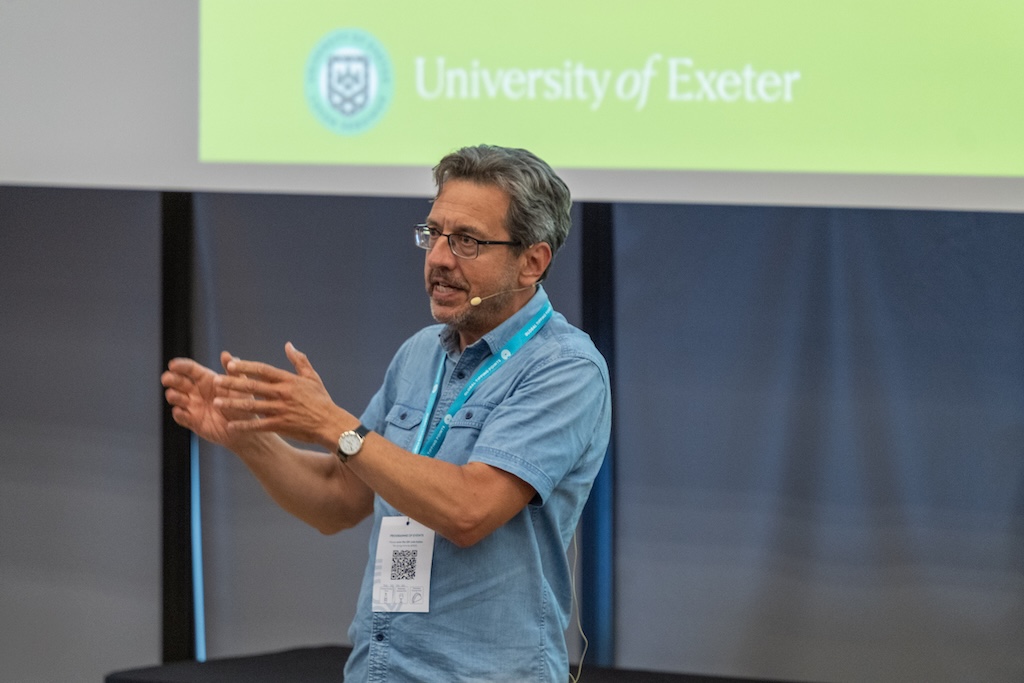
Monbiot said the conversation around food systems was “going backwards”, pointing to the growing popularity of “simple living, grow-your-own soul food” tropes on social media:
“There is this complete confusion between what looks nice – between the bucolic, romantic, aesthetic and cottagecore that you can post up on Instagram – and what we actually need in order to intervene effectively in this huge Leviathan of a system which is going to crush us into dust.”
In his closing remarks, Lenton mused that the research community was on a quest to discover the “recipe” behind positive tipping points. He explained:
“We’re passionate as researchers to seek out the early opportunity signals that systems we want to get rid of might be able to get tipped out of.”
Having a toolkit for identifying the “generic” signals of when an incumbent system is showing signs of destabilising could guide efforts from activists, policymakers and investors to drive positive change for the planet, he said.
Lenton said upcoming research, set to be published in Sustainability Science, represented a “first attempt” at a methodology “for anyone who wants to ask whether a system has the potential for a positive tipping”. The methodology in question would also seek to answer the following questions, he said:
“If [a system] has [the potential to tip], how close is it? What factors would influence it? In particular, what could bring it forward? And then what actions could influence those factors to tip other systems?”
Lenton urged scientists at the conference to help him “refine and apply” the methodology. He also urged colleagues to keep “documenting” evidence of positive tipping over the years ahead. He explained:
“There is a theory of change here. We have got to enable each other to learn faster [and] to spread these initiatives better.”
New science
Modelling projects
Along with the main plenaries, the conference included around 50 breakout meetings, split between “research sessions” and “action workshops”.
Among the new research being presented at these sessions were early results from the “TIPMIP” international modelling project.
Rockström told Carbon Brief the “biggest change” in tipping-points science since the first conference in 2022 is the launch of TIPMIP. He said:
“The most solid scientific basis in the IPCC are all the ‘MIPs’, the modelling comparison programmes. The biggest one is CMIP [the Coupled Model Intercomparison Project], which gives us the data and the scenarios to be able to deliver the Paris Agreement.
“Now, we finally have a MIP for tipping points – and the tipping point comparison community is here at the conference, as well as [scientists from] the big Earth system models. Big tipping modelling analysis [is underway] on AMOC risks, on the Amazon rainforest, on permafrost and the ice sheets. That is a major advancement.”
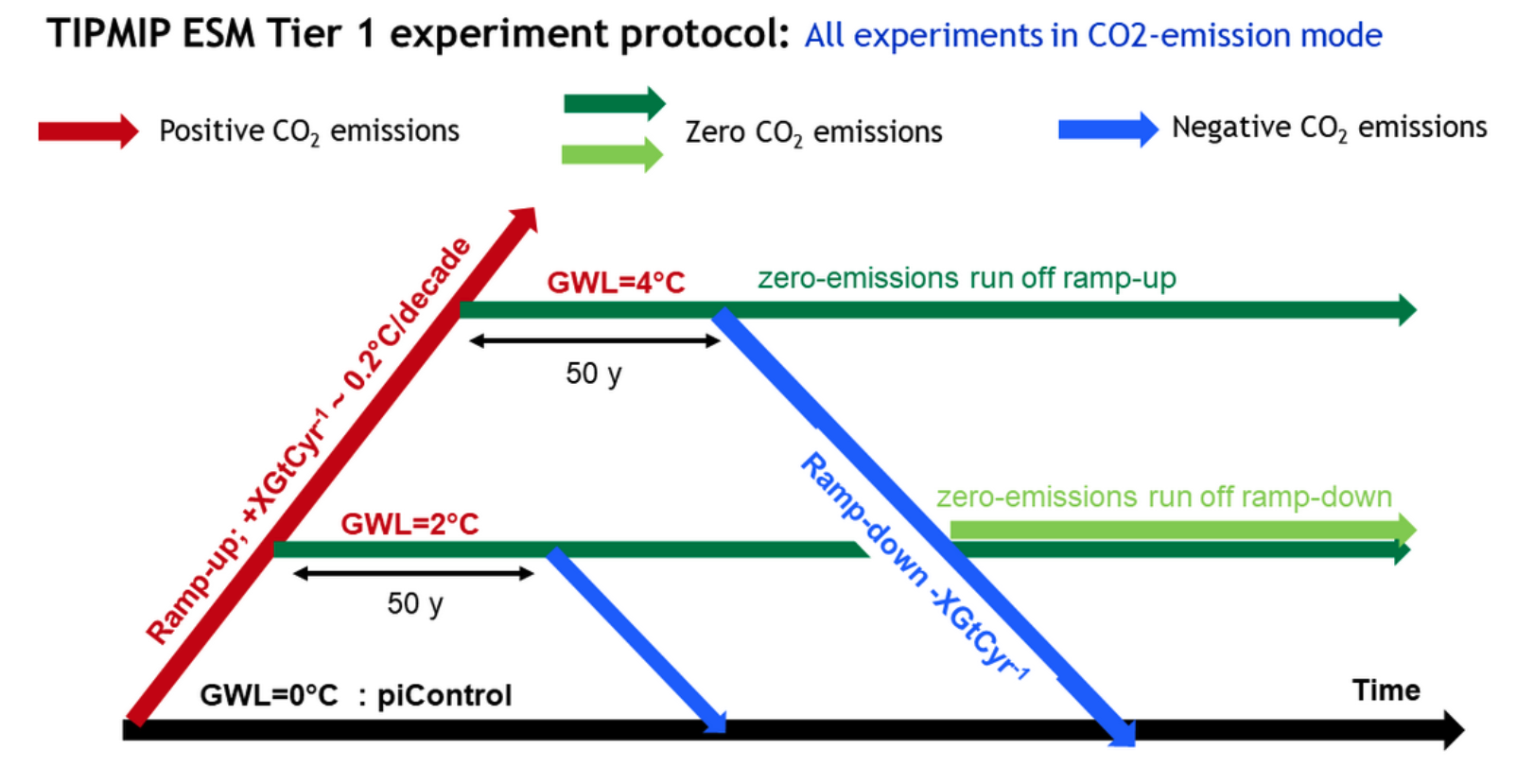
Dr Jeremy Walton, who leads the software engineering team for the UK Earth System Model at the Met Office Hadley Centre, kicked off one research session by unpacking the Earth system modelling “experiment protocol” within TIPMIP. This is a “framework for the modelling and investigation of climate overshoot and tipping points”, he explained, which sets out a consistent set of “idealised” – or simplified – experiments for scientists to conduct in order to build up a large dataset of results from lots of climate models.
The figure below illustrates these experiments, which include control runs with no global warming (black line), runs where warming is stabilised, such as at 2C or 4C (green lines) and further runs where warming is subsequently reduced via carbon removal (blue lines).
In all cases, warming first “ramps up” at a rate of 0.2C per decade “because that matches the observed rate in recent years”, Walton said.
Antarctica
Prof Colin Jones from the University of Leeds presented some initial results from the idealised experiments for the Antarctic ice sheet, carried out by Dr Sophy Oliver of the National Oceanography Centre in Southampton.
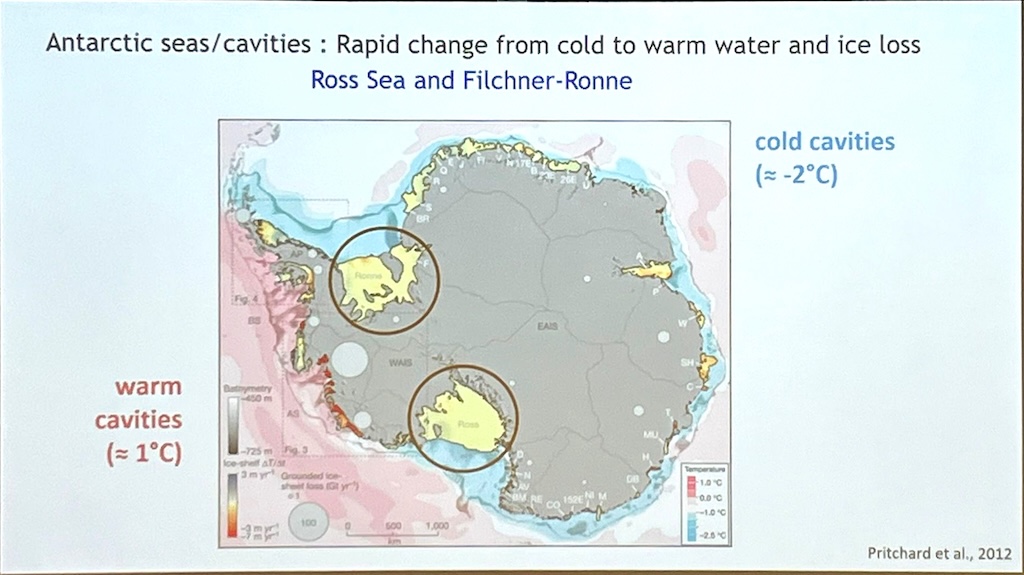
The analysis focuses on the massive Ross and Filchner-Ronne ice shelves, which float on the ocean and hold back land ice behind them. At the moment, Jones explained, they are both “cold-water cavities”, in that the ocean water beneath the shelves is “below the freezing point of sea ice”. However, if they “tip” to “switch to being warm-water cavities, then there’s a risk for rapid loss of ice”, he said.
The switch happens because melting of Antarctic ice adds freshwater beneath the ice shelves. This reduces the “density barrier” between the cavity and warmer open ocean, said Jones, reaching a “sudden point where the salinity is sufficiently low that the density has changed and it allows open ocean water” to get into under the ice shelves.
Their model runs suggest that there is a “danger zone” for the Ross ice shelf of around 3.5-4C, Jones said:
“If you go more than 4C, it will always tip [in model runs]…If you stay below about 3C, it will never tip.”
For the Filchner-Ronne ice shelf, “it is basically the same mechanism, but it happens at a higher warming level”, noted Jones, with a “danger zone” around 5-5.5C.
Also focusing on Antarctica, Sacha Sinet from Utrecht University presented analysis on the interactions between AMOC and the polar ice sheets, with results suggesting that the loss of the Antarctic ice sheet could actually stabilise the AMOC and prevent it from collapsing.
Sinet’s research is currently being reviewed before potential publication.
Another study on Antarctica was published on the opening day of the tipping points conference. The research, led by Dr Alessadro Silvano from the National Oceanography Centre, uses satellite data to reveal a marked increase in surface salinity across the Southern Ocean since 2015, coinciding with a “dramatic decline” in Antarctic sea ice.
The findings suggest that the Southern Ocean “might have entered a new system”, Silvano said. He explained how he has been observing an increase in salinity in the top 100 metres of the ocean. This is “counterintuitive”, he said, as “you think the more melting of ice, then you should freshen the ocean instead”.
The increase is because the ocean is becoming “less stratified”, meaning that warm water – which is also more salty – is “able to reach the surface of the ocean more”, making is harder for sea ice to regrow. he explained:
“And this is circumpolar. So it’s happening everywhere you see the increase in salinity.”
This has the potential to drive a self-reinforcing feedback loop, Silvano wrote in an article for the Conversation:
“We may have passed a tipping point and entered a new state defined by persistent sea ice decline, sustained by a newly discovered feedback loop.”
When asked by an audience member whether solar geoengineering could help, Silvano noted: “The problem for Antarctica is that melting is driven by the ocean. You cannot stop warming in the ocean, so that, to me, is an impossible task.”
Ecological shifts
Away from Antarctica, Dr Bette Otto-Bliesner of the US National Center for Atmospheric Research introduced another “MIP” – the What If Modeling Intercomparison Project (WhatIfMIP), which aims to investigate the consequences of what happens if a tipping point is crossed.
In particular, the programme will look at the cascading effects of one tipping element on another, including Amazon dieback, shifts in boreal forests, AMOC collapse, permafrost loss and the collapse of the Greenland and West Antarctic ice sheets, Otto-Bliesner explained.
One area of focus will be on the potential implications of “Sahel greening”, Otto-Bliesner said:
“We don’t think the Sahara is going to green in the next few centuries. But there is a project in the Sahel region called the Great Green Wall Initiative, where they’re actually planting trees. They’ve already started this…So what are the consequences of that, in terms of precipitation, drought, but also…heatwaves?”
In another talk, Caroline Wallington – from the Centre for Sustainability Transitions at Stellenbosch University in South Africa – presented a global analysis of ecosystems and people at risk of 21 different ecological “regime shifts”.
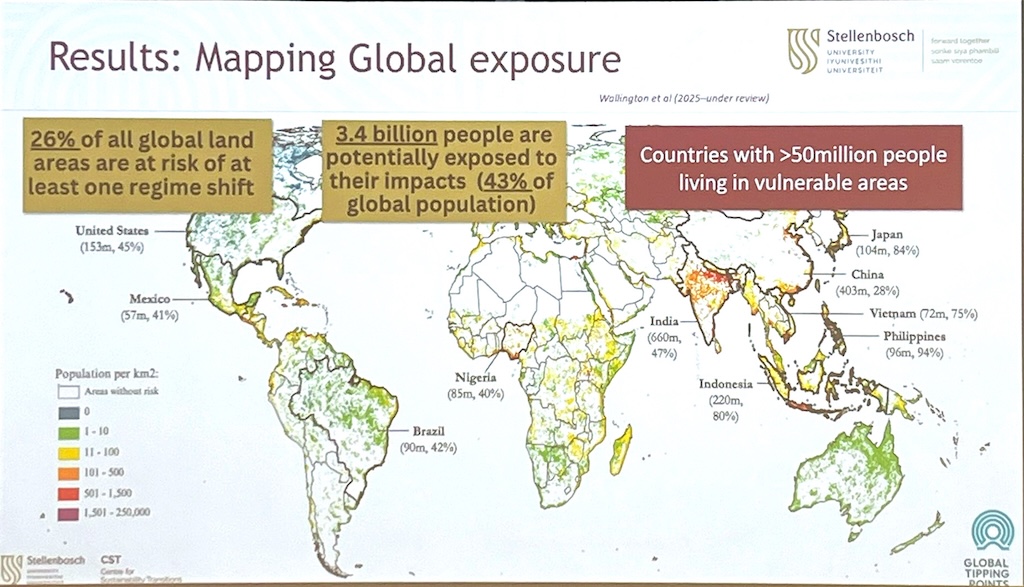
The findings show that 26% of the global land area is at risk of at least one ecological shift, covering 3.4 billion people, or 43% of the global population.
Around 31% of corals are at risk of a regime shift, Wallington said, while 30% of tundra is at risk from a transition to boreal forest and 28% of tropical forests are at risk of tipping into savannah.
The regions of the world at highest risk include the south Pacific, south-east Asia and central America, Wallington noted. Some of the most populous countries in the world are at risk from these regime shifts, she added, including China, India, the US and Indonesia.
Paris limits
Dr Nico Wunderling, from the Center for Critical Computational Studies at Goethe University Frankfurt and the Potsdam Institute for Climate Impact Research, presented on how tipping point risks are affected by “overshooting” temperature goals, such as the Paris Agreement’s 1.5C limit.
His work indicates that “tipping risks are even non-negligible now at global warming levels of 1.3-1.5C”, while overshooting 2C would mean “entering a very high risk zone for climate tipping elements”.
Wunderling presented some early results – currently undergoing peer review – on how the risk of Amazon dieback depends on both the levels of warming and deforestation.
When only warming is considered, current pathways to 2.7-2.8C above pre-industrial levels “seem to still relatively keep the Amazon rainforest at a safe level”, he said. However, he added, when deforestation is included, tipping risks become much closer – “to levels that are well within the Paris Agreement, so about 1.5-2C”.
Wunderling recently wrote a Carbon Brief guest post on “cascading” tipping points, indicating that the “majority of interactions between tipping elements will lead to further destabilisation of the climate system”.
Where next?
In the closing plenary, Rockström confirmed that PIK would host a tipping points conference in Berlin in 2027.
He also revealed that plans were afoot to host a tipping points conference in 2026 in Malaysia, following discussions with Jameela Mahmood of the Sunway Centre for Planetary Health in Kuala Lumpur.
Rockström said this reflected the need to host the conference in the global south and the importance of “building momentum” around tipping point risks and opportunities.
He added that the Malaysia-hosted conference could be held “in connection” with the COP31 climate summit, should Australia’s bid to host the UN talks in 2026 prove successful.
Meanwhile, a second global tipping points report is earmarked for the latter half of 2025.
(Carbon Brief covered the first global tipping point report in 2023).
Lenton told Carbon Brief the upcoming report will be “tighter” than its predecessor and “major” on governance issues.
Explaining the rationale for giving governance top billing in the report, Lenton said:
“We want to lead on the things we need. We clearly need some improvements in governance and institutions to get on top of both the tipping point risks and, arguably, the opportunities. Everyone can see that – it has been repeated several times already at this meeting. So, it is important to be clear what differences [governance] makes and what different kinds of governance we are calling for.”
The report will also offer an “update on tipping point risks and opportunities”, Lenton said, and include three case studies looking at Earth system tipping points – the shutdown of AMOC, Amazon dieback and coral die-off. It will also feature one “localised” example of a glacier tipping point and its consequences.
The case studies are designed to provide “more specific and concrete guidance” on how to avoid tipping risks, according to Lenton.
In addition, Ricarda Winkelmann told Carbon Brief that she and her colleagues will be answering a “call on the scientific community to put together a robust risk assessment on tipping dynamics”. This will involve “creating a first global atlas of tipping financial risks”, she explained – in time to feed into the seventh assessment report (AR7) of the Intergovernmental Panel on Climate Change (IPCC).
Discussing AR7 with Carbon Brief, Rockström said he was “very disappointed” that, at a meeting last year, countries decided not to include a special report on tipping points in the IPCC’s AR7 cycle.
This happened because the topic “makes policymakers and some member countries around the world very uncomfortable”, Rockström said.
Despite the “illogical” decision, the AR7 assessment reports will “see much more tipping-point science”, added Rockström, “for the simple reason that we have TIPMIP [and] we have a much broader community now – it’s entering the mainstream of Earth system modelling”.
This is “so important” in order to narrow uncertainty ranges in projections of tipping points, Rockström argued:
“I am of the view that one reason why we’re not acting faster on the climate crisis – one of many reasons – one fundamental reason is that we in the scientific community are not able to communicate precision on risk.
“Science on tipping point risk is so important because so many actors are using the uncertainty ranges as an excuse for not acting. So, as long as the AMOC continues to have medium confidence, then you can go on forever kicking the can down the road.”
The Exeter meeting comes against a backdrop of cuts to climate science funding in the US, including to the budget of the National Oceanic and Atmospheric Administration (NOAA).
Lenton said the tipping-point community was “traumatised” by the developments – “especially [on behalf] of colleagues in the US” who had lost their jobs. He added:
“It is already influencing things. If we lose NOAA and we lose our state-of-the-art assessment of the state of the oceans – these are dangerous erosions of our ability to sense whether the Earth system is destabilising or not. This is a fundamental loss.”
During the conference, the convenors drafted a conference statement, which they encouraged delegates to endorse.
With global warming approaching the Paris Agreement 1.5C limit, the statement warns that this places “humanity in the danger zone where multiple climate tipping points pose catastrophic risks to billions of people”.

It says that the “window for preventing these cascading climate dynamics is rapidly closing”, adding:
“We join the COP30 presidency in calling on governments to enact policies that help trigger positive tipping points in their economies and societies, which generate self-propelling change in technologies and behaviours towards zero emissions.”
The statement concludes by arguing that “decisive policy and civil society action” is needed for the world to “tip its trajectory from facing unmanageable climate tipping point risks to seizing positive tipping point opportunities”.
The post Tipping points: Window to avoid irreversible climate impacts is ‘rapidly closing’ appeared first on Carbon Brief.
Tipping points: Window to avoid irreversible climate impacts is ‘rapidly closing’
Climate Change
DeBriefed 3 July 2026: US faces scorching Independence Day | Record ocean temperatures | Vietnam’s EV surge
Welcome to Carbon Brief’s DeBriefed.
An essential guide to the week’s key developments relating to climate change.
This week
Heating up
NOT FREE FROM HEAT: “Dangerous, record-breaking” heat altered plans for 4 July celebrations across the US this weekend, reported the Associated Press. New York and Boston hit 100F (37.8C) on Thursday, said the newswire. CNBC reported that temperatures of up to 105F (40.5C) are forecast in central and eastern parts of the country, with “daily, monthly and all-time records possible”.
TEMPERATURES SOAR: Heat that hit western Europe last week spread east to “scorch” Germany, Hungary, Romania, Poland and others, said Bloomberg. Red warnings for extreme heat were issued in a number of nations, noted the outlet, adding that the heat “underscores how climate change is transforming summers in the world’s fastest-warming continent”. The Independent said last month was confirmed to be England’s hottest June on record.
HEAT DEATHS: June’s extreme temperatures caused more than 2,000 excess deaths in Spain and France, reported the Guardian. The countries are bracing for further heat that “could bring temperatures of 44C (111F) over the coming days”, said the newspaper. Deaths in France rose almost 30% at the heatwave “peak” on the week of 22 June, according to Le Monde. Last week’s conditions also led to around 480 excess deaths in the Netherlands, reported Reuters.
BOILING: Global ocean temperatures reached record levels for this time of year, reported NBC News, “fuelling fears of more dangerous heatwaves this summer and fanning concerns over the escalating global climate crisis”. Scientists told the Financial Times that this could lead the world towards “uncharted territory”. The newspaper said global average sea surface temperatures reached 20.96C on 21 June, exceeding June records for 2023 and 2024.
Around the world
- GOAL DROPPED: The World Bank will “abandon” its goal to devote 45% of annual lending resources to climate-related projects, reported Reuters. Carbon Brief explored what it could mean for global climate action.
- FIVE-YEAR PLAN: China plans to invest more than 20tn yuan ($2.9tn) in “key energy projects and new business models” over the next five years, according to International Energy Net.
- DRILLING: The Guardian said UK Labour politicians “urged” the likely next prime minister Andy Burnham to ignore “deluded” calls to develop the Rosebank oil field located in the Atlantic north of Scotland.
- PLASTIC TALKS: Countries and activists feared key issues could be sidelined at “critical” talks on a global treaty to curb plastic pollution in Kenya, said Climate Home News. A treaty could have “important implications” for climate change, reported Carbon Brief in 2024.
- CANADA PIPELINE: Canadian prime minister Mark Carney announced plans to build an oil pipeline to supply Asia with up to 1m barrels per day, reported the Financial Times. Earlier this week, Carney called the previous government’s climate plans “expensive” and “divisive”, said CBC News.
63
The number of UK newspaper editorials calling for more oil and gas extraction in the North Sea so far in 2026, according to Carbon Brief analysis.
Latest climate research
- Including emissions from permafrost thaw raises the likelihood of the Arctic becoming a net-carbon source by more than 50% at 2C of warming | Earth System Dynamics
- Net-zero scenarios relying less on carbon dioxide removals lead to fewer residual emissions, which offers greater health improvements for “non-white and low-income groups” in particular | Nature Climate Change
- Agricultural plots of land in sub-Saharan Africa owned by women face heat impacts 2-2.5 times higher than those owned by men | Nature Sustainability
(For more, see Carbon Brief’s in-depth daily summaries of the top climate news stories on Monday, Tuesday, Wednesday, Thursday and Friday.)
Captured

Wind and solar were the world’s largest source of new energy in 2025, according to Carbon Brief analysis of the latest Energy Institute statistical review of world energy. Wind and solar also saw the fastest growth, up by 18% in 2025. Nevertheless, every source of energy – including coal, oil, gas, nuclear and hydro – also reached global all-time highs last year.
Spotlight
Vietnam’s EV surge
Carbon Brief explores the reasons behind soaring electric-vehicle sales in Vietnam.
Motorbikes are a constant fixture on streets across Vietnam. They pollute the air in cities and make crossing the road a feat of endurance.
But, increasingly, people are moving away from petrol-powered vehicles to save money and reduce air pollution.
Sales of electric motorbikes, scooters and mopeds more than doubled in Vietnam last year, according to a recent report from the International Energy Agency (IEA).
This identified that Vietnam has the largest electric vehicle (EV) market in south-east Asia.
Nearly one-in-five of the two-wheeled vehicles sold last year were electric, it noted, in a nation with 102 million people and 77m motorbikes.
This is “particularly impactful” given they are the main mode of transport in Vietnam, said Lam Pham, Asia energy analyst at thinktank Ember. He told Carbon Brief:
“Electrifying road transport is essential for Vietnam to achieve its net-zero target by 2050. Road transport accounted for around 86% of transport-sector emissions in 2022.”
The nation has just 6.8m cars, but this number is also climbing, partly due to EVs, with nearly 40% of new car sales being electric.

This is “above levels seen in most European countries”, noted the IEA. (The UK’s figure is around 30%.)
EV incentives
Fuel costs surged in south-east Asian countries earlier this year after the energy crisis caused by the US-Israel war on Iran.
This “accelerated” discussions from “why use EVs” to “why keep paying more for fuel”, said Dr Tham Nguyen, a lecturer at the Ho Chi Minh City campus of Australia’s Royal Melbourne Institute of Technology (RMIT) University, who has researched Vietnamese public attitudes to EVs.
But the surge is “not driven by fuel prices alone”, noted Pham.
Increased EV sales can also be attributed to a “convergence of affordability, convenience and sustainability”, Nguyen said:
“Vietnamese consumers buy EVs because they see real value with immediate personal benefits, such as cost savings and energy security, alongside long-term environmental gains.”
Government policies have also incentivised sales through registration fee exemptions and tax cuts for EVs.
Another factor is affordable EVs sold by Chinese companies and Vinfast, a Vietnamese manufacturer. The IEA report noted that Vietnam is the only country in south-east Asia with “sizeable” domestic production of accessible EVs.
Vinfast reported a 219% year-on-year increase in orders for electric motorbikes and e-bikes in the first quarter of 2026, but the company has yet to turn a profit.
Pham noted that “growing public awareness of air pollution” has also “dramatically strengthened” public support for EVs.
Future plans
Vietnam’s major cities also have plans to get drivers to go electric or turn to public transport.
The capital city Hanoi announced that it would ban fossil-fuel-powered motorbikes from a central zone this month, but this has been postponed until 2028.
Ho Chi Minh City, the nation’s largest city with more than 9.5 million people, intends to introduce low-emission zones and swap 400,000 petrol-powered motorbikes to electric by 2028.
The city’s green transport plans focus on metro lines, electric buses and e-bikes, explained RMIT associate professor Catherine Earl. She noted that walking and cycling are currently “not popular, accessible or safe for many residents in Ho Chi Minh City’s hot and humid climate”.
Looking ahead, Pham said Vietnam could focus on “purchase subsidies, financing schemes and adequate charging or battery-swapping infrastructure, to ensure lower-income riders, including delivery and ride-hailing drivers, are not negatively affected”.
Watch, read, listen
‘JUST 1%’ OF EMISSIONS: The Guardian debunked arguments that climate actions from smaller countries are “insignificant”.
DRILLING RISKS: Mongabay reported on the possible impacts oil drilling in the Amazon could have on a “little-known reef”.
HEATING UP: The BBC Climate Question podcast discussed the weather pattern El Niño and its links to climate change.
Coming up
- 7-10 July: AI for good global summit, Geneva, Switzerland
- 7-15 July: UN high-level political forum on sustainable development, New York
- 8-10 July: Ninth meeting of the board of the fund for responding to loss and damage, Manila, Philippines
Pick of the jobs
- Green Alliance, senior partnerships officer | Salary: £42,748-£47,346. Location: London
- World Vision, environment and climate action senior adviser | Salary: Unknown. Location: Kenya
- Nature Energy, interim associate or senior editor | Salary: Unknown. Location: London or Milan
- Climate Analytics, senior communications manager – climate policy (maternity cover) | Salary €60,605-€66,880. Location: Berlin
- Carbon Exchange, researcher | Salary: Unknown. Location: Hong Kong
DeBriefed is edited by Daisy Dunne. Please send any tips or feedback to debriefed@carbonbrief.org.
This is an online version of Carbon Brief’s weekly DeBriefed email newsletter. Subscribe for free here.
The post DeBriefed 3 July 2026: US faces scorching Independence Day | Record ocean temperatures | Vietnam’s EV surge appeared first on Carbon Brief.
Climate Change
Q&A: How will the World Bank’s abandoned finance goal affect climate action?
The World Bank has abandoned a target for 45% of the funding it gives developing countries to be “climate finance”, following months of pressure from the Trump administration in the US.
However, a concerted effort by developed- and developing-country shareholders has seen the bank hold onto its “action plan” for tackling climate change.
The multilateral development bank (MDB) – which is headquartered in Washington DC – is the single largest provider of climate finance globally, distributing $39.2bn in 2025 alone, primarily as loans.
Amid widespread aid cuts by developed countries, the World Bank and other MDBs have previously pledged to significantly scale up their climate finance over the next decade.
Despite scrapping its central target, the bank says it will continue to support the demands of its “clients”, many of which have explicitly stated their need for climate-related investment.
Here, Carbon Brief looks at the likely impact of the World Bank’s policy shift and whether it is – as one expert puts it – “mostly a symbolic victory” for the US.
- How does the World Bank support climate action?
- Why has the World Bank abandoned its climate-finance target?
- Why is the World Bank important for international climate finance?
- How will these changes affect global climate action?
How does the World Bank support climate action?
The World Bank is the oldest and largest MDB. It is tasked by its 189 member governments – the bank’s shareholders – with supporting development projects around the world.
The US is the bank’s largest shareholder, followed, in order, by Japan, China, Germany, France and the UK.
Every year, the bank provides billions of dollars – predominantly as loans – to developing countries.
(One part of the World Bank, the International Development Association – IDA – specifically distributes grants to lower-income nations, as well as lower-interest loans.)
Through its financing, the World Bank also has an important role in “mobilising” private investments in developing countries.
In recent years, the bank has increasingly focused on helping developing countries to cut emissions and adapt their economies for climate change.
The World Bank provided $164bn in what it calls financing with climate “co-benefits” between 2020 and 2025.
The largest share of this funding – roughly one-fifth – went to clean energy and electricity access projects. Smaller shares went to areas such as public transport, water supply and sustainable farming.
As the map below shows, the largest recipients of the bank’s climate funds since 2020 have been emerging economies, such as Turkey ($10.3bn), India ($9bn) and Nigeria ($6.3bn).
Among the largest World Bank projects in recent years are two extensive programmes in India, totalling nearly $3bn, supporting renewables and green hydrogen.
Others include $1.7bn for a Pakistan hydropower project, $926m for Iraq’s railways and $803m to boost “green development” in Colombia.
Despite the bank’s major role in providing climate finance to developing countries, it has faced heavy scrutiny from climate advocates.
In particular, they have noted the dominance of loans that push developing countries further into debt. The World Bank has also been criticised for a lack of transparency around how it classifies projects as “climate-related”, as well as “over-reporting” of climate finance.
Why has the World Bank abandoned its climate-finance target?
When World Bank president Ajay Banga – nominated by former US president Joe Biden – took over the institution in 2023, there were widespread calls for MDB reform.
Many of the bank’s shareholders wanted to see billions more dollars being channelled to support climate action. Later that year, Banga announced that the bank would ensure that 45% of the bank’s funding was climate finance by 2025.
This replaced an existing target of 35% for climate finance between 2021 and 2025, which had been set out in the bank’s second climate change action plan (CCAP).
The CCAP is intended to “mainstream” climate action in the bank’s work. With it in place, the World Bank’s climate finance more than doubled from $17.2bn in 2020 to $39.2bn in 2025.
As the chart below shows, this meant the World Bank exceeded its 2025 goal, with climate-related projects making up a 48% share of total funding that year.

When Biden was replaced by Donald Trump as president in 2025, the US administration turned against international cooperation, including climate finance.
However, the US did not walk away from the World Bank, where it exerts considerable power as the largest shareholder.
With the CCAP due to expire in July 2026, the US has spent months pressuring the bank and its shareholders to weaken or abandon the plan altogether.
US Treasury secretary Scott Bessent issued a statement during the 2026 World Bank and International Monetary Fund (IMF) spring meetings in April 2026, in which he called for “jettisoning” the 45% climate-finance target. More broadly, he said:
“We welcome the coming expiration of the CCAP and…expect the bank to immediately shift its myopic focus on climate and financing volumes to one that emphasises high-quality, durable projects.”
This vision involves a push for the World Bank to finance more fossil-fuel projects, including drilling for new gas. (The bank has committed since 2019 to stop funding upstream oil and gas projects.)
The decision on whether to continue with the CCAP was negotiated behind closed doors by the board of directors – representing national shareholders. There were reports of “deep divides”.
A joint statement from 19 of the 25 directors last year affirmed the need for both a plan and a target. The US, Russia, Kuwait and Saudi Arabia all declined to sign up, while Japan and India abstained, according to Reuters.
There were reports of European nations championing a climate plan, bolstered by support from the developing countries that would stand to receive climate finance. The US call to drop the 45% target entirely was reportedly backed by Saudi Arabia and Russia.
Ultimately, the day before the CCAP was due to lapse, the World Bank announced what appeared to be a middle ground. It would drop both the 45% target and the 35% goal it had replaced, while also “extend[ing]” the CCAP.
UK development minister Jenny Chapman told a committee hearing in the House of Commons the next day that this marked a “compromise”. She said:
“It wasn’t clear we were going to get a CCAP at all and a bank without an action plan on climate is a problem for us – so that’s a good outcome.”
Supportive shareholders had been pushing for a one-year extension of the plan. While the World Bank did not initially define the length, Chapman confirmed on LinkedIn that the plan had, in fact, been extended “indefinitely”.
The bank said it would also engage an “independent evaluation group” to assess the CCAP, in line with a board request.
Gaia Larsen, director of climate finance at the World Resources Institute (WRI), tells Carbon Brief that this evaluation will likely be “relatively free from political ideology” and could be “focused on how to make the CCAP more effective”.
Why is the World Bank important for international climate finance?
Under the Paris Agreement, developed countries – including major World Bank shareholders in Europe and elsewhere – are obliged to provide climate finance for developing countries.
This includes a target of $300bn a year by 2035, which is expected to largely come from developed countries. One significant way these nations can contribute to this goal is via their support for MDBs, particularly the World Bank.
The World Bank has described itself as “by far the largest provider of climate finance to developing countries”. Each year, it oversees half of all climate finance from MDBs and far more than any single donor country.
Many developed countries have, therefore, enthusiastically backed the World Bank’s climate efforts, as well as a “bigger” role for MDBs in development more broadly. The bank can lend sums that far exceed the amount of new public finance that individual nations are willing to commit.
This is particularly significant, given many of these nations, including the UK, Germany and France, have announced large cuts to their aid budgets in recent years.
Carbon Brief analysis suggests that roughly a fifth of the international climate finance provided and “mobilised” by developed countries in recent years can be attributed to their World Bank contributions, as the chart below shows.
(This only accounts for the World Bank financing that can be linked to developed-country shares in the bank. Developing countries, such as China, also have significant shares, which are not included in the chart below.)

MDBs – including the World Bank – have committed to providing $120bn in climate finance to developing countries by 2030.
This was set to come from greater shareholder contributions, combined with a programme of reforms to free up capital.
If the World Bank continued to provide half of the MDB total, it would need to increase its climate finance by around 50%, from $39.2bn today to $60bn in 2030.
Therefore, experts see a “key” role for the World Bank in achieving not only the $300bn target, but also the more aspirational $1.3n target that countries agreed as part of the “new collective quantified goal” (NCQG) on climate finance at COP29 in 2024. This includes the private capital it could “unlock” through its lending.
Joe Thwaites, international climate finance director at Natural Resources Defense Council (NRDC), tells Carbon Brief that these “NCQG politics” are “quite important”. He says:
“The maths of the $300bn does not work if the MDBs pull back and so I think that’s why you’re seeing developed countries taking a stand.”
How will these changes affect global climate action?
To date, the World Bank has only released minimal details about its new climate plans. As such, experts say the impact on future climate finance remains uncertain.
Jon Sward, environment project manager at the Bretton Woods Project, tells Carbon Brief:
“They have said they are going to retain all the same processes about climate-finance reporting. So, of course, there is a world in which, actually, climate finance continues to increase like it has been.”
Some of the World Bank’s internal organisations will, in fact, keep their climate-finance goals for the time being. For example, the IDA’s largely grant-based funding retains a 45% target for its current round, which will last until 2028 – the year of the next US presidential election.
However, WRI’s Larsen tells Carbon Brief that the changes, from a bank that was previously a “champion for climate action”, remain significant:
“This reality, reinforced by the elimination of the 45% goal, means that it would not be surprising to see a reduction in climate investments.”
In a statement, the World Bank said its “work on climate is and will remain firmly client driven”, noting that it supports nations undertaking their Paris Agreement climate plans.
Therefore, its climate focus may come down to whether there is demand for climate action from “client” countries receiving finance.
At an April event in discussion with the climate sceptic Bjørn Lomborg, Bessent said that global financial institutions should focus on growth, characterising climate action as an “elite belief”.
The implication from the US Treasury secretary was that recipient countries are not interested in climate action. However, as reported by Devex, a group of World Bank shareholders representing nearly 100 developing countries, wrote a letter that appeared to push back against this framing.
This “G11+” group, led by Brazil and China, said the bank “must remain firmly client-driven”, noting that countries are “following nationally determined pathways toward climate action”. NRDC’s Thwaites tells Carbon Brief:
“It’s one thing for the Europeans to talk about climate…This was the client countries [100 developing countries] saying: ‘No, we want this.’”
Recent research by the ODI thinktank found that 79% of developing-country officials polled wanted to see MDB investment in solar projects, 54% wanted hydropower and 47% wanted wind power. Only 13% wanted investment in gas-power plants.
Rishikesh Ram Bhandary, a senior development researcher at Boston University, has stressed the need for an “enhanced CCAP”, which could be supported by the bank’s new independent evaluation. Among other things, he tells Carbon Brief:
“The bank needs to make a more convincing case about how climate change is being integrated into development priorities rather than competing with them.”
Thwaites says he is hopeful that the outcome is “mostly a symbolic victory for the US”.
However, he says major shareholders from Europe and elsewhere should make it clear to the bank that it is not “the only game in town” when it comes to climate finance. He says:
“If [the World Bank] are going to cave into one shareholder, when the vast majority of the other shareholders are supportive of continuing climate action, they can take their money elsewhere.”
The post Q&A: How will the World Bank’s abandoned finance goal affect climate action? appeared first on Carbon Brief.
Q&A: How will the World Bank’s abandoned finance goal affect climate action?
Climate Change
As food shocks spread, citizens are showing more leadership than governments
Rich Wilson is CEO of the Iswe Foundation and co-founder of the Global Citizens’ Assembly.
The numbers are stark. According to the 2026 Global Report on Food Crises, 266 million people across 47 countries experienced high levels of acute food insecurity last year, nearly double the figure recorded a decade ago.
Meanwhile, disruptions to oil, gas and fertiliser flows through the Strait of Hormuz drove a 46% month-on-month spike in urea prices early this year, sending agricultural price indices up 8% and raising the spectre of a global affordability crisis.
This is not a blip. It is a new baseline. The EAT-Lancet Commission concluded that food systems now account for roughly 30% of total greenhouse gas emissions and are the largest single contributor to the climate crisis. The science has been clear for years.
Now some of the solutions to the problem are becoming socially acceptable too.
Earlier this year, people from more than 60 countries and territories, selected not by vested interest, but by lottery, spent seven weeks examining the evidence on food and climate for the latest Global Citizens’ Assembly. They heard from scientists, farmers and industry. They worked through 42 hours of structured deliberation, engaging with some difficult trade-offs.
They were not asked to endorse a predetermined conclusion. They were asked an open question: what changes, if any, should we make to how we grow, share and eat food, so that everyone has enough to nourish themselves while tackling the causes and impacts of climate change?
Phase down industrial animal farming
Their answer was unambiguous. They voted to protect forests. They voted to phase down industrial animal food production. They voted for supply chain reform and corporate accountability, explicitly rejecting the idea that the burden of change should fall on individual consumers. All 22 of their Calls to Action passed with over 85% support, a super-majority of randomly selected people from every region of the world, in agreement.
Consider what the assembly was actually being asked to decide. Industrial animal food production is the primary driver of tropical deforestation. Protecting more land as forest and ecosystem means less land available for the expansion of industrial production. That is a real trade-off, with real consequences for real livelihoods. Politicians have spent years avoiding it.
These randomly selected people looked at the evidence, deliberated across time zones and cultures, and chose the forests, with 64% in strong support and a further 20% in favour. People from livestock farming communities voted for change. Not because they were told to. Because deliberation led them there.
We estimate there have now been more than 7,000 citizen participation initiatives worldwide in the last decade. They have been organised because, as our 2025 report: People in the Lead demonstrated, people are now consistently and significantly ahead of politicians on issues ranging from climate to AI governance.
The people know best
What the research consistently shows is that ordinary people, given proper evidence and time, produce recommendations that are more effective and more aligned with public values than what emerges from elected legislatures. The gap in global governance is no longer primarily between science and the public. It is between citizens and their political leaders.
That gap matters for more than procedural reasons. When policy treats people as passive recipients rather than active participants, it leaves out the very actors whose behaviour, trust and consent the transition depends on. Institutions that speak only to other institutions, and negotiate only with state actors and industry lobbies, are missing out on the trust and energy of the people they are supposed to serve.
Governments, left to their own devices, are not moving fast enough to prove that argument wrong. At COP30 in Belém last November, countries failed to agree on a fossil fuel phaseout roadmap, and even full implementation of every submitted national climate plan still leaves the world on course for 2.3 to 2.8C of warming.


Citizens’ track at COP
But the Brazilian presidency grasped something important. Among the conference’s more significant outcomes was the formal launch of a Citizens’ Track within the UNFCCC process, a mechanism for connecting the global participation field to intergovernmental climate negotiations. Türkiye and Australia, who together hold the COP31 presidency in Antalya this November, now have the opportunity to strengthen and institutionalise what Brazil began.
In Guatemala, Indigenous women build climate resilience with old and new farming methods
The question before us is no longer whether citizens can contribute to solving these problems. Across the world, in local food networks, in community assemblies and in participatory planning processes, they already are, quietly generating more ambitious and more legitimate solutions than those emerging from formal diplomatic channels.
What is required now is the political courage to connect people to power. Not to consult citizens and file the results. Not to invite them to observe while the real decisions are made elsewhere. But to recognise the public as partners in perhaps the most consequential governance challenge of our time.
The post As food shocks spread, citizens are showing more leadership than governments appeared first on Climate Home News.
As food shocks spread, citizens are showing more leadership than governments
-
Climate Change11 months ago
Guest post: Why China is still building new coal – and when it might stop
-
Greenhouse Gases11 months ago
Guest post: Why China is still building new coal – and when it might stop
-
Greenhouse Gases2 years ago嘉宾来稿:满足中国增长的用电需求 光伏加储能“比新建煤电更实惠”
-
Climate Change2 years ago嘉宾来稿:满足中国增长的用电需求 光伏加储能“比新建煤电更实惠”
-
Renewable Energy8 months agoSending Progressive Philanthropist George Soros to Prison?
-
Climate Change2 years ago
Bill Discounting Climate Change in Florida’s Energy Policy Awaits DeSantis’ Approval
-
Carbon Footprint2 years agoUS SEC’s Climate Disclosure Rules Spur Renewed Interest in Carbon Credits
-
Greenhouse Gases12 months ago
嘉宾来稿:探究火山喷发如何影响气候预测


