

By Allison Kite, Kansas Reflector
Senators heard three hours of testimony from anti-wind sources and just one hour from proponents of renewable energy
A series of bills professing to protect rural residents from industrial wind claim to bring transparency, limit abuse and enact safety measures to protect against the supposed health hazards of turbines.
In reality, they would transform Kansas, one of the top producers of wind energy for two decades, into one of the most restrictive states in the nation, pro-wind experts say.
“This is punitive. This is not progressive,” said Kimberly Gencur Svaty, public policy director for the Kansas Advanced Power Alliance. “This is not laying out a path of economic development or growth for the state of Kansas.”
Kansas has embraced renewable development for years. The expansion of wind energy in Kansas has been embraced by Democrats and Republicans alike — and the state’s status as one of the top producers in the nation is celebrated.
But opposition to wind energy has found an ally in the Johnson County Republican leading the Senate Utilities Committee. The struggle between burgeoning resentment of industrial wind projects and the state’s two-decade history as the “Saudi Arabia of wind” received attention in early February in Sen. Mike Thompson’s committee.
“He’s been very clear he is very, very opposed and would like to end renewable energy, and so he brings these wolves-in-sheep-clothing bills to say, ‘Oh, these are just meant to do reasonable things,’ when quite clearly they’re not,” said Alan Claus Anderson, vice president of the energy group at Polsinelli law firm.
Thompson, in just his third session as a state senator, has established a reputation as a frequent critic of wind energy and touts dubious science about the health effects of wind. His committee is sponsoring half a dozen bills, most of them introduced at his request, enacting what the industry claims are poison pill restrictions on wind farms. Thompson didn’t respond to a request to comment for this story.
His committee heard for two days in February from anti-wind sources who claimed proximity to wind turbines could cause cardiovascular disease, sleep disturbance and headaches. They cited anecdotes and disputed research showing no evidence of significant health harms from wind turbines. There is evidence wind farms can cause annoyance, but those sensations are often worse for people who are opposed to wind energy as an underlying cause for their frustration.
“I thought and assumed that wind turbines were quiet, good for the world, and I assumed they were safe,” said Ben Washburn, a retired cardiologist from Iowa who presented for an hour to the committee. “The last few years I’ve witnessed the good, the bad, the ugly of wind turbines. The topic is massive, emotions are high, and distortion and corruption is in play.”
Washburn said to people who believe renewables are the only path forward, “I would ask you to carefully reconsider.”
And while Washburn and fellow wind critics’ testimony was supposed to be purely informational, one of them repeatedly voiced his support for Thompson’s bill requiring wind turbines to be sited at least a mile or 10 times the height of the turbine from the next property line.
After two days of hour-long presentations outlining supposed risks of wind energy, supporters of Thompson’s anti-wind bill got a third day in committee to speak directly about the legislation for five minutes each.
Only on February 10 did pro-wind forces and experts get to speak on Thompson’s bill — also for five minutes each. An expert with his PhD in environmental health and a career studying the health effects of wind got his credentials questioned. And Thompson cut off another senator voicing his opposition to the legislation.
“If we move forward with this bill — we are now a net exporter of energy — we will no longer be an exporter of energy,” said Sen. Robert Olson, an Olathe Republican. “We’ll be an importer of energy. And —”
Thompson cut him off. “Are you testifying or are you asking a question? We need to make —”
“I’m making a comment here, which I have a right, I believe,” Olson said.
Thompson said he would limit Olson’s time to comment, and Olson voiced his frustration with the dayslong anti-wind testimony.
“You know, we had people all week say what they want for an hour, and I sat in here for a long time,” Olson said.
Thompson said, “This is my committee, and I’m saying get a question in.”
Gencur Svaty encouraged the committee following her testimony to ask questions so that pro-wind advocates would get more time to speak, noting the previous days of testimony. Thompson responded that anti-wind groups testifying on his bill the day before were also limited to five minutes.
Anderson said the informational hearings held by Thompson’s committee were not meant to compile information in good faith.
“I struggle to say informational because they were obviously not intended to give good information,” Anderson said. “The people who presented are on the fringe of the fringe.”
Health effects of wind
Opponents of wind energy have made numerous claims regarding the potential health consequences of living near a turbine.
They say the whooshing sound can cause stress, and infrasound — sound waves too low for people to hear — can harm the body.
Washburn cited a 1970 paper on pollution that called noise a “scourge of the modern world” and said ambient noise could cause atherosclerotic disease, or plaque buildup in the arteries, and death.
He took issue with wind turbines, too, not based on health but because wind is an intermittent energy resource that he called unreliable. He said moving to renewable energy only is “absurd.” And he recalled a public meeting in Iowa where he claimed a wind developer’s representative was hesitant to say wind was safe.
Research has shown a link between wind turbines and feelings of annoyance but that there is not sufficient information to link wind turbines to disease.
The University of Iowa’s College of Public Health, Iowa Policy Project and the Iowa Environmental Council reviewed several pieces of research and found the consensus was there was little scientific evidence to support the idea that wind energy poses a threat to human health.
Another literature review published by researchers in Switzerland found in 67 peer-reviewed and web articles published between 2012 and 2017 that annoyance was the only symptom of wind turbine exposure that was backed up by science.
The article acknowledged people who live near wind turbines might experience anxiety or distress, which is highly dependent on their attitudes toward wind energy.
And the article notes there are known negative effects from the use of fossil fuels to create electricity. That includes climate change, but also asthma for individuals living near coal-fired power plants.
“If you just want to have no wind turbines ever, well, then we’re going to have more coal-fired power plants and more disease,” said David Osterberg, lead researcher for the Iowa Policy Project and professor emeritus at the University of Iowa College of Public Health’s Department of Occupational and Environmental Health.
Osterberg said in an interview he doesn’t doubt people who live near turbines experience symptoms, but that it doesn’t come from sound. It could be a result of annoyance or stress from a large project they don’t want moving in near their home.
“But that is not a health effect that we can fix by moving the turbines back half a mile … so what they’re asking for does not take care of their symptoms,” Osterberg said. “They’re still going to be mad.”
Christopher Ollson, an environmental health scientist with Ollson Environmental Health Management, acknowledged a link between environmental noise and health concerns. But he told senators on the committee 20 years of research has shown noise from wind turbines isn’t loud enough to create those concerns.
“There is considerable research over the last 20 years that has studied this topic,” Ollson said. “The … provisions in this bill are far more excessive than any other state in this country, any of the local ordinances that have worked for more than 20 years.”
Fight over wind
Rural residents who have opposed wind projects moving into — or proposed — in their communities pleaded with the Utilities Committee on Wednesday to enact Thompson’s restrictions.
Aside from the one-mile setback, the bill would limit the decibel noise of the projects to levels the industry says are impossible and prohibit any shadow flicker on non-participating landowners’ property. Wind proponents say the way the bill is written would allow existing wind farms to be shut down over shadow flicker, something Anderson called “reckless” and said would threaten reliability of the power grid.
Several of Thompson’s bills have sought to shift power in siting wind farms to landowners who aren’t participating in the project and have voiced complaints about turbines moving in.
Proponents of wind energy often say landowners who want turbines on their property have a right to participate in the project without interference from their neighbors — while opponents say they have a right to enjoy their property free from what they see as the nuisance of wind turbines.
Gayla Randel, of Marshall County, told senators pro-wind forces would likely say they couldn’t enact Thompson’s restrictions because it would kill development.
“But what I want you to think about is, are they actually saying they can’t do their work unless they infringe on the property rights of nonparticipants,” Randel said. “Because that’s what it sounds like to me.”
Other supporters of Thompson’s bill said wind companies “steamroll” rural neighbors when they come into town.
“Unless you have a board of county commissioners who are actually savvy to wind projects, counties are sitting ducks,” said former Marion County Commissioner Dianne Novak. “We are at the mercy of these companies.”
The Kansas Reflector is a nonprofit news organization. This story was republished under Creative Commons license CC BY-NC-ND 4.0.

‘This is punitive’: Kansas Senate committee considers poison pill wind energy bills

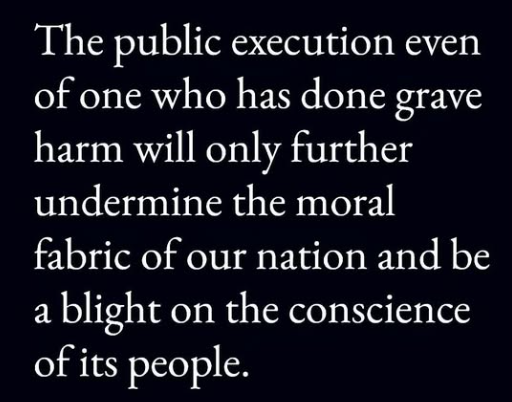 When I was young, I heard someone say, “The first execution this country televises will be the last one ever performed here.”
I think he was right at that time. You’d have millions of people watch that barbarism and realize that it was done in their name.
But today, we’re a far more insensitive, brutal, and stupid people that we were 50 years ago. If you doubt that, just look at the quality of the people at the top of the federal government–people like RFK, Jr., Hegseth, and Trump.
 As suggested at left, the world will never forget that the launch pad for all the destruction during Trump’s second term was our nation’s failure to prosecute the criminal sociopath for his attempted overthrow of the U.S. federal government on January 6, 2021.
Had these acts of treason been dealt with swiftly, all of this would have been avoided.
 The answer will probably surprise you.


-
Climate Change1 year ago
Guest post: Why China is still building new coal – and when it might stop
-

 Greenhouse Gases2 years ago
嘉宾来稿:满足中国增长的用电需求 光伏加储能“比新建煤电更实惠”
-
Greenhouse Gases1 year ago
Guest post: Why China is still building new coal – and when it might stop
-

 Climate Change2 years ago
嘉宾来稿:满足中国增长的用电需求 光伏加储能“比新建煤电更实惠”
-

 Renewable Energy12 months ago
Sending Progressive Philanthropist George Soros to Prison?
-
Climate Change2 years ago
Bill Discounting Climate Change in Florida’s Energy Policy Awaits DeSantis’ Approval
-
Greenhouse Gases1 year ago
嘉宾来稿:探究火山喷发如何影响气候预测
-

 Climate Change2 years ago
Analysis: China’s CO2 falls 1% in Q2 2024 in first quarterly drop since Covid-19